
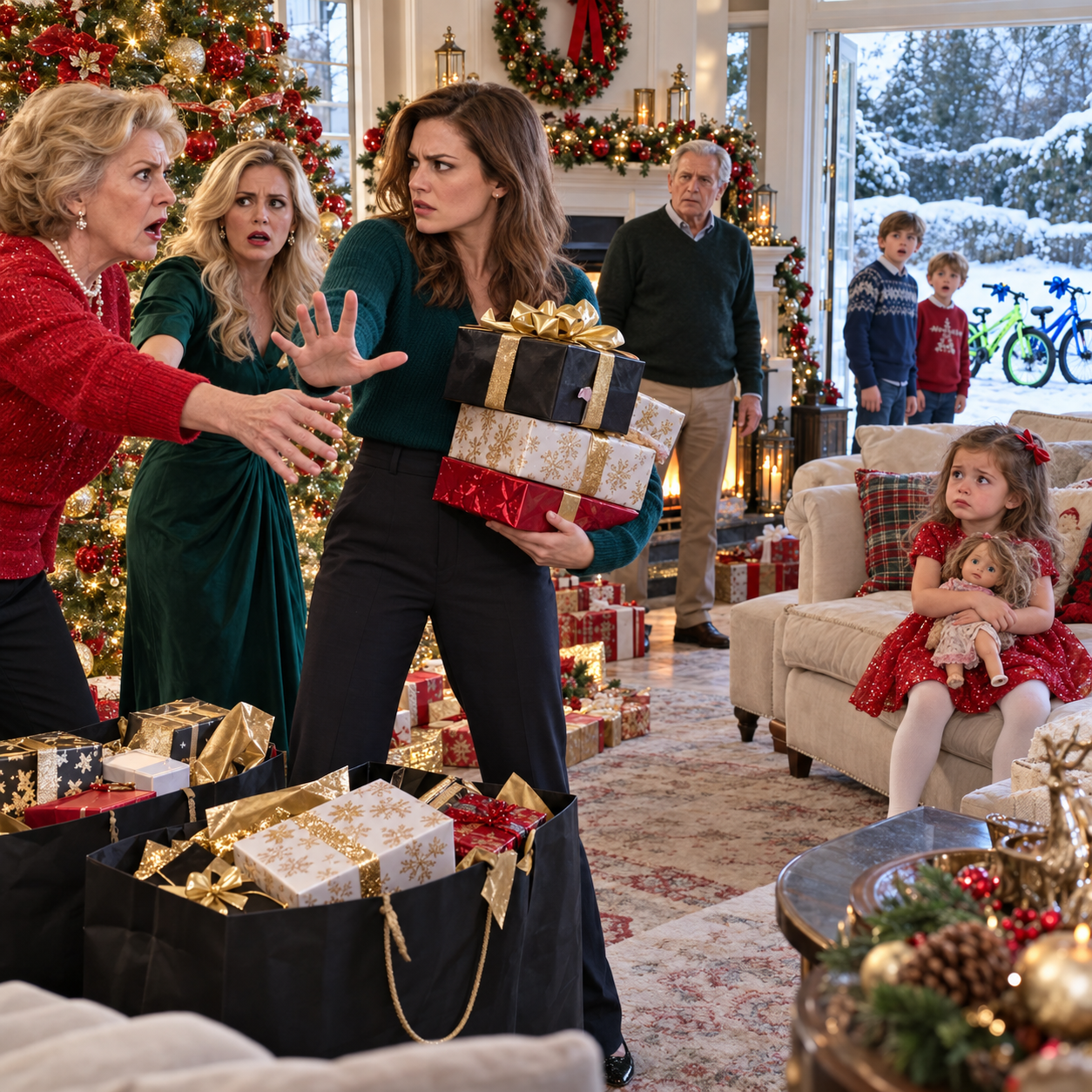
### Part 2: Cutting Off Their Money Reveals What My Love Was Worth
For two days, I ignored every ringing phone and concentrated on making Christmas feel safe again for my daughter. We watched cartoons, cooked pasta, and played with the presents I’d bought for her myself. Alina never asked about visiting Grandma, although she left the broken doll on a chair in her bedroom. Every time I passed that chair, I remembered how carefully she’d tried to smile.
On the third day, my sister texted, “Are you finished throwing your tantrum?” followed by a laughing emoji. An hour later, she complained that her sons couldn’t understand why their aunt had ruined Christmas. I deleted neither message, but I answered neither.
My mother’s message arrived that evening. She accused me of embarrassing her, ruining the holiday, and filling Alina’s head with problems a three-year-old couldn’t possibly understand. Then came the familiar sentence that had followed me throughout adulthood: “After everything we’ve done for you.”
My father called on the fourth day, leaving a voicemail about everyone being upset and asking why I was acting so cold. Not one of them mentioned my daughter’s feelings. Nobody asked whether she’d cried or why I’d left. They wanted the uncomfortable consequences to disappear, but not the behavior that had caused them.
That evening, I carried their presents into my living room and lined them along the wall. I stared at the expensive perfume, electronics, jackets, and accessories, remembering all the birthdays and holidays when I’d bought affection disguised as gratitude. Then I removed the wrapping paper and packed everything into donation boxes. The next morning, most of it went to a women’s shelter, a youth center, and a local family assistance program.
I didn’t photograph the donations or announce them online. I simply stopped paying for my family’s approval.
When January arrived, I canceled my usual financial transfers. The $300 I’d been sending my sister every week stopped, along with the extra $600 a month I’d contributed toward my parents’ mortgage for two years. I no longer covered Dad’s car insurance, sent grocery money, or paid miscellaneous bills whenever someone complained about being short on cash. Until those payments stopped, I hadn’t realized how much of my income was quietly supporting people who called me a failure.
The panic began almost immediately.
My mother called twice a day, and my sister suddenly wanted to discuss our “misunderstanding.” Dad forwarded a final utility notice showing an overdue balance of $432.66 and a scheduled disconnection. Normally, I would have opened my banking app and handled it before dinner. This time, I closed the email without touching my account.
Then a friend told me she’d overheard my mother at the pharmacy asking whether she could pay for part of a prescription and return for the remainder. The news unsettled me because necessary medication was different from designer handbags and restaurant dinners. I hoped Mom would arrange what she needed, but I wasn’t willing to reopen unlimited financial support through another guilt-filled message. I had spent years confusing emergency assistance with an obligation to finance everybody’s life.
A week later, my sister appeared at my front door without warning. Her eyes looked tired, and she kept glancing past my shoulder toward the television playing in the living room. “Mom and Dad are struggling,” she said. “They didn’t realize how much you were helping.”
“Neither did I,” I answered.
She rubbed her forehead. “You’re really taking this too far over one stupid moment.”
I stepped onto the porch and pulled the door nearly closed behind me. “That moment happened to a three-year-old who trusted every adult in that room.”
“Family doesn’t keep score, Barbara.”
“Then why does everyone remember what I owe them but forget what I give?”
She stood there silently before asking whether I still had the Christmas gifts. When I told her where I’d donated them, her mouth tightened with anger. “You’re becoming cruel,” she said.
I watched her walk away and wondered how refusing to buy someone a drone had become cruelty while humiliating my daughter was apparently acceptable.
Over the following weeks, Dad’s car was repossessed, and my mother’s credit card was declined at the grocery store. Another friend spotted Mom working behind the counter at a neighborhood gas station, wearing a blue employee vest. I remembered her once saying retail work was beneath respectable women, usually while I handed her money for salon appointments or shopping trips. The photograph wasn’t something I celebrated, but it made one thing painfully clear.
My family had never been financially independent. They had simply been dependent on someone they felt entitled to insult.
My sister returned one afternoon, accusing me of letting everyone fall apart to prove a point. She said her youngest son might have to quit a sport because they couldn’t afford new equipment, while her husband was exhausted trying to replace the money I’d provided. I told her I was sorry the children were disappointed, but their parents would have to make decisions within their own budget.
She shook her head. “You’re enjoying this, aren’t you?”
I wanted to deny it immediately.
Instead, I stood silently because part of me did enjoy knowing they could no longer control me through guilt. That frightened me more than I expected, although I wasn’t ready to examine why.
Then my mother decided that private pressure wasn’t enough.
She took our family conflict to Facebook, and what she wrote about my little girl was even uglier than what she’d said on Christmas morning.
### Part 3: Their Public Lies Collapse When The Broken Doll Exposes Everything
My mother’s Facebook post appeared on a Thursday morning, wrapped in sentimental language about motherhood, sacrifice, and the heartbreak of raising an ungrateful daughter. She described herself as an aging woman forced to work nights while her successful child lived comfortably and refused to help. She never mentioned the hundreds of dollars I’d transferred regularly or the years I’d spent paying bills she never publicly acknowledged. Most importantly, she never mentioned Christmas.
The comments filled with sympathy from family friends, distant relatives, and women who remembered my mother from church. People called me selfish, urged me to remember where I’d come from, and praised Mom for surviving such terrible treatment. I might have ignored the entire performance if my sister hadn’t added a comment beneath it. “She’s always taken from you, Mom. Now everyone can finally see her true colors.”
I stared at those words, remembering the $300 that used to leave my bank account every Friday.
Then things became more personal.
A close friend received a call from Mom claiming I was behaving unpredictably and isolating myself. A coworker forwarded a message from my sister suggesting I wasn’t emotionally well and might need someone to check on me. It was an extraordinary accusation from people who hadn’t asked one sincere question about my daughter since Christmas. I saved the messages, hoping I would never need them.
But the comment that finally broke my silence appeared beneath my mother’s original post.
Someone had asked how little Alina was doing.
My mother replied, “We gave her a sweet little doll for Christmas, but she didn’t even say thank you. Looks like she’s learning from her mother.”
I felt my hands go cold.
They’d hurt my daughter once in our family living room, and now they were inviting strangers to judge a child who hadn’t even learned to write her own name. I opened the Christmas photographs on my phone and found the picture I’d taken after Alina opened her gift. There she sat in her red dress, holding a one-legged doll, her confused little face turned toward me. The photograph captured more truth than anything my mother had written.
I didn’t publish my daughter’s face for the world to examine. Instead, I privately contacted several relatives and friends who had commented and explained what happened, including the $500 I’d sent specifically for Alina’s presents. I described the new bicycles, the damaged doll, and my mother’s exact words. To a few trusted relatives, I privately showed the photograph so they could understand what I’d witnessed.
By the following morning, my mother’s post had disappeared.
She offered no public correction and no apology, but two days later a package arrived without a return address. Alina’s name was written across the top in thick black marker. Inside was a beautifully packaged American Girl doll, complete with accessories and extra outfits. It was the same doll she’d circled in a catalog before Christmas.
A card read, “We hope you like this one better. Love, Grandma and Grandpa.”
Alina hugged the new doll, looked up at me, and smiled. “Mommy, she has both her legs this time.”
I turned toward the kitchen before my daughter could see my tears.
The expensive replacement didn’t erase Christmas, but it marked the beginning of something unfamiliar. My father sent a message admitting he finally understood why I’d walked away. A week later, Mom mailed a handwritten apology acknowledging that she’d hurt us and promising to do better. Soon afterward, two boxes appeared on my porch containing a personalized princess bedspread, books, puzzles, a music box, and a delicate rose-gold necklace I’d admired almost two years earlier.
For once, someone had remembered something I wanted rather than something I could provide.
Still, I didn’t respond.
Eventually, my sister asked to meet at a coffee shop halfway between our homes. She looked exhausted when I arrived, her hands clasped around a paper cup she hadn’t touched. “We used you,” she admitted, staring at the table. “We got so used to you fixing everything that nobody thought about what it cost you.”
I waited, unsure whether she meant the words or was simply rehearsing another approach.
“Mom cried when she saw that picture of Alina,” she continued. “I think she finally understood what she did.”
“She understood when she watched Alina open the box,” I answered. “She just didn’t expect anyone to hold her accountable.”
My sister lowered her eyes and told me they’d discussed repaying what they owed, perhaps by selling Dad’s coin collection, her husband’s motorcycle, or some of Mom’s jewelry. It was the first time anyone in that family had suggested sacrificing something of their own rather than taking something from me. Then she cautiously asked whether Alina and I would attend Easter dinner.
I folded my hands on the table. “Start by returning the $500 I sent for my daughter’s Christmas gifts. Then write her an apology she can understand.”
Three days later, the full $500 appeared in my bank account, labeled for Alina.
That evening, a handwritten card arrived addressed directly to my daughter. My mother admitted the doll was wrong, said Alina deserved better, and apologized without blaming me.
I read the card aloud at bedtime.
Alina listened, nodded solemnly, and said, “Okay, Mommy.”
Her forgiveness came easily because she was three years old and still believed apologies meant people wanted to be kind.
Mine was harder.
And when Easter morning arrived, I discovered that an apology and a restored relationship were two very different things.
### Part 4: A Final Revelation Changes Everything I Believed About Forgiveness
On Easter morning, my father sent a photograph of their decorated dining table. My sister followed with pictures of colored eggs and baskets arranged across the backyard, while Mom sent a photograph of a little pink basket waiting on the porch. Alina’s name had been written across a satin ribbon tied to its handle. I studied the pictures for several minutes before putting my phone down.
We didn’t go.
Instead, Alina and I made pancakes shaped like rabbits, decorated eggs at our kitchen table, and planted flowers beside the front steps. She wore a yellow dress and announced that her favorite egg was the purple one because it looked like a tiny planet. I watched her laugh in the sunlight and realized nobody was measuring her happiness against anyone else’s that morning. There were no cousins competing for attention, no adults making cruel jokes, and no little girl wondering why she wasn’t good enough.
Later, when Alina was napping, I listened to a voicemail from my mother. Her voice sounded quieter than usual as she said she’d hoped to see us but understood if we weren’t ready. She didn’t mention bills, groceries, or how difficult life had become. She simply said she loved us and would respect my decision.
That should have brought relief.
Instead, I opened our old messages and found myself reading their apologies again, searching for evidence of how deeply they regretted hurting me. I replayed Dad’s voicemail and remembered my sister sitting across from me, admitting how they’d taken advantage of my generosity. For months, I’d told myself I was carefully deciding whether to trust them again. But sitting alone in my kitchen, I confronted something I hadn’t wanted to admit.
I had started enjoying their shame.
I remembered how satisfying it felt when my sister lost her confidence, how closely I’d watched for signs of my mother’s remorse, and how I’d quietly hoped their apologies would become more desperate. They’d spent years holding approval just beyond my reach, allowing me to chase it through gifts, favors, and financial sacrifices. Now I had the power to make them chase mine.
And without meaning to, I’d begun playing the same game.
The realization struck harder than any angry message because it revealed something I couldn’t blame entirely on them. Protecting my daughter had been necessary, and stopping the payments had been my right. But turning forgiveness into an endless test was slowly keeping me connected to the very people I wanted freedom from. I didn’t need their humiliation to prove that what they’d done was wrong.
I picked up my phone and reread the apology my mother had mailed weeks earlier. For the first time, I let it stand as an apology without demanding that it make up for every wound of my childhood. I still wasn’t ready to return to family dinners, and I wasn’t going to finance anyone’s household again. But I could stop treating their suffering as evidence of my worth.
That afternoon, I wrote my mother a short letter.
I told her I appreciated the apology and that Alina had received the card. I explained that we needed distance, that future contact would happen slowly, and that money could no longer be the foundation of our relationship. Most importantly, I said my daughter would never again be expected to accept humiliation as the price of belonging to a family.
I didn’t ask for more presents, more repayments, or more demonstrations of remorse.
I mailed the letter the following morning.
Weeks passed, and my phone grew quiet. My parents occasionally asked how Alina was doing, and my sister sent ordinary updates about her boys without mentioning financial problems. They still faced the consequences of years of overspending, but those problems belonged to the adults responsible for them. I had finally stopped mistaking every struggle in their lives for an emergency I was required to solve.
One Sunday, Alina discovered the original broken doll tucked inside a box of old toys. She carried it into the kitchen while I was washing strawberries and placed it carefully on the counter. My chest tightened when I recognized its scratched face and missing leg.
“Mommy, can we fix her?”
I dried my hands and knelt beside her. “We can try, sweetheart.”
We searched through a small container of spare toy parts, but there was nothing that matched the doll. Alina considered that for a moment before retrieving a soft pink blanket from her room. She wrapped the doll carefully, placed it in a toy stroller, and announced that the doll could still go on adventures.
I smiled, though my throat had tightened.
“She’s still a good doll,” Alina said. “She just needs someone to be nice to her.”
I pulled my daughter into my arms, remembering how that same toy had once made her question whether she deserved love. Now she was looking at something damaged and choosing tenderness instead of ridicule. I couldn’t change what my mother had said on Christmas morning, but I could make sure those words never became the voice my daughter heard inside her own head.
That evening, I placed the old Christmas photograph in a private folder on my phone. I wasn’t erasing the past or pretending my family had suddenly become different people. I simply no longer needed to look at my daughter’s humiliation to remember why I’d drawn my boundaries.
My parents still call sometimes, and perhaps one day we’ll sit together for a holiday meal again. If that happens, it will be because they’ve learned to treat us with respect, not because I’ve paid enough bills or collected enough apologies. For now, our little home is filled with ordinary happiness: Sunday pancakes, porch flowers, bedtime stories, and a child who never has to earn her mother’s affection.
I once believed that keeping my family together meant giving until I had nothing left.
The truth was that I couldn’t purchase the love they’d withheld, and I didn’t need to punish them forever to prove I deserved better.
My daughter had taught me something my entire family never could.
Love isn’t measured by how much someone gives you, how much you owe them, or how badly they can make you feel.
Sometimes love is simply a little girl wrapping a broken doll in a blanket and deciding it deserves kindness.
And sometimes the greatest gift a mother can give her child is making sure she grows up knowing she deserves that same kindness, too.
THE END.
All characters and events in this story are fictional, created for storytelling and entertainment purposes. Thank you sincerely for reading. Your feedback and support are invaluable and motivate me to continue sharing more stories with you.


