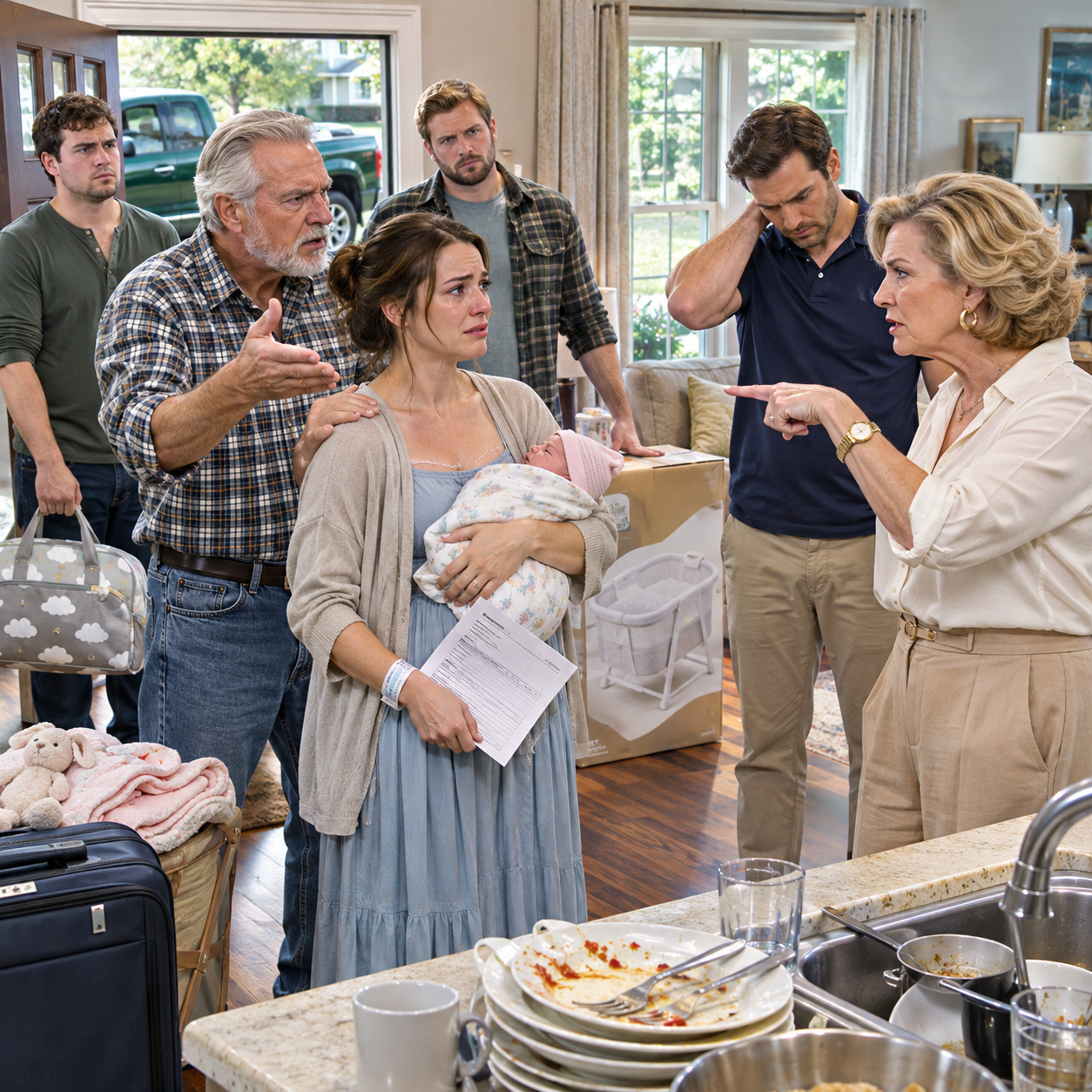
### Part 2: A Secret Payment Exposed the Help We Never Received
Recovery at Dad’s house wasn’t easy, but for the first time since Clover’s birth, I wasn’t afraid to ask for water, food, or a few minutes of sleep. Stuart’s wife delivered freezer meals, Felix assembled the bassinet and checked its instructions twice, and Dad left oatmeal beside my bed every morning. Nobody called me lazy. Nobody watched the clock while I rested.
Owen texted daily. He asked about Clover, apologized for how things had “gone sideways,” and explained that Harriet had been struggling since his father died two years earlier. He said she came from a different generation and didn’t always express herself well. I understood grief, but I couldn’t understand why protecting his mother’s feelings required abandoning mine.
Five days after arriving at Dad’s, I opened our joint bank account to pay a bill. A transaction caught my attention.
$3,200. Transferred to Harriet Gallagher three weeks before Clover’s birth.
I called Owen immediately. “Why did you send your mother thirty-two hundred dollars?”
He hesitated. “To help with the baby. Cooking, cleaning, groceries. She was going to handle everything.”
I stared at the screen. “Owen, the kitchen was filthy when I got home. She demanded that I cook for her.”
“She said she had things planned.”
“Did you ask for receipts? Did you even discuss this with me?”
His silence answered both questions.
Then I remembered the expensive sectional and matching entertainment center Harriet had proudly shown us during a video call months earlier. She’d claimed she’d been saving for years. I couldn’t prove our money had paid for her furniture, but I wrote down the transfer date, Owen’s explanation, and everything I’d personally witnessed.
A week after I left, Owen’s aunt Glenda sent me a message accusing me of disrespecting a grieving widow. According to her, calling my father over a minor disagreement was immature. I almost responded until Clover stirred against my shoulder, reminding me where my energy belonged.
Two days later, a woman named Rosemary Vance called.
“Vivien, this is Rosemary from Harriet’s neighborhood group. I brought her a little gift for Clover. Did she give it to you?”
“No, I’m sorry. I haven’t seen it.”
Rosemary paused. “Well, perhaps there’s been a misunderstanding. I also wanted to ask about the meals.”
“What meals?”
Her voice became careful. Eight families in the neighborhood had organized two full weeks of dinners starting when Clover came home. There were casseroles, soups, and even a grandmother’s pot roast on the schedule. But eleven days before my daughter was born, Harriet had canceled every delivery.
“She told us you were very private,” Rosemary explained. “She said you didn’t want people coming around and preferred to manage things yourselves.”
My fingers tightened around the phone.
“Vivien? Is that what you wanted?”
“No,” I whispered. “Nobody told me about any of this.”
For several seconds, Rosemary said nothing. Then she murmured, “Oh, honey.”
After the call, I sat looking at Clover’s sleeping face. Eight families had offered to feed us, and Harriet had deliberately turned them away. Then she’d stood over me after my surgery, demanding dinner as though I’d failed some essential test of motherhood.
I called Owen and told him everything.
“That doesn’t sound like Mom,” he insisted.
“Then call her. Ask her directly.”
Three hours passed before he called back. His voice was noticeably smaller.
“She said she thought strangers bringing food would be intrusive. She believed you’d want privacy.”
“Did she ask me?”
“No.”
“Did I ever say I didn’t want help?”
Another pause.
“No, Vivien. You didn’t.”
I looked down at my daughter and realized something worse than the money was missing.
Harriet hadn’t simply failed to help us.
She had taken away the help other people were offering, then made me feel guilty for needing it.
And my husband had paid her to do it.
### Part 3: Hidden Evidence Forced My Husband to Confront His Mother
Owen came to Dad’s house two days later carrying flowers and a folder of bank statements. I accepted the flowers, but I put my handwritten notes between us on the kitchen table. Dad had taken Clover for a walk, leaving us alone with questions neither of us could avoid anymore.
“I want to call your mother,” I said. “Together.”
Owen studied the transfer receipt, then nodded.
Harriet answered cheerfully when she heard his voice, but her warmth disappeared when he mentioned the neighborhood meal group.
“I was protecting Vivien’s privacy,” she insisted.
“She never asked you to,” Owen replied.
“I have forty years of experience managing a household. I know what new mothers need.”
I leaned toward the speakerphone. “Harriet, eight families offered to bring us food. You canceled their deliveries, then demanded that I cook dinner four days after my C-section. What exactly were you protecting me from?”
“Being overwhelmed by strangers,” she snapped.
“And what was the $3,200 for?”
“Compensation for my time and effort. You would have paid a stranger to do everything I was doing.”
I glanced at Owen. “What were you doing? Because I remember the dirty dishes, and I remember being ordered into the kitchen.”
“I raised children, Vivien. I don’t need a performance review from you.”
Owen leaned forward. “Mom, did that money pay for household expenses?”
Silence.
“Mom?”
“I had some personal expenses,” she finally admitted.
Owen stared at the bank statement. “Like the furniture you bought for your condo?”
Her voice hardened. “I refuse to be interrogated by my own son.”
The call ended.
Owen remained still, looking at the dark phone screen. For once, he didn’t offer an excuse or explain why his mother hadn’t meant what she said.
“I’m sorry,” he whispered. “I should have checked. I should have protected you.”
“I don’t need you to fight your mother for me,” I answered. “I need you to stop helping her hurt me.”
He lowered his eyes, but this time he listened.
The rumors continued. Glenda accused us of humiliating Harriet over grocery money, while Harriet told neighbors she’d spent an exhausting week cooking and cleaning for an ungrateful daughter-in-law. Rosemary eventually learned the truth and called to apologize.
“Harriet has organized our neighborhood deliveries for three years,” she said quietly. “She likes being the person who decides what everyone needs. I don’t think people will trust her with that responsibility again.”
I didn’t ask anyone to punish Harriet. I simply wanted the truth to stop changing every time she told it.
Meanwhile, Owen began visiting regularly. He learned Clover’s feeding schedule, changed diapers without being asked, and discovered that sometimes she needed nothing more than a steady shoulder. One afternoon, he lifted her during a furious crying spell, and she settled against his chest almost immediately.
“How did you know that would work?” he asked.
“She doesn’t know it’s you,” I said softly. “She just knows someone is there.”
He looked at our daughter for a long time.
Then Harriet announced a welcome celebration for Clover at the fellowship hall of St. Andrew’s. Owen asked whether I’d attend, explaining that he wanted Clover to know her grandmother’s family. I wanted that too, provided it didn’t mean teaching my daughter that love required accepting humiliation.
The day before the gathering, Rosemary called with a warning. Harriet had been practicing a speech about the sacrifices she’d made for our family. She intended to present herself as the wounded grandmother whose help had been cruelly rejected.
I told Owen. He promised to speak with her, but called back an hour later.
“Mom says she has a right to explain her side.”
“Then I have a right to explain mine.”
On Saturday afternoon, I entered the fellowship hall wearing a loose dress that wouldn’t rub against my healing incision. Clover slept against my chest. Inside my jacket pocket were the bank transfer and the notes I’d written at Dad’s house.
White balloons floated above yellow tablecloths. Someone had baked three different pies, and a cheerful banner welcomed Clover. Harriet greeted me with a bright smile, kissed my daughter’s forehead, and guided us to a table as though nothing had happened.
For nearly an hour, I spoke with relatives, accepted congratulations, and wondered whether I had misjudged her intentions.
Then Harriet stepped to the front of the hall and tapped a spoon against her glass.
“Before we celebrate our beautiful Clover,” she announced, “I’d like everyone to understand what this family has been through.”
The room fell silent.
And I knew the celebration was about to become something else entirely.
### Part 4: The Public Truth Finally Gave My Family a Future
Harriet smiled at the room as she described the exhausting weeks she’d endured while helping her son and his recovering wife. She claimed she’d organized meals, managed the household, and sacrificed her own comfort to make sure we had everything we needed. Then she placed a hand over her heart. “Sometimes the people we love most are the ones who appreciate us least.”
Several guests turned toward me.
I stood slowly, shifting Clover carefully against my shoulder. “Harriet, may I ask you something?”
Her smile tightened. “Of course, dear.”
“Which meals did you cook for us?”
A whisper moved through the room.
“I made certain everything was taken care of.”
“I’m asking about the actual meals,” I replied. “Because when I came home from the hospital, there were dirty dishes everywhere, and you told me to put my newborn down and cook dinner for you.”
Glenda lowered her fork. Rosemary sat motionless two tables away.
Harriet’s face reddened. “I gave up an entire week to help you. Apparently, that means nothing.”
Before I could answer, Owen stepped forward.
“Mom, stop.”
Every head turned.
“You canceled the neighborhood meal deliveries,” he said. “Eight families had offered to feed us for two weeks. You told them Vivien didn’t want their help, even though she knew nothing about it.”
Harriet stared at him. “Owen, how dare you embarrass me?”
He stood beside me. “I also sent you $3,200 for groceries, cooking, and household support. You admitted using it for personal expenses.”
Someone at the back of the room set down a fork.
“You didn’t prepare meals,” Owen continued. “You didn’t keep the house clean. You turned away people who wanted to help, then demanded that my wife cook for you four days after she’d undergone surgery to deliver our daughter.”
Harriet looked around desperately. “I’ve sacrificed everything for this family!”
Owen’s voice remained steady. “You organized this gathering, Mom. You decided to give a speech about what happened. If you wanted people to know the truth, you should have told them the truth.”
Rosemary stood.
“I organized those dinners,” she confirmed. “Harriet told us Vivien had declined the help. I spoke with Vivien afterward. She never knew we’d made the arrangements.”
For the first time since I’d known her, Harriet seemed unable to find an answer.
She snatched up her handbag. “You’ll all regret treating me this way.”
Then she walked out.
The door closed quietly behind her.
Glenda approached me afterward, her expression filled with embarrassment. “Harriet told me she’d been cooking and cleaning all week. She said you left because Owen asked you to help around the house.”
“That isn’t what happened,” I said.
“I can see that now.” She looked toward Clover. “I owe you an apology.”
I nodded. “I’ll take it.”
That evening, Owen drove Clover and me back to Dad’s house. We sat on the porch while Dad watched our daughter inside. The sky was turning lavender, and I could hear the faint creak of the porch swing beneath us.
“I should have stood up for you years ago,” Owen said.
I waited.
“After Dad died, I felt responsible for keeping Mom happy. I thought agreeing with her was easier than letting her get upset.” He swallowed. “But I wasn’t keeping the peace. I was making you pay for it.”
“I spent three years convincing myself that the little things didn’t matter,” I said. “I can’t pretend they suddenly don’t hurt.”
He nodded. “What do you need from me?”
It was the first time he’d asked without trying to decide the answer himself.
“Time. Consistency. And I want your mother to repay the money.”
He agreed.
Harriet refused at first, insisting that the money was compensation she’d earned. Owen held his ground through three difficult conversations, explaining that any relationship with Clover would require honesty and accountability. Eventually, Harriet agreed to repay the $3,200 in installments.
The first payment arrived on a Tuesday. I spent it on groceries, baby supplies, and occasional help while I continued healing. For once, the money was used exactly as it had been intended.
Several weeks later, Clover and I returned to our house in Cedar Falls. Rosemary’s neighborhood group delivered dinners for two weeks, just as they’d originally planned. Every family apologized for believing Harriet’s story, and every evening someone left something warm and nourishing at our door.
Owen began therapy. He learned to recognize how often he’d confused keeping his mother comfortable with being a good husband. When Harriet attempted to spread another distorted version of the church gathering, he called her and told her plainly that she couldn’t disrespect me and expect unrestricted access to our family.
Our marriage didn’t heal overnight. There were painful conversations, difficult evenings, and moments when I wondered whether rebuilding trust was even possible. But Owen kept showing up, not with flowers or explanations, but with changed behavior.
Eight months after Clover’s birth, Dad arrived carrying a Dutch oven filled with beef stew. Clover was sitting in her high chair, dropping banana pieces onto the floor with the serious concentration of a tiny scientist.
Dad surveyed the kitchen. Clean bottles dried beside the sink, folded laundry rested on the counter, and a drawing from Stuart’s daughter hung on the refrigerator.
“Looks lived in,” he said.
“It is.”
Owen was repainting Clover’s bedroom, the second time he’d offered to do it without being asked. Dad glanced down the hallway, then back at me.
“He’s trying,” he observed.
“He is.”
Dad nodded. “Trying matters. What matters more is whether a person keeps trying when it’s uncomfortable.”
Clover held out a piece of banana. Dad accepted it with enormous seriousness.
“Thank you, ma’am.”
I laughed, and the sound surprised me with how easily it came.
Owen appeared in the doorway, paint speckling his forearm. “Is that your stew, Dale?”
“Enough for three nights.”
Owen smiled. “Next time, dinner’s on me.”
Dad raised an eyebrow. “I’ll believe that when I smell it.”
We all laughed.
I carried Clover toward the kitchen window, watching the ordinary afternoon light settle across our backyard. Eight months earlier, I’d stood in this same house with a fresh surgical incision while someone told me I’d been resting long enough. One phone call had brought my father and brothers to the door, but it hadn’t been their arrival that ultimately changed my life.
It was realizing I didn’t have to accept cruelty just because it came from family.
Owen approached and gently took Clover from my arms. “Go sit down,” he said. “I’ll finish dinner.”
I studied his face. There was no impatience, no glance toward his mother, no suggestion that I owed anyone something in return.
“Are you sure?”
He kissed Clover’s forehead. “I’ve got her.”
I sat at the kitchen table while my father lifted the lid off his stew and Owen carried our daughter down the hallway. From the other room came Clover’s delighted squeal, followed by her father’s laughter.
For years, I’d believed that keeping a family together meant enduring whatever threatened to pull it apart. Now I understood that a family only becomes stronger when the people inside it are willing to protect one another.
Harriet had tried to teach me that a woman’s worth depended on how much she could sacrifice without complaining.
My father had reminded me of something far more important.
I was allowed to need help. I was allowed to expect kindness. And I was allowed to leave a room where neither was offered.
That afternoon, no one asked me to prove I deserved rest.
Dinner was already being taken care of.
And for the first time in a very long while, I felt completely at home.
THE END.
All characters and events in this story are fictional, created for storytelling and entertainment purposes. Thank you sincerely for reading. Your feedback and support are invaluable and motivate me to continue sharing more stories with you.