
### Part 2: The Groom’s Father Discovered What His Son Had Hidden
I held out both hands. Garland studied the fresh burn on my knuckle, then raised his own palm to show a thick white scar running toward his wrist.
“Steel cable,” he said. “Cincinnati. Nineteen seventy-eight. Nearly took me off a building.”
Tiny, standing beside the backhoe bucket, let out a low whistle.
Garland turned toward Dad’s old Lincoln welder, studying it like an old friend.
“My son tells me you don’t like weddings,” he said. “Your sister says you’d rather work.”
“That’s not exactly true.”
“Then tell me what’s true.”
I swallowed.
“I wasn’t invited, Mr. Whitaker.”
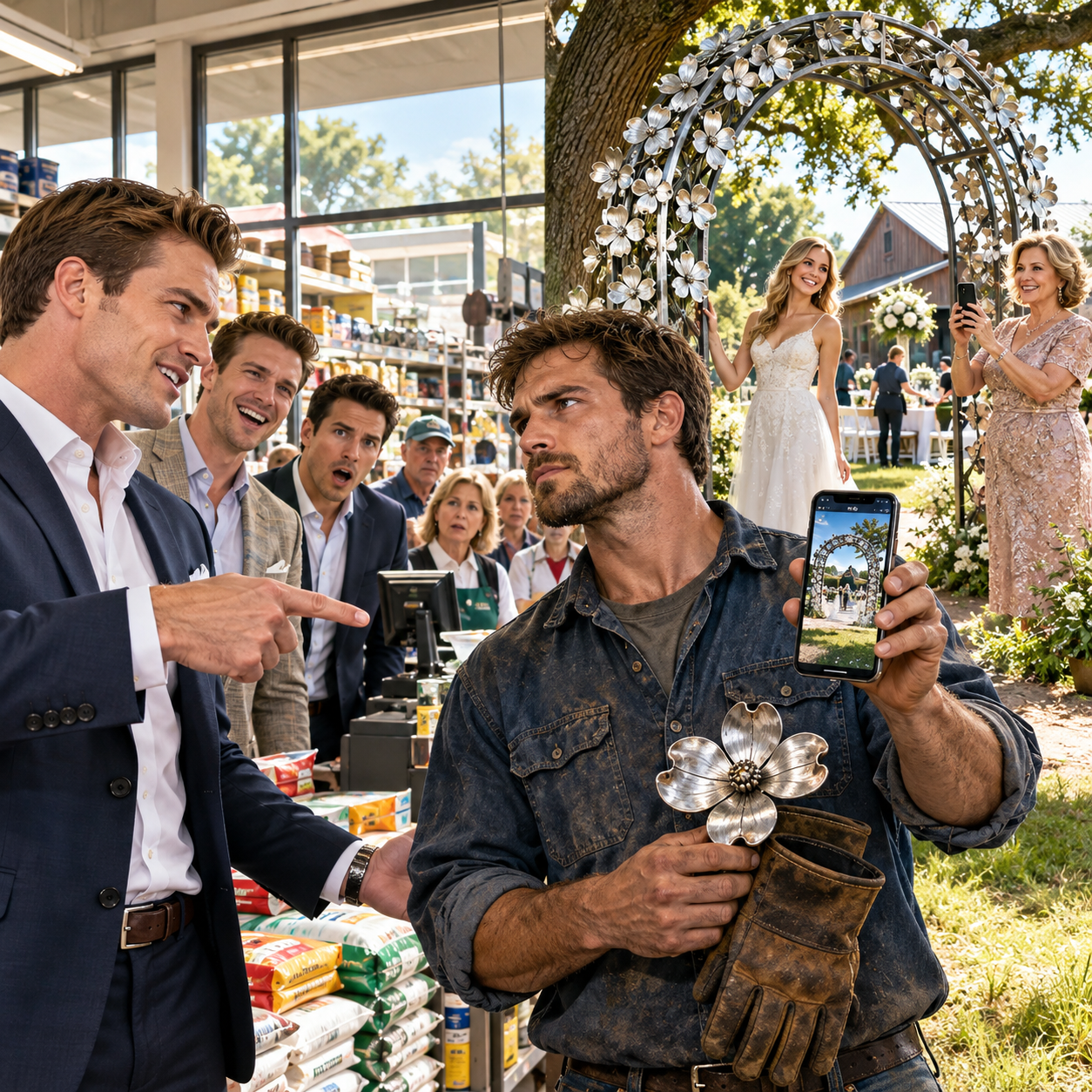
He nodded slowly. He’d seen my arch beneath Francis’s oak and couldn’t believe the craftsmanship. Marne had shown him the invoice, including those four words beside the labor charge.
“No charge for Sid,” he repeated.
He asked about the dogwood blossoms.
I told him about Dad planting the tree for Sydney and taking her picture beneath it every spring.
Garland glanced away.
“My Francis would’ve loved that.”
He explained that he’d mentioned wanting to meet me at dinner. Sydney, Mom, and Preston had exchanged uncomfortable looks before insisting I was antisocial.
“Did they actually tell you not to come?”
“Yes, sir.”
“Anything in writing?”
I showed him Sydney’s registry message and repeated what she’d said about his family’s money.
Garland took an old flip phone from his pocket and dialed Preston. He placed it on speaker between us.
“Son, why isn’t Sydney’s brother invited?”
Preston sounded half asleep.
“Dad, come on. He’s a welder. He’ll show up looking like he crawled out of a furnace. Even Sydney’s mom doesn’t want him there.”
Garland stared at the phone.
“A welder?”
“You know what I mean.”
“I certainly do.”
He ended the call.
For several seconds, the only sound came from the cooling metal in my shop.
Then he asked whether my coffee was any good.
“Not really.”
“Pour me some anyway.”
He drank it standing up. Before leaving, he hired me to replace the crooked front gate at his farm.
“Full price,” he insisted.
“That’s how I work.”
The old man smiled.
Over the next few Saturdays, Garland returned to watch me build the gate. Sometimes he brought gas-station coffee. Sometimes he criticized my welding technique, usually correctly. He spoke about Francis, a former schoolteacher who could maneuver a livestock trailer better than any hired hand, and about the barn she’d restored before cancer took her.
Eventually, he spoke about Preston.
The condo, truck, and credit cards all belonged to Garland. Every job Preston had obtained came through his father’s connections. Every failure had been quietly covered up.
“I thought I was giving him opportunities,” Garland admitted. “Instead, I taught him nothing costs anything.”
One Saturday, he confessed that the wedding had been Preston’s final chance to demonstrate responsibility before Garland considered handing over part of the company.
“I wanted to see how he treated people when there was nothing to gain.”
He rubbed his scarred hands together.
“Now I know.”
After I installed his new double gate, Garland offered to invest in my business. I refused to give up ownership, so he proposed something else: steady subcontracting work on three upcoming buildings and an interest-free loan for a proper shop and plasma-cutting table.
“A loan, not ownership,” he said. “We put everything in writing.”
“With a lawyer?”
“Wouldn’t have it any other way.”
We shook hands.
What I didn’t know was that Garland had already decided to confront his son.
He told Preston and Sydney that he wanted me at their September 20 wedding. They had until the rehearsal to apologize and invite me themselves.
Sydney promised to call.
She never did.
On Wednesday, September 17, Garland asked at supper whether they’d spoken to me.
Sydney smiled across the table.
“We invited him. He said he didn’t want to come.”
Mom sat beside her and said nothing.
Garland drove straight to my workshop that night.
I was welding a railing when his headlights swept across the barn wall. He stepped inside, looking older than he’d looked the previous Saturday.
“Will, has anybody called you about the wedding?”
“No, sir. Not since July.”
He slowly lowered himself onto an overturned bucket.
“That’s twice they’ve lied to my face.”
I switched off the welder.
Garland told me he was withdrawing financial support. Preston would return the truck, move out of the condo, surrender the credit card, and find honest work.
“And the wedding?” I asked.
“Canceled. I’m not hosting a marriage built on contempt and lies.”
I shook my head.
“I never wanted to ruin Sydney’s wedding.”
“You didn’t,” he replied. “They did.”
He explained that Preston would have until Friday to tell Sydney himself. Garland wanted his son to accept responsibility without anyone rescuing him.
Then he looked around the workshop.
“Didn’t you say you and Carly planned to marry at the courthouse next spring?”
“Yes, sir.”
“Well, I’ve got a barn prepared for a rehearsal supper, caterers paid, musicians booked, and enough brisket to feed an army.”
I frowned.
“What are you saying?”
Garland stood up.
“Marry Carly on Friday. Under that arch you made. Francis would have loved that.”
At home, Carly was on the couch in her scrubs, eating cereal straight from the box.
I told her everything.
She put the cereal down.
“This Friday?”
I nodded.
She stared at me for four seconds.
“Yes.”
Then her eyes widened.
“Will, I don’t have a dress!”
For the first time since Sydney’s phone call, the future felt like something I could actually look forward to.
### Part 3: Our Wedding Exposed The Lies Behind Their Perfect Celebration
Before sunrise Thursday, I drove to the farm with a new steel plate in my truck. Beneath the oak, Garland held a flashlight while I unbolted the initials S and P from the arch.
I replaced them with W and C.
The dogwood blossoms remained untouched.
I kept the original plate, wrapping it carefully in an old moving blanket. Whatever Sydney had done, those letters had once represented a gift made with love.
That afternoon, Carly and I obtained our marriage license at the Scott County Clerk’s office. Kentucky required no waiting period. The clerk smiled when Carly mentioned we were getting married the next evening.
Then Carly went dress shopping with her mother, Ria, while I started making phone calls.
Tiny cried before I finished telling him.
Carly’s father, Lamar, promised to iron his best shirt. My uncle Wyatt agreed to close his tire shop early. Dad’s eighty-four-year-old mother, Hester, announced that she’d need someone to drive her because she intended to bring her good purse.
Mama Hester had been furious since learning I’d been excluded from Sydney’s wedding.
“Your daddy would have had something to say about that,” she told me.
“I know, Mama.”
I invited everyone who’d shown up for me throughout my life.
I didn’t invite Mom or Sydney.
That night, Carly asked whether I was certain.
“They left me off their list,” I said. “I’m allowed to make my own.”
Meanwhile, Garland had informed Preston that the wedding was canceled.
Preston kept it from Sydney.
He apparently believed he could persuade his father to reconsider. He told her the rehearsal supper was canceled over a disagreement about money, but Saturday’s ceremony would proceed.
So Friday afternoon, while Carly was stepping into her wedding dress, Sydney sat in a Lexington salon getting her nails done. She posted smiling photographs with her bridesmaids beneath the caption, “One more day.”
At six o’clock, sixty-some guests gathered beneath the oak.
Marne had transformed the space with white flowers, warm lights, and chairs borrowed from the rehearsal setup. Tiny wore a suit stretched across his massive shoulders. Mama Hester sat in the front row wearing lavender, her purse firmly in her lap.
Garland had brought nearly thirty ironworkers from his crews. They sat together near the barn, freshly showered, wearing their good shirts.
When Carly appeared beside her father, I forgot every bitter word spoken that summer.
She wore a simple ivory dress, her hair pinned loosely above her shoulders. She looked nervous until our eyes met.
Then she smiled.
I reached for her hand beneath the arch I’d built with Dad’s welder.
At six fifteen, our pastor pronounced us husband and wife.
Tiny shouted, “Finally!”
The whole gathering laughed.
As the sun lowered behind the barn, light slipped through the steel dogwood blossoms and scattered delicate shadows across Carly’s dress.
I wished Dad could have seen it.
Then I looked at Mama Hester wiping her eyes and knew that, somehow, part of him was there.
During dinner, Garland rose with a glass of sweet tea.
“I’ve spent my life building things,” he began. “And I’ve learned that what a man does when nobody’s paying him tells you more than anything else.”
He pointed toward the arch.
“Will built that for his sister without charging a penny for his labor. A man who puts that much care into something he gives away is a man I’d trust with my own name.”
He raised his glass.
“To Will and Carly.”
Everyone stood.
Even Mama Hester, whose knees hadn’t been cooperative in years.
Carly’s cousin Jolie spent the evening uploading photographs to Facebook. I barely noticed. I was too busy dancing with my wife, laughing with Tiny, and persuading Mama Hester to take one turn around the dance floor.
At nine thirty, my phone began vibrating.
Sydney.
I stepped outside the barn.
“WHAT ARE YOU DOING AT MY VENUE?” she screamed.
I held the phone away from my ear.
“Why is everyone at my farm? Why are you standing under my arch?”
I looked through the barn doors at Carly laughing with her father.
“Because I got married.”
Silence.
“You WHAT?”
“Married Carly. About three hours ago.”
“That’s supposed to be MY wedding!”
“No, Sid. Your wedding isn’t happening.”
Her breathing changed.
“What are you talking about?”
“Garland canceled it. Ask Preston. He’s known since Thursday morning.”
“You’re lying.”
“No. That’s what you and Preston did to his father.”
The line went quiet again.
Then her voice became very small.
“Is my arch still there?”
I watched the lights glowing through the dogwood blossoms.
“The arch is there. But you told me not to come and to send a gift. So I took my gift back.”
I ended the call.
At ten o’clock, Garland’s office emailed Saturday’s entire guest list, explaining that the wedding would not take place.
My mother called three times in five minutes.
I turned off my phone.
Then I walked inside, found Carly, and asked my wife for another dance.
### Part 4: The Truth Finally Reached My Mother And Changed Everything
The next morning, Carly and I drove to a little cabin in Gatlinburg for four days. We paid for it ourselves, despite Garland offering to cover the cost.
“You’re stubborn,” he told me.
“Learned from watching you.”
He laughed.
While we were away, Preston surrendered the truck keys, moved out of his father’s condo, and began looking for work.
Two Mondays later, he reported to an ironworking crew building a parking garage in Lexington. Garland arranged for him to begin as an ordinary laborer, earning eighteen dollars an hour.
The foreman received one instruction.
“Treat him like everybody else.”
His new boots squeaked so loudly that the crew nicknamed him Squeaky.
He hated every minute.
But he kept showing up.
Sydney’s response was different.
Ten days after the canceled ceremony, she arrived at Garland’s farmhouse wearing her best church dress and carrying a bakery coffee cake. Standing beside the gate I’d made, she asked whether he’d consider financing a smaller wedding in the spring.
“Just family,” she said. “Everything was a misunderstanding.”
Garland studied her.
“Your brother built you an arch for free. You couldn’t find him a chair.”
Then he closed the door.
He kept the coffee cake.
That evening, Sydney ended her engagement by text. She told Preston she needed a man who could provide the lifestyle she’d been promised.
Preston showed his father the message.
Garland read it without speaking, then handed back the phone.
“Let her keep the ring,” he said when Preston complained. “It’s the last thing she’ll get from us.”
Sydney returned to her childhood bedroom in Mom’s house.
The same hallway where Dad’s dogwood photographs used to hang.
Meanwhile, Mom faced awkward questions from church friends who had watched her fifty-day wedding countdown. When she discovered that Mama Hester and Uncle Wyatt had attended my ceremony, she called my grandmother in tears.
“Why didn’t anyone tell me?”
Mama answered calmly.
“Well, Deanna, I guess it was a tight guest list.”
On Friday, October 3, two weeks after my wedding, Mom’s silver Buick rolled into my gravel driveway.
I was finishing a railing for a church in Paris, Kentucky. I switched off Dad’s welder, lifted my helmet, and walked outside wiping my hands on a rag.
Sydney climbed out first.
Her eyes were swollen.
“You ruined my life!”
Mom followed more slowly.
“How could you go behind your sister’s back and tell that man those things about our family?”
I looked from one to the other.
“I didn’t go to him. Garland came here.”
Sydney crossed her arms.
“Now Preston’s working construction, everyone at church is talking, and I’m living in my old bedroom. I hope you’re happy.”
I folded the rag.
“Sid, Garland asked me why I wasn’t invited. I told him the truth.”
“You could have lied for me!”
Something inside me finally settled.
“You lied enough for both of us.”
Her mouth opened, then closed.
“I built you a wedding arch with Dad’s machine. I shaped dogwoods into the steel because Dad planted that tree when you were born. I wanted you to remember him.”
Sydney looked away.
“I gave you three weekends of my work because I loved you. You hugged me under that arch, then called eight days later and told me I wasn’t good enough to stand beneath it.”
Mom shifted beside her.
I faced her.
“And when I called you, you told me to look at my hands.”
Her expression tightened.
“Will—”
“Those were Dad’s hands, Mom. They paid for our groceries. They fixed our house. They held us when we cried.”
The workshop seemed unusually quiet.
“I didn’t destroy Sydney’s future. I didn’t make Preston lie. I didn’t make either of them take Garland’s money for granted.”
I set the rag on my workbench.
“All I did was stop helping them pretend.”
Sydney pulled at Mom’s sleeve.
“Let’s go.”
But Mom wasn’t looking at her.
Her eyes had dropped to my hands.
For years, she’d seen the burns, the dirt, the rough skin, and nothing else.
This time, her face changed.
She reached toward my right hand, hesitated, and covered her mouth.
“Danny,” she whispered.
I nodded.
“Yeah, Mom.”
She started crying without making a sound.
I didn’t embrace her. Not because I wanted to punish her, but because one moment of recognition couldn’t erase years of shame.
They eventually drove away.
I went back inside and finished the railing.
The church was expecting it Monday.
Almost a year has passed since that afternoon.
Last March, I moved into my own workshop, an old cinder-block garage outside Georgetown with three bay doors and an office overlooking a horse pasture. Garland’s lawyer prepared our loan agreement exactly as promised, and I’ve been making payments ahead of schedule.
The sign outside carries my business name, not his.
Garland sends me steady railing and stairwork contracts. Carly says I’ll eventually need employees, and I keep telling her I’ll think about it.
Mom calls about once a month now.
She asks about Carly, the shop, and whether I’m getting enough rest. Once she asked if I was wearing gloves, then caught herself and laughed.
It’s not forgiveness. Not completely.
But it’s a beginning.
Sydney and I haven’t spoken. I hear she’s working at the boutique again. The original steel plate bearing S and P remains wrapped in a blanket in the shop.
I haven’t decided what to do with it.
Preston is still working on Garland’s crew.
Last month, he climbed a forty-foot column and called his father from the top. Garland told me it was the first call from Preston in ten years that didn’t include a request for money.
He sounded proud when he said it.
And the arch?
It’s outside my workshop now.
Garland arrived one April morning with a flatbed truck, a small crane, and two workers. They helped me anchor it beside the front walkway, where sunlight still catches every handmade dogwood blossom.
“That thing was paid for twice,” Garland told me. “Once with my money. Once with your heart. It belongs where somebody appreciates the work.”
Every Saturday, his old white Ford rolls into my lot around seven.
He brings two coffees, settles onto his favorite overturned bucket, and watches me weld.
Sometimes Tiny drops by. Sometimes Carly brings sandwiches. Mama Hester occasionally visits and tells customers I’m the finest welder in Kentucky, which is an exaggeration I don’t have the heart to correct.
Last Saturday, Garland stood beside Dad’s old Lincoln machine for a long time.
“Mind if I try something?”
I handed him my welding helmet.
He lowered it, struck an arc, and ran a clean bead across a scrap of steel.
When he lifted the helmet, he was grinning like a teenager.
“Still got it.”
I examined his work.
“Sure do.”
He held up his scarred hand beside mine.
For a moment, I could almost see Dad standing between us.
Then Garland pointed at my last weld.
“You’re running that machine a little hot, son.”
I laughed.
Outside, the dogwood blossoms cast their shadows across the concrete, and Carly’s wedding ring flashed in the morning sunlight as she waved from the doorway.
My mother had once told me to hide my hands because wealthy people might judge them.
Those same hands had built my sister’s wedding arch, brought me a lifelong friendship, helped me earn my own business, and held my wife’s hands beneath the oak.
I looked down at my father’s old scars, now joined by my own.
For the first time in years, I wasn’t thinking about who was ashamed of them.
I was thinking about everything they’d built.
THE END.
All characters and events in this story are fictional, created for storytelling and entertainment purposes. Thank you sincerely for reading. Your feedback and support are invaluable and motivate me to continue sharing more stories with you.


