## Part 2: A Forgotten Credit Card Exposes a Much Bigger Betrayal
The next morning, I opened my banking website and found a payment I couldn’t explain. It belonged to a credit card account I hadn’t used in more than a decade, an old joint account I’d opened for David when he was in college. Back then, it was meant for emergencies: a broken transmission, an unexpected medical bill, something that could leave a young man stranded. The current balance was nearly four thousand dollars.
I leaned closer to the screen. Three hundred dollars at an upscale grocery store. Five hundred at a luxury home boutique. One thousand for custom closet consultations. The remaining charges included expensive household accessories, specialty foods, and purchases I had never authorized for their new lifestyle.
I recognized the store names from Sarah’s shopping bags.
My hands went cold. David had kept the card, and somehow he and Sarah had decided my forgotten account could quietly finance their transition. I remembered my husband telling me that generosity wasn’t the same as surrender, and for the first time I understood what he’d meant.
I called the bank.
“I need to close the account ending in 4402,” I told the representative.
“Would you prefer a temporary freeze?”
“No. I want it permanently closed, and I need a statement of the balance.”
When the call ended, I saved the records and shut my laptop. I didn’t go looking for an argument. I pulled on my gardening gloves, stepped into the backyard, and started pruning roses.
At 2:15, Sarah’s SUV swung into the driveway. She marched through the side gate with a single shopping bag bouncing against her wrist, her cheeks bright red beneath flawless makeup.
“Did you cancel David’s emergency credit card?”
I clipped a dead rose. “You mean my credit card?”
“It was declined at Whole Foods! There were people behind me. I had to use my own debit card!”
“That must have been inconvenient.”
“Inconvenient?” Her voice climbed. “The cashier looked at me like I’d done something wrong!”
I removed my gloves. “Sarah, that account was meant for David’s college emergencies, not imported cheeses and custom closet consultations. You and David both earn six-figure salaries. You can pay for your groceries yourselves.”
“Families help each other,” she snapped. “You have plenty in your retirement accounts.”
“My retirement money is for my retirement.”
She took a step toward me, expecting me to retreat. I reached for the garden hose instead.
“David is going to hear about this.”
“I hope he does. Remind him there’s nearly four thousand dollars to settle.”
I turned toward the hydrangeas while Sarah marched away. The screen door slammed so hard that a bird startled out of the maple tree. My roses survived the disturbance beautifully.
By Saturday, Sarah had found another battlefield.
I opened the laundry room door and discovered piles of her delicate gym clothes and David’s dress shirts covering every available surface. A sticky note clung to a sweater: Cold water only. Hang dry.
I fetched a large black trash bag and carefully placed every garment inside. Then I carried the bag into the guest room and deposited it on their bed without folding a single shirt.
Afterward, I changed the password to the guest Wi-Fi network.
An hour later, David appeared in the living room holding his laptop. “Mom, the internet isn’t working.”
“Mine works.”
“Sarah can’t stream her workout class. My phone says the password’s wrong.”
“That’s because I changed it.”
He rubbed his temples. “Why are you making everything so difficult?”
“Because you’re grown adults who have turned my home into a free hotel. Use your cellular data, and tell Sarah the laundry room isn’t her personal dumping ground.”
“Mom, please. Stop fighting with her.”
“I’m not fighting, David. I’m saying no.”
That evening, I was pouring water in the kitchen when Sarah’s voice carried through the guest room door.
“You promised this would be easy!” she hissed. “You told me she’d do anything to keep us happy!”
“Keep your voice down,” David whispered.
“No! You said we could stay rent-free for a year while we gutted the townhouse and bought all the new furniture!”
My hand stopped halfway to my mouth.
A year.
Not three weeks of painting. Twelve months of living under my roof, eating my food, using my utilities, and charging purchases to my credit.
“She’ll cave,” David murmured. “She always does. By next month she’ll be cooking for us again.”
I set my glass on the counter without making a sound.
For five years, I had excused David’s selfishness because I was afraid of losing another person I loved. Now I understood that he had mistaken my grief for permanent weakness.
I walked into my bedroom, knelt beside the bed, and pulled out a cardboard moving box.
I wasn’t packing my belongings.
I was preparing for the possibility that my own son would have to pack his.
## Part 3: Their Secret Yearlong Plan Collapses Under My New Rules
Sunday morning, I carried two grocery bags into the kitchen and began separating what belonged to me from what I’d been buying for my uninvited long-term guests. Premium coffee, expensive snacks, imported treats, and unopened bottles of wine went into the bags. I took them to the trunk of my car, leaving ordinary oatmeal, canned beans, and tap water in the pantry. Nobody would go hungry, but nobody would be enjoying a luxury vacation at my expense.
At the front door, I noticed the spare key to my late husband’s SUV was missing from its usual hook. David had been using the vehicle because it burned less gas than his truck, something I’d allowed during previous visits. I found the key among his things on the hallway table and returned it to my purse. The SUV would stay parked until I could arrange its sale.
Then I called my cellular provider. David’s number was still attached to the old family plan we’d maintained for years, and I asked to have it removed at midnight. The representative confirmed the change, and I wrote the details in my notebook. My son had built his comfortable adult life on conveniences I kept paying for.
At noon, Sarah opened the refrigerator and stared inside.
“Where’s my almond milk?”
“I stopped buying specialty groceries.”
“What about the coffee?”
“I decided to reduce my expenses.”
David entered the room a few minutes later, holding his empty key ring. “Mom, where’s the SUV key? I need to go to the hardware store.”
“In my purse. I’m planning to sell the vehicle next week, so I want to keep the mileage down.”
“But my truck needs gas.”
“There’s a station three blocks away.”
Sarah slammed the refrigerator door. “You’re deliberately making us miserable.”
I set down my crossword puzzle. “You wanted house rules. Here’s mine. Pay your own way, respect the homeowner, and ask permission before using someone else’s property.”
David glanced helplessly at his wife.
“If that arrangement doesn’t suit you,” I continued, “the Marriott downtown has excellent room service.”
For several seconds, neither spoke. Then Sarah grabbed her handbag and walked out, leaving David behind to stare at me like I’d become someone he didn’t recognize.
I knew that look. He had worn it when he was sixteen and discovered I wouldn’t buy him a second car after he wrecked the first. I’d loved him fiercely through every mistake, every difficult year, and every disappointment. But love wasn’t permission to take advantage of someone.
Over the following days, Sarah stopped speaking to me, and David communicated mostly through exhausted sighs. I kept my routines: morning coffee, afternoon walks, my crossword puzzle by the window. When I passed the guest room, I could hear their arguments through the door. They spoke of renovation costs, furniture deposits, and temporary housing as though my house had been a financial strategy rather than a family favor.
On Thursday, my book club ran fifteen minutes late. I drove home at 6:30, looking forward to a quiet evening, and found several unfamiliar cars crowding my driveway. Music floated through the front windows, followed by laughter and the unmistakable clink of wineglasses.
I stepped inside and smelled garlic, tomato sauce, and expensive perfume.
Sarah was hosting a dinner party.
Three couples stood around my kitchen island, drinking wine from the crystal glasses my husband and I had received on our twentieth anniversary. Sarah wore a silk dress beneath one of my aprons, stirring a huge pot of pasta on my stove. David stood near the refrigerator, smiling nervously at a man discussing real estate.
“Oh, Caroline!” Sarah exclaimed, her voice suddenly sugary. “You’re home early.”
Six strangers turned toward me.
“We decided to have a little get-together,” she announced. “I hope you don’t mind. There’s plenty of food, so you can grab a plate and take it to your room.”
One woman gave me a sympathetic smile, the kind people reserve for elderly relatives who need gentle handling. Another guest glanced toward the hallway as though expecting me to obediently disappear.
I put my book club bag on the counter.
Sarah lifted her chin. “Caroline, did you hear me?”
“I heard every word.”
Then I noticed a glossy folder beside the wine bottles. Across its cover, in elegant black lettering, were the words Complete Townhouse Renovation — Twelve-Month Project Timeline.
I opened it.
And suddenly I understood exactly why my daughter-in-law had been so confident about making herself at home.
## Part 4: One Dinner Party Reveals the Truth and Ends Their Free Ride
I turned the first page of the renovation folder. Architectural drawings showed walls being demolished, bathrooms rebuilt, and an elaborate custom closet extending across what had once been a spare bedroom. A construction schedule stretched nearly twelve months into the future. There was nothing about a three-week painting job.
“That’s a beautiful project,” I said, lifting the folder where everyone could see it. “Although I’m surprised the painting is going to take an entire year.”
Sarah’s stirring spoon stopped.
One of her friends smiled. “Oh, it’s a complete renovation. Sarah showed us the plans last month. They’re practically rebuilding the place.”
The kitchen fell quiet.
“Really?” I asked. “Because David told me they only needed somewhere to stay for three weeks.”
David’s face drained of color. Sarah opened her mouth, but no words came out. The woman who had just spoken looked between us and slowly lowered her wineglass.
I closed the folder and set it beside the stove.
“Good evening, everyone. I’m Caroline, the homeowner. I’m sorry you were invited without my permission, but this gathering is ending now.”
Sarah laughed sharply. “Caroline, don’t be ridiculous.”
I reached over and switched off the burner beneath her pasta.
“Please collect your belongings,” I told the guests. “I’m closing my home for the evening.”
One man immediately set his glass down. “We had no idea.”
“Of course you didn’t,” I said. “You were told this was their home to use.”
Sarah’s cheeks turned crimson. “You can’t humiliate me in front of my friends!”
“Then you shouldn’t have invited them into a house that doesn’t belong to you.”
I pointed to the apron. “Please leave that here too.”
Her fingers trembled as she untied it. The guests began collecting purses and jackets, murmuring apologies as they moved toward the front door. Within minutes, their cars were disappearing down the driveway.
The silence that followed was heavier than the music had been.
Sarah stood beside the untouched pasta, tears gathering beneath her mascara.
“You vicious, bitter old woman,” she whispered.
David stepped forward. “Sarah, stop.”
“No!” She swung toward him. “You told me she’d be happy to have us! You said she’d never stand up to you!”
I watched my son’s expression change. Until that moment, he’d let his wife carry the blame for every demand, every insult, every attempt to control my house. But the renovation folder lay between us now, and there was nowhere left for him to hide.
“Is that true, David?” I asked. “Was this your idea?”
He looked toward the floor, just as he had when Sarah first handed me her list.
“Mom, I thought once we got settled, you’d understand.”
“Understand what?”
“That it made more sense for us to stay here while the townhouse was renovated. Renting somewhere else would have cost a fortune.”
“So you decided I should pay instead.”
He flinched. “I was going to explain.”
“When? After you’d moved into my bedroom? After another four thousand dollars appeared on my credit card?”
“Mom, please.”
I looked at him and saw the little boy who used to bring me crooked drawings from school, who had cried when his father died, who had promised at the funeral that he’d never let me feel alone.
That boy was gone, replaced by a man who had confused his mother’s love with an unlimited supply of money, space, and forgiveness.
“You lied to me,” I said quietly. “And you let your wife treat me like a servant because you thought I wouldn’t risk upsetting you.”
His eyes filled. “I didn’t think of it like that.”
“That’s the problem, David. You didn’t think of me at all.”
Sarah wiped her cheeks with the back of her hand. “Fine. We’ll leave when the townhouse is ready.”
“No,” I replied. “You’ll leave tonight.”
David lifted both palms. “Mom, it’s late. We don’t have anywhere arranged.”
“You have two incomes, two vehicles, and enough money to renovate an entire townhouse. You have options. What you no longer have is permission to live here.”
“Please don’t do this.”
“I’ve already made my decision. You need to be out by nine tomorrow morning, at the absolute latest. And we’ll arrange repayment of the credit card balance.”
I watched him struggle for an answer. Part of me desperately wanted him to apologize, to show that he understood what he’d done. Instead, he looked at Sarah, hoping she could find a way to change my mind.
She couldn’t.
At 11:45 that night, the familiar rumble of suitcase wheels crossed my hardwood floor. Sarah walked past me without speaking, her lips pressed into a narrow line. David stopped at the front door, one hand resting on the handle.
For one brief second, I thought he might turn around and say he was sorry.
Instead, he asked, “Are you really choosing this house over your own son?”
My throat tightened.
“No, David. I’m choosing to stop paying for a relationship that should never have had a price.”
He lowered his eyes and stepped outside.
I closed the door, turned the deadbolt, and fastened the chain. Their cars pulled away, and the red taillights disappeared beyond the maple trees. I stood in the hallway for a long moment, listening to the refrigerator hum and the old grandfather clock strike midnight.
The following morning, I woke at eight.
For the first time in nearly two weeks, nobody was demanding breakfast. Nobody was waiting for laundry. Nobody was planning to take my bedroom, my retirement money, or another piece of the quiet life my husband and I had built.
I brewed my dark-roast coffee and toasted one slice of sourdough bread. Blackberry jam glistened beneath the morning light as I settled into my favorite chair by the kitchen window.
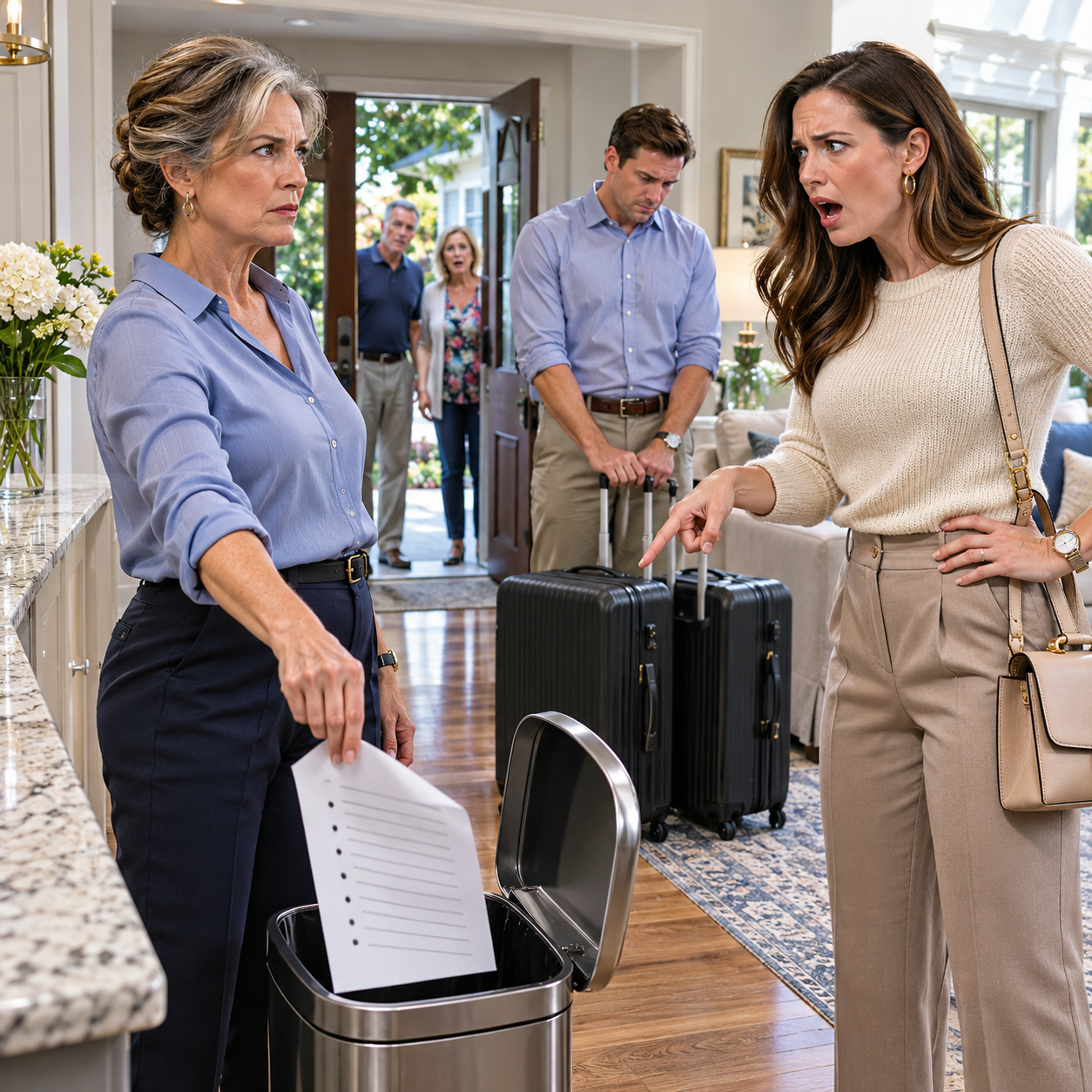
On the counter sat the original house-rules list, rescued from the trash when I’d emptied the bin. I unfolded it once more, remembering Sarah’s confident smile and David’s silence. Then I tore it neatly in half and dropped both pieces into the recycling.
My son was still my son, and I hoped someday we’d find a way to speak honestly again. But if that day came, he would have to knock, apologize, and enter as someone who respected me—not someone who expected to own everything I had.
I took a slow sip of coffee.
For thirty years, I’d shared this home with a man who made me feel loved. For five years after his death, I’d been afraid that protecting my peace meant losing what remained of my family.
Now I knew the truth.
A home doesn’t become empty when the people taking advantage of you finally leave.
Sometimes, that’s when it begins to feel like home again.
THE END.
All characters and events in this story are fictional, created for storytelling and entertainment purposes. Thank you sincerely for reading. Your feedback and support are invaluable and motivate me to continue sharing more stories with you.