
## Part 2: A Fifty-Thousand-Dollar Request Exposed What My Son Really Wanted
Nine days passed without an apology.
I delivered a casserole to my neighbor Dolores, whose knee had been troubling her since October. On New Year’s Eve, I watched Jimmy Stewart movies with Pepper sleeping against my slippers.
Then, on January third, Mason finally texted.
Hey, Mom. Lake house open house is Saturday the 14th at nine. Best lot on the water. Hope you’ll come.
Not a word about Christmas.
For six months, Mason and Ashley had been pursuing a four-bedroom vacation home on Center Hill Lake. They wanted me to contribute fifty thousand dollars toward the down payment, promising impressive rental income and rising property values.
Mason had even mentioned how Leonard always dreamed of owning a lake house.
My husband had made that remark once, years earlier, during a backyard fish fry.
I’d agreed verbally because I wanted to help my son build something beautiful.
Now I wondered whether he remembered his father at all, or merely remembered which stories made me reach for my checkbook.
I replied, Okay.
On January fourteenth, I arrived at a cedar-and-glass house overlooking gray winter water. Ashley greeted me with a carefully arranged smile and a one-armed hug. Mason kissed my cheek.
The real estate agent led us through spacious rooms while Ashley explained where expensive furniture would go.
Downstairs, I spotted a swollen baseboard beside the sliding door. A dark brown stain climbed the drywall.
“There’s water damage,” I said, crouching to inspect it. “Possibly rot in the sill plate.”
“The sellers offered a two-thousand-dollar credit,” Mason answered.
Ashley gave me the patient smile she reserved for people she considered unsophisticated.
“Gloria, the agent knows what she’s doing.”
I stood without arguing.
Back upstairs, Mason touched my elbow.
“Mom, there are other offers. We’d really like to get your commitment in writing today.”
“We brought the paperwork,” Ashley added. “Did you bring your checkbook?”
I studied both their faces.
Not one question about how I’d spent Christmas.
Not one acknowledgment of what had happened.
“Finish looking around,” I said.
I stepped onto the deck, where a bitter wind swept across the lake. Below me, the dock swayed against its moorings. Somewhere across the water, a loon cried.
I thought about Leonard. He’d spent thirty-eight years making sure I never felt like a burden in my own home.
Then I walked through the house, past the waiting paperwork, and straight to my car.
Forty minutes later, I entered my credit union in Murfreesboro.
Dennis Hill, who’d managed our accounts for nineteen years, looked up from his desk.
“Gloria? What can I do for you?”
“I’d like to put fifty thousand dollars into a five-year certificate of deposit. Fixed term.”
He studied me. “That locks it up until 2028.”
“I understand.”
He turned his computer toward me.
And I signed.
My next stop was my daughter Amanda’s little brick house. She taught high school art, owned her home outright, and had inherited Leonard’s habit of telling uncomfortable truths.
Over chamomile tea, I described the Christmas party, the lake house, and the certificate.
“Good,” she said.
Then she smiled sadly.
“Dad once said Mason traded his backbone for a sticky note when he married Ashley.”
“Your father never said that.”
“Thanksgiving. Four years ago. I was sitting beside him.”
For one brief moment, I laughed so hard my eyes watered.
That afternoon, I texted Mason.
Come to dinner. Seven sharp. Bring Ashley.
They arrived precisely at seven.
Mason stepped into my dining room with his jaw clenched. “You walked out on us. The agent had everything ready.”
“Sit down,” I said.
I’d set three places. In the middle sat a grocery-store rotisserie chicken inside its plastic container and a bag of dinner rolls.
Ashley stared at the table.
“I’m not hungry.”
“That’s fine.”
I unfolded my napkin.
“The fifty thousand dollars is now in a five-year CD. There won’t be a check.”
Mason’s face drained.
“But Mom, you promised.”
“I said I’d consider helping. That was before I understood what kind of relationship we had.”
Ashley pushed back her chair.
“You’ve been difficult since our wedding! Every holiday, every dinner, you find something to complain about. You make us look terrible, then act wounded.”
I kept my voice even.
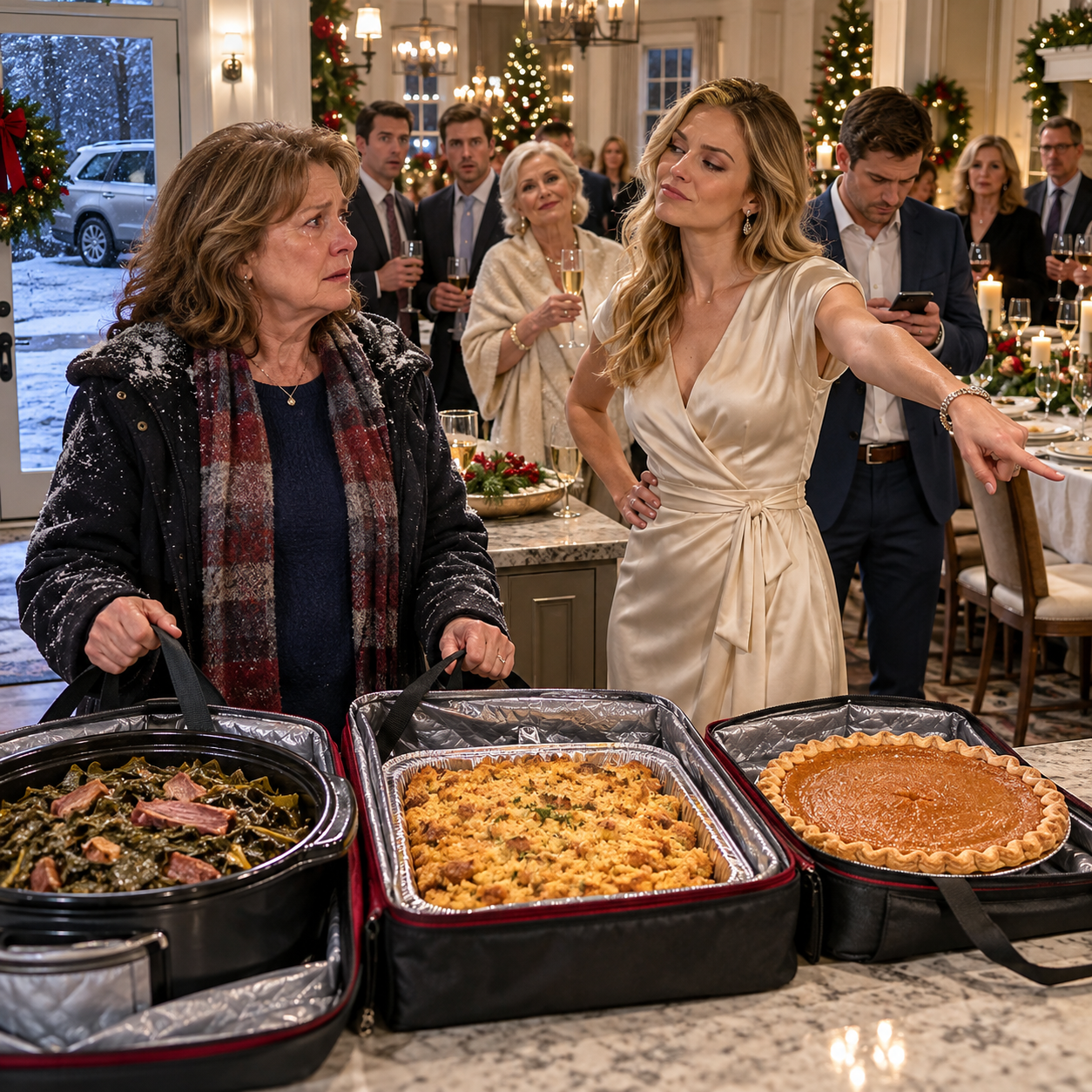
“I brought homemade food through an ice storm. You humiliated me before your guests. I left without raising my voice.”
“You wanted to punish us!”
“No. I wanted to have Christmas dinner somewhere I was welcome.”
Mason rubbed his forehead.
“Ash, please.”
She swung toward him.
“If you let her get away with this, she’ll control us forever! We’re going to lose that house!”
Then something slipped out.
“I spent five thousand dollars on Christmas dinner, and the refund still hasn’t arrived! We’re trapped in a rental, your career isn’t going anywhere, and your mother won’t even write one check!”
I watched Mason lower his eyes.
He’d heard every word.
And he still couldn’t defend me.
That’s when I noticed the little lighthouse keychain hanging from Ashley’s purse. I’d bought it in Maine with Leonard. Two years earlier, I’d given Mason the attached spare house key so he could water my plants.
Somehow, it had become hers.
I walked over and unclipped it.
“Excuse me,” Ashley snapped. “That’s my key.”
“It’s my house key. And my lighthouse.”
I tucked it into my cardigan pocket.
“Mason, you’re welcome to eat. But the money isn’t coming. And nobody enters this house without my permission anymore.”
Ashley grabbed her purse and headed for the door.
My son hesitated, staring at the untouched chicken. For a second, I saw the boy who used to follow Leonard around the backyard carrying a toy hammer.
Then he followed his wife.
I closed the door, returned to the table, and ate my dinner.
The chicken was ordinary. The rolls were cold.
But for the first time, I had served exactly what I wanted in my own home.
## Part 3: Winter Brought Unexpected Allies And Consequences Nobody Could Hide
February arrived with bare trees, freezing mornings, and a silence I hadn’t expected to enjoy.
Mason texted once to ask whether I was well. In March, he sent a photograph of a cardinal perched on his fence.
I answered both messages kindly.
But I stopped doing the work of repairing a relationship I hadn’t broken.
One afternoon, Connie Pierce called.
She launched into a polished lecture about forgiveness, family harmony, and why mothers of married sons needed to understand their “secondary position.”
I listened until she finished.
“Thank you, Connie. I’ve heard your opinion.”
Then I hung up and returned to my jigsaw puzzle.
A week later, a cream-colored envelope arrived from Brentwood.
Inside was a handwritten letter from Marilyn Sullivan, wife of Mason’s managing partner.
She’d heard about my collard greens, cornbread dressing, and sweet potato pie. Her husband had apparently spent more time discussing the meal that never happened than the expensive party itself.
Marilyn was collecting recipes for her church cookbook.
Would I consider sharing mine?
I sat at Leonard’s old writing desk and carefully copied his mother’s sweet potato pie recipe onto fresh stationery.
As I sealed the envelope, I realized something.
The very food Ashley had called embarrassing was being welcomed by people she’d desperately wanted to impress.
Later, Amanda brought more news.
Roy Sullivan had watched Mason’s household unravel over a missing catered dinner, then spent Christmas Eve buying waffles for the stranded guests.
The following week, Mason was quietly removed from a major client account he’d been pursuing.
No one officially connected the decision to the party.
But Roy had reportedly said he preferred assigning important relationships to people whose personal lives appeared steady.
I didn’t celebrate my son’s professional setback.
I wished he’d learned respect without paying such a price.
Spring brought gentler things.
Amanda started dating Patrick Allen, Colin’s cousin, a soft-spoken contractor with a dry sense of humor. She brought him for dinner in April, and I prepared the same three dishes Ashley had refused.
Patrick took a second helping of dressing.
Amanda scraped the last of the sweet potato pie from its dish.
Nobody mentioned themes.
Nobody suggested hiding anything.
As the weather warmed, I planted tomatoes behind the fence and painted my porch swing the deep teal Leonard had always liked. On Wednesday evenings, I joined a memoir-writing group at the library, where people my age gathered to put memories into words.
Some evenings I wrote about my husband.
Other evenings I wrote about the difference between being needed and being loved.
By July, I could sit on my porch without constantly checking the road for Mason’s car.
Then one afternoon, while I was trimming black-eyed Susans, his dented old Jeep pulled into my driveway.
Mason climbed out.
Ashley sat motionless in the passenger seat before finally following him toward the porch.
In her hands was a folded sheet of notebook paper.
“The lake house deal fell apart,” Mason said.
I lowered my garden shears.
“Why?”
“The inspection found serious rot in the sill plate. Exactly where you said it would be.”
He stared at the ground.
“We’ve started marriage counseling. Connie stayed with us for a month, which made everything worse. And the caterer’s refund finally came in April.”
“I’m glad you got your money back.”
Mason gave a humorless little smile.
“Ashley framed the refund check. She thought it was funny.”
Ashley didn’t laugh.
Instead, she unfolded her paper. Her fingers trembled against the creases.
“Gloria,” she began, “I’ve come to apologize.”
I looked from the prepared words to her face.
For the first time in five years, I wondered whether my daughter-in-law understood what an apology actually required.
## Part 4: One Honest Confession Changed Everything, But My Boundaries Remained
Ashley stared at her notebook paper.
“I want to apologize for Christmas Eve,” she read. “I recognize that my words were hurtful, and I value the important role you play in our family.”
I waited.
“The role I play?” I repeated.
She looked up.
“That’s not what I meant.”
“Then tell me what you mean, Ashley. Without reading it.”
The paper shook in her hands.
For several seconds, nobody spoke. A breeze stirred the flowers beside my porch, and somewhere inside the house, Pepper barked at a passing car.
Finally, Ashley crumpled the paper.
“Mason’s boss barely returns his calls anymore,” she whispered. “My mother stopped speaking to me after I told her what actually happened at Christmas. And everybody knows about the dinner.”
Her eyes filled.
“Marilyn Sullivan wrote you a thank-you note. She asked for your recipes. I haven’t been invited to anything she’s hosted since.”
She looked directly at me.
“I called your food cheap because I wanted my party to look expensive. I made you feel small because I was afraid people would think I wasn’t good enough.”
The words came out unevenly, without rehearsal.
“And when the catering failed, I expected you to save me anyway.”
Mason turned toward her. He looked as surprised as I felt.
“I was ashamed,” she continued. “But instead of admitting it, I blamed you. I’m sorry.”
I rested my shears on the porch railing.
There had been a time when those words would have sent me rushing forward to comfort her.
Not anymore.
“Thank you for telling me the truth,” I said. “But an apology doesn’t erase five years of being treated like an inconvenience.”
She wiped her cheeks.
“I know.”
“Mason will always be my son. He’s welcome here any Sunday he wants to visit. The house key stays with me. And that fifty thousand dollars stays exactly where I put it.”
Ashley nodded.
“As for you, I appreciate what you’ve said today. But trust takes more than one conversation. We’ll see what happens next.”
She looked toward the open screen door, then lowered her eyes.
“I understand.”
Without another word, she returned to the Jeep.
Mason remained at the bottom of the steps.
“Mom,” he said quietly, “I should’ve defended you that night.”
“Yes, you should have.”
“I kept thinking if I stayed out of it, things would calm down.”
“And did they?”
He shook his head.
“I watched you carry Dad’s Christmas food out into the rain. I knew how much that dinner meant to you, and I let you go.”
His voice broke on the last words.
That was the truth I’d needed from him.
Not a promise about money. Not another excuse about keeping peace.
Just the acknowledgment that he’d watched me be hurt and had chosen silence.
I stepped aside.
“There’s sweet potato pie in the kitchen, if you’d like some.”
He looked up.
“Really?”
“Really.”
Pepper greeted him with an expression of profound suspicion.
We sat at the old kitchen table with two slices of pie and glasses of iced tea. I put the sugar on the side, just as Leonard always had.
For nearly an hour, we talked.
Mason told me about counseling, his worries at work, and how embarrassed he’d been when the house inspection proved I’d been right.
I told him how lonely Christmas had felt after his father died, and how exhausting it had become to pretend that his wife’s contempt didn’t hurt.
We didn’t solve everything.
But neither of us pretended anymore.
When he left, I watched him walk back to the Jeep. Ashley sat waiting in the passenger seat.
I felt no need to chase after them.
The following Saturday, I rose early and began cooking.
I simmered collard greens with smoked turkey, baked Leonard’s cornbread dressing, and prepared the sweet potato pie from his mother’s handwritten recipe.
By late afternoon, my backyard smelled like every good Christmas I’d ever known.
Amanda arrived with Patrick, who immediately began wrestling with the charcoal grill. Dolores came over with her knee finally healed. Two women from my memoir group settled beneath the oak tree with iced tea.
Marilyn Sullivan drove down from Brentwood carrying a casserole of her own.
And Mason arrived alone.
Without being asked, he unfolded the extra chairs and helped set the table.
When everyone was seated, I placed the greens in the center, with the dressing beside them and the pie waiting on its little stand.
A crack ran across the golden surface of the pie.
For once, I didn’t try to hide it.
“Supper’s ready,” I called.
Everyone reached for a plate.
Amanda laughed at something Patrick said. Dolores complimented my tomatoes. Marilyn asked whether the dressing recipe might go into the next church cookbook.
Mason looked across the table.
“Dad would’ve loved this,” he said.
I felt a familiar ache, but this time it came with warmth.
“Yes, honey. He would have.”
I served my guests, filled my own plate, and sat at the head of the table beneath the Tennessee evening sky.
For years, I’d thought being a good mother meant giving until there was nothing left to give.
But Leonard had taught me something better through thirty-eight years of marriage.
Love wasn’t measured by how much disrespect you could endure.
It was measured by the care people showed one another when nobody had anything to gain.
That evening, I wasn’t waiting to be included in somebody else’s celebration.
I was home.
At my own table.
Surrounded by people who wanted to be there.
And every single dish belonged.
THE END.
All characters and events in this story are fictional, created for storytelling and entertainment purposes. Thank you sincerely for reading. Your feedback and support are invaluable and motivate me to continue sharing more stories with you.


