
### Part 2: A Stolen Design Threatens My Father’s Carefully Protected Reputation
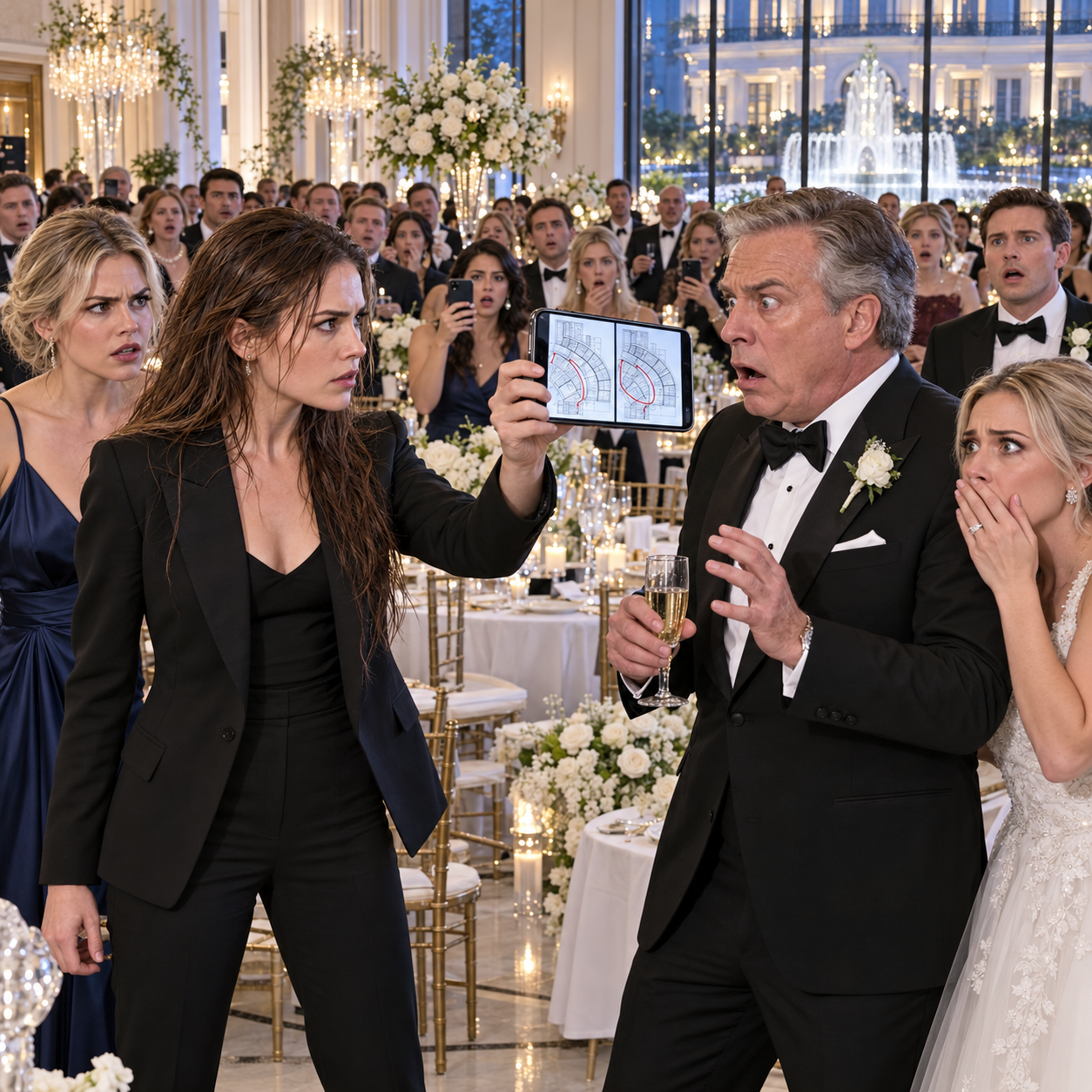
Dad stared at my phone and quietly demanded that I put it away. “Whatever little professional grievance you’ve invented can wait until after the wedding,” he said, trying to sound amused for the people gathering around us. I didn’t move. “Did you use my acoustic corridor concept in your Calder presentation?” I asked.
His eyes flicked toward one of his partners, a silver-haired man I’d known since childhood. “Family members discuss ideas, Maya. That doesn’t mean you own every curved hallway in America.” I nodded, opened my original study, and showed him the firm’s published drawings beside it. “Same corridor radius, same three-stage acoustic transition, same mechanical isolation zones,” I said. “And the same labeling error I corrected six months after I sent you my file.”
The silver-haired partner stepped forward. “Greg, did our Calder team receive material from your daughter?” Dad ignored him and looked around, searching for someone willing to laugh. Nobody did. I could almost see him calculating whether dismissing me would still work in front of witnesses who understood the professional implications. When he reached for my phone, I pulled it away.
“You don’t understand how architecture firms operate,” he snapped. “You’re taking a family conversation and making ridiculous accusations.” I kept my voice level. “I’m showing you what I can document, Dad, not accusing you of something I can’t prove.” His partner’s expression darkened when Dad refused to answer the question directly.
Clara stepped between us, her wedding dress brushing the polished floor. “Can everyone please stop?” she pleaded, glancing toward the reception tables. “This is supposed to be our celebration.” I understood that she wasn’t wrong to want her wedding back, but I was tired of being the only person expected to preserve everyone else’s happiness.
I lowered my phone. “You’re right, Clara. I came here to celebrate you, and I’m leaving the reception now.” Dad relaxed, already mistaking my decision for surrender. Then I added, “I have another engagement in this hotel.”
His eyes narrowed. “What engagement?”
I turned toward the ballroom doors without answering. Emily followed me, and behind us Dad began talking loudly about how I’d always been oversensitive. When he claimed he’d only nudged me and I’d lost my balance, Emily stopped walking. “There are at least twelve videos showing exactly what happened,” she said, and several guests glanced instinctively toward their phones.
At 9:13, I reached the corridor outside the Calder Salon. Dad caught up, followed by Clara, his business partner, and nearly twenty guests who were pretending they weren’t interested. “You think some old sketches can threaten me?” he muttered. “Remember who opened doors for you.”
I turned to face him. “I remember every door I had to open myself.” His expression hardened as I continued, “You think everything I accomplish belongs to you because I’m your daughter. It doesn’t.”
At precisely 9:15, the salon doors swung open.
A hotel coordinator emerged, followed by several Calder Foundation board members, two preservation commissioners, project counsel, and the foundation’s executive director. Dad immediately straightened his jacket and arranged his face into the polished smile he used with important clients. But the executive director looked straight past him.
“Maya! There you are,” she said, walking toward me with an outstretched hand. “We’ve been waiting for our lead consultant.”
The hallway fell completely silent.
I shook her hand, noticing that my suit cuffs were still slightly damp. Her eyes moved from my hair to the curious wedding guests gathered behind me. “Everything all right?” she asked. “Just a wedding complication,” I answered.
Dad stepped forward before anyone could speak again. “Greg Thompson, Thompson and Hale Architecture. We’re finalists for the Calder commercial package.” The executive director’s expression remained polite. “Yes, Mr. Thompson. I know who you are.”
He placed a hand against his chest. “And this is my daughter, Maya.”
The executive director smiled at me. “Yes. Maya Thompson, founder of Thompson Acoustic Works, whose team was unanimously selected this afternoon as the Calder Exchange’s lead acoustic and adaptive reuse consultant.”
For several seconds, nobody moved.
Dad looked from her to me, his mouth opening without producing a word. Clara pressed one hand against her chest, while Emily lowered her head to conceal an unmistakable smile. The executive director continued discussing my firm’s appointment, the foundation’s confidence in our design, and the responsibility we would carry in preserving the historic building.
“Selected?” Dad finally managed.
“Yes,” I replied.
“You never told me.”
I met his eyes. “You never asked.”
His partner turned sharply toward him. “Greg, did you know Maya’s firm was competing for this appointment?” Dad said no so quickly that even Clara seemed startled. I could have used that moment to mock him the way he’d mocked me, but watching him struggle was nothing like the victory I’d once imagined.
Instead, I opened the original email again and looked toward the foundation’s attorney.
There was something far more important than embarrassing my father.
There was the truth.
### Part 3: The Evidence Forces My Sister to Confront Our Father’s Lies
The foundation’s attorney studied my father’s expression as the gathering grew quiet. I explained that I’d sent Dad an early version of my acoustic corridor study two years earlier, long before the Calder competition began. When I discovered similar elements in Thompson and Hale’s presentation, I’d disclosed the overlap six weeks before the wedding and supplied the foundation with the original source files. “I didn’t ask anyone to disqualify his firm,” I said. “I asked for an independent assessment.”
Dad interrupted immediately. “This is ridiculous! Similar designs develop independently every day.” I agreed, which seemed to confuse him. “Exactly why I provided dated models, version histories, emails, and the attachment you received,” I answered. His partner looked at him. “Greg, you actually had the file?”
Clara turned toward Dad before he could answer. “Did you know the design was hers?” His jaw clenched. “Stay out of this, Clara.” She stared at him, stunned. “This is my wedding.” He replied, “Then act like it and let the professionals handle this.”
Something shifted in my sister’s face. Her husband moved beside her and gently took her hand, but she kept looking at our father. For the first time that night, she seemed to understand that pleasing him wouldn’t protect either of us. Dad had always changed the rules whenever someone challenged him.
The attorney spoke carefully. “Ms. Thompson notified us six weeks ago. The foundation has had the matter under review, and no determination about your firm’s conduct will be made in this hallway.” Dad seized on those words. “Exactly! She’s angry about a harmless joke and trying to ruin my career.” I looked directly at him. “The disclosure happened six weeks ago, Dad. You pushed me into a fountain fifteen minutes ago.”
His partner took a small step away from him. The attorney continued, explaining that the newly revealed circumstances warranted an expanded independent review of Thompson and Hale’s submission. When the partner asked whether their finalist status would be suspended pending that review, the answer was yes. Dad stood rigid as the implications settled around him.
Then he spotted a guest watching the fountain video on a phone. “Delete that,” he ordered, pointing toward the screen. The guest lowered the phone without obeying. Dad turned toward Clara. “Tell these people they’re exaggerating.”
Clara didn’t look away this time. “I saw you push her, Dad.” When he insisted it was playful and called me sensitive, Clara shook her head. “That’s what you always do. Maya is sensitive, I’m stressed, and whenever Mom disagreed with you, she was emotional.” Her voice steadied. “Everybody has a personality defect the moment they stop agreeing with you.”
Dad reached toward the bandstand and demanded the microphone. The bandleader hesitated and looked at Clara for permission. She shook her head, and the microphone remained untouched. I watched Dad’s expression change as he realized that, for once, being the loudest person in the room no longer gave him control.
Clara suddenly looked at me. “Maya, why did Dad tell me your sixteenth-birthday competition happened a week after my scholarship interview?” Before I could answer, she continued, remembering the college celebration I’d supposedly refused to attend out of jealousy. I told her Dad had said the restaurant reservation had been reduced and there was no place for me. Clara stared at him, her eyes filling with tears.
“You made me think she resented everything good that happened to me,” she whispered. Dad waved dismissively. “That was years ago.” Clara took a breath. “Years ago doesn’t make it a misunderstanding.”
He began listing everything he’d sacrificed for us: private schools, vacations, houses, college expenses, opportunities. I waited until he finished before reminding him that he’d paid only one year of my education while scholarships, assistantships, and loans covered the rest. “I’m grateful for what you gave me,” I said. “But gratitude doesn’t mean surrendering my dignity.”
“After everything I’ve done, this is how you repay me?” he demanded.
“You keep talking about love like it’s an investment,” I answered. “That’s why every disagreement feels like someone stealing from you.”
Clara removed the decorative place card announcing his special father-of-the-bride toast and folded it in half. “Dad, you’re finished speaking tonight,” she said. “I want you to leave the reception.”
His expression crumpled into disbelief. “Because of her?”
“Because you shoved my sister into a fountain and cared more about being embarrassed than about hurting her.” Her husband offered to arrange a car, and Dad’s partner quietly said they should leave. Dad looked at me one final time. “You’ve always known how to ruin things.”
I didn’t defend myself.
“You still need me to be the problem,” I said.
He opened his mouth, then turned away. The crowd parted without applause or laughter, and the ballroom doors closed behind him. Clara stood beside me, crying silently, while the Calder executive director approached and offered to postpone the announcement.
I looked down at my damp cuffs and shook my head.
“I’ve postponed enough good things because of him.”
### Part 4: My Father’s Final Confession Reveals What Freedom Really Means
At 9:42 that evening, I stood before the Calder Foundation’s board in the adjoining salon. When the executive director announced my name into the microphone, people applauded because they respected my work, not because they expected me to become the punchline. I spoke about the responsibility of adapting historic buildings without erasing the things that made them worth preserving. Halfway through, I recognized how closely those words described the choices I’d been making about my own family.
The consequences for Dad arrived without dramatic public declarations. The following Monday, Thompson and Hale announced that he would step away from the Calder submission while the authorship issue was reviewed. Two weeks later, the firm withdrew from that competition entirely. At the next quarterly meeting, his partners removed him as managing partner, citing concerns about leadership and professional judgment.
The independent design review eventually concluded that my original material had been incorporated into his team’s concept without adequate attribution. Dad wasn’t ruined, and he wasn’t suddenly penniless. But the professional reputation he’d spent decades protecting had been damaged by decisions he couldn’t dismiss as somebody else’s sensitivity. I didn’t celebrate his downfall, and I refused to rescue him from it.
The fountain video circulated among wedding guests, although Clara asked people not to post it publicly. Most respected her wishes, and I was grateful because I had no desire to turn my sister’s wedding into an internet spectacle. The truth was already documented where it mattered. I didn’t need strangers watching my humiliation to prove that it happened.
Three months later, Dad sent me a twelve-paragraph email. He wrote about pressure, expectations, the sacrifices he’d made, and how difficult it had been to raise daughters with different personalities. The word sorry appeared only once, immediately followed by if. I read the message, closed my laptop, and returned to work.
Six months after the wedding, another email arrived.
This time, there were only four sentences.
I humiliated you. I pushed you after you asked me to stop. I used work you trusted me with and convinced myself that being your father gave me some right to it. I was wrong.
I read those words three times, searching for the excuses that had always followed his apologies. There were none. For the first time, he’d described his own actions without blaming me for them. I didn’t reply immediately because I was finally beginning to understand that forgiveness wasn’t something I owed anyone on a deadline.
Clara and I began repairing our relationship in quieter ways. We compared childhood memories, discovered how often Dad had carried distorted messages between us, and made one simple rule: if either of us heard that the other had said something hurtful, we would ask directly. We didn’t become inseparable overnight, but we stopped allowing someone else to interpret our relationship for us. That changed more than any dramatic family reconciliation could have.
One afternoon, Emily asked whether I regretted telling Dad to remember the moment beside the fountain. I thought about the freezing water, the laughter, the way I’d instinctively looked for someone to defend me. Then I remembered the bandleader refusing to hand Dad the microphone until Clara approved. “That’s the moment I want to remember,” I told Emily.
For years, my father had assigned us roles in a story that protected his pride. Clara had to be the successful daughter who proved he was a wonderful parent, while I had to be the disappointing one who explained why our family sometimes fought. Neither role had anything to do with who we really were. The moment we stopped playing them, his authority began to crumble.
A year after the wedding, I stood inside the unfinished Calder Exchange performance hall, watching construction workers install the first section of my acoustic corridor. Steel framing curved around the passageway, acoustic panels waited beside the walls, and my company’s drawings lay open across a worktable. My name appeared beneath the design, exactly where it belonged. I ran one hand along the newly installed framework and remembered a little cardboard model disappearing beneath a serving dish fifteen years earlier.
Clara visited that afternoon, stepping carefully around the construction materials. When she saw the curved corridor, she stopped and turned toward me with sudden recognition. “Maya, is this the same thing you designed when you were sixteen?” I smiled. “A much better version.” She looked around at the enormous structure taking shape. “I wish I’d understood what you were building back then.”
I touched her arm. “You’re seeing it now.”
We stood together for a while, listening to workers call measurements across the unfinished hall. There were things about our childhood neither of us could recover, and I knew our relationship with Dad might never become what we’d once wanted. But the possibility of reconciliation no longer controlled my happiness. Whatever he chose to do next belonged to him.
As we walked toward the exit, Clara glanced at the plans one last time. “You know,” she said, smiling softly, “Dad always made it sound like you were fixing echoes.” I looked back at the corridor I’d designed and laughed. “I suppose I was. I just didn’t realize how many of them were coming from home.”
At her wedding, my father had wanted two hundred people to laugh because I arrived without a date. Fifteen minutes later, he discovered that his daughter had built an entire career while he was busy making her feel small. The greatest surprise wasn’t that I’d succeeded without his approval. It was that I’d finally stopped waiting for it.
I walked out of the Calder Exchange beside my sister, into the bright afternoon sunlight, carrying nothing I needed to hide.
My father’s opinion had occupied far too much room in my life.
I wasn’t going to give it another inch.
THE END.
All characters and events in this story are fictional, created for storytelling and entertainment purposes. Thank you sincerely for reading. Your feedback and support are invaluable and motivate me to continue sharing more stories with you.


