
Part 2: My Husband Finally Heard What His Silence Had Been Saying
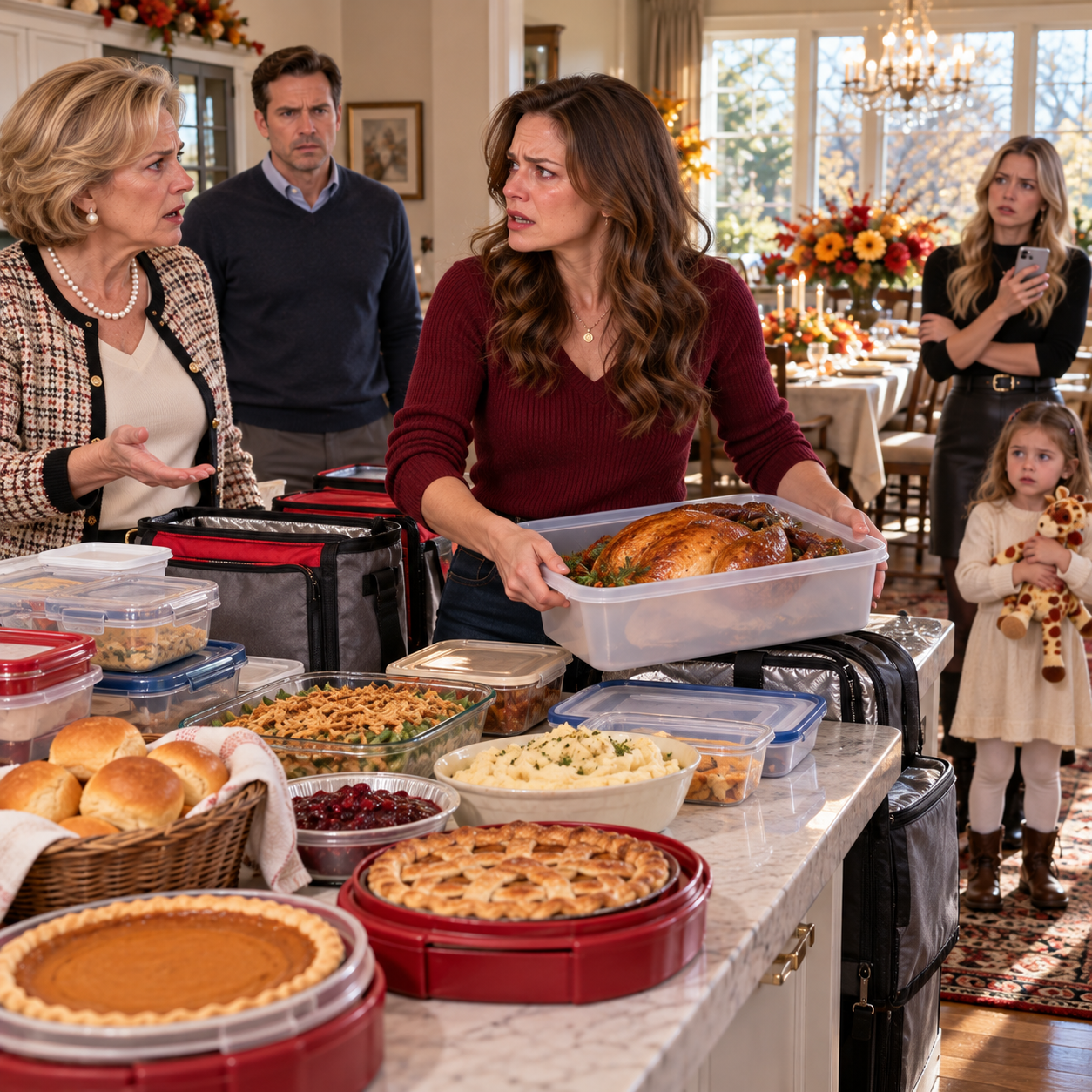
My mother was watching the Thanksgiving parade when Poppy burst through her front door. She welcomed her granddaughter with a hug, then noticed me standing behind her carrying two pies and a large food bag. She asked what had happened, but when she saw my expression, she guided us inside instead of demanding an explanation. She put the kettle on while I settled Poppy in the living room.
I told Mom about the cooking, the comparisons, and Lucas’s silence. She listened without interrupting, then asked whether I wanted to go home or stay for dinner. I admitted that I couldn’t bear taking everything back to my own kitchen and eating alone. She looked toward her small dining room and said we’d simply have to find a few more chairs.
Mom called Aunt Deb, who invited my cousin Wesley and his girlfriend. Within an hour, seven of us were finding places around a table designed for five. We reheated the food properly, set out mismatched plates, and squeezed the extra chairs between the kitchen doorway and the window. Nobody cared that the tablecloth was too short.
When Wesley tasted the apple pie, he asked whether I’d consider making one for his birthday. Aunt Deb wanted the cranberry sauce recipe, and Mom insisted the rolls were good enough to eat without butter. For the first time that day, I laughed without worrying that someone would compare my cooking to another woman’s. Poppy announced that this was her favorite Thanksgiving ever.
Later, while I was helping Mom wash dishes, headlights swept across the kitchen window. Lucas’s car pulled into the driveway, and I watched him sit behind the wheel for several seconds before getting out. When Mom opened the door, she offered him coffee and a plate of food. He accepted the coffee but barely touched it.
He asked whether we could speak privately, so we stepped onto the back porch. The November air was cold, and I folded my arms against my sweater while he leaned against the railing. Lucas said he’d been thinking about how abruptly I’d left. Then he asked why I hadn’t told him how upset I was before that afternoon.
I stared at him because I genuinely couldn’t believe the question. I reminded him of the car rides home when I’d mentioned Linda’s comparisons and the conversations when I’d asked him to stop dismissing my feelings. He looked down and admitted that he’d always believed the comments were too small to confront. I told him that repeating a small hurt for six years didn’t keep it small.
Through the window, we could see my mother laughing with Aunt Deb while Poppy danced around the dining table. Lucas watched for a while before saying that everyone seemed comfortable, even though nothing about the evening had been carefully arranged. I told him that was what I’d wanted at his parents’ house. I hadn’t needed perfect compliments, only the freedom to contribute without being evaluated.
Lucas apologized for staying silent when his mother questioned my cooking. He said he’d spent most of his life avoiding disagreements with her because she became defensive whenever anyone challenged her. I understood the habit, but I reminded him that avoiding discomfort for himself had left me to carry it instead. He nodded and said he needed to change that.
Before we could continue, his phone rang. Cassie was calling to say their father, Warren, had burned his hand while trying to prepare something for Linda after the food was gone. Uncle Mark had driven him to urgent care, where the burn had been cleaned and dressed. Warren was home again, but Lucas wanted to check on him.
I offered to go along because Warren had always been gentle with Poppy and kind to me. We left our daughter with Mom, who promised to keep her entertained until we returned. During the drive, Lucas apologized again and said he wouldn’t expect me to prepare another meal for his family. I told him I was going to see Warren, not replace the dinner I’d taken away.
The house smelled faintly of overheated butter when we arrived. Warren sat on the couch with his hand bandaged, looking embarrassed by the attention. He explained that he’d tried to make something for Linda because she hadn’t eaten much since breakfast. I checked that he’d received proper care and reminded him to follow the clinic’s instructions.
Cassie sat nearby without her phone, unusually quiet. After Lucas went to check on his father, she approached me in the kitchen and apologized for bringing up Ryan repeatedly. She said she’d grown accustomed to talking about her because Ryan had been part of their family gatherings when Cassie was younger. She admitted she hadn’t considered how it might feel to me.
I thanked her for acknowledging it, and she surprised me by confessing that she’d eaten two of my rolls before I packed them. When I reminded her that Linda had called them dense, Cassie smiled sheepishly and said they were actually delicious. We both laughed, and the tension between us eased for the first time that day. It wasn’t a complete repair, but it was a beginning.
Linda was sitting alone at the kitchen table when I returned from putting away a few dishes. She asked whether we could talk, and I sat across from her. She told me about growing up with very little money and spending years trying to make her home look impressive to people she believed were judging her. She said she’d become so focused on doing everything correctly that she often forgot how her comments sounded.
I listened, but I didn’t rush to comfort her. Linda admitted that she’d repeatedly brought up Ryan because she associated those memories with holidays when the family felt close. She hadn’t intended to make me feel unwelcome, yet she could now understand why I did. I told her that intentions mattered, but the impact of her words mattered too.
She apologized for making me feel as though I was being measured against someone from Lucas’s past. I thanked her and explained that I needed to see a lasting change before I could feel comfortable again. Linda said she understood, although I could tell the conversation wasn’t easy for her. We agreed not to pretend everything was resolved that night.
Before we left, Warren asked to speak with me. He said he’d heard some of the comparisons over the years but had convinced himself it wasn’t his place to intervene. I reminded him that he’d always been kind to me, and he answered that kindness should have included speaking up when someone at his table was uncomfortable. His apology moved me because it acknowledged something I hadn’t known how to explain.
On the drive home, Lucas reached across the console and rested his hand beside mine. He said he’d make sure I wasn’t left alone in that position again. I told him I wanted to believe him, but promises would mean little without action. He said that was fair, and we drove the rest of the way quietly.
Part 3: A Year Later We Finally Gathered Around One Table
The weeks after Thanksgiving were awkward, but something had begun to change. Linda called occasionally without offering advice about how I should run my home, and Cassie started asking about Poppy instead of bringing up Ryan. Lucas also became more willing to address comments in the moment. He wasn’t suddenly comfortable with disagreement, but he was finally recognizing when his silence left me unsupported.
For Christmas, Lucas and I invited both families to our house. Linda arrived carrying a casserole and asked where she could help, rather than inspecting what I’d prepared. After dinner, she stood beside me drying dishes while I washed them. We spoke about Poppy’s preschool, the weather, and ordinary things that didn’t require anyone to defend themselves.
In January, my mother’s furnace stopped working during a cold spell, so she stayed with us for three nights. One evening, Linda dropped by with soup and ended up sitting at the kitchen table with Mom for nearly two hours. They talked about growing up with limited money, raising children, and the habits they wished they hadn’t passed down. I heard Linda laughing from the hallway and realized I hadn’t heard that sound from her without feeling tense in a long time.
By spring, family gatherings had become easier. Not perfect, but easier in ways that mattered. If Linda began making an unnecessary comparison, she usually caught herself, and Lucas no longer waited for me to say something first. Warren began taking a more active role in planning meals, while Cassie occasionally brought desserts she’d learned to make herself.
I also changed. I stopped treating every visit as an opportunity to prove I deserved my place and began accepting that I could participate without managing everything. Sometimes I brought food, and sometimes I didn’t. When I was tired after a hospital shift, I stayed home without feeling obligated to explain.
As the next Thanksgiving approached, I decided to cook again. I wasn’t trying to recreate the previous year or prove that I could survive another difficult holiday. I simply enjoyed preparing food, and Poppy was old enough to help shape rolls and stir cranberry sauce. This time, we planned to celebrate at my mother’s house, where everyone would have room to contribute.
On Wednesday evening, while the pies cooled beside the stove, Linda called. She sounded nervous when she asked whether she could bring stuffed mushrooms to dinner. My hand paused over the cranberry sauce as she explained that she’d found the recipe Ryan’s mother used to make. For a brief moment, the old frustration returned.
Then Linda said she wanted to share the dish because it had been part of family gatherings she remembered fondly. She asked whether I’d be comfortable with that and made it clear she could bring something else if I preferred. I thought about how different the question sounded from her comments a year earlier. She was asking rather than assuming, and I told her the mushrooms would be welcome.
On Thanksgiving afternoon, my mother’s house was full of people before the turkey came out of the oven. Aunt Deb and Wesley arrived early, while Cassie brought her boyfriend and Warren carried a covered casserole into the kitchen. Lucas helped set up an extra folding table, and Poppy insisted on arranging napkins at every place. Nobody seemed bothered that the chairs didn’t match.
Linda arrived with her mushrooms in a large baking dish. She placed them on the counter and explained that she’d practiced the recipe twice because she wanted to get it right. When I tasted one, the goat cheese and herbs were perfectly balanced. I told her they were excellent, and she smiled with unmistakable relief.
Wesley asked for the recipe after trying several. Linda wrote it down on the back of an envelope, explaining how the filling worked and why the mushrooms needed to be dried before baking. I watched her speak about something she enjoyed without using it to make anyone else feel inadequate. That difference meant more to me than any compliment she could have offered.
During dinner, Poppy sat beside Warren and repeatedly asked for another honey-wheat roll. He tore one open for her, then told everyone that his granddaughter had inherited her mother’s excellent taste in food. I looked across the table at Linda, wondering whether the familiar comparison would follow. Instead, she picked up one of my rolls and said she’d been looking forward to them all week.
Cassie laughed and reminded her that she’d once questioned whether I’d let the dough rise properly. Linda shook her head, smiling at herself, and admitted she’d been far too critical. Lucas asked whether that meant the famous bakery-roll story was officially retired. Linda told him not to push his luck, and the table erupted in laughter.
I laughed too, surprised by how easy it felt. A year earlier, a conversation like that would have made me retreat into myself, uncertain whether anyone was laughing at my expense. Now everyone understood why those comparisons had been hurtful, and nobody was asking me to pretend otherwise. They could acknowledge an old mistake without repeating it.
After dinner, Linda joined me in the kitchen while we packed leftovers. She asked whether I’d like to learn the stuffed mushroom recipe before Christmas. I told her I’d enjoy making them together, and we discussed which ingredients I should buy. It felt like an ordinary conversation between two women who were becoming comfortable with each other.
Later, Lucas found me standing near the dining-room doorway, watching Poppy play with her cousins. He asked whether I was having a good Thanksgiving, and I told him I was. He slipped an arm around my shoulders and said he was glad we’d invited everyone. I leaned against him, grateful that he no longer treated keeping the peace as something I was responsible for doing alone.
The following Christmas, Linda came over to teach me how to make the mushrooms. We spent the afternoon chopping herbs, filling mushroom caps, and talking about recipes our mothers had taught us. When the family arrived, Cassie asked whether Linda had prepared the dish again. Linda pointed toward me and said I’d done most of the work while she supervised.
I caught her eye, and we both smiled. For once, hearing about Ryan’s old recipe didn’t make me feel compared with someone I could never compete against. It had become something Linda and I could share, a memory that no longer belonged exclusively to the past. What once made me feel excluded had slowly become an invitation to belong.
I still think about the Thanksgiving when I carried every dish back to my car. I remember how lonely it felt to stand in that kitchen while Lucas watched without speaking, and how frightened I was that leaving would make everything worse. But I also remember my mother’s crowded table, Warren’s honest apology, and the conversations that followed. None of those moments would have happened the same way if I’d continued pretending the comments didn’t matter.
I used to believe family harmony depended on ignoring uncomfortable things. Now I know that being honest about them can create a different kind of peace, one that doesn’t require anybody to disappear inside their own discomfort. Linda didn’t become a different person overnight, and neither did Lucas. They changed through repeated choices, just as I learned to trust those changes without forgetting why they were necessary.
That Christmas evening, Poppy sat between her grandparents eating one of the stuffed mushrooms we’d made together. She announced that it was delicious, then reached for a honey-wheat roll and declared that was delicious too. Linda laughed and told her she was lucky to have so many people who enjoyed cooking for her. Looking around the table, I realized that was what I’d wanted all along: a family where everyone had room to contribute and nobody needed to compete for a place.
The End .
All characters and events in this story are fictional, created for storytelling and entertainment purposes. Thank you sincerely for reading. Your feedback and support are invaluable and motivate me to continue sharing more stories with you.


