
### Part 2: The Lake House Revealed What My Daughter Expected From Me
The following week, I received no apology. Sarah sent two photographs of the lake property, a message about its renovated kitchen, and a reminder to bring my checkbook on Friday. I answered her practical questions but said nothing about the money. I needed to see whether either of them understood what had happened without my explaining it for the hundredth time.
The house stood beside a wooded lake, its enormous windows reflecting the gray December sky. Sarah met me in the driveway, looking relieved until she noticed I had come alone. Greg was already inside with the real estate agent, discussing the outdoor entertaining area.
“Isn’t it wonderful?” Sarah asked, linking her arm through mine. “The kids could spend entire summers here.”
“It’s beautiful,” I admitted. “But before we go any further, we need to talk about Thanksgiving.”
Her smile faded. “Mom, can we please not do this in front of the agent?”
Inside, Greg moved from room to room describing the parties he intended to host and the clients he hoped to entertain. His architecture firm had lost two major contracts that year, something Sarah had mentioned reluctantly over lunch. I understood why owning an impressive vacation property might appeal to him. What I didn’t understand was why a man worried about his career wanted another expensive mortgage.
In the basement, I noticed a long crack running diagonally across one foundation wall. The agent explained that a previous inspection had recommended further evaluation, although the sellers believed the damage was minor. Greg interrupted before she finished.
“We’ll deal with that during negotiations,” he said, turning toward me. “The important thing is getting our offer in before someone else takes it.”
I looked at Sarah. “Have you calculated what this place will cost every month, including taxes, insurance, and maintenance?”
“We’ve done the numbers,” Greg answered.
“I was asking Sarah.”
She examined the floorboards. “Greg handles most of that.”
The agent politely excused herself to make a phone call. Greg began explaining that the seller expected a substantial deposit and that they needed my contribution immediately to make the purchase possible. I listened until he finished, then told them I wouldn’t be providing the money.
Sarah stared at me. “But you promised.”
“I did,” I acknowledged. “And I should have thought more carefully before promising such a large gift. I’m sorry for putting you in a position where you counted on it.”
Greg rubbed his forehead. “Wendy, we cannot afford to start over because you’re upset about Thanksgiving.”
“This isn’t a punishment over dessert,” I said. “I’ve spent years accepting disrespect because I thought it was the price of staying close to my daughter. I’m not going to make another major financial decision under that pressure.”
Greg walked away toward the stairs. Sarah followed him after giving me a look I hadn’t seen since her teenage years, a mixture of anger and disappointment that made me feel terribly old.
I left the property and drove downtown to see Thomas, the financial adviser who had worked with Arthur and me for nearly two decades. He listened while I explained that I wanted to protect the forty thousand dollars from another impulsive promise. After reviewing my other savings and making sure I had sufficient emergency funds, he helped me place the money in a five-year certificate of deposit.
“You know there’s a penalty if you withdraw it early,” he reminded me.
“I know,” I replied. “That’s a consequence I’m prepared to accept if I ever change my mind.”
By late afternoon, I was sitting across from my son, David, at a diner near his auto repair shop. David had Arthur’s steady eyes and a habit of listening without interrupting. When I finished telling him about the house, he folded his hands around his coffee mug.
“Mom, I’m glad you’re protecting yourself,” he said. “But remember, Sarah’s still your daughter. You don’t have to let Greg spend your money, and you don’t have to stop loving her either.”
“I don’t know how to reach her anymore.”
“Maybe she has to decide to reach back.”
At five o’clock, I sent Sarah a message inviting them both to dinner at seven. They arrived precisely on time, Greg looking impatient and Sarah avoiding my eyes. I had prepared vegetable soup, warm bread, and a plate of cookies from the grocery store.
Greg barely glanced at the food. “Let’s not drag this out. We need to know whether you’re giving us the money.”
“No,” I said. “I’ve transferred it into a long-term savings certificate. I’m keeping it for my own future.”
Sarah pulled out a chair. “Mom, we planned our whole year around this.”
“I understand you’re disappointed.”
“Disappointed?” Greg repeated. “You’ve embarrassed us in front of the agent and made Sarah feel terrible. All because I said something about a pie crust.”
I put down my spoon. “You keep talking about the pies because it’s easier than acknowledging how you treat me. You criticize my home, my clothes, and nearly everything I bring into yours. Sarah watches it happen and asks me to overlook it.”
Greg looked toward my daughter, apparently expecting her to intervene. She stared at the untouched soup in front of her.
“We include you in everything,” he said. “Not every family makes that effort.”
“Inviting someone into your home isn’t the same as making them welcome.”
Sarah’s eyes filled. “Please, Mom. You know how angry Greg gets when plans fall apart.”
She looked toward him immediately, as though regretting the words. Greg pushed his chair back, announced that the conversation was pointless, and told Sarah they were leaving.
At the front door, he stopped. “Don’t expect invitations for Christmas if this is how you’re going to behave.”
I looked at Sarah, waiting for her to say whether that was truly what she wanted. She said nothing, and the absence of an answer hurt more than Greg’s threat.
“Sarah,” I said, “you still have my spare house key. I’d like it back for now.”
Her lips trembled, but she unclipped the key from the little bronze-dog keychain Arthur had given her. She placed it carefully on the hallway table and followed her husband outside.
After their car disappeared, I picked up the key and slipped it into my pocket. I had protected my savings, but the sight of Sarah walking away without looking back stayed with me long after I turned off the porch light.
### Part 3: The Money Stayed Mine While Our Family Slowly Changed
Christmas came without an invitation from Sarah. I sent presents for her children through David, with simple cards telling them I loved them, and I resisted the urge to ask whether Greg had allowed the gifts beneath their tree. Whatever disagreements existed between the adults, I didn’t want the grandchildren carrying them.
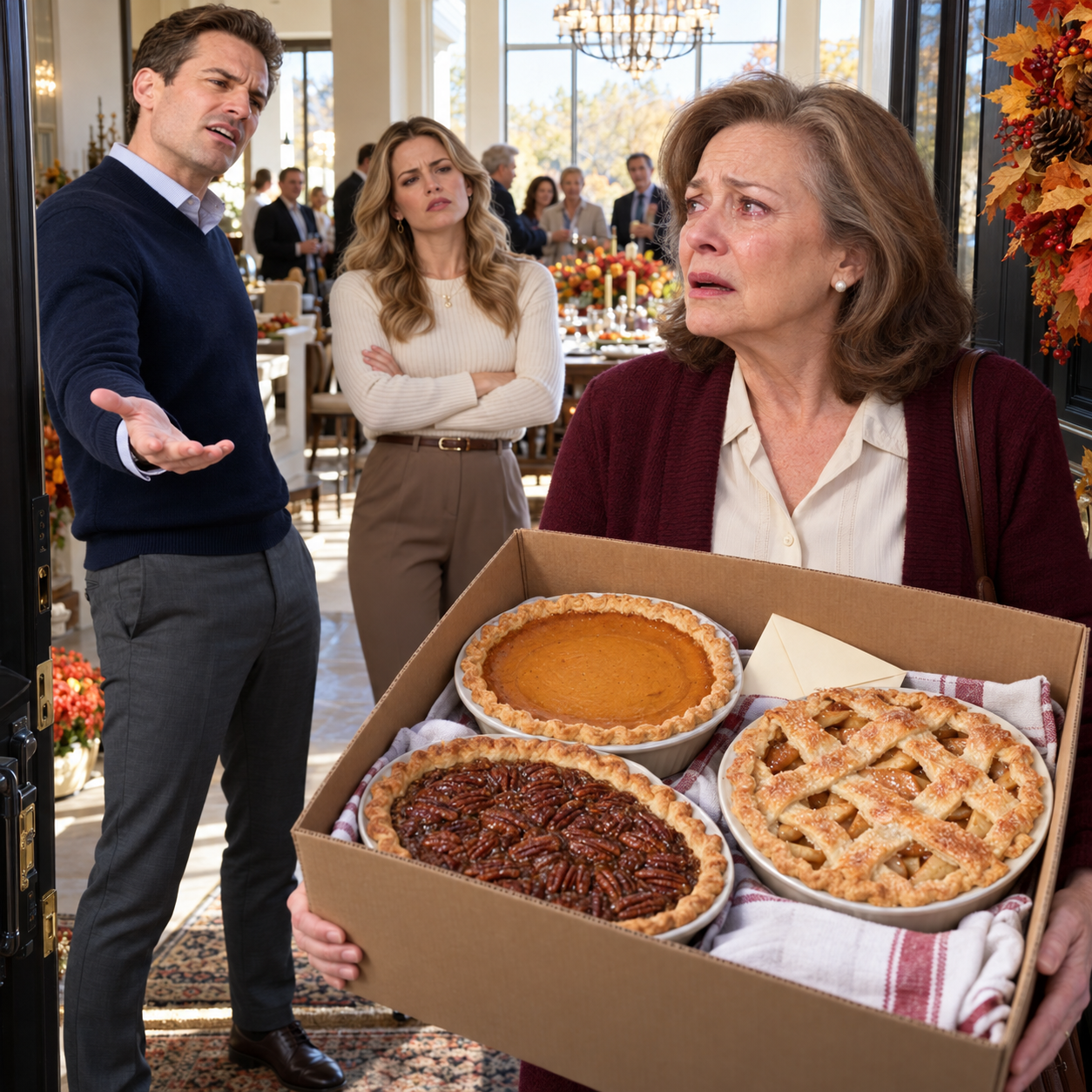
I spent Christmas Eve at David and Maria’s house, where three children argued cheerfully over board games and wrapping paper covered the living room floor. Maria asked me to make dessert, so I baked the same pumpkin, apple, and pecan pies I had carried away on Thanksgiving. David’s youngest son ate two servings of apple pie and asked whether I could teach him to make it.
“Of course,” I said, wiping cinnamon from his cheek. “Your grandfather would have loved that.”
During January and February, I began making small changes at home. I joined the library’s volunteer reading program, signed up for water aerobics, and painted my living room a warm butter-yellow. I still missed Sarah, especially when I passed the photographs of her children in the hallway, but I stopped organizing every day around the possibility of a phone call.
One Tuesday in March, I was pruning the roses beside my porch when Sarah’s SUV turned into the driveway. She stepped out wearing an old gray fleece, without makeup, her hair pulled loosely behind her head. She looked tired in a way that had little to do with sleep.
“Hi, Mom,” she said.
I set down the pruning shears. “Would you like some tea?”
Inside, she sat at the kitchen table while I filled the kettle. For several minutes, she talked about the children’s school and a broken dishwasher. Then her fingers tightened around her mug.
“We didn’t get the lake house,” she said. “Greg was furious. He said I should have convinced you to change your mind.”
“I’m sorry he blamed you.”
She gave a shaky laugh. “He blames me for everything lately. He checks the credit card statements and questions what I spend on groceries. If I disagree with him, he tells me I’m making his life harder.”
I sat across from her. “Does he frighten you, Sarah?”
She considered the question before answering. “Sometimes. He hasn’t hurt me physically. But I spend so much time making sure he’s not upset that I don’t even know what I want anymore.”
We talked for nearly an hour. She admitted that she hadn’t managed their household finances for years and didn’t know exactly how much debt they carried. When she finally asked whether she could stay with me for a while, I took her hand.
“If you feel unsafe going home, you and the children can stay here,” I told her. “But I don’t want us to repeat the old arrangement, where I solve every problem while nothing changes. We need a plan that belongs to you.”
“What kind of plan?”
“Your own access to money. Someone qualified you can talk to privately. Legal advice if you need it. And enough time to decide what you want without either Greg or me making the decision for you.”
Sarah wiped her face with a tissue. “I thought you’d just tell me to leave him.”
“I don’t know what you should do about your marriage,” I said. “I do know you’re allowed to have a voice in it.”
She didn’t move into my spare bedroom that afternoon. Instead, we spent the following week finding a counselor, reviewing her financial information, and discussing practical options. I made clear that I would help her and the children find safety whenever necessary, but the forty thousand dollars would remain untouched.
Over the next few months, Sarah started individual counseling and opened an account in her own name. Eventually, Greg agreed to attend marriage counseling, although Sarah told me their first sessions were difficult. I didn’t ask for every detail. For the first time, I understood that loving my daughter didn’t mean overseeing her marriage.
She began visiting on Sunday afternoons, sometimes with the children. Our conversations were careful at first, filled with ordinary subjects like school projects and the weather. Gradually, there were longer moments when she seemed comfortable enough to laugh.
One afternoon, while we washed coffee cups together, Sarah stopped beside the sink.
“I owe you an apology,” she said. “For Thanksgiving. You worked so hard, and I acted like you were embarrassing me.”
I turned off the faucet.
“I was worried about Greg’s reaction,” she continued. “But that doesn’t excuse how I treated you.”
“Thank you for saying that.”
She nodded, and we finished drying the dishes together. It wasn’t a perfect reconciliation, but it was the first conversation we’d had in years that didn’t require me to pretend nothing was wrong.
By July, my backyard was full of people for a summer barbecue. David stood at the grill while Maria carried bowls of potato salad to the picnic table. Thomas and his wife had stopped by, and several women from my gardening group were discussing tomatoes beneath the maple tree.
Sarah arrived with her children shortly after noon. Greg wasn’t with them, and nobody asked why. She was still working through what her marriage would become, and I had learned to respect that uncertainty.
I brought out a freshly baked cherry pie in the blue ceramic dish Arthur had bought for our twentieth anniversary. Its crust was uneven, and a little cherry filling had bubbled down one side. Before I could set it down, my grandson appeared beside me carrying a stack of paper plates.
“Grandma, did you make that yourself?”
“Every bit of it.”
“Can I have the first piece?”
I handed him a plate, and Sarah came over to help cut the slices. She looked at the old ceramic dish for a moment, then touched the edge of the crust.
“Dad always liked them when they looked like this,” she said quietly.
“He said that’s how you knew somebody had made them with care.”
Sarah smiled, and we stood together serving pie while the children ran laughing through the sprinklers.
The forty thousand dollars was still safely in my account. Greg and Sarah hadn’t bought the lake house, and our family hadn’t returned to the way it had been before Thanksgiving. Some relationships were still uncertain, and there were conversations ahead that none of us could avoid.
But when I looked around my backyard, I saw people eating from mismatched plates, moving chairs to make room for one another, and asking for second helpings without worrying how anything appeared in photographs.
I sat beside Sarah beneath the maple tree and took a bite of cherry pie. The crust was buttery, the fruit slightly tart, and the afternoon sunlight warmed my hands.
For the first time in a very long while, I wasn’t trying to earn my place at someone else’s table.
I was sitting comfortably at my own.
The End .
All characters and events in this story are fictional, created for storytelling and entertainment purposes. Thank you sincerely for reading. Your feedback and support are invaluable and motivate me to continue sharing more stories with you.


