
Part 2: A Quiet Question Forced Everyone to Acknowledge Who Owned the House
When we entered the kitchen, one of Wade’s boys slid across the floor and struck the counter with his shoulder. A drinking glass rolled toward the edge, and I caught it before it fell. “Boys, why don’t you enjoy that lovely yard?” I suggested, and Charlene reluctantly called them outside. Cecilia watched them go with an expression I recognized from patients who had finally been allowed a full night’s sleep.
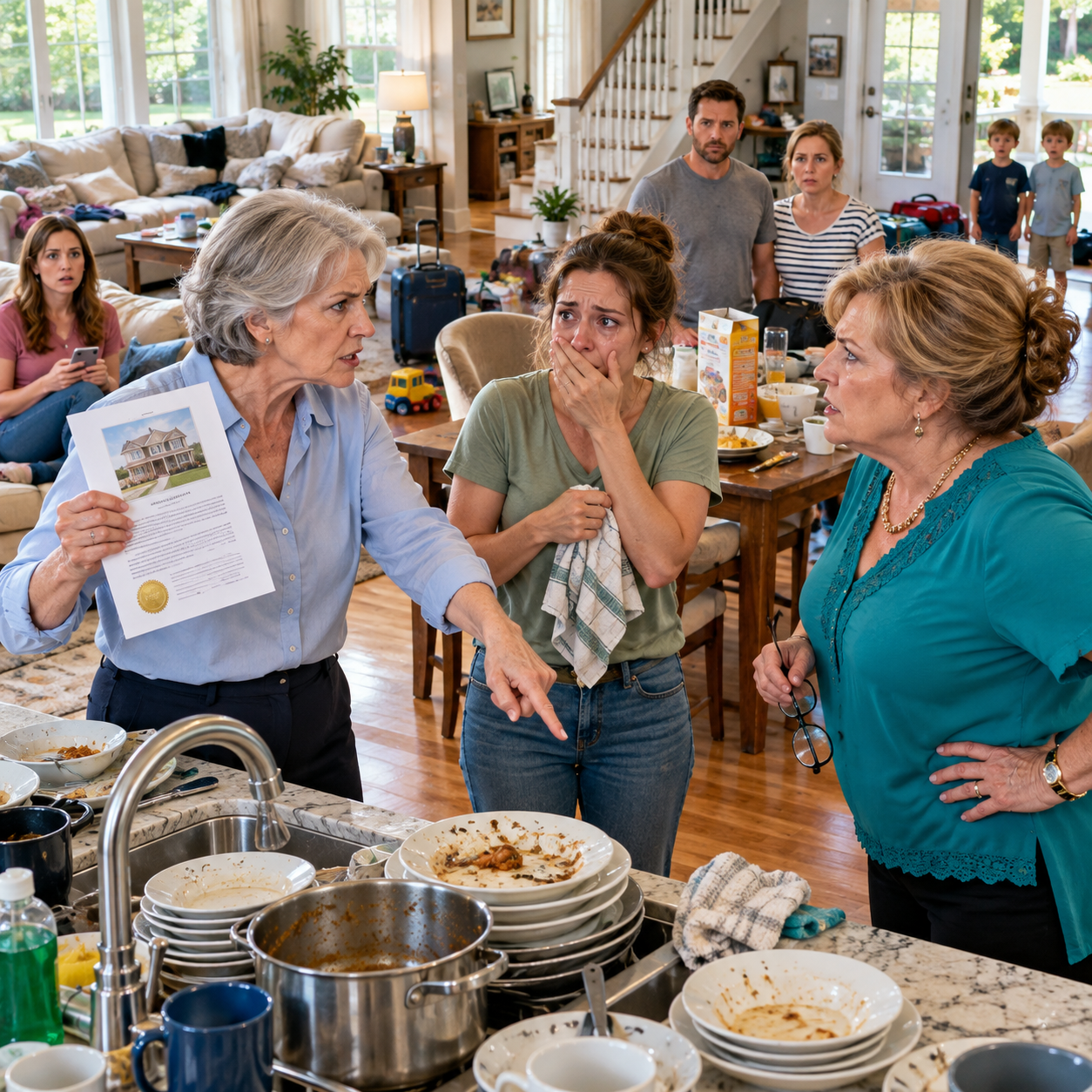
“Judith, have you finished your little walk?” Miriam asked without looking up from her magazine. “There’s fresh coffee if Cecilia hasn’t put everything away.” I thanked her and said I’d rather speak to everyone for a few minutes. Deb lowered her phone, Wade turned his chair, and Miriam removed her reading glasses with the measured patience of a woman accustomed to controlling a conversation.
“This is a beautiful property,” I began, looking around at the floors Cecilia had restored and the curtains she’d sewn herself. “Cecilia has worked hard to make it comfortable, and I understand you’ve all enjoyed being here.” Miriam smiled. “She’s been very generous. That’s what family does, Judith, especially when someone is going through a difficult time.” I nodded and asked whether everyone understood that the house belonged to Cecilia alone.
Miriam’s smile narrowed. “Well, it’s Gavin’s home too. They’re married.” I explained that the registered title was in Cecilia’s name, that I had purchased it for her before the marriage, and that no one should assume my son-in-law owned a share simply because he lived there. I wasn’t giving a lecture about every legal right spouses might have; I wanted them to understand that Cecilia’s wishes could not simply be dismissed. “Whatever Gavin may have told you,” I added, “he doesn’t get to turn her objections into an invitation to stay indefinitely.”
Deb leaned forward. “Wait, Gavin doesn’t own this place?” I shook my head, and she looked toward Cecilia with an expression that made it clear she’d been told something different. Miriam set her glasses on the arm of the chair. “I think you’re being unnecessarily technical. Families share things, and marriage means making accommodations.” I glanced toward the kitchen, where three enormous pots were soaking in the sink, and asked whether that sharing included taking turns with the cooking and cleaning.
Nobody answered immediately.
“For eighteen days,” I continued, “Cecilia has been feeding everyone, cleaning up after everyone, and buying groceries for everyone. She’s given up her bedroom, and this morning I found her crying while she washed your breakfast dishes.” Miriam’s expression hardened. “She never told me she was overwhelmed.” Cecilia looked at the floor, and Miriam added, “If she wanted help, she could have asked instead of letting you come here and embarrass us.”
My daughter reached into her pocket and took out her phone. “I did ask,” she said quietly. “Last Tuesday, I asked whether everyone could make their own breakfast. You said the boys needed a proper meal and that I was already awake.” She held the screen toward Miriam, displaying their exchange, and I watched my daughter’s thumb tremble against the edge of the case. Miriam barely glanced at it before saying, “I didn’t realize you were keeping records of our conversations.”
“She shouldn’t need records to be heard,” I replied. Miriam rose from her chair and informed me that I couldn’t enter someone else’s marriage and order people out. On that point, I agreed with her. Then I turned toward Cecilia, who was still holding her phone, and asked the only question that mattered.
“Cece, do you want them to stay?”
She looked at Deb, then at Wade and Charlene, before finally facing Miriam. The woman who had spent eighteen days apologizing for everything drew a slow breath and answered, “No. I want everyone to leave. Today, if possible.”
Deb pushed herself upright. “You’re throwing us out because your mother showed up?” Cecilia shook her head. “I’m asking you to leave because I haven’t had a peaceful morning in my own house for almost three weeks.” Wade stared at his coffee cup while Charlene began collecting the children’s things from the yard. Miriam looked at Cecilia as though she’d spoken in a language nobody had taught her.
“Gavin will be furious,” Miriam warned.
“I know,” Cecilia answered. “But I’m going to tell him myself.”
There was no shouting after that, although every closed drawer and rolling suitcase seemed unusually loud. Deb muttered about needing somewhere to recover from her breakup, and Miriam repeatedly mentioned the inconvenience of finding another place to stay. Wade carried bags to the pickup without arguing, while Charlene gathered an inflatable pool, folding chairs, and a portable fire pit they’d somehow brought for a temporary visit. I began clearing the breakfast dishes, but Cecilia stopped me and said she’d rather do them together later.
By two that afternoon, everyone was ready to leave. Miriam came down the hallway pulling a wheeled suitcase, paused beside the kitchen, and studied the dishes still stacked near the sink. “Well,” she said, “I suppose someone ought to finish those before Gavin comes home.” Cecilia didn’t move, and after several seconds Miriam looked toward the front door instead.
Wade was the last to leave. He stopped beside Cecilia, his keys dangling from one finger, and said, “For what it’s worth, you shouldn’t have had to ask so many times.” He didn’t wait for a response before joining his family outside. When his truck disappeared beyond the apple trees, Cecilia sat at the kitchen table and pressed her palms against her face.
I put the kettle on and found her favorite blue mugs hidden behind several mismatched coffee cups. We drank tea without discussing whether we’d handled everything perfectly, because I doubted either of us knew yet. At six o’clock, headlights swept across the kitchen wall as Gavin returned from watching a game with friends in Grimsby. He walked through the front door, noticed the empty living room, and asked a question that made Cecilia put down her cup.
“Where’s my mother?”
Part 3: My Son-in-Law Finally Heard What His Wife Had Been Saying
“They left,” Cecilia told him, pulling out the chair opposite hers. “I asked them to go, and Mom helped me.” Gavin looked toward me, then toward the hallway leading to the bedrooms, as if he expected to find his family hiding somewhere. “You sent everybody away while I was gone?” he asked. His voice wasn’t loud, but he spoke to me rather than to his wife.
“I didn’t send anyone anywhere,” I replied. “Cecilia made the decision.” Gavin rubbed his forehead and said his mother was already dealing with enough trouble at her condo. He’d promised her somewhere to stay until things improved, and now she was calling him repeatedly from Deb’s car. Cecilia asked him to sit down before they discussed his mother.
He remained standing for a moment, his car keys clenched in his hand. “You could’ve waited until I got home,” he said, finally lowering himself into the chair. Cecilia opened her phone and showed him the messages she’d sent over the previous two weeks. In one, she asked when his relatives were leaving; in another, she explained that she couldn’t keep buying groceries and preparing meals for everyone. His replies were still there, suggesting they discuss it later or reminding her that his family was having a difficult summer.
“I told you three times,” she said.
Gavin studied the messages without touching the screen. “I thought you were frustrated, not that you wanted them gone immediately.” Cecilia pulled a folded grocery receipt from her pocket and laid it beside the phone. “I bought groceries four times last week, Gavin. I gave your mother our bedroom. I made dinner for eight people when I had a migraine, and you told me she was only trying to feel welcome.”
He began to answer, but Cecilia continued before he could find the words. She told him about the criticism of her cooking, the constant requests, and the afternoon Miriam had complained that the garden needed weeding while Cecilia was preparing lunch. She described waking before everyone else so she could have twenty minutes alone in the kitchen, only to discover that Miriam had started getting up earlier too. When Cecilia finally mentioned crying at the sink that morning, Gavin looked toward the enormous dish rack and asked why she hadn’t told him things had become that bad.
“I did,” she said again, and this time he didn’t challenge her.
I had liked Gavin from the beginning, and I could still see the man who’d brought Cecilia flowers after her first farmers market visit and helped her build raised garden beds without being asked. But he had grown up believing his mother’s disappointment was something he needed to prevent at almost any cost. He was the son who answered every call, smoothed over every disagreement, and found ways to accommodate people until someone else carried the inconvenience. He had become so skilled at keeping Miriam comfortable that he’d stopped noticing when his wife wasn’t.
“Mom wasn’t trying to hurt you,” he eventually said.
“Neither was I when I asked her to leave,” Cecilia replied. “But you’ve been acting like her intentions matter more than what happens to me.”
Gavin looked at me. “Did you know she felt this way before today?” I explained what Cecilia had told me outside, including the grocery bills and their sleeping arrangements. He admitted he’d known about the pullout but hadn’t considered how humiliating it might feel to surrender their bedroom indefinitely. When I asked about the RV, he said he and Cecilia had only been discussing the possibility, not making a purchase, and that he’d been careless to bring it up while asking her to cover his family’s expenses.
Cecilia slid the receipt across the table. “I’m not asking you to give up your family,” she told him. “I’m asking you to remember you have a wife when they want something.” Gavin studied the total printed at the bottom, then put his keys beside it. He said he’d reimburse the groceries from his next two paychecks and take over dinner and cleanup for the following week. More importantly, he acknowledged that he’d treated her objections as something to manage rather than something to respect.
His apology wasn’t especially eloquent. He stumbled over a few words, stopped to think, and admitted he’d been afraid of hearing his mother accuse him of abandoning her. He told Cecilia that he should have been honest about the house and that he had no right to let his relatives treat her hospitality as an unlimited resource. She listened without promising everything was fine, then asked whether he would still be willing to say those things when Miriam called again.
His phone rang before he could answer.
The screen displayed his mother’s name. Gavin stared at it for several seconds, then answered on speaker when Cecilia nodded. Miriam began by asking whether he’d spoken to Judith about interfering in their marriage, but Gavin interrupted gently. “Mom, Cecilia asked me more than once to help her, and I didn’t listen. We should have agreed on the visit together, including when it would end.”
Miriam insisted she’d never intended to be a burden. Gavin told her he believed that, but intentions didn’t change the fact that Cecilia had been exhausted and unhappy. There was a long pause before Miriam said she’d discuss things with him when he’d had time to calm down. He answered that there was nothing to calm down about and that he wouldn’t discuss his wife as though she were a troublesome child.
After the call, Gavin asked Cecilia whether she wanted him to move the bedroom furniture back where it belonged. She told him the furniture hadn’t moved; they’d simply stopped sleeping there. He went to the den, carried the blankets to the laundry room, and began folding the pullout bed while Cecilia and I stood in the doorway. It was an ordinary household chore, but his willingness to do it without asking her for instructions was the first useful thing he’d offered all day.
The following weeks weren’t magically easy. Miriam stopped speaking to Cecilia and called Gavin almost every other day with updates about her condo, complaints about Deb, or minor health concerns. Sometimes Gavin slipped into his old habit of trying to solve everything, and Cecilia had to remind him that listening to his mother didn’t mean volunteering their home. They established a simple rule: overnight guests required both spouses to agree in advance, and neither would pressure the other into changing an answer.
I visited less often than I wanted to, not because Cecilia had asked me to stay away but because I remembered Miriam’s accusation that I’d taken over her marriage. I wanted Cecilia to become confident in her own decisions rather than trade one powerful voice for another. When she called to talk through disagreements, I listened and asked what she wanted instead of telling her what to do. By September, I noticed that she was no longer apologizing before giving me her opinion.
One afternoon she called with news that had nothing to do with Gavin or his mother. She’d made apple butter from the trees in her backyard and sold fourteen jars at the farmers market in Beamsville. Every jar had disappeared within an hour, and three customers had asked whether she would take orders for autumn. She sounded breathless with excitement as she described the labels she’d designed and the older gentleman who’d bought four jars for his grandchildren.
“Fourteen jars, Mom,” she repeated. “I didn’t think anyone would want them.”
I smiled into the telephone. “You’ve been making good things with those apples since the day you moved in.”
“I know,” she said. “I guess I just forgot that other people might think so too.”
Part 4: An Autumn Visit Showed Me What Giving Her Freedom Really Meant
By October, the apple trees had turned gold and rust, and Cecilia’s garden was being prepared for winter. I drove down one Friday afternoon with empty canning jars in the trunk and found Gavin stacking firewood beside the shed. He waved, wiped his hands on his jeans, and came over to carry the jars inside. There was none of the stiffness I’d felt between us after the July confrontation, though I suspected we both remembered it whenever we looked toward the driveway.
The house smelled of cinnamon, apples, and wood smoke. Cecilia had rearranged the living room so that sunlight reached the armchair beside the window, and the floors were polished enough to reflect the pale afternoon sky. Her dining table stood beneath a simple hanging light, set with real dishes and cloth napkins instead of being used as a temporary storage shelf. A small row of labeled preserves stood on the sideboard, waiting for customers who would collect them the following morning.
During dinner, Cecilia announced she was thinking about buying a secondhand chest freezer she’d found in Welland for eighty dollars. Gavin thought it was a good idea and said they could eventually consider converting the back shed into a workspace for her preserves business. “We’d have to check the zoning and food-production requirements,” he added, reaching for another serving of vegetables. Cecilia smiled because he was discussing possibilities instead of promising her what he thought she should do.
Their conversation wandered naturally from the freezer to the apple harvest, then to whether they could afford better shelving next spring. I listened to them disagree mildly about how much space Cecilia would need, and it struck me that neither seemed threatened by the other’s opinion. Gavin no longer finished her sentences, and she didn’t look toward him before making a suggestion. They sounded like two people learning to share a life rather than one person continually making room for the other’s obligations.
After dessert, Gavin’s phone rang. Miriam wanted to discuss Thanksgiving and mentioned that Deb might need somewhere to stay for a few nights if her plans fell through. Gavin glanced at Cecilia, who gave a small shake of her head, and he told his mother they weren’t hosting overnight visitors. I continued drying dishes while he listened to her objections and repeated his answer without raising his voice.
When he hung up, Cecilia said, “Thank you.” Gavin shrugged, looking slightly embarrassed. “You shouldn’t have to thank me for asking before inviting people to stay.” Then he picked up the remaining plates and carried them to the sink. I remembered him standing in that same kitchen in July, defending a household full of people who hadn’t lifted a finger, and decided his small, imperfect progress was worth more than another grand apology.
Later, Cecilia told me Miriam had finally sent her a message after nearly two months of silence. It was brief and somewhat awkward, acknowledging that the visit had lasted longer than intended and that Cecilia had been expected to do too much. There was no sweeping confession, no sudden transformation into a considerate mother-in-law. Cecilia had answered politely, saying she appreciated the message but wasn’t ready for another visit, and Miriam had responded with a simple acknowledgment.
“Are you disappointed she didn’t say more?” I asked.
“Maybe a little,” Cecilia admitted, turning a jar of apple butter between her hands. “But I don’t need her to agree with everything I say. I need her to respect it when I say no.” She put the jar down and smiled faintly. “Gavin understands that now. Most days, anyway.”
Before leaving, I walked through the garden while Cecilia checked the covers she’d placed over the last of her vegetables. She showed me a new section of fencing she’d repaired herself and a small patch where she hoped to grow strawberries the following spring. The old bench beneath the apple trees was still there, weathered but sturdy. I sat for a moment, remembering how she’d hidden her cracked hands beneath her legs on that hot July morning.
Cecilia joined me, carrying two cups of tea. “Do you ever regret buying this place?” she asked, settling beside me. I looked toward the house, knowing the line of credit would take another four years to repay and that I had postponed several comforts I’d once imagined for retirement. I told her the truth: there were months when the payments felt heavy, but I’d never wished the house belonged to anyone else.
“I used to think you gave it to me because you were afraid I couldn’t manage on my own,” she said.
“I gave it to you because you’d spent too many years being told you couldn’t.”
She watched a leaf drift into her teacup before lifting it out with two fingers. “Perry used to say I was selfish whenever I wanted something different from him. After a while, I started believing that asking for anything was selfish.” She glanced toward the kitchen window, where Gavin was putting away the dinner dishes. “When Miriam moved in, I knew I was unhappy, but I kept thinking a better wife would find a way to make everyone comfortable.”
I took her hand and turned it palm upward. The cracks around her knuckles had healed, and her skin was stained faintly brown from working with apples and cinnamon. “Being considerate doesn’t mean making yourself disappear,” I told her. Cecilia looked at our hands for a moment, then squeezed mine and said she wished she’d understood that years earlier.
I knew what she meant because I had my own history of making things easier for other people. I’d spent my working life caring for patients, comforting families, and finding solutions when someone needed help, and I’d sometimes carried that same instinct too far with my daughter. I could offer advice, money, shelter, and reassurance, but I couldn’t live her life for her. Even the gift of a house would mean very little if I treated the deed as permission to control her decisions.
When it was time to leave, Cecilia walked me to my car beneath a sky that had turned the pale silver of an Ontario autumn evening. She helped me place the empty basket in the trunk and waited while I found my keys. Then she said, “Thank you for something you probably don’t even realize you did.”
“What’s that?”
“You treated this house like it belonged to me, even when I forgot it did.”
I hugged her, feeling her cheek settle briefly against my shoulder. I told her she’d never needed my permission to protect what was hers, and she laughed softly before reminding me that she’d once asked permission to repaint her own kitchen cabinets. We both knew there was sadness beneath the joke. But she was laughing again, and I could see the porch she’d painted, the garden she’d planted, and the business she was slowly building without asking anyone whether she deserved them.
As I drove home along the QEW, I thought about Miriam and the eighteen days she’d spent occupying my daughter’s home. I didn’t hate her, and I doubted she understood fully how frightening those weeks had been for Cecilia. She was accustomed to being needed, to measuring her children’s loyalty by how much they would rearrange their lives for her. When Gavin finally stopped rearranging his marriage around her wishes, she had to face a different kind of relationship.
I also thought about the $212,000, the overtime shifts I’d worked during my nursing career, and the retirement account I’d watched shrink when I made the purchase. People sometimes asked why I hadn’t simply helped Cecilia with a down payment on a smaller place. I could have done that, and perhaps it would have been easier financially, but I’d wanted her to have one place where she wouldn’t have to negotiate her right to belong.
Fourteen months after handing her the keys, I finally understood something important about the gift I’d made. The title was legally hers from the beginning, but her confidence in using that ownership had taken longer to grow. She hadn’t needed me to fight every battle, and she certainly hadn’t needed me to choose her marriage for her. She’d needed someone to remind her that her wishes mattered, then leave enough room for her to act on them.
When I reached my apartment, I hung my spare key to Cecilia’s house on the little brass hook beside the door. I would always keep it for emergencies, just as she’d asked me to, but I knew I wouldn’t use it again without calling first. The next time I visited, I wanted her to open the door herself, smiling because she was happy to see me.
And that, more than the price of the house, was what I had always wanted to give my daughter: a home where opening the door was her choice, and closing it was her right.
The End .
All characters and events in this story are fictional, created for storytelling and entertainment purposes. Thank you sincerely for reading. Your feedback and support are invaluable and motivate me to continue sharing more stories with you.


