
## Part 2: I Packed My Suitcase And Left Without Asking Permission
In the guest room, I opened the suitcase I’d brought six weeks earlier and began folding my sweaters. I packed my toiletries, my paperback novel, and the handmade quilt I’d carried from Columbus because I wanted something familiar nearby. I didn’t rush, and I didn’t cry. After thirty-one years working in hospital emergencies, I’d learned that the most important decisions sometimes require the quietest hands.
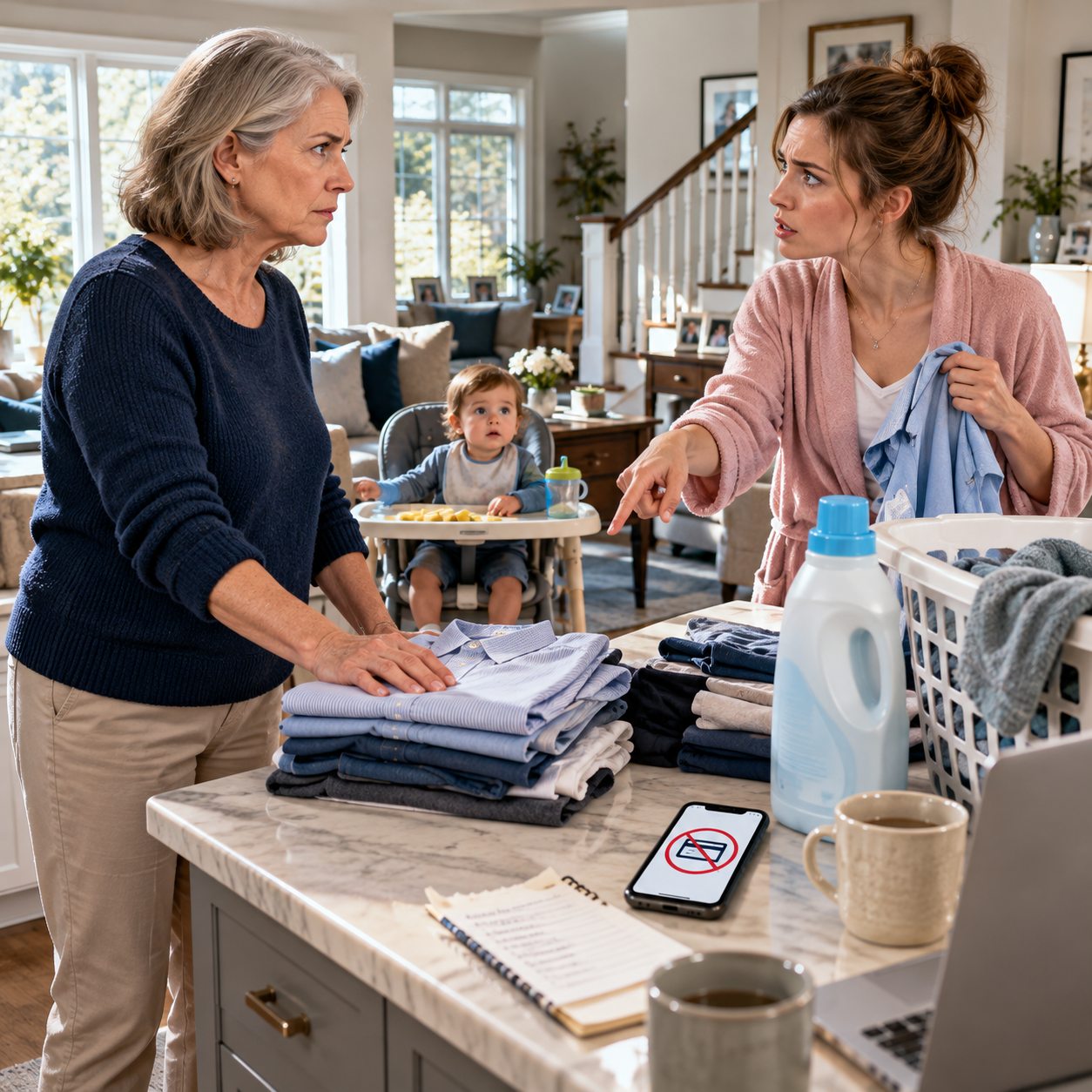
When I returned downstairs, Haley was pouring herself another cup of coffee. Finn sat safely in his high chair, happily working on a banana, while my packed suitcase rolled behind me across the kitchen tiles. Haley looked at it, then at me. “What are you doing?” she asked, her voice suddenly sharp. “I’m going home,” I replied.
“Now? Iris, you can’t leave now. Joel’s at the construction site, I have a nine o’clock meeting, and Finn hasn’t even finished breakfast.” She set down her coffee so abruptly that some spilled onto the counter. I glanced toward my grandson, who was perfectly content beneath his mother’s watchful reach. “He’s safe, Haley. And you’re his mother.”
Her expression hardened. “You’re seriously leaving because I asked you to check a detergent label? That’s incredibly selfish. We’ve been nothing but grateful to you.” I looked at the shirts still stacked beside the washing machine and wondered how many small humiliations a person could swallow before the final one became impossible. “I’m not leaving because of the detergent,” I said. “I’m leaving because you have forgotten I’m a person.”
Haley opened her mouth, but I continued before she could interrupt. “You said you didn’t want to manage me, and that’s fine. But I didn’t retire from thirty-one years of nursing to become invisible in my own son’s house.” Her eyes flickered toward the suitcase, and for the first time since I’d arrived, she appeared genuinely uncertain. “I came because I love this family,” I told her. “That doesn’t mean you own every hour of my life.”
I leaned toward Finn, kissed his warm forehead, and gently held his little cheeks between my palms. He smiled up at me with Gerald’s beautiful blue eyes, completely unaware that his grandmother was saying goodbye to something much bigger than a visit. “I love you, little man,” I whispered. Haley remained beside the island as I walked out, and the front door closed behind me with a soft, ordinary click.
The drive home took two and a half hours. By noon, I was sitting in my own kitchen eating a proper lunch, listening to the familiar hum of my refrigerator. I unpacked, made coffee, and settled into the armchair beside my living room window. For four uninterrupted chapters, nobody asked me to wash a bottle, find a missing sock, or adjust a schedule.
At 7:30 that evening, my phone rang. Joel’s name appeared on the screen, followed by a message when I didn’t answer. “Mom, Haley told me what happened. You really didn’t need to leave like that.” A few minutes later came another message, telling me Haley was upset and that we needed to discuss how I’d handled things.
Then, twelve minutes later, a different message appeared.
“Mom, did you cancel the truck payment? The lender says nothing is scheduled this month.”
I stared at the screen, feeling a strange heaviness settle behind my ribs. My son hadn’t asked whether I’d arrived safely, whether I was exhausted, or why I’d finally reached my limit. But the missing $580 had frightened him enough to notice my absence. By nine o’clock, seven additional messages had arrived, the last explaining that his payment needed to be made by the twentieth to avoid collection consequences and damage to his credit.
I turned the phone facedown and went to bed.
On Saturday morning, headlights swept across my living room window at 9:15. Joel’s expensive pickup stopped beside my curb, and both he and Haley climbed out into the cold. I opened my front door but kept the storm door locked between us. Joel glanced at Haley, then looked straight at me. “Mom, we need to understand what’s happening with the truck.”
I rested my hand on the doorframe. “Then I suppose,” I said, “you’ve finally come to ask me a question.”
## Part 3: The Missing Truck Payment Revealed What My Son Expected
Joel stood on my porch with his jaw clenched, looking like a little boy who’d been caught doing something he knew was wrong. Haley wrapped her arms around herself against the wind, her face pale and impatient. “Iris, we’re not here to argue,” she said. “But that’s almost six hundred dollars we haven’t budgeted for, and we can’t suddenly come up with it.”
“Five hundred and eighty dollars,” I corrected gently. “That’s what I’ve paid every month for fourteen months.” Joel shifted his weight, and I watched something uncomfortable move across his face. “Was there a problem with your bank?” he asked. “No, sweetheart. I canceled the transfer myself.”
The silence that followed felt heavier than an argument. Joel stared at me, then glanced toward the truck, as though the vehicle itself might provide an explanation. “Why would you do that without telling me?” he asked. I held his gaze. “Because somewhere along the way, what I gave you out of love became something you believed you were entitled to receive.”
Haley shook her head. “That’s completely unfair. We didn’t know it was going to become some big issue.” I looked from her to Joel, remembering how easily they’d laughed with Gail while I ate soup alone, how naturally they handed me grocery lists, and how rarely either of them thought to say thank you. “You had fourteen months to ask whether I could still afford that payment,” I said. “And forty-three days to make me feel welcome in your home.”
Joel rubbed a hand across his forehead. “Mom, we were overwhelmed. We needed help.” The words sounded painfully familiar, the same explanation he’d offered when he first asked me to visit. “I know you needed help, Joel. That’s why I came, and that’s why I paid for the truck when Haley was pregnant.” I swallowed against the unexpected tightness in my throat. “But needing help and treating someone like hired staff are two different things.”
Haley’s cheeks reddened. “I never treated you like staff.” I thought about the endless corrections, the grocery list, the laundry, and the evening I’d watched Gail receive the welcome I never did. “When your mother came, she was a guest,” I said. “When I came, I was a convenience. I love Finn with my whole heart, but I am still a human being outside of being his grandmother.”
Joel finally lowered his eyes. For a moment, I could almost see the young boy who used to follow Gerald around our backyard with a plastic hammer, determined to help his father fix everything. But that little boy was now a grown man with a wife, a child, and responsibilities I could no longer carry for him. “You both have jobs,” I reminded him. “You have a house, and you made the decision to buy that truck. You can make the payment without me.”
“What if we can’t?” Joel asked quietly.
“Then you’ll have to change something.”
Haley looked away, and Joel stood motionless. I could see that neither had expected an answer that didn’t include an offer to rescue them. “I love you, Joel,” I told him. “And nothing will ever change how much I love Finn. But I won’t buy the right to be treated with kindness in my own family.”
I closed the door before another argument could begin. Through the glass, I watched Joel place his hand against the back of his neck while Haley walked toward the passenger side. Neither looked angry anymore. They looked frightened by the sudden realization that a problem they’d considered permanently solved was now theirs to handle.
The following two weeks were uncomfortable. Joel eventually sent a long apology, but halfway through it, he began listing the ways he believed I’d disappointed them. I answered only the apology, telling him I appreciated it and would talk when we were both ready. Haley remained silent for three weeks before texting to ask for Finn’s allergist’s phone number, which I’d carefully saved during my stay.
I sent her the number without adding anything else. They made the truck payment themselves, although I never asked whether they used savings or rearranged their budget. I returned to my Thursday dinners with Ruth, cleared the dead plants from my garden beds, and accepted an additional Wednesday shift at the health clinic. I also bought a proper bedside lamp for my own guest room, remembering how strange it had felt to spend six weeks in a house where nobody had thought to make room for me.
Then, one Sunday evening, Joel called again. This time, he didn’t mention the truck or ask for a favor. Instead, he asked about my garden, listened while I described the clinic, and quietly admitted that he and Haley had been having difficult conversations. Just before ending the call, he turned his phone toward Finn, who was pushing a toy truck along the living room baseboard.
My grandson looked up, recognized my face, and waved his entire little arm. “Bah!” he shouted happily, making my eyes sting. I waved back and whispered, “Hello, my darling.” After the call ended, I sat with the phone resting in my lap, missing him so fiercely it hurt.
But I didn’t call Joel back to offer another six weeks.
Love had brought me into their house. Love, I was beginning to understand, could also require me to stay away.
## Part 4: My Son Finally Confessed The Truth Behind His Dependence
Eight weeks after I walked out of Joel’s house, he called on a Thursday evening and asked whether he and Haley could visit that Sunday. “Just for lunch, Mom,” he said. “We’d like to bring Finn, if that’s okay.” I almost asked what they needed before catching myself. “I’d love to see you,” I replied, “but Joel, I can’t take on another childcare arrangement.” He answered immediately. “That’s not why we’re coming.”
They arrived shortly after noon, carrying a small overnight bag for Finn’s supplies and a covered dish Haley had prepared. I stood in my doorway watching my grandson reach both arms toward me, his face lighting up as though our eight weeks apart had been no more than a long afternoon. I lifted him into my arms and breathed in the familiar smell of baby shampoo. Behind him, Haley watched quietly, holding the dish with both hands.
We ate lunch at my kitchen table. Haley complimented the quilt draped across my chair, and Joel asked whether the health clinic had hired another nurse. Nobody mentioned grocery lists or laundry, and when Finn spilled water beside his plate, Joel fetched a towel and cleaned it himself. It was such a small thing, but I noticed.
After lunch, Joel placed an envelope on the table. “Mom, there’s something I need to tell you about the truck.” I felt my stomach tighten, expecting another request for money. Instead, he slid a receipt toward me, showing that he’d traded in the expensive pickup and purchased a less costly used vehicle. “We made the payment you canceled,” he said. “Then we sat down and looked at our finances. We couldn’t justify keeping it.”
I stared at the paperwork. For fourteen months, I’d helped protect a truck that had become more important to my son than admitting he couldn’t comfortably afford it. “That must have been a difficult decision,” I said. Joel nodded, but he didn’t look away. “It wasn’t the truck that was hardest to give up, Mom. It was admitting I’d been letting you carry something that belonged to me.”
Then Haley said something I hadn’t expected.
“I didn’t know how long you’d been paying for it.”
I looked toward her. She lowered her eyes briefly before continuing. “I knew you helped when I was pregnant. Joel told me you’d offered to cover a payment while things were tight, but I didn’t realize it kept happening every month.” Her voice wavered, and she glanced at her husband. “When the lender sent that notice, I finally understood how much money we’d been relying on without talking about it.”
Joel nodded. “I knew it wasn’t just one payment,” he admitted. “I told myself I’d take it over the next month, then the next. Eventually, I stopped thinking about it.” He pressed his palms against the table. “I let Haley believe our finances were more comfortable than they were, and I let you keep making up the difference.”
That was the revelation I’d never expected. For weeks, I’d directed most of my anger toward Haley because hers had been the voice correcting me in the kitchen. But my son had quietly allowed two women to live with different understandings of the same financial arrangement, and neither of us had realized how much responsibility he was avoiding.
“Why didn’t you tell me?” I asked him.
Joel looked at Finn, who was stacking colorful blocks on the living room rug. “Because I was ashamed,” he said. “Dad would’ve expected me to handle my own bills, and I didn’t want you thinking I couldn’t provide for my family.” His voice cracked slightly. “But instead of being honest, I made you pay for my pride.”
I looked down at the receipt, remembering Gerald teaching Joel to change a tire in our driveway when he was sixteen. Gerald had always said that asking for help was nothing to be ashamed of, but pretending you didn’t need it could cost you more than money. I wished he could have been sitting beside me that afternoon. Perhaps Joel wished the same thing, because he reached across the table and touched my hand.
Haley cleared her throat. “And I owe you an apology too, Iris. Not because of the truck. Because of how I treated you.” She glanced toward the kitchen counter, where I’d set our lunch dishes. “I was exhausted, and I kept acting like every mistake you made was another problem for me to solve. You were watching my son, keeping my house running, and giving up your own life. I didn’t even make you feel welcome.”
I hadn’t realized how desperately I’d wanted to hear those words until my eyes filled with tears. Haley wasn’t making excuses this time, and Joel wasn’t interrupting to defend her. I wiped my cheek with the corner of a napkin and took a moment before answering. “I never expected perfection,” I told them. “I just wanted you to remember that I was there because I loved you.”
Joel reached into the envelope again and withdrew a smaller piece of paper. It was a check for $580. “This doesn’t repay everything you’ve done, Mom,” he said. “But it’s the first payment I want to give back to you. We’ll work out the rest over time.”
I held the check without speaking. The money mattered, especially now that I understood how completely he’d taken it for granted, but the more important thing was that he’d made a decision without asking me to make it for him. “Thank you,” I said. “And I need you both to understand something. I want to be Finn’s grandmother, not your permanent childcare solution.”
Haley nodded. “We found a temporary licensed childcare arrangement while we wait for the daycare opening. We’re handling his appointments ourselves.” She hesitated, then added, “And when you visit, I want you to actually be our guest.” I smiled faintly. “That would be nice.”
We didn’t repair everything that afternoon. Forty-three days of resentment couldn’t be erased by a lunch, a check, or a few apologies. But when Finn climbed into my lap with one of his toy trucks, nobody asked me to clear the table or wash the dishes. Joel and Haley carried their plates to the sink together, leaving me by the window with my grandson tucked against my chest.
Before they left, Haley paused beside the entryway table. “Iris, next time we’d love to have you over for dinner. Just dinner. You won’t have to do anything.”
I looked at Joel, who was fastening Finn into his car seat, and then back at her. “I’d like that,” I said. “As long as I can bring dessert.”
Haley smiled, genuinely this time. “Only if you want to.”
After they drove away, I returned to the kitchen and washed my coffee cup. The envelope rested beside the lavender diffuser I’d bought for myself, and sunlight stretched across the floor where Finn had played. I still had my house, my friends, my clinic, and the life I’d worked so hard to rebuild after Gerald died.
I also had something I hadn’t possessed eight weeks earlier: the beginnings of a relationship with my son in which I didn’t have to disappear to prove that I loved him.
I remembered the stack of laundry I’d left on Haley’s counter, the shirts folded neatly despite everything I’d been feeling. Once, I would have finished the entire load before leaving, afraid that stopping would make me a bad mother. Now I understood that my son had needed to learn how to finish some things himself.
I switched off the kitchen light and walked into my quiet living room.
For the first time in years, I wasn’t wondering what more I needed to give.
I was simply looking forward to seeing my family again.
THE END.
All characters and events in this story are fictional, created for storytelling and entertainment purposes. Thank you sincerely for reading. Your feedback and support are invaluable and motivate me to continue sharing more stories with you.


