
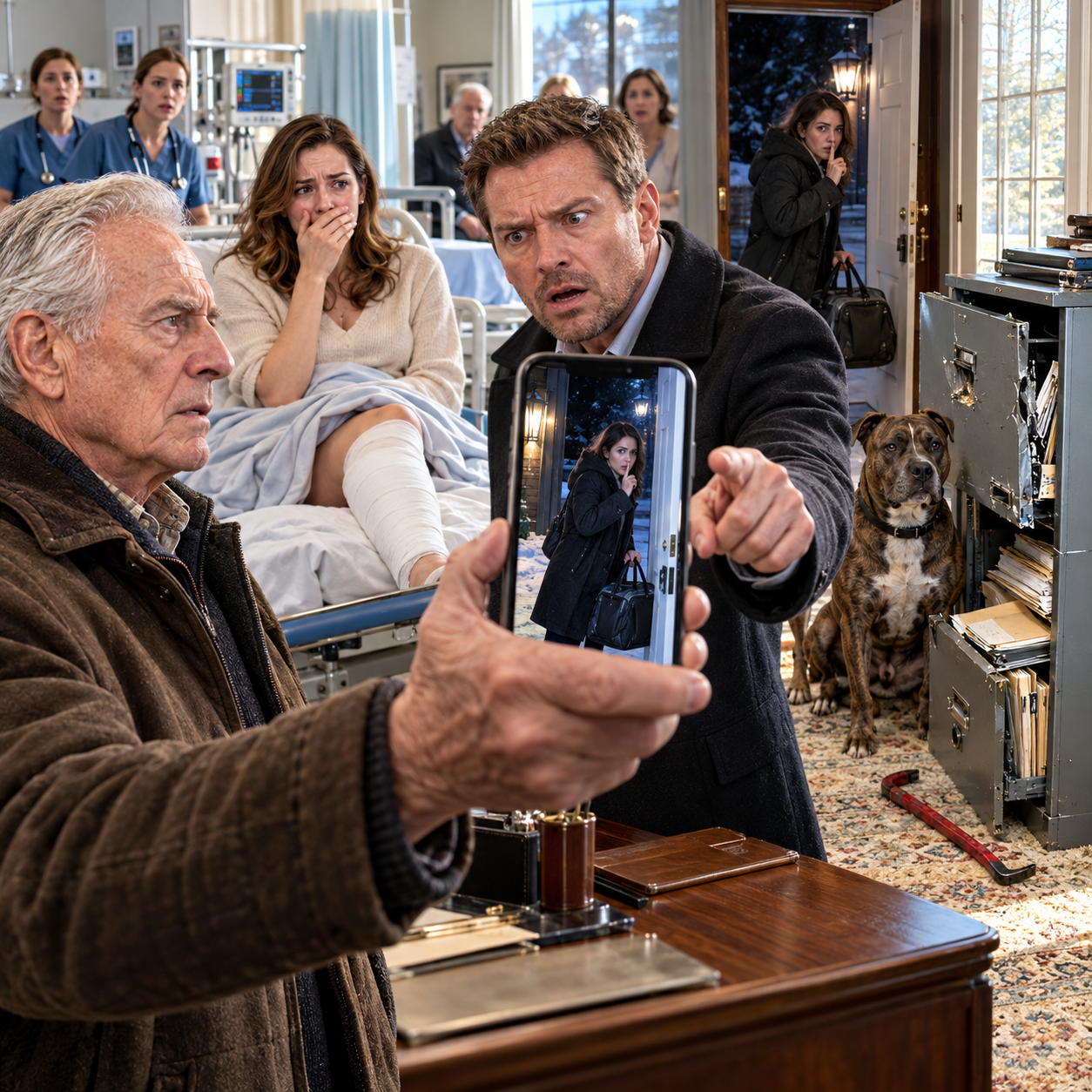
## Part 2: A Poisoned Pill Bottle Revealed the Plot Against My Independence
I closed the den door and stood perfectly still.
In thirty-eight years of accident investigations, I’d learned that the most revealing evidence was often something people forgot to disturb.
The thermostat was exactly where I’d left it. The furnace hummed steadily. Joan’s piano stood beneath the living room window, untouched, with a thin layer of dust across its polished lid.
I checked the utility company’s outage records.
Nothing.
No power failure in our neighborhood. No interruption anywhere near our street.
The weather advisory Jenna had mentioned had expired before she entered my house.
I opened the security system’s history. At 2:51 a.m., someone had disarmed the alarm using Tyler’s emergency code.
My son hadn’t just known his wife was there.
He’d given her the means to enter.
I sat down, and Moose rested his chin on my knee.
For a moment, I wanted to drive straight back to the hospital and demand answers. But I could already hear Tyler’s response.
Dad’s confused again. He’s imagining things. Look what his dog did to Jenna.
Worse, I knew how convincing he could sound.
So I made another decision.
I drove Moose to Glenn Nelson’s acreage outside Okotoks. Glenn took one look at my face and quietly opened his gate.
“How long do you need me to keep him?”
“Until I know he’s safe.”
Glenn rested a hand on Moose’s broad shoulders.
“Then he’s staying with me.”
From there, I drove downtown to see my lawyer, Paula Edwards.
Paula was fifty-nine, blunt, fiercely intelligent, and completely unimpressed by expensive suits or sentimental excuses.
She watched the camera footage twice. Then she examined my notebook, the damaged cabinet photographs, and the evidence I’d brought from home.
When she reached the entries about my missing glasses and rearranged medication, her expression hardened.
“Russell, have you been taking those pills?”
“Of course. They’re prescribed.”
“Then we’re going to have them examined.”
She leaned back and studied me.
“Tell me something. Does Tyler still believe he has your enduring power of attorney?”
I nodded.
In 2019, I’d signed documents naming Tyler to act for me if I became incapable of managing my affairs.
But two months earlier, frightened by the strange incidents at home, I’d quietly returned to Paula and revoked that authority. I’d appointed an independent professional instead.
Tyler knew nothing about the change.
Paula tapped the desk.
“Your house is worth more than two million dollars. If they can make people believe you’ve lost your capacity, they may be trying to get control of it.”
The words made the room seem smaller.
I’d bought that house with Joan in 1989. We’d spent decades paying the mortgage, planting trees, replacing windows, and arguing over paint colors.
Now someone wanted to turn all those years into a transaction.
Paula contacted Sergeant Corey Myers of the Calgary Police Service’s elder abuse investigators.
He listened without interrupting. He examined the footage, then asked who had access to my medication, who knew where I kept my legal papers, and whether Tyler had ever requested money.
Two days later, he called me back.
“Mr. Gray, we have a serious problem.”
Testing had found that some of my blood pressure capsules contained zopiclone, a prescription sleeping medication that wasn’t supposed to be there.
About a third of the capsules had been tampered with.
I gripped the edge of my kitchen counter.
For months, I’d been waking up foggy, forgetting conversations, losing entire stretches of the morning.
I’d begun wondering whether my mind was failing.
Someone had been helping that happen.
“There’s more,” Myers said.
Tyler’s construction business, Miller Builders, was drowning. It owed approximately $310,000 in unpaid tax obligations, and a supplier had obtained a judgment against it.
Jenna had accumulated roughly $140,000 in credit-line debt.
Together, they were facing a financial disaster.
And my paid-off house represented the escape they couldn’t afford themselves.
That evening, Tyler texted me.
Dad, we’ve arranged for Dr. Owens to come Thursday at ten. Just a simple home assessment. Jenna and I think it’s time we discussed your future. Love you.
Dr. Brian Owens.
I remembered him from a clinic visit in January. Jenna had taken me there for a flu shot, and he’d asked several strange questions about my memory.
At the time, I’d thought he was being thorough.
Now I remembered how frequently he’d looked toward Jenna before writing in his notes.
I forwarded the message to Sergeant Myers.
His response came immediately.
Don’t cancel.
When we met the following morning, he laid out the possibility of documenting what happened at that appointment with police present and recording equipment installed under proper authorization.
“Your son may believe that old power of attorney is still valid,” he said. “If he tries to use a false medical finding to take your property, we need to see exactly what he does.”
I stared at the tabletop.
“You want me to let him think I’m losing my mind?”
“Only if you’re willing.”
I thought about Tyler at twelve years old, asleep against my shoulder after a long day fishing.
Then I thought about Joan, who had trusted me to protect the home we’d built.
“I’ll do it.”
On Tuesday evening, Jenna appeared carrying a pot of chicken soup.
She wore a soft smile and the same perfume Joan used to compliment.
“Russ, sweetheart, you look exhausted.”
“I haven’t been sleeping well,” I answered.
She placed the soup on the stove.
While I sat in the living room pretending to struggle with the television remote, the kitchen camera recorded her opening my medication bottle.
From her purse, she produced a small brown vial.
Carefully, she began altering the capsules.
She didn’t know investigators had already replaced my medication with safe substitutes.
She didn’t know they were watching.
When she finished, she brought me a steaming bowl of soup and kissed my forehead.
“Eat up, Russell. You’ll feel better soon.”
I looked into her smiling face.
For nine years, I’d treated that woman like a daughter.
Now I understood that her kindness had been part of the trap.
And Thursday morning, I would find out how far my own son was willing to go.
## Part 3: A Fake Medical Examination Exposed My Son’s Ultimate Betrayal
Thursday arrived bright and bitterly cold.
By eight o’clock, Sergeant Myers had officers positioned inside my basement and garage. More waited in an unmarked vehicle outside. Paula arrived through the back entrance shortly after nine-thirty, carrying her briefcase.
The hidden recording equipment was running.
I sat at the dining room table with Joan’s photograph directly across from me.
At 9:50, the doorbell rang.
Tyler entered first, followed by Jenna and Dr. Owens.
Jenna wore a navy cardigan and walked with a slight limp. The injury was real, though she seemed determined to remind everyone of it.
“Morning, Dad.” Tyler squeezed my shoulder. “We’re going to get everything sorted today.”
Dr. Owens barely met my eyes.
They seated me beneath the dining room chandelier. Tyler remained standing behind the doctor’s chair while Jenna hovered at my side.
“What year is it, Russell?” Owens asked.
I answered slowly.
“Can you tell me who’s currently serving as prime minister?”
I hesitated before replying.
Then he handed me a sheet of paper.
“Please draw a clock showing ten past eleven.”
I deliberately crowded the numbers toward one side.
Owens stared at my drawing.
His pen hovered above the form.
“I’m not sure this is sufficient,” he murmured.
Tyler leaned forward.
“Doctor, you’ve heard what Jenna’s been saying. Dad’s been confused for months. He’s leaving burners on, losing medication. We can’t keep pretending everything’s fine.”
Jenna placed a thick white envelope beside the doctor’s coffee cup.
“Perhaps this will help with your time and trouble.”
Dr. Owens looked at her.
Then at the envelope.
After several seconds, he opened his medical bag, removed a form, signed it, and pressed his stamp against the paper.
Tyler practically snatched it from his hand.
A certificate declaring me incapable of managing my affairs.
“Good,” my son whispered.
He opened the large brown folder he’d brought.
First came the old power of attorney from 2019.
Then a real estate listing agreement for my house.
Finally, a bank application for a home equity line of credit, already filled out.
I stared at the papers.
Tyler had placed the price of my entire life on the table.
“Dad,” he said, suddenly gentle, “we’re taking care of everything. You won’t have to worry about bills or the house anymore. We’ll handle it.”
Jenna rested her hand on my shoulder.
“You’re going to be much happier once someone else makes the difficult decisions.”
I looked at her fingers against my sweater.
Then I lifted my eyes to Tyler.
“Before you do anything else,” I said, “there’s somebody I’d like you to meet.”
The pantry door opened.
Paula Edwards walked into the dining room, set her briefcase beside my chair, and faced my son.
“Good morning, Tyler.”
He froze.
“Paula? What are you doing here?”
“Representing your father. The power of attorney you’re holding was revoked on December twelfth. It has no legal authority.”
Tyler stared at the document.
“No. That’s impossible.”
“Your father made that decision while fully capable of managing his affairs. And we have serious questions about the medical certificate you just obtained.”
Jenna’s hand slid off my shoulder.
Dr. Owens began gathering his things.
Then the basement door opened.
Sergeant Myers climbed the stairs with four officers behind him.
“Nobody leave the room, please.”
The doctor stopped moving.
Myers identified himself and indicated the recording equipment.
“We’ve documented what happened here.”
Jenna’s face changed first.
The tears vanished.
“It was Tyler!” she shouted. “He planned everything! The pills, the doctor, the house! I just did what he told me!”
Tyler turned on her.
“You bought those pills! You found Owens! You’re the one who said Dad would never notice!”
He stopped mid-sentence.
The silence afterward was terrible.
Myers glanced at the recorder.
“You can both continue explaining when we’ve advised you of your rights.”
Jenna sank into a chair.
Tyler stood motionless, staring at the forms spread across my dining room table.
The officers separated them and escorted them outside.
Through the window, I saw Peggy standing on her front steps with her arms folded. Other neighbors watched silently as my son was placed in a police vehicle.
Tyler looked back once.
Our eyes met through the glass.
There was no apology on his face.
Only disbelief that his father had outwitted him.
I turned toward Joan’s photograph.
“I kept the house,” I whispered.
But as the police cars pulled away, I understood something more painful.
I’d saved my home by proving that my son had tried to steal it.
And no amount of evidence could give me back the man I’d believed I’d raised.
## Part 4: Justice Finally Came, But Forgiveness Required One Last Difficult Choice
The criminal investigation continued for months.
Investigators recovered messages, financial records, and correspondence that confirmed Tyler and Jenna had planned to portray me as incapable of managing my own affairs.
The damaged cabinet, tampered medication, overnight security footage, and recorded medical examination all became evidence.
When the case finally reached sentencing, I sat in the courtroom with Paula beside me.
Jenna received seven years in prison.
Tyler received five.
Dr. Owens was sentenced to three years and lost his medical license.
Miller Builders collapsed under its debts and tax obligations. The bank eventually took the house Tyler and Jenna had called home.
I watched my son stand before the judge, his shoulders rounded beneath a suit that suddenly seemed too large.
The judge spoke about the cruelty of exploiting an elderly parent’s trust.
Then she looked directly at me.
“Mr. Gray, the patience you demonstrated under these circumstances was extraordinary.”
I lowered my eyes.
I hadn’t felt extraordinary.
I’d felt frightened, betrayed, and terribly alone.
But one piece of news made me smile for the first time in months.
Animal Services closed its investigation into Moose.
Their written findings concluded that his response to an unauthorized late-night intrusion did not justify declaring him dangerous.
I framed that letter and hung it beside Joan’s photograph.
The dog Tyler wanted destroyed had helped protect the documents they were trying to steal.
Before sentencing, in March, I visited Tyler at the Calgary Remand Centre.
He sat behind the glass, thinner than I remembered, his hands folded tightly together.
For several minutes, neither of us spoke.
Finally, he picked up the telephone.
“I’m your son, Dad.”
“I know.”
His eyes filled.
“Don’t you believe I was desperate?”
“Yes, Tyler. I believe you were desperate.”
“Then you understand why—”
“No.”
He stopped.
I leaned closer to the glass.
“For thirty-eight years, I investigated accidents. People always wanted to know which single mistake caused everything to fall apart.”
I swallowed.
“But there was never just one mistake. There was a chain of decisions. And usually, someone had a chance to stop it.”
Tyler looked down.
“You had hundreds of chances,” I said. “Every time you called to tell me I was confused. Every time Jenna touched my pills. Every time you looked at my house and saw money instead of memories.”
His lips trembled.
“Can you forgive me?”
I held the telephone for another moment.
“I’m not here to punish you, Tyler. The court has handled that. And I’m not carrying hatred around for whatever years I have left.”
I paused.
“But you’ll never have a key to my house again.”
Then I put down the receiver and walked away.
The hardest part came afterward.
Avery had gone to live with Jenna’s mother, Karen Robinson, a retired teacher in Airdrie who’d known nothing about the scheme.
Karen and I met at a Tim Hortons on a gray Saturday morning.
She cried into her coffee.
“I’m so sorry, Russell.”
“You didn’t do this,” I told her. “And Avery didn’t either.”
We agreed that whatever our children had destroyed, we wouldn’t let it destroy our granddaughter’s childhood.
Now, every second Sunday, Karen brings Avery to my house.
Moose waits by the door, wagging his tail so hard his whole body sways.
Avery sits on the living room carpet and decorates his toenails with washable markers. Sometimes she asks about her parents. I answer honestly, gently, without making her carry the weight of their choices.
Last Sunday, she looked up at me.
“Grandpa, does Moose still guard your special room?”
“Sometimes, sweetheart.”
“Does he have to?”
I glanced toward the den.
“No,” I said. “Not the way he used to.”
I changed every lock after the arrests. The old spare key still rests beneath a brass paperweight on my desk.
A three-dollar piece of metal had nearly cost me my home, my independence, and my peace.
But it taught me something I’d spent seventy-two years learning.
Love does not require you to surrender your boundaries. And family does not earn the right to hurt you simply because you share a name.
That evening, after Avery went home, I closed the den door.
“Watch the room,” I said softly.
Moose settled onto the carpet, his chin resting on his paws.
For a moment, I watched him.
Then I opened the door again.
“Come on, old boy.”
He followed me inside, settled beside my chair, and sighed as I switched on the reading lamp.
Outside, snow drifted quietly across the garden Joan had planted.
Inside, the house was warm.
Everything important was exactly where it belonged.
And for the first time in a very long while, nobody was coming through my front door unless I invited them.
THE END.
All characters and events in this story are fictional, created for storytelling and entertainment purposes. Thank you sincerely for reading. Your feedback and support are invaluable and motivate me to continue sharing more stories with you.


