I grabbed the military radio before the desk sergeant could stop me and spoke a single word into the microphone. Four soldiers were lost somewhere in a deadly ice storm. The sergeant threatened to have me removed. Then a trembling voice came through the static, asking a question nobody in that room expected.
## Part 1: One forbidden radio command awakens a secret buried fifteen years.
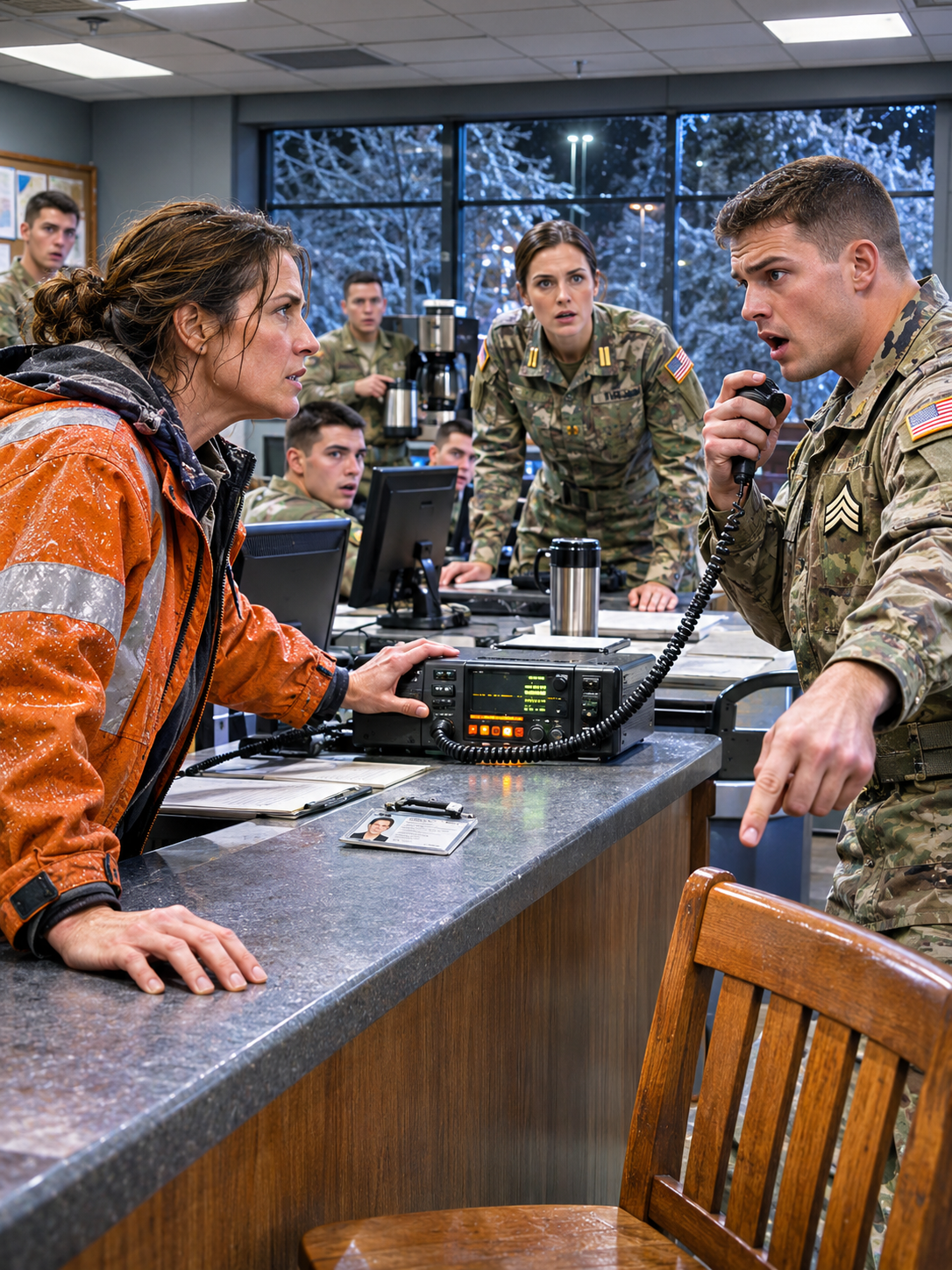
“Retirees don’t touch the radio, ma’am.” Sergeant LaCosse delivered those words without raising his voice, his hand wrapped tightly around the microphone. It was 3:00 a.m. on February 11, 2026, inside the military police station at Fort Drum, New York, and freezing rain had been coating the installation in ice for nine straight hours. I stood across the counter in a dripping public works parka, watching a young man struggle to reach four soldiers who had disappeared beyond the training ranges.
My name is Dana Holcomb, and I was forty-three years old. I had retired from the Army as a sergeant first class in November 2022, after twenty years of service, and spent the next three winters driving a snowplow. That night, I had come to report a power line lying across Range Road, throwing blue sparks against the frozen pavement. I hadn’t intended to stay longer than five minutes.
But the radio kept hissing.
“How long have they been missing?” I asked. LaCosse glanced at the two specialists working behind him, then back at me. “Their truck left the trail around midnight,” he answered. “They started walking toward a road, lost their GPS, and stopped answering our calls.”
“Are they still walking?”
“As far as we know.”
“Then you need to stop them.”
His jaw tightened. Behind him, a corporal named Diggs lowered his telephone, while a private beside the coffee maker stopped pouring. At the back of the office, First Lieutenant Brooks was speaking urgently into another phone. Nobody had slept, and everybody looked frightened enough to resent anyone who noticed.
“Ma’am, we have a search team waiting, fifty miles of range roads, and no confirmed position,” LaCosse said. “Please sit down. Retirees don’t touch the radio.”
A nervous laugh escaped the corporal.
I watched the transmission indicator flicker. Somewhere beyond the station walls, somebody was repeatedly pressing a microphone without speaking. I had heard that particular pattern before: a frightened person holding on to the one object that still connected him to the world, afraid to release it even long enough to listen.
LaCosse set the handset down and rubbed his eyes.
I reached across the counter.
“Ma’am, don’t—”
I pressed the button.
“Stop.”
One word. Nothing more.
The steady hiss disappeared.
LaCosse took the microphone from my hand, his face darkening. “You have absolutely no authority to transmit on this frequency.”
I stared at the silent radio. Ten seconds passed, then fifteen. The specialists resumed typing, and Diggs gave another uncomfortable chuckle.
Then a voice broke through.
“Ma’am?”
The entire room went still.
“Ma’am, is that really you?”
LaCosse lifted the handset. “Identify yourself, over.”
The voice ignored him.
“Were you the radio operator in Kunar?”
My fingers went cold inside my gloves.
Fifteen years collapsed into a single instant. I could smell a plywood operations room, feel a grease pencil beneath my fingers, and hear men struggling to breathe in mountain snow.
Lieutenant Brooks put down her telephone.
“Sergeant,” she demanded, “what exactly is happening?”
Before LaCosse could answer, the radio clicked again.
“Desk, this is Staff Sergeant Petrakis. All four personnel have halted movement. We’re together. Request the woman who just transmitted.”
LaCosse stared at me.
“You know this man?”
“I think I do.”
“Who are you?”
“Dana Holcomb. Retired Army.”
“I can see that.” His voice sharpened. “You just interfered with an active emergency operation. Sit on that bench until I decide what to do with you.”
I looked toward the wooden bench beneath the station bulletin board. Years earlier, I might have argued, produced my retirement paperwork, or demanded to speak with his commander. Instead, I sat down, folded my wet gloves in my lap, and listened.
LaCosse keyed the radio.
“Team leader, disregard previous instruction. Continue toward the road.”
“Negative, Desk.”
“That is a direct order.”
“With respect, Sergeant, we’ve been lost in weather before. We’re not moving until we talk to her.”
The young sergeant’s face drained.
Through the speaker came four men’s breathing, faint but unmistakable.
I recognized Petrakis now, although his voice had changed since the last time I’d heard it. He had been nineteen years old when we first met over a military radio. Back then, he had been standing on an Afghan mountain with thirty-one other soldiers, trapped in snow so thick they couldn’t see their own footprints.
And the last time an officer ordered those men to keep walking, one of them never came home.
I pressed my palms against the wooden bench.
Not again.
## Part 2: A forgotten mountain tragedy reveals the power of stopping.
Fifteen years earlier, on February 9, 2011, I was a staff sergeant serving as the night operations NCO for an infantry battalion in Afghanistan’s Kunar Province. Our operations center occupied a former schoolhouse, with plywood partitions, battered radios, and maps sealed beneath cloudy plastic. Captain Rick Del Monte commanded the night shift, and he liked to remind me that my responsibility was to pass along his instructions. “Holcomb, you’re the radio,” he would say, pointing toward the equipment as though I were another piece of it.
That evening, Lieutenant Sean Gallo’s platoon was stranded high above a remote valley when a violent snowstorm grounded the helicopters scheduled to retrieve them. Thirty-two soldiers started descending toward an outpost roughly four kilometers away, following a narrow mountain trail. Within an hour, the trail disappeared beneath fresh snow, and their radio operator began transmitting increasingly confused position reports. Captain Del Monte circled possible locations on his map, but nothing the platoon described matched the terrain.
I listened to their breathing.
They were walking in circles.
I finally raised my microphone.
“Stop. Everybody stop moving.”
Captain Del Monte turned sharply.
“Holcomb?”
I kept talking. “Lieutenant Gallo, get your men together. Count everyone. Sit down if you can, and stay close enough to touch one another. Then be completely silent for sixty seconds.”
After a minute, Gallo returned.
“Sergeant, I hear something. Maybe a generator.”
I leaned over the map. The only operating generator in that valley belonged to the outpost. I arranged for its crew to switch it off briefly and restart it so the platoon could identify the sound, then requested illumination rounds to provide another landmark. Moving in short, carefully controlled intervals, the men began making progress.
But after nearly two hours, Captain Del Monte lost patience.
He took the handset from me.
“They’re moving too slowly,” he said. “Lieutenant, stop all this listening. Pick a direction downhill and cover ground.”
“Sir, that’s dangerous,” I whispered.
“Pass what I tell you, Holcomb.”
I sat on my hands.
For fifty-eight minutes, I listened to thirty-two men moving through darkness while their breathing grew heavier. At 1:58 a.m., Del Monte returned the handset without a word.
“Stop,” I transmitted again.
The platoon halted and counted off.
Thirty-one voices answered.
One was missing.
We eventually brought thirty-one men through the outpost gate between 5:10 and 5:40 that morning. The official report praised the operations cell and named its commanding officer. My name appeared nowhere, and the missing soldier was reduced to a sentence about contact being lost during severe weather.
I never forgot him.
Now, fifteen years later, I sat in the Fort Drum lobby while Lieutenant Brooks approached.
“You were the radio operator in Kunar?” she asked.
“Yes, ma’am.”
“And you believe you can locate my missing team?”
“I believe I can help them locate themselves.”
I looked straight at her.
“Give me two minutes on that radio.”
Brooks studied my face, then held out her hand to LaCosse. He hesitated before surrendering the handset, and she placed it in mine.
“Petrakis, it’s Holcomb.”
A long breath came through the speaker.
“I knew it was you, ma’am.”
“How are your people?”
“Ruiz’s hands are hurting pretty badly. Kessler and Boone are all right. Nobody can feel their feet much.”
“Stay close. I need sixty seconds of absolute quiet, then tell me everything you hear.”
The clock moved painfully slowly.
At last Petrakis answered.
“Wind. Branches breaking. And something strange. A humming sound with a little clicking underneath.”
I closed my eyes.
Blue sparks flashed across my memory.
“The fallen power line,” I whispered.
Brooks leaned closer.
I explained that I had passed a live line beyond the second gate, near the old firing points, less than an hour earlier. Its electrical arcing made exactly the sound Petrakis described.
“You might be half a mile from Range Road,” I told him. “But do not follow that humming. There’s an energized wire across the pavement, and you could walk straight into it.”
“Then how do we reach you?”
I looked through the station window.
My orange snowplow stood beneath the security lights, its engine idling, its windshield coated with ice.
“I’ll bring something you can hear from the woods.”
Brooks followed my gaze.
“What?”
“My truck has an air horn loud enough to wake half the installation.”
For the first time that night, her expression changed.
She turned toward LaCosse.
“Get the search team to the second gate. Stage medical personnel and notify the utility crews. Ms. Holcomb is leading them.”
Then she handed me the portable radio.
“Bring those soldiers home.”
I slipped it inside my parka and walked into the storm, carrying a promise I had failed to keep fifteen years earlier.
## Part 3: Four soldiers return alive, but one memory refuses burial.
The plow’s engine shuddered as I eased onto Range Road, its headlights revealing trees bent beneath enormous sleeves of ice. Two search vehicles joined me at the second gate, staying well behind the blade while broken branches cracked through the darkness. I drove slowly, gripping the wheel so tightly that my knuckles ached, while Petrakis kept talking through the portable radio. Ruiz was twenty-three and from Texas, Kessler had grown up in Minnesota, and Boone was a quiet twenty-one-year-old who apparently considered conversation unnecessary even during an emergency.
I asked Petrakis about his daughter.
“She’s nine,” he answered. “Lives in Syracuse. Wants to be a veterinarian.”
“What’s her name?”
A pause followed.
“You did this in Kunar.”
“Did what?”
“Asked Lieutenant Gallo about his wife and his dog. Kept him talking the whole way down.”
I swallowed.
“Sometimes a familiar thought helps when everything else feels unfamiliar.”
“I was nineteen,” Petrakis said. “I thought we were going to die.”
“You didn’t.”
“No, ma’am. Because you kept talking.”
At 3:58 a.m., I stopped the plow roughly two hundred feet from the arcing power line. Blue light flashed against the ice ahead, and I instructed the search team to remain clear of the hazard. After checking the team’s position over the radio, I sounded the air horn.
Its roar rolled through the frozen woods.
“Left!” Petrakis shouted. “The horn’s to our left!”
I coordinated their short movements with the rescuers, pausing between signals so they could confirm their direction without approaching the electrical buzzing. The search team aimed their flashlights into the trees from a safe section of road. Orange lights flickered through the branches.
“I see your truck!” Petrakis cried.
At 4:19 a.m., four shapes emerged from the woods.
The first was a broad-shouldered man supporting a smaller soldier whose hands were tucked beneath his arms. Two others followed close behind, moving carefully across the ice. The search team reached them, wrapped blankets around their shoulders, and hurried them into heated vehicles.
Petrakis stopped before climbing inside.
He turned toward my plow.
For a moment, he stood beneath the falling ice and raised one hand.
I lifted mine behind the windshield.
There was nothing left to say.
At the aid station, doctors found that Ruiz had frostnip rather than serious frostbite. Petrakis had a cut on his forehead, but refused treatment until the other three were examined. At 6:10, still wearing a blanket, he returned to the military police station.
“Where is she?” he asked.
LaCosse explained that I had gone back to plowing.
Petrakis looked at the bench beneath the bulletin board. A damp patch still marked where I had been sitting.
“You made her sit there?”
LaCosse lowered his eyes.
Petrakis sat on the bench himself and told them about Afghanistan. He described thirty-two soldiers trapped on a mountain, a woman who had commanded them to stop, and a radio voice that had remained with him through every winter since. He explained that he had used the same lesson during later emergencies in Alaska and New York, although nobody had ever told him the radio operator’s name.
Then he told them about the soldier who never made it down.
Specialist Tobias Earl.
Twenty-two years old. Kentucky.
The thirty-second man.
While Del Monte directed the platoon downhill, Earl had fallen behind carrying part of a machine gun. When the formation finally stopped and counted off, his absence became undeniable. They searched for an hour, until I told Lieutenant Gallo he had to protect the remaining men and continue toward shelter.
Earl was found that April, sitting against a rock with the equipment in his lap.
For fifteen years, I had wondered whether he might have lived if I’d taken the microphone back from Del Monte instead of sitting on my hands.
Back at Fort Drum, Lieutenant Brooks discovered that LaCosse had begun an incident report accusing me of interfering with an emergency frequency. She made him read it, then reconsider what he had witnessed. He deleted the draft and wrote a new account, admitting his own mistake and crediting the recovery to the retired public works driver he had ordered onto a bench.
I knew nothing about that report.
By 7:30, I had returned my plow, logged the mileage, and handed the borrowed radio to my supervisor, Gary Lindquist.
“That’s military police equipment,” he observed.
“Long story.”
He looked at the salt remaining in my truck.
“Used plenty.”
It was the closest Gary ever came to delivering a speech.
When I reached home, I removed my wet boots and stood before an old radio scanner gathering dust above my refrigerator. I had purchased it after retiring, hoping that hearing familiar transmissions might comfort me. Instead, every burst of static reminded me of Earl.
I took it down, wiped away the dust, and plugged it in.
Voices filled my kitchen.
For the first time in three years, I let them.
## Part 4: A fifteen-year confession finally gives a forgotten soldier peace.
The following afternoon, Sergeant LaCosse stood outside the public works office, holding his uniform cap in both hands. The storm had ended, and the trees were shedding ice in bright sheets beneath the winter sun. Gary Lindquist watched from the trailer doorway as the young sergeant stepped forward and came to attention.
“Ma’am, I owe you an apology.”
“You were protecting your emergency desk,” I told him.
“I was protecting my authority,” he answered. “I forgot what the desk was supposed to protect.”
I studied him for a moment.
He looked younger without the counter between us.
LaCosse explained that Lieutenant Brooks had reviewed both versions of his report. The corrected account included everything, even the exact words he had spoken to me, and he had requested official recognition for my actions. The garrison commander wanted a ceremony, perhaps a certificate and a commander’s coin.
“No ceremony,” I said.
“Ma’am, you saved four soldiers.”
“Lieutenant Brooks handed me the radio when it mattered. Make sure somebody thanks her.”
LaCosse looked down at his cap.
“Then could I ask you something else?”
He explained that eight military police officers rotated through the overnight desk. They knew how to notify range control, record transmissions, and dispatch a search team, but nobody had properly trained them in communicating with people lost in severe weather.
“Would you teach us?”
I thought of the wet bench, four figures appearing beneath the trees, and a young soldier named Tobias Earl who had never reached the bottom of his mountain.
“One hour,” I said. “No medals.”
LaCosse smiled faintly.
“And bring Lieutenant Brooks.”
Before leaving, he shook my hand and mentioned that his father had served in Kunar in 2010. He hoped to ask him about the mountain and the word that had saved Petrakis.
Two days later, an email arrived from Rick Del Monte.
I recognized the name immediately.
He was retired now, living in Virginia and working in commercial insurance. Someone from the division had contacted him after the Fort Drum rescue, asking about the old incident in Afghanistan. He had spent two days thinking before writing to me.
His message was brief.
He remembered the fifty-eight minutes.
He remembered taking the radio from me and ordering the platoon downhill. He remembered returning the handset when he realized his decision had been wrong. Most painfully, he remembered that his official report had concealed his mistake while allowing the recognition to pass around the person who had actually guided those men to safety.
He had spent fifteen years telling young officers about the importance of listening to experienced soldiers.
But he had never used my name.
Until now.
Staff Sergeant Holcomb brought thirty-one men down that mountain, he wrote. I took the radio away from her for fifty-eight minutes, and I should not have. I’m sorry.
I read those words three times at my kitchen table.
I had imagined that apology in many forms over the years. Sometimes I pictured an angry confrontation, sometimes a courtroom, sometimes a military hearing where every missing minute was finally accounted for. But the truth arrived quietly, through an ordinary email, while my scanner murmured beside the refrigerator.
I answered the following week.
I told him I had also been afraid, and that I had chosen to remain silent when I should have spoken. I told him neither of us could know whether a different decision would have saved Earl, but neither of us needed to carry those fifty-eight minutes alone.
Then I told him Earl’s mother still lived in Kentucky.
His reply came later.
I’ve written to her.
Three days afterward, Petrakis visited the public works yard with a black coffee and a folded piece of paper. He handed me both through the window of my plow.
“My daughter made this.”
I unfolded a colored-pencil drawing of an enormous orange truck beneath blue trees. Four stick figures were walking toward it, holding one another’s hands. The truck’s horn was nearly as large as the cab.
At the bottom, in careful nine-year-old handwriting, were six words.
Thank you for finding my dad.
My throat tightened.
“Tell her the picture is perfect,” I said. “Especially the horn.”
In March, I returned to the military police station to teach eight young officers and Lieutenant Brooks. We gathered around a radio in the break room while I explained how to calm frightened people, organize a group, confirm their numbers, identify reliable landmarks, and coordinate movements with rescuers. I reminded them that instructions mattered less when nobody was able to listen.
LaCosse took notes throughout.
When the hour ended, he asked whether I might come back for the next group.
“I’ll think about it,” I answered.
He smiled because we both knew that meant I probably would.
In April, I drove Range Road in my own pickup. The power line had been repaired, the ice had vanished, and sunlight filtered through the trees where four soldiers had walked out of the darkness. A strip of faded orange search tape still fluttered from a branch.
I parked, stepped onto the dry pavement, and stood listening to the birds.
For years, I had remembered Kunar as the night I failed one soldier. Now I could also remember the thirty-one who came home, the four who found their way through an ice storm, and the people who had learned something because the truth was finally spoken.
I could not change what happened to Tobias Earl.
I would never pretend otherwise.
But I could refuse to let my silence become the last thing I passed down.
That evening, I made dinner with the scanner playing softly above the refrigerator. A dispatcher mentioned a fallen tree, someone reported a loose dog, and a public works driver complained about a damaged road sign.
Ordinary voices. Ordinary problems.
I listened without fear.
For fifteen years, I had believed the most important thing I ever said on a radio was one word: Stop.
But I finally understood that the other word mattered just as much.
Speak.
Because courage isn’t always found in the person holding the highest rank, and wisdom doesn’t disappear when someone retires. Sometimes the person everyone tells to sit down is the only one who recognizes the sound of someone calling for help.
And sometimes, after carrying fifty-eight minutes of regret for half a lifetime, you are given another chance to reach for the microphone.
This time, I did.
THE END.
All characters and events in this story are fictional, created for storytelling and entertainment purposes. Thank you sincerely for reading. Your feedback and support are invaluable and motivate me to continue sharing more stories with you.