
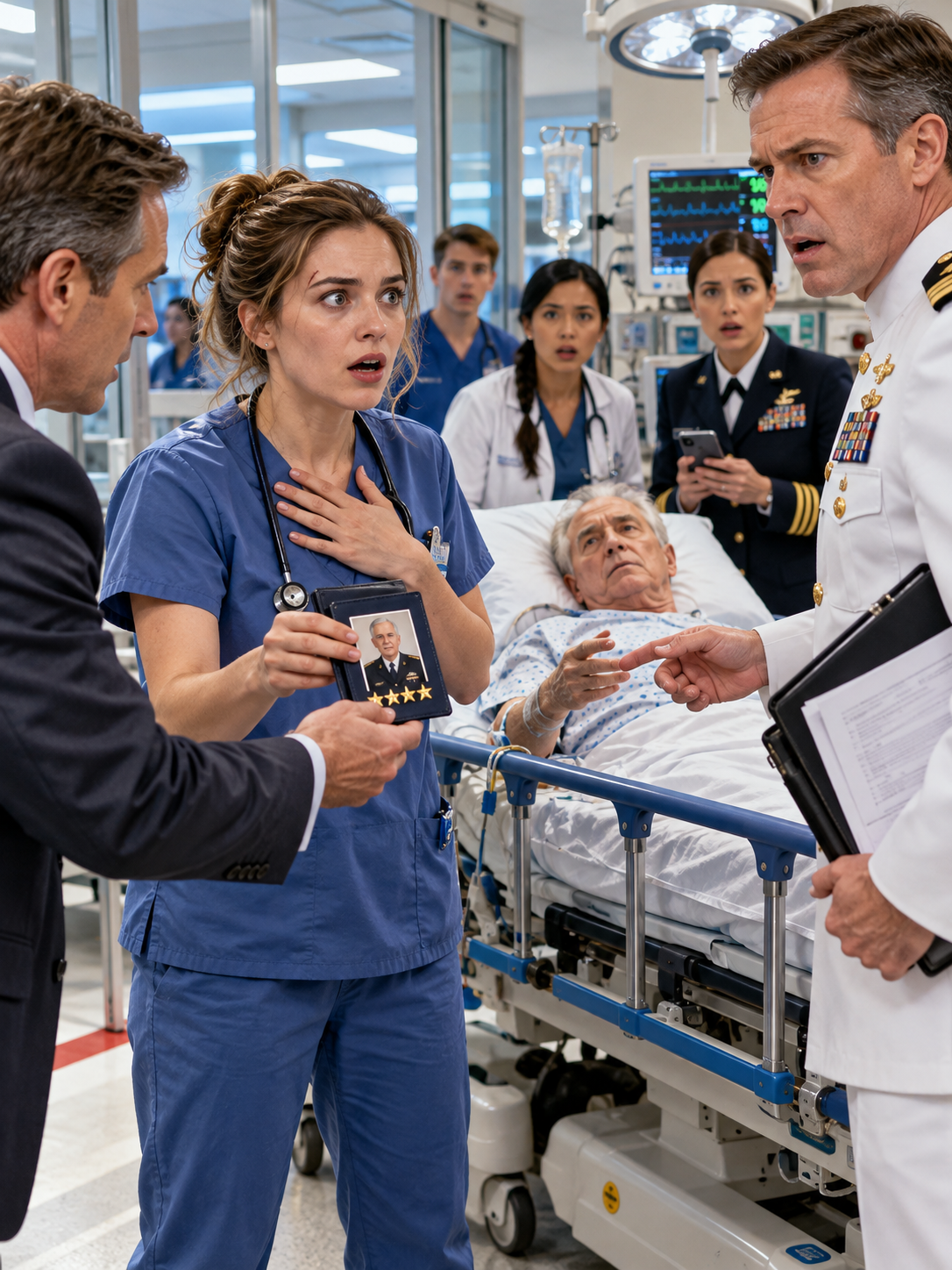
### Part 2: The Admiral’s Life Hangs Between Two Terrible Decisions
Commander Ellison stared at the badge, then at the patient, as though the hospital floor had shifted beneath him. Lieutenant Commander Anna Torres stood beside the bed, her phone still in her hand, and explained that Admiral Maddox had personally insisted on chairing the nine o’clock selection board. No one had understood why a four-star admiral wanted to interview an ordinary nursing applicant. Now he was lying unconscious beneath a white hospital sheet, and the nurse Ellison had threatened to disqualify was standing beside him.
I had barely absorbed the news when the cardiac monitor began screaming. His pressure dropped to 84 over 50, his neck veins became distended, and the heart sounds beneath my stethoscope were suddenly distant. “Dr. Reyes, the fluid around his heart may be increasing,” I said, already watching her reach for the ultrasound probe. The screen confirmed our fear: blood was accumulating around his heart, restricting its ability to pump.
“Cardiac tamponade,” Reyes said, her voice low and urgent. She called for the surgical team to be ready immediately, warning everyone that the damaged aorta required extremely careful management until the surgeons could repair it. Captain Lowell, the cardiothoracic surgeon, was preparing the operating room. Every second suddenly felt loud enough to hear.
As the gurney rolled toward the elevators, the admiral lifted one trembling hand and caught my sleeve. His eyes opened briefly, settling on my name badge. “Keller,” he whispered with an expression I couldn’t understand. Then the elevator doors closed between us.
In the surgical waiting room, I finally picked up the bag Chief Trent had retrieved from the curb. My new blazer was still neatly folded inside, its gold buttons catching the overhead lights. I had imagined wearing it for a formal interview, sitting straight before senior officers and explaining why I deserved a Navy commission. Instead, I’d spent the morning kneeling on asphalt and arguing with the very people whose approval I needed.
My phone vibrated.
An email from the Navy Nurse Corps Accession Office appeared on the screen, its subject reading: Candidacy Withdrawn.
The explanation was painfully brief. I had failed to attend my scheduled interview, and my application had been closed under Commander Ellison’s authority. I stared at the signature until the letters blurred, then placed the phone facedown on my knee.
Chief Trent lowered himself into the chair beside me. For several minutes he said nothing, and I was grateful because I didn’t trust my voice. Finally, he leaned forward and said, “I served in the Army before transferring to the Navy. Did two years on protective details in Baghdad.”
I turned toward him.
“The way you positioned yourself beside the admiral,” he continued, “the way you watched the entrances and controlled the space around that vehicle. That’s not ordinary nursing training.”
I tightened my grip on the blazer. “Some things aren’t on my résumé.”
“Neither were six years of restricted government service, apparently.”
My stomach dropped. He wasn’t accusing me; his voice held the quiet recognition of someone who knew what classified service could cost a person. I looked through the glass toward the operating corridor before answering. “Army Criminal Investigation Division. Protective Services Battalion. Six years as a special agent.”
Trent nodded slowly.
“We protected senior officials,” I added. “Generals, visiting government representatives, anyone the Army assigned us to keep safe. I left after a mission overseas went wrong.”
He studied the thin white scar through my eyebrow and the smaller scars across my knuckles. “You haven’t spoken about it in a long time, have you?”
“Eleven years.”
The number made his expression change.
Eleven years ago, I had been part of a three-vehicle convoy traveling along a highway outside Kabul. Brigadier General Reed Dunmore occupied the lead vehicle, accompanied by a Navy captain serving as liaison. When the convoy came under attack, we lost communications almost immediately, and by the time I reached the general, he had been gravely wounded.
I stopped speaking and pressed my palms together.
Trent waited.
“The general died while I was holding his hand,” I finally said. “There was another officer, a Navy captain. He had a serious chest wound, but I managed to keep him alive until the evacuation helicopter arrived.”
I could still remember the dust sticking to my lips and the man’s blood soaking through my sleeves. For thirty-one minutes, I’d held pressure against his wound and begged him to keep breathing. I had been evacuated separately afterward, the report was sealed, and no one ever told me whether the captain survived.
Chief Trent sat perfectly still.
Then he asked, “What did you say to that captain while you were trying to save him?”
I looked down at my hands.
“The same thing I said this morning.”
### Part 3: A Forgotten Battlefield Promise Reveals the Admiral’s Secret
Trent slowly leaned back, his eyes fixed on mine. “Jo, Admiral Maddox attended a private memorial breakfast for General Dunmore this morning. He goes every year on the anniversary of that mission.”
For a moment, the waiting room seemed to lose its sound. The television continued moving silently above us, a cleaning cart rattled through the corridor, and the clock advanced another minute. Yet all I could hear was the ragged breathing of a young Navy captain eleven years earlier.
“That can’t be possible,” I whispered.
Trent folded his hands. “For years, the admiral has tried to learn the identity of the Army agent who saved his life. The records were sealed, and every request ran into restrictions.”
I remembered the captain’s face beneath the dust and blood. His eyes had been pale blue, but I’d never known his name; by the time the helicopter lifted him away, his identification had been secured beneath his damaged uniform. I hadn’t recognized him as the silver-haired stranger stepping from the SUV because eleven years had changed us both.
“This spring, a restricted service code on your Nurse Corps application was flagged as a possible match,” Trent continued. “The admiral requested your interview personally because he wanted to meet the person behind that record.”
I covered my mouth as the truth settled over me. He hadn’t been coming merely to evaluate my qualifications. He’d been searching for the woman who held him alive through the worst thirty-one minutes of his life.
“And this morning,” Trent said softly, “he heard your voice again.”
My mind returned to the pavement, to his desperate grip and his strange request that I repeat my promise. I’d assumed he was frightened and confused. Now I understood that he had recognized something my own memories had buried.
I lowered my face into my hands, but the tears came anyway.
For years, I’d believed I’d failed that convoy because the general had died. The classified investigation had left me unable to discuss the details or explain the scars I carried, and eventually I’d resigned from protective service. Nursing had become my way of doing something useful with the life I’d been allowed to keep.
My mother had understood, even when I couldn’t explain everything to her. She’d died three years earlier, leaving me with a nearly empty apartment, one stubborn houseplant, and the nursing journals I kept stacked beside my bed. I wished she could have been sitting next to me now, telling me that saving one life was never a small thing.
Dr. Reyes appeared in the waiting room carrying two paper cups of coffee. She handed one to me and sat down without asking questions. When I told her I had been disqualified from the interview, she looked toward the operating doors and shook her head. “You recognized an emergency that could have been fatal if we’d treated it differently. Whatever happened with your interview, you made the right medical decision.”
At 4:42 that afternoon, Captain Lowell finally emerged from surgery.
His blue scrubs were creased, his surgical mask hung beneath his chin, and his eyes showed the exhaustion of a difficult operation. Chief Trent stood immediately, while Lieutenant Commander Torres stepped forward with both hands clasped tightly together. I remained seated because my legs suddenly seemed incapable of supporting me.
“He survived,” Lowell announced.
The breath I’d been holding escaped so quickly it hurt. Lowell explained that his team had repaired the damaged ascending aorta with a graft and treated the dangerous bleeding around his heart. He said the admiral had been only minutes away from a fatal collapse, and that unnecessary movement or inappropriate early treatment might have prevented him from reaching the operating room.
“He’s in the cardiac intensive care unit,” Lowell continued. “The next forty-eight hours will be critical.”
I nodded, barely trusting myself to speak.
Then the surgeon added something unexpected.
“Before anesthesia, he gave us one instruction. He wanted the nurse who stayed with him this morning to remain nearby.”
I looked at Trent, who smiled through damp eyes.
That night, I slept in a waiting-room chair with my blazer folded beneath my head. Torres brought me clean scrubs, Dr. Reyes checked on me between patients, and Trent appeared whenever the coffee machine needed another visitor. Every time a door slammed, my body flinched before I could stop it, but I stayed where the admiral had asked me to stay.
Two mornings later, Torres led me into the cardiac intensive care unit. Admiral Maddox was awake, propped against white pillows, his face pale but his eyes remarkably clear. Dr. Reyes stood near the monitors, Trent waited by the door, and Commander Ellison occupied an uncomfortable position at the foot of the bed.
I had finally put on my navy blazer.
The admiral noticed the gold buttons, then looked toward Ellison.
“Commander,” he said in a hoarse voice, “shall we begin Miss Keller’s interview?”
Ellison stiffened. “Sir, her candidacy was closed after she failed to appear.”
The admiral looked at me for a long moment.
“She arrived at 8:47,” he answered. “Thirteen minutes early. I know exactly where she was.”
### Part 4: One Final Revelation Changes My Future and Restores My Honor
Commander Ellison swallowed and unfolded the paper in his hands. Admiral Maddox adjusted himself against the pillows, wincing slightly as Dr. Reyes reminded him not to strain. Torres and Trent stood quietly near the doorway, and I suddenly felt more nervous than I had on the hospital pavement. On that morning, I’d known what needed to be done; now I had to explain why I belonged in the Navy.
“Read the first question, Commander,” Maddox instructed.
Ellison glanced down. “Why should the United States Navy select you as an officer in the Nurse Corps?”
I looked at the admiral, then at my hands. They had carried soldiers, steadied frightened patients, and worked countless night shifts in a hospital where I’d often felt invisible. My answer came without the polished phrases I’d rehearsed for weeks.
“Because when someone needs help, I know how to stay,” I said. “I don’t want a uniform to prove I’m important, sir. I want to serve alongside people who understand that a patient’s life matters more than anyone’s pride.”
The admiral smiled faintly.
“Eleven years ago,” he said, “a young Army agent told me I wasn’t going to die on her watch. I was badly wounded, and I remember very little about what happened around us, but I remember her voice.”
My eyes filled.
“I spent years trying to find her,” he continued. “When your application appeared, I recognized the restricted service reference associated with that mission. I requested your interview because I hoped to thank you in person.”
I glanced toward Chief Trent. He gave a small nod, confirming what he’d told me in the waiting room.
“But I didn’t know whether you were the person I’d been searching for,” the admiral admitted. “Then I heard you speak beside that SUV, and I knew.”
“Sir, I didn’t recognize you.”
“I know, Lieutenant-to-be. That’s what makes this important.”
He reached for a glass of water, and Torres helped him take a careful sip before he continued.
“You thought I was a stranger. You had every reason to continue walking toward those doors, especially knowing your future depended on being on time. But when you realized someone was dying, you chose the responsibility in front of you.”
He turned toward Ellison.
“Commander, you saw an unexplained section in her record and decided it meant dishonesty. You saw her arrive late to a meeting and decided she lacked discipline. Did you ever ask whether those six years contained service the applicant was forbidden to discuss?”
Ellison’s face tightened. “No, sir.”
“Did you examine the patient she was helping before ordering her to leave him?”
“No, sir.”
The room remained silent.
Ellison finally turned toward me. “Miss Keller, I judged you without understanding the circumstances, and I was wrong. I owe you an apology.”
I held his gaze. I remembered standing outside those glass doors, begging him to understand that another human being needed me, but I also knew I didn’t want my future built on making him feel as powerless as he’d made me feel.
“Thank you, Commander,” I said. “I accept.”
Admiral Maddox instructed Ellison to step down as chair of the selection board and spend the next ninety days assigned to the emergency department’s night rotation under Dr. Reyes. “You’ll learn what an emergency actually looks like when a few minutes determine whether a family receives good news or devastating news,” he said. Dr. Reyes nodded once, and Ellison accepted the assignment without argument.
Then the admiral turned back toward me.
“The Navy is developing a specialized medical response program,” he said. “It will train Nurse Corps officers and protective personnel to recognize and manage life-threatening emergencies involving senior leaders during the first critical minutes.”
I listened carefully as he explained that the program required someone who understood both medical care and protective operations. My six years in Army CID, which had nearly disqualified me, were precisely the experience the new program needed. He wanted me to help build it, beginning with a commission as a lieutenant, subject to the necessary formal approvals and training requirements.
I stared at him.
“My restricted record—”
“We’ll begin the authorized review to release the information needed for your appointment,” he assured me. “You shouldn’t have to choose between honoring an oath and proving your service.”
For eleven years, I’d believed my past was a locked door I could never open. Now the man I’d once struggled to keep alive was offering me a future in which that same past could help protect others.
I stepped closer to his bed and carefully placed the identification badge Trent had given me onto the blanket. The admiral covered it with his hand, then reached for mine.
“One more time, Jo,” he whispered.
I bent toward him, remembering a roadside in Afghanistan, a hospital curb, and all the years between.
“Stay with me, sir. You’re not leaving on my watch.”
His eyes softened.
“That’s the voice,” he said. “Welcome to the Navy.”
Six months later, I stood at the front of a training classroom wearing my Navy dress uniform. A gold bar gleamed on each shoulder, and twenty nurses and protective personnel sat before me, waiting for their first lesson in crisis response. Chief Trent occupied a chair in the back row, his arms folded and a small, approving smile on his face.
Behind me, written across the whiteboard, were seven words:
Never wait for permission to save someone.
I still flinched whenever a heavy door slammed, and there were mornings when I woke with the memory of the men we hadn’t brought home. But I no longer treated those memories as proof that I’d failed. Admiral Maddox had survived eleven years ago, and he’d survived again because I’d recognized a stranger’s distress when everyone else was looking somewhere else.
At the end of class, a young lieutenant approached me with her notebook pressed against her chest.
“Ma’am, what if stopping to help means losing the opportunity you’ve worked your whole life for?”
I looked at the gold bar on my shoulder, then toward the window where sailors crossed the courtyard beneath the morning sun. I remembered my abandoned blazer, the email closing my application, and a silver-haired man asking me to repeat the words that had once kept him alive.
“Sometimes,” I told her, “you won’t know what your decision will cost until much later. You still have to do what you know is right.”
She smiled and returned to her seat.
As the classroom emptied, Chief Trent approached my desk and placed a framed photograph beside my training materials. It showed Admiral Maddox at his recovery ceremony, standing between Dr. Reyes and me, his hand resting gently on my shoulder. On the back, he’d written a short message in his own handwriting.
To the woman who saved my life twice, eleven years apart: Thank you for never walking away.
I traced the letters with my thumb, remembering how close I’d come to believing that missing one interview meant losing everything.
Instead, I’d discovered something no selection board could have taught me.
A uniform could recognize my service, but it had never been the source of my worth. That had been there all along, in the choices I made when nobody was watching.
And for the first time in my life, I didn’t feel invisible anymore.
THE END.
All characters and events in this story are fictional, created for storytelling and entertainment purposes. Thank you sincerely for reading. Your feedback and support are invaluable and motivate me to continue sharing more stories with you.


