
### Part 2: Eleven Years of Sacrifice Revealed My Mother’s Hidden Agenda
My brother Chuck was five years younger than me, and growing up, he received opportunities I was expected to surrender. When I earned admission to a state university, Mom said we couldn’t afford tuition and encouraged me to attend community college instead. That same year, she found enough money for Chuck’s expensive traveling baseball team. I worked behind a grocery store deli counter, finished my degree, and eventually became a fourth-grade teacher.
Dad was different from Mom, or so I’d always believed. Otis Gaines was a quiet mill worker who taught me to change oil and let me hand him tools from the hood of his old truck. He thanked me for every wrench, never realizing how much those small words meant. When he suffered his heart attack at fifty-two, I rushed to the hospital still wearing my classroom identification badge.
A week later, Mom told me his insurance wouldn’t cover four hundred dollars in monthly heart medication. She opened a joint account, and I arranged automatic deposits despite barely earning enough to support myself. Over the years, additional emergencies followed: a leaking roof, a broken furnace, medical expenses, and unexpected family debts. Whenever I requested an explanation, Mom accused me of treating my father’s health like a business transaction.
Corey never pressured me about those payments after we married. He knew how frightened I’d been of losing Dad, and he respected my desire to help. But I had made another choice, one I wasn’t proud of: I’d stopped examining the account because asking questions meant facing my mother’s anger.
My thirtieth birthday should have warned me. Mom called at six that morning, and I answered expecting her to sing the birthday song. Instead, she requested thousands for Chuck’s new gourmet grilled-cheese truck, which failed six weeks later. She remembered to wish me happy birthday only when she was hanging up.
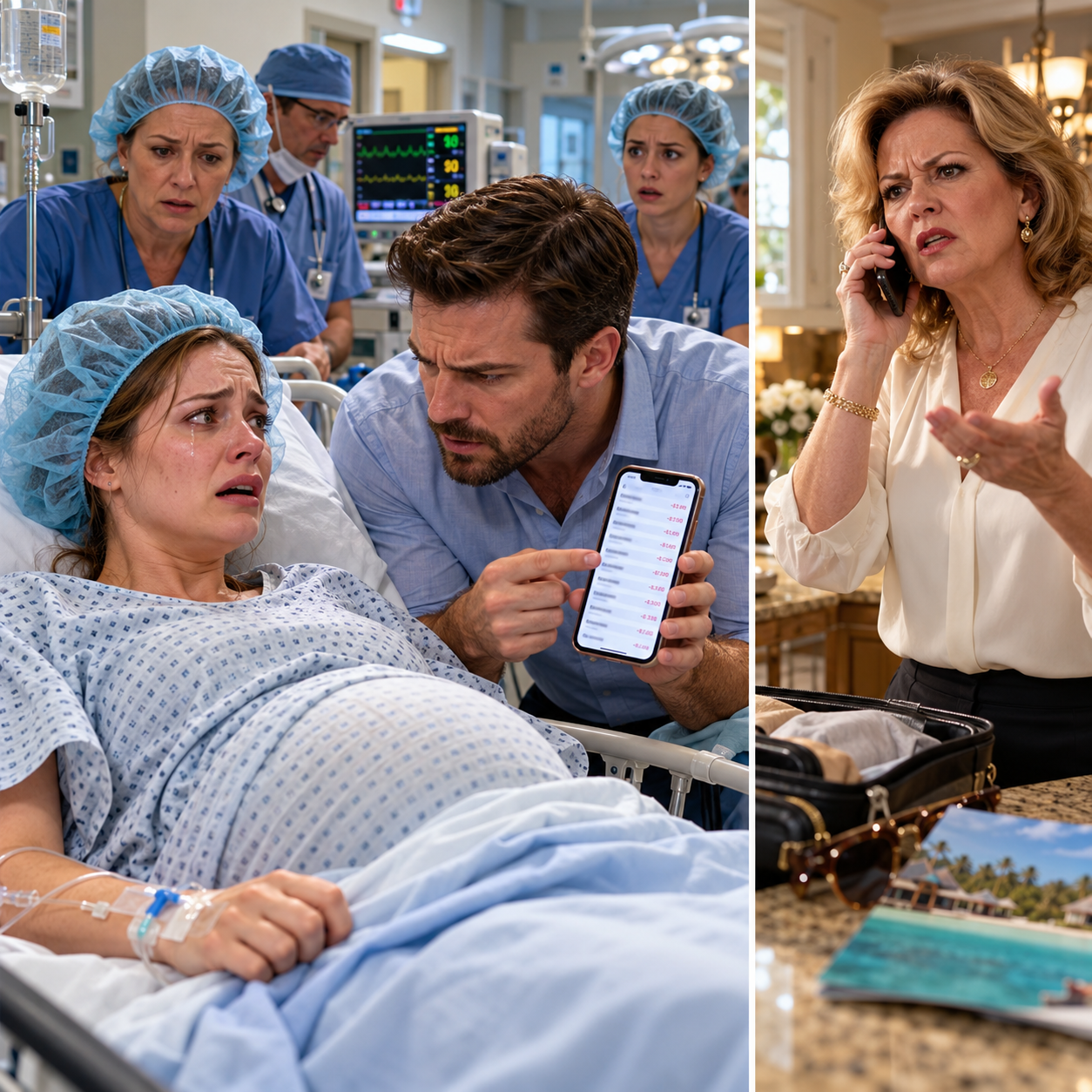
On Wednesday morning, I woke in the hospital with my incision aching and my newborn sleeping beside me. Corey handed me my phone, which displayed thirty-one missed calls. Mom’s first voicemail offered congratulations before mentioning a banking problem; later messages accused Corey of sabotaging our family. Chuck had sent two furious texts about his bounced rent and an upcoming truck payment.
“Why is Chuck’s rent being paid from Dad’s medical account?” I asked.
Corey opened his laptop and showed me a spreadsheet containing 132 monthly bank statements. The payments stretched back to the week after Dad’s heart attack, arranged beside my deposits and the balances left behind. I stared at the figures until they blurred, then looked toward my sleeping daughter.
“Keep the account frozen,” I said. “And I want Dad here on Friday.”
I texted him personally, announcing his granddaughter’s arrival and inviting him to visit. He answered almost immediately, promising to come and telling me he loved me.
Meanwhile, Mom tried contacting the nurses’ station to find out whether I could use my phone. Amy placed restrictions on visitors and refused to give out information without my permission. That evening, I received a surprisingly gentle message from Reagan, congratulating me and asking whether we could talk privately when I recovered.
Then I saw Mom’s Facebook post: a photograph of a candle in her kitchen, accompanied by a message about daughters who choose husbands over family. Church acquaintances were already offering sympathy and prayers. Corey asked whether I wanted him to respond, but I shook my head.
“This time, I speak for myself,” I told him.
He promised he wouldn’t interfere, even if my mother confronted him directly.
Friday morning, Dad entered my hospital room holding grocery-store carnations, his gray hair carefully combed. Corey placed our daughter in his enormous hands, and Dad’s eyes filled with tears as he whispered that she had my nose. For one beautiful minute, I thought our family might still have something worth saving.
Then Mom set her purse beside my untouched breakfast and announced, “Now, Keri, we need to discuss what your husband has done to your brother.”
I watched Dad’s smile disappear.
She hadn’t come to meet her granddaughter.
She’d come to recover access to the money.
### Part 3: A Hospital Confrontation Uncovered the Truth Behind Every Payment
“Your brother is facing eviction,” Mom began, smoothing her expensive blouse. “His honeymoon reservations are gone, his truck payment is overdue, and Reagan is devastated. All because Corey interfered with an arrangement that worked perfectly for eleven years.” She turned toward my husband with an accusing stare, but he remained beside our sleeping baby.
“Why was Chuck’s rent coming out of Dad’s medical account?” I asked. Mom sighed, explaining that families share money and that I’d become selfish since getting married. Then she insisted the account contained her personal savings from twenty years of working behind the pharmacy counter. Dad nodded uncertainly and asked whether I could return her money until everything settled down.
I looked at him and realized he genuinely believed her.
“Dad, do you know what that account was originally for?” I asked.
He hesitated. “Your mother said it was for emergencies, and that you’d help manage things if something happened to her.”
Mom interrupted, accusing me of resenting Chuck since childhood. She claimed I was punishing him during his wedding week, then questioned what kind of mother would behave so cruelly while holding a newborn. My blood pressure monitor began alarming, and Amy entered immediately, giving my parents five minutes before she’d end the visit.
Dad glanced at the monitor and offered to get coffee. Once he disappeared into the hallway, Mom continued demanding that I call the bank.
Then her phone rang.
It was Chuck, crying so loudly that I heard him across the room. Reagan had returned her engagement ring after her father, Roland, discovered the eviction notice and questioned how Chuck could afford a luxury honeymoon while failing to pay rent. When Reagan pressed him about the source of his money, Chuck admitted that Mom had always handled his expenses.
“Mom, whose money have you been giving me?” he sobbed.
My mother’s face drained of color. She promised to fix everything, ended the call, and turned toward Corey with sudden desperation.
“Did you tell Otis about the account?”
Corey gently adjusted our daughter’s blanket. “That’s not my question to answer, Valerie.”
“Did you call my husband?”
He looked directly at her. “Keri can tell her father whatever she decides.”
A soft sound came from the doorway.
Dad stood there holding two paper coffee cups.
He had heard enough to know there was something he didn’t understand.
“Dad,” I said, pushing myself upright despite the pain in my abdomen. “Please put those down.”
He placed the cups beside his carnations. I looked him in the eyes and asked how much his heart medication actually cost.
“Eleven dollars a month,” he answered. “The union insurance covers the rest. Always has.”
The room became painfully quiet.
“Mom told me it cost four hundred,” I whispered. “I’ve sent her that much every month since your heart attack.”
Dad lowered himself into a chair.
“She told me your insurance wouldn’t pay,” I continued. “Fifty-two thousand eight hundred dollars in regular transfers, plus another nineteen thousand for emergencies.”
His face tightened. “But I paid for our roof myself. I used my retirement money.”
Mom immediately claimed I was confused by postoperative medication. I turned Corey’s laptop toward Dad and opened the account records.
“There isn’t a single payment to a pharmacy in these statements,” I said. “Not one in eleven years.”
I pointed to the first major withdrawal: six thousand dollars spent at a used-car dealership, three weeks after the account opened. It was the truck Chuck received for his high school graduation, which Mom had claimed was purchased with an inheritance. Then came four years of Chuck’s rent, $8,100 for his failed food truck, a ten-day cruise Mom claimed she’d won at church, and deposits for the wedding venue and honeymoon suite.
“Altogether, I deposited $71,800,” I said. “Sixty-nine thousand four hundred dollars went toward Mom and Chuck. Only $2,400 remained when Corey requested the hold.”
I looked at her trembling hands.
“The resort needed $6,900. You called demanding $4,500 because that was exactly what the account was short.”
Mom finally stopped denying the withdrawals. She claimed Chuck needed financial support because he wasn’t as capable or fortunate as I was. According to her, my teaching career, marriage, and independence proved I could afford to sacrifice.
“You could have asked me to help Chuck,” I said. “Instead, you used Dad’s heart condition because you knew I’d never refuse him.”
Dad’s expression changed again, this time into something worse than anger.
“You told me Keri never called,” he said to Mom. “You said she forgot about us after getting married.”
“I called every Sunday,” I told him. “Mom always said you were resting.”
Dad closed his eyes.
For eleven years, we’d both believed the other was pulling away.
I told Mom the bank hold would remain until the review was resolved, the joint account would be closed through the proper process, and I expected the entire $71,800 repaid. If she refused to cooperate, I’d seek legal advice and formally report how she’d obtained the money.
She stared at me. “You would really do that to your own mother?”
“You made me responsible for that account,” I answered. “I’m finally taking responsibility for it.”
Dad stood and took Mom’s phone. He called Chuck, asked him to put Reagan on speaker, and calmly explained that his daughter’s money had paid for Chuck’s truck, rent, business, and wedding arrangements without her knowledge.
“Your sister thought she was paying for my heart medicine,” he told them. “You’ll have to take responsibility for your own bills now. And Reagan, you don’t owe this family a wedding.”
When he hung up, he asked Mom to wait in the car.
For the first time in my life, she left a room without getting the final word.
Dad approached my bed, enclosed my hand between his rough palms, and apologized for believing the distance between us was my fault. Then he turned to Corey.
“Why didn’t you tell me yourself?”
Corey glanced at me before answering. “Because Keri needed to tell her own story. She deserved to be believed for herself, not because her husband spoke for her.”
Dad nodded and asked to hold his granddaughter again.
For the next hour, he sat beside me, quietly admiring her tiny hands while his coffee turned cold.
### Part 4: My Family’s Lies Collapsed, but My Daughter Inherited Freedom
There was no dramatic courtroom battle afterward. The consequences arrived through canceled wedding plans, unpaid bills, and conversations that nobody could avoid anymore. Reagan initially postponed the wedding, but a month later, she ended the engagement entirely. She sent me a message thanking me for refusing to hide the truth, and I told her she deserved a marriage built on honesty.
Chuck lost his apartment and sold his truck before it could be repossessed. He moved into a room above a friend’s garage and found work loading shipments at a hardware store. Six weeks after my daughter’s birth, he finally contacted me, insisting he’d believed the money came from Mom’s savings.
“I believe you didn’t know whose money it was,” I replied. “But I don’t believe you never wondered why you didn’t have to pay your own bills.”
A week later, he transferred twenty dollars into my account with a short note identifying it as his first repayment. It was the first time my younger brother had ever sent me money rather than requesting it. I didn’t forgive everything because of twenty dollars, but I recognized that he had finally begun accepting responsibility.
Dad didn’t divorce Mom. After four decades of marriage, he wasn’t prepared to abandon the vows he’d made, but something fundamental between them had changed. He moved into their spare bedroom, removed her access to his personal accounts, and told his brothers and a church deacon what had happened.
Mom’s Facebook post disappeared. People who had once praised her generosity began questioning the expensive vacations and wedding arrangements she’d enjoyed while claiming financial hardship. For a woman who valued her reputation above almost everything, losing that admiration was devastating.
Then came the final surprise.
Mom had owned a wooded parcel near Lake Erie for years, inherited from an aunt and carefully reserved for her retirement. All those times she’d described herself as financially desperate, she’d possessed an asset she’d never considered using to help Chuck.
In February, she sold that property for $64,000.
Dad drove through falling snow to deliver the check himself. Standing on my porch with his coat collar turned up, he explained that Mom would repay the remaining $7,800 through twenty-four monthly payments of $325 from her pharmacy wages.
“The first payment starts next month,” he said.
I looked at the check, remembering all those evenings when I’d stretched a teacher’s salary to cover expenses my mother had invented.
“Thank you for bringing it, Dad.”
He shook his head. “I should have protected you from this.”
“You didn’t know.”
“I should have wanted to know.”
Neither of us had an easy answer to that.
Every month, the repayment arrives with the same plain description in the transaction record. There’s no affectionate message, no apology, and no explanation. Just an acknowledgment that the money was never hers to spend.
Mom hasn’t called since our confrontation. She mailed a birthday card for my daughter, signed only “Grandma,” and I placed it in a drawer without deciding whether to give it to her someday. I’ve learned that forgiveness, reconciliation, and access to my child are separate decisions, and I don’t have to make any of them before I’m ready.
Dad visits every Sunday now.
He arrives carrying a box of donuts, settles onto our living room carpet, and plays with his granddaughter while Corey makes coffee. Sometimes he hands her wooden spoons, patiently accepting each one when she offers it back.
And every time, he says, “Thank you.”
One afternoon, he looked up at me while she crawled across his lap.
“Eleven years,” he murmured. “You spent eleven years trying to keep me healthy, and I never knew.”
“I thought you needed me.”
“I did, sweetheart,” he answered. “Just not for the money.”
I sat beside them, and for the first time in years, loving my father didn’t feel like an obligation measured in dollars.
Months later, I asked Corey what he’d noticed first while scrolling through those transactions in the hospital. He considered the question before answering.
“The date the account opened,” he said. “You were twenty-three, barely supporting yourself, and somebody decided your sense of responsibility was something they could exploit.”
I leaned against him without speaking.
He had understood in seconds what I’d spent eleven years refusing to see.
We named our daughter on our third night in the hospital, when the room was quiet and we finally had time to look at each other without fear. Her name belongs to our little family, and I intend to keep that one precious detail private.
Someday, when she’s old enough, I’ll tell her about the money, the lies, and the morning her father helped me find my voice. I’ll explain that loving someone doesn’t require surrendering your judgment, and that kindness without boundaries can become a cage.
Most importantly, she’ll never have to earn my affection by being useful.
And when her birthday comes, I’ll call her in the morning, whether she’s ten years old or fifty.
Not because I need money.
Not because there’s an emergency.
Just because I want to hear her voice and sing to the daughter who taught me that becoming a mother didn’t mean I had to remain the obedient child my family had always demanded.
For eleven years, I believed my love was keeping my father alive.
In the end, it was my daughter’s arrival that finally gave me the courage to live my own life.
THE END.
All characters and events in this story are fictional, created for storytelling and entertainment purposes. Thank you sincerely for reading. Your feedback and support are invaluable and motivate me to continue sharing more stories with you.


