
## Part 2: My Son Confesses the Debt Behind His Birthday Promise
For a moment, I wondered whether I had misunderstood him.
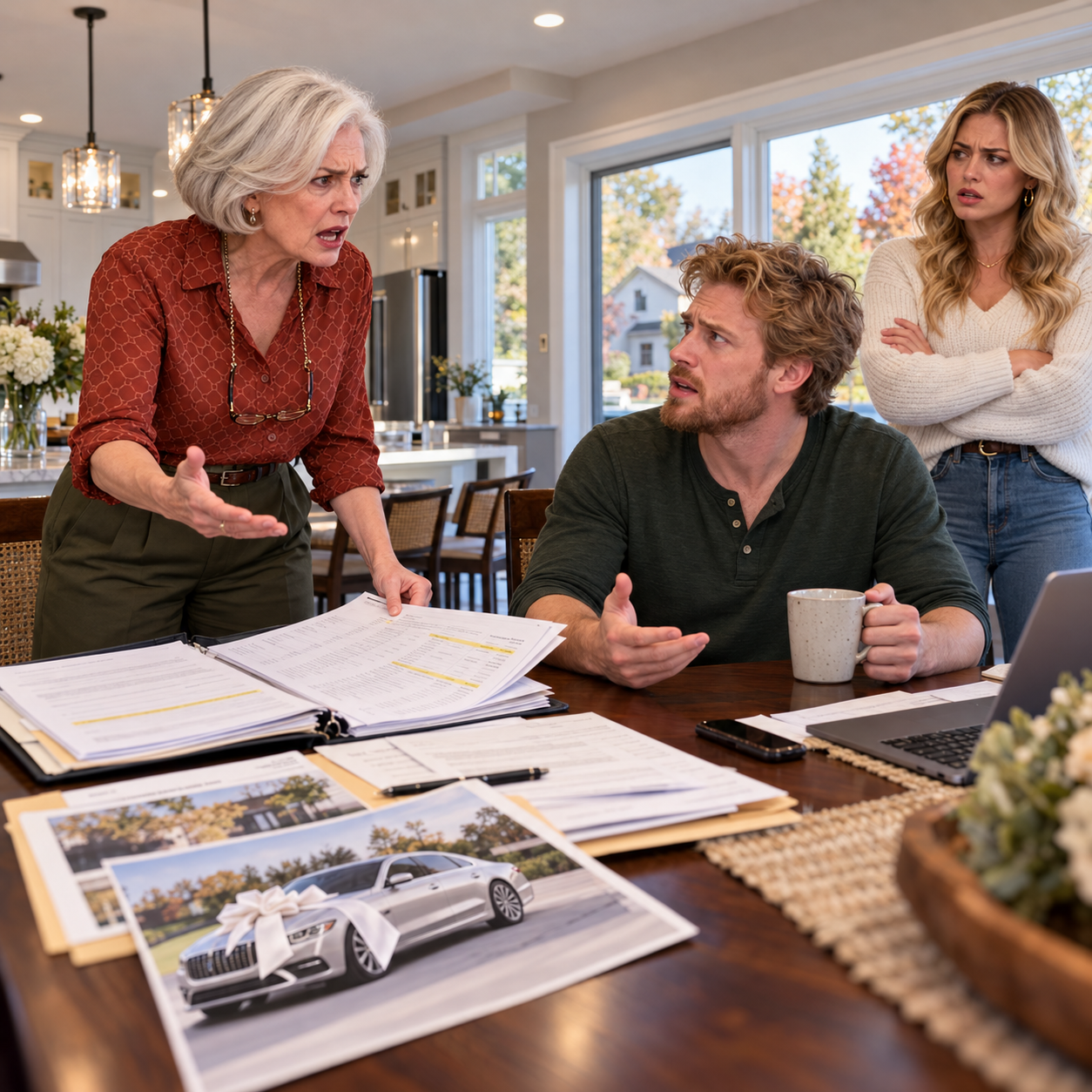
“You want to borrow thirty thousand dollars to buy your wife a birthday present?”
Derek rubbed his forehead. “It’s not supposed to be permanent. The Henderson project is finally moving forward, and when the payment comes through, I’ll pay you back.”
“How much do you actually owe?”
He shifted in his chair.
“Mom, that’s not really—”
“How much?”
He stared at the coffee between his hands.
“Seventy-three thousand.”
I reached for my reading glasses, although there was nothing in front of me to read.
“Credit cards?”
“Mostly. Two personal loans. Some business expenses.”
“And Petra knows?”
He nodded.
“The Henderson contract was delayed eight months,” he said. “I kept using credit to keep everything running. Every time I thought I was catching up, another bill came due.”
I looked at the man across from me and remembered the little boy who once cried because he had accidentally broken a neighbor’s window. He had insisted on telling the truth before anyone discovered it. Somewhere between that frightened child and the exhausted adult sitting in my kitchen, he had learned to hide mistakes until hiding them became more expensive than admitting them.
“Does Petra understand how much trouble you’re in?”
“She knows about most of it.”
“Then why is she shopping for a luxury car?”
He pressed his palms together.
“Because I told her I could afford it.”
The admission came so quietly that I almost missed it.
He explained that Petra had been talking about the car for nearly two years. She had watched friends buy houses, take vacations, and replace old vehicles while she and Derek lived in my spare bedrooms. He had promised her that this birthday would be different, hoping the Henderson payment would arrive in time.
“But it didn’t,” I said.
“No.”
“And instead of telling her, you decided to use my money.”
He said nothing.
I opened the folder beside my chair and placed the printed account records between us.
“Petra has already borrowed money from this line without telling me. And last night, I heard you two discussing how to get the access codes.”
His face changed.
“You heard that?”
“Every word that mattered.”
He leaned back and closed his eyes.
I told him about my visit to the bank. His expression tightened when I explained that Petra’s access had been removed and further borrowing frozen.
“Mom, I’m in serious trouble.”
“I can see that.”
“I don’t know how to fix it.”
“Then you need professional help, Derek. Not another loan you haven’t earned the right to ask for.”
He wiped his eyes with the heel of his hand. For several seconds, neither of us spoke.
Then I asked the question that had been bothering me since the dealership.
“Was Petra planning to tell me before the money was transferred?”
Derek looked toward the stairs.
“She thought you’d be less upset once the car was already ours.”
Around ten o’clock, Petra came downstairs wearing a pale silk robe and carrying her phone.
She stopped when she noticed the paperwork.
“What’s going on?”
“Sit down, Petra,” I said.
She glanced at Derek, but he offered no explanation.
I told her about the bank, the unauthorized purchases, and the conversation I had overheard. As I spoke, she sat straighter, her fingers tightening around her phone.
“We were going to pay you back,” she said.
“With what?”
“Derek has a contract coming.”
“That contract hasn’t paid him, and he’s already seventy-three thousand dollars in debt.”
She turned sharply toward him.
“You told her?”
“He needed to,” I answered.
Petra looked back at me.
“Marlene, I know how this sounds, but you have savings. Your house is paid off. We’re trying to get our lives started.”
“Your lives started eighteen months ago when I gave you somewhere to live without rent.”
Her cheeks colored.
“You offered.”
“Yes, I did. I offered a bedroom and breathing room. I didn’t offer ownership of my retirement.”
She put her phone face down.
“I wanted one nice thing,” she said. “Everybody else seems to get ahead, and I’m still living in somebody else’s house.”
For the first time that evening, I heard the embarrassment beneath her anger.
“I understand wanting independence,” I told her. “But a thirty-thousand-dollar car purchased with somebody else’s credit isn’t independence.”
Derek reached for her hand. She moved it away.
“I told myself you’d understand afterward,” she admitted.
“That’s what worries me, Petra. You didn’t think I deserved to decide beforehand.”
I explained that the birthday dinner could still happen, but no money would be transferred. I also told them I was reviewing the disputed charges with the bank and would seek legal advice.
Petra asked whether I intended to throw them out.
“Not tonight,” I answered. “But living here cannot continue under the same arrangement. We will discuss expenses, repayment, and a realistic plan for moving forward.”
Derek nodded. Petra stared toward the kitchen window.
Before going upstairs, I gathered the statements and placed them back in their folder.
For thirty-one years, I had taught children that borrowing something meant asking permission and returning it. I had never expected to explain the same principle to two adults living under my roof.
## Part 3: An Attorney and a Birthday Dinner Force Difficult Admissions
Tuesday morning, Cody found me in the backyard examining tomatoes that had begun turning orange.
He was wearing his dinosaur pajamas and carrying a plastic watering can.
“Grandma, can we pick these?”
“Not yet, sweetheart.”
“Why?”
“They need a little more time.”
He studied the largest tomato before carefully touching it with one finger.
“How do you know when it’s ready?”
“You pay attention to it.”
He considered that answer seriously, then watered the soil around the plant with such enthusiasm that his slippers became muddy.
Watching him, I realized that my grandson had spent most of his childhood surrounded by adults who were struggling to tell each other the truth. I didn’t want him growing up believing that affection came with invisible debts or that love meant allowing people to do whatever they pleased.
Derek appeared at the back door a few minutes later.
“Mom, I contacted a credit counselor.”
“Good.”
“He wants me to bring all my statements tomorrow.”
“Bring everything, Derek. Even the things you’re embarrassed about.”
He nodded and went inside to prepare Cody’s breakfast.
On Wednesday, I met with an attorney named Eleanor Ashcroft. She was a practical woman with silver-framed glasses who reviewed documents carefully before offering an opinion.
She explained that Petra’s authorized-user status complicated the earlier transactions. Depending on the account agreement, the bank might treat them differently from purchases made by a complete stranger. Nevertheless, the proposed transfer without my permission raised serious concerns, and I needed to preserve my records and follow the bank’s dispute procedures.
“Are you hoping to punish them?” she asked.
“No. I want my money protected.”
“Then don’t let guilt persuade you to restore their access.”
She helped me prepare a written record of the disputed charges and a proposed repayment agreement. She also advised me to document any future financial arrangement with Derek and Petra instead of relying on informal promises.
I left with copies of everything in a new folder.
That evening, I found Derek at the kitchen table surrounded by bills. His laptop displayed a spreadsheet, and a legal pad beside it contained numbers written in three different colors.
“How bad is it?” I asked.
“Worse than I thought.”
He showed me the counselor’s preliminary plan. Even after reducing expenses and negotiating with creditors, repayment would likely take thirty-six months, assuming his income remained steady.
“There’s no room for a car,” he said.
I sat beside him.
“There wasn’t room for one before, either.”
He gave a small, tired laugh.
“I know.”
Then he told me he had called the dealership and canceled the planned purchase. They were losing the reservation, and Petra had barely spoken to him since.
“She thinks I’ve humiliated her,” he said.
“She’s disappointed.”
“That’s putting it mildly.”
“Derek, disappointment is something adults have to survive.”
He studied the spreadsheet again.
“She keeps saying I made promises.”
“You did. And you need to take responsibility for that. But promising something you couldn’t afford doesn’t give either of you permission to make me pay for it.”
On Thursday, I received written confirmation that Petra’s access had been removed and the line of credit was restricted. I added it to the folder beside my other records.
Petra passed through the kitchen that afternoon carrying a basket of laundry.
“Are you keeping all that because you’re going to sue me?”
“I’m keeping it because I need accurate records.”
She looked uncomfortable.
“I really didn’t think of it as stealing.”
“I believe you didn’t want to think of it that way.”
She stopped beside the counter.
“My mother used to tell me that if somebody loved you, they’d find a way to give you what you needed.”
I folded the letter.
“Did she tell you how to tell the difference between needing something and wanting it?”
Petra didn’t answer immediately.
“No,” she said at last.
Friday evening, we went to a small Italian restaurant for her birthday.
It was a familiar neighborhood place with dark wooden booths and little candles on the tables. Cody wore his dress shoes and spent several minutes admiring their reflection beneath the overhead lights. Petra wore a green dress, and Derek brought her a small wrapped package that contained a silver bracelet he had purchased with money from his own checking account.
For most of dinner, we avoided discussing finances.
Cody described a classmate who could whistle through her fingers. Petra talked about her certification coursework and an upcoming examination. When Derek asked her a question about the field she wanted to enter, she answered with genuine enthusiasm.
I hadn’t heard that much life in her voice for weeks.
After the waiter brought chocolate cake with a candle, Derek rested his hands on the table.
“I need to say something.”
Petra looked at him.
“Not here, Derek.”
“I won’t make a scene.”
He turned toward me.
“Mom, I’m sorry for lying about the debt and letting you believe everything was under control. I’m working with the counselor, and I’m going to repay what we owe you. Not because you’re making me, but because it’s ours to repay.”
I watched him carefully.
“I’d like to see the plan.”
“You will.”
Then he turned toward his wife.
“Petra, I made you promises I couldn’t keep. I let you think we were closer to being financially secure than we actually were. I wanted you to be proud of me, and I made things worse trying to avoid disappointing you.”
Petra studied the unlit candle.
“That doesn’t make what we did to your mother okay,” he continued.
She looked up at me.
“I know,” she said.
There was a long pause before she spoke again.
“I kept thinking about everything I wanted us to have. I wasn’t thinking about what it would cost somebody else.”
I didn’t rush to comfort her.
“I appreciate you saying that.”
Her eyes glistened.
“I’m sorry, Marlene.”
“Thank you.”
Cody had fallen asleep against the padded booth, one arm wrapped around a dinner roll he had claimed as his own.
I looked at the little boy and then at his parents.
“I don’t need either of you to be perfect,” I said. “But I do need to know that my home and my finances are safe around the people I love.”
Derek nodded. Petra wiped her eyes with her napkin.
We finished the cake without trying to solve everything else that evening.
When we returned home, I made tea for three and left the kitchen light on a little longer than usual.
## Part 4: Our Family Learns That Real Trust Requires More Than Apologies
The months following Petra’s birthday were not particularly graceful.
There were awkward breakfasts, tense discussions about bills, and evenings when I could hear Derek and Petra arguing quietly behind their bedroom door. They began contributing toward household expenses, and we signed a repayment agreement covering the unauthorized charges. We also agreed they would work toward getting their own place instead of treating my house as a permanent solution.
Derek followed his thirty-six-month debt plan. Petra increased her work hours while continuing her certification program, although some days she barely spoke to me beyond necessary politeness. I accepted that rebuilding a relationship didn’t require everybody to feel comfortable immediately.
The line of credit remained frozen. Petra’s access was never restored.
Those decisions weren’t negotiable, even when things improved.
What surprised me was how much energy I had spent maintaining peace before the conflict. For years, I had been afraid that saying no would create distance between my son and me. In reality, my reluctance to set limits had allowed that distance to grow quietly while we all pretended everything was fine.
Four months after the birthday, Derek came home carrying a bag of mandarin oranges.
He found me at the kitchen table reviewing reading exercises for the library’s volunteer tutoring program.
“Thought you might like these,” he said.
He washed two oranges, sat across from me, and began peeling one.
We talked about Cody’s schoolwork and a client Derek hoped to sign. For once, he didn’t ask whether I could lend him money or help with a bill.
Eventually, he put down the orange peel.
“Mom, can I ask you something?”
“Of course.”
“Are you still waiting for us to leave?”
I considered my answer.
“I’m waiting for you to build a life you can afford. That’s different.”
He nodded slowly.
“I thought you hated having us here.”
“I never hated having you here, Derek. I hated wondering whether I could trust what you were telling me.”
He looked toward the window.
“I was afraid you’d stop loving me if you found out how badly I’d messed up.”
“I knew you were struggling. What hurt was that you thought hiding it from me was better than letting me see the truth.”
He brushed the remaining peel into a neat pile.
“I don’t think I’ll ever be able to repay everything you’ve done.”
“Then stop trying to measure it that way. Pay your actual debts. Be honest with your wife. Raise Cody to understand that other people’s belongings aren’t his just because they love him.”
He smiled faintly.
“That’s a pretty specific lesson.”
“Apparently it needs teaching.”
We ate our oranges while the kitchen clock ticked above the doorway.
A few weeks later, Petra told me that the silver sedan had been sold to someone else.
She mentioned it while putting away groceries, without bitterness or theatrical regret.
“I saw it driving near the shopping center,” she said. “At least, I think it was the same one.”
“How did you feel?”
She placed a carton of milk in the refrigerator.
“Strange, actually. I used to imagine how happy I’d be driving it.”
“And now?”
She closed the refrigerator door.
“Now I think about the payments.”
I smiled.
“That’s probably progress.”
She almost smiled back.
By the following spring, Derek and Petra had begun looking at affordable apartments. Their marriage still required work, and I knew some of the trust between the three of us might never return to what it had been. But the conversations were different now, grounded in actual numbers rather than hopeful promises.
Cody remained wonderfully unconcerned with our adult accounting.
He had developed a passion for drawing maps of imaginary countries, complete with rivers, mountains, forests, and cities named after people he loved. Every Tuesday after school, he arrived with fresh drawings and spread them across my kitchen table.
One afternoon, he showed me a country with a backward-running river and a mountain shaped like a question mark.
In the middle was a small city surrounded by green trees.
“That’s where the grandmothers live,” he explained.
“Do we get our own city?”
“Yes. Because grandmothers know where everything is.”
I laughed and kissed the top of his head.
He couldn’t have known about the folders in my cabinet, the account statements, or the afternoon I sat in my car outside the bank wondering whether protecting myself would cost me my family.
But perhaps he understood something simpler.
People who love one another need places where they feel safe.
I had spent years making my home that place for everybody else. At sixty-four, I finally understood that I deserved to feel safe there, too.
And as Cody bent over his drawing, carefully adding another road to the grandmother’s city, I realized that the most important thing I had protected wasn’t my money.
It was the possibility of loving my family without losing myself.
The End .
All characters and events in this story are fictional, created for storytelling and entertainment purposes. Thank you sincerely for reading. Your feedback and support are invaluable and motivate me to continue sharing more stories with you.


