
Part 2: Their House Flooded And They Arrived Expecting Mine To Become Theirs
Their SUV pulled into my driveway twenty-seven minutes later. David climbed out carrying two overnight bags while Sarah struggled with a pair of enormous suitcases. The tires were crusted with dirty snow, and neither of them had bothered to call again before arriving.
I opened the front door because I wasn’t going to leave them standing in the cold. Sarah stepped past me, pulling her luggage across the entryway rug, and glanced around with an expression I remembered from the first time she had visited. “It’s so warm in here,” she complained. “And there’s that old-house smell again.”
David dropped his bags beside the stairs and sat on the living room sofa without removing his boots. I watched him put one muddy heel on my coffee table.
“Boots off, David.”
He gave me a weary look. “Mom, please. We’ve had a nightmare morning.”
“Then take them off and have a cup of coffee.”
He complied, although he left both boots in the middle of the floor.
Sarah had already reached the kitchen. She opened my refrigerator and started rearranging the shelves, moving a casserole dish onto the counter to make room for several plastic containers.
“Some of this stuff needs to go,” she announced. “Your milk is probably bad.”
“The date is next Tuesday.”
She studied the carton. “Well, I don’t trust it.”
“Then don’t drink it.”
She returned the milk with a little more force than necessary. I made sandwiches while David called a contractor, and for fifteen minutes, we almost resembled an ordinary family facing an unfortunate emergency.
Then Sarah asked where I kept my spare bedding.
“The guest bedroom at the end of the hall has clean sheets,” I told her. “There’s another small room beside it.”
She exchanged a look with David. “Actually, we’d prefer your room. David’s back has been acting up, and you’ve got the king-sized mattress.”
I put down the knife I was using to slice tomatoes. “My room?”
“It’s only temporary, Olivia. You could use the smaller bedroom.” She said it with the brisk confidence of someone rearranging hotel accommodations. “We’re already dealing with enough stress.”
David remained seated at the kitchen island. “The guest mattress is pretty old, Mom.”
“Then I’ll look into replacing it someday,” I said. “But I’m sleeping in my own bed.”
Sarah’s lips tightened. “You’re one person. We’re two. I’m not sure why this has to be difficult.”
I didn’t argue about square footage. I went upstairs, checked that the keypad lock on my bedroom door was engaged, and placed the brass guest-room key on the hallway table.
When Sarah followed with her suitcase, she headed directly toward my bedroom. She turned the handle twice before noticing the keypad.
“Olivia, you’ve locked it.”
“Yes. The guest room is farther down.”
She stared at me. “You’re actually doing this?”
“You’re welcome to stay for the next two nights while you arrange temporary housing. But my bedroom isn’t available.”
David appeared halfway up the stairs. “Can we please not fight? Sarah hasn’t slept properly since the pipe burst.”
I looked at him. “Neither of you has to fight with me. There are clean towels in the bathroom, and I made lunch.”
He picked up the brass key without meeting my eyes.
That evening, I heard them talking through the heating vent. Sarah was upset that I hadn’t offered to wash their clothes or change the bedroom arrangements. David said something too softly for me to hear, followed by the unmistakable sound of a suitcase being dragged across the floor.
I remained downstairs, reading the same page of my novel three times.
The next morning, a handwritten note was taped to my coffee maker. Sarah had listed organic groceries, imported coffee, gluten-free snacks, and several toiletries she preferred. Beneath the list she’d written, “With the insurance deductible, we’re going to need you to cover these for now.”
I removed the note and laid it beside the sink.
For three years, I’d been quietly helping David with expenses. When he lost his job, I’d agreed to cover his cellphone plan, their car insurance, and his gym membership until he got back on his feet. He found another job, earned a promotion, and started taking vacations again, but I had never revisited those payments.
I opened my laptop and found the recurring charges. Together, they amounted to several hundred dollars every month, money I’d continued paying because I could afford it and because David had never mentioned stopping. I realized I was still treating his financial independence as something that might happen eventually.
I contacted the providers, arranged for the cellphone account to be transferred out of my name, removed my payment authorization from their insurance account, and canceled the gym membership. I forwarded David the notices so he could make his own arrangements, especially for the insurance premium coming due.
Then I put Sarah’s grocery list in the recycling.
Around lunchtime, David came into the kitchen holding his phone. “Mom, my service is disconnected. I’ve been trying to talk to the contractor.”
“The provider sent you instructions to activate your own plan.”
He stared at me. “You canceled it?”
“I stopped paying for it.”
Sarah came in behind him, holding her own phone. “And our insurance company says the payment method was removed. Do you have any idea what kind of week we’re having?”
“I do,” I said. “I also know you’ve both been employed for quite some time.”
David pulled out a chair. “You could have warned us.”
“I sent you the account information this morning.”
“That’s not what I mean.”
I understood him perfectly. He meant I could have continued paying until he decided he was ready for the arrangement to end.
Sarah put her phone on the counter. “Fine. If we’re going to cover all those bills ourselves, we can’t afford a hotel. We’ll just stay here until the house is finished.”
I looked between them. “That wasn’t the arrangement.”
“We’re family,” she answered. “Surely you can make room.”
For the second time that week, I heard the word family used as though it settled every question without requiring anything from the people saying it.
Part 3: A Simple Boundary Became The Confrontation None Of Us Wanted
I reminded them that I’d offered two nights, not an indefinite stay. David said the insurance paperwork was complicated, and Sarah insisted that every decent hotel within driving distance was charging outrageous rates. Neither disputed what I’d said; they simply kept talking as though a different answer would eventually appear.
“Please call the insurer again about temporary lodging,” I told David. “And make whatever arrangements you need for tomorrow.”
Sarah gave a short laugh. “I can’t believe we’re discussing checkout times when our house is practically destroyed.”
“Your house is damaged,” I said gently. “I know that’s frightening. But this house is still mine.”
She left the kitchen without touching the breakfast I’d made.
That afternoon, I tried to work in my greenhouse. My late husband had built its shelves from leftover cedar, and tending the plants had become my favorite quiet habit since his death. As I pinched dead leaves from a rosemary plant, I remembered David at eight years old, following his father around with a toy toolbox.
He’d once been the little boy who insisted on helping me carry groceries, even when the bags dragged against his knees. Somewhere along the way, my eagerness to make life easier for him had taught us both that I would always do whatever was required.
By the next afternoon, they had arranged to meet the insurance adjuster at their damaged house. Sarah came downstairs dressed in a wool coat and expensive boots, carrying a folder of contractor estimates.
“We’ll probably be back around six,” she said. “Could you have dinner ready?”
“I won’t be making dinner for you tonight.”
She stopped halfway to the door. “Olivia, we’re exhausted.”
“I understand. But you’ll need to find somewhere to stay this evening.”
David sighed. “Can we deal with this after the adjuster?”
“We already have.”
They drove away without answering.
I waited until their car disappeared around the corner, then went upstairs to the guest room. Clothes covered the floor, soda cans crowded the nightstand, and one of my good towels lay damp beneath an open suitcase. I packed their belongings carefully, folded what could be folded, and checked the drawers so nothing was left behind.
David’s gaming console went into its padded case. Sarah’s cosmetics went into a toiletry bag, and her jewelry box was wrapped inside a sweater. I carried the suitcases to the covered front porch, where they’d be protected from the weather.
Before changing the front-door access code, I sent David a message. “Your things are packed and safe on the porch. Your guest stay has ended as we discussed. There are two available hotels nearby, and I’ve sent you their information. Please call me if I’ve missed anything belonging to you.”
The message showed as delivered.
I opened the smart-lock application and removed the code I’d given David five years earlier, when he used to stop by after work. I remembered how pleased he’d been to have his own access, how casually I’d told him he never needed permission to visit.
At 5:45, headlights crossed my living room window.
David saw the luggage first. He stood beside the car for several seconds, then walked toward the porch with Sarah close behind him. She entered his old code, waited for the red light, and tried again.
“Mom?” David called. “Open up, please.”
I went to the door and opened it with the security chain engaged.
His expression was less angry than bewildered. “You seriously packed our things?”
“Everything’s there. I checked the room twice.”
Sarah moved beside him. “We’re supposed to sleep in a hotel while you sit here with three empty bedrooms?”
“I sent you the hotel information.”
“That’s not the point.”
“Then tell me what the point is.”
She looked toward David, waiting for him to answer. He rubbed both hands over his face before speaking.
“Mom, you know we don’t have another place ready.”
“You have a car, savings, and an insurance policy that may cover temporary lodging. I gave you two nights to work out the next step.”
David leaned closer to the narrow opening. “I thought you would want to help us.”
“I did help you.”
Sarah’s cheeks had turned pink from the cold. “You’re punishing us because Christmas didn’t go your way.”
I looked at David. “Your wife told me I should have asked before coming to brunch. You stood beside her and said nothing. Now you’ve come into my home, tried to move me out of my bedroom, and informed me how long you’ll be staying.”
He lowered his eyes, exactly as he had on Christmas morning.
“Mom, I know that was awkward.”
“It wasn’t awkward, David. It was hurtful.”
Sarah pulled her coat tighter. “Well, if this is how you treat your own son, don’t expect us to come running when you want to see your grandchildren someday.”
They didn’t have children yet. She was threatening to keep me from people who didn’t exist, and the desperation behind it was almost as disturbing as the words themselves.
I looked at her through the narrow opening. “I hope someday there are children for all of us to love. But that isn’t something I’m going to bargain over on my front porch.”
I asked David one last time whether he had the hotel addresses. He nodded.
“Drive carefully,” I told them.
When I closed the door, I remained in the hallway for a while. I could hear them moving luggage toward the car, talking in sharp, muffled voices. My hands were trembling, and I sat on the bottom stair until the engine started.
An hour later, my daughter Emma called from two states away.
“David says you threw them out into the snow,” she began.
“They were here two nights. I packed their things, and I gave them hotel information.”
Emma exhaled. “That sounds a little different from his version.”
I told her about Christmas, the bedroom, the grocery list, and the bills I’d been paying. She listened without interrupting.
“Mom,” she finally said, “you’ve been helping David so long he thinks help is something that belongs to him.”
I looked toward the kitchen, where the holiday cards were still lined up along the windowsill. “I suppose I wanted him to know he could always come home.”
“He can come home and still knock.”
We spoke for nearly an hour. Afterward, I washed the cups left in the guest room, straightened the blankets, and closed the bedroom door.
For the first time in years, I wasn’t waiting to find out what my son needed next.
Part 4: My Son Returned With An Apology And Another Request
January passed slowly. I joined a neighborhood book club, repotted the orchids in my greenhouse, and learned to cook smaller meals without feeling that something was missing from the table. Some evenings were peaceful; others, I reached for my phone because I’d seen a funny photograph or heard a song David used to love.
I didn’t call him. I was beginning to understand that missing someone didn’t mean I had to reopen every arrangement that had hurt me.
On a gray Tuesday afternoon, the doorbell rang.
David stood alone beneath the porch light. His hair needed cutting, and there were shadows beneath his eyes. He held a folded piece of paper that he kept turning between his fingers.
“Hi, Mom. Could we talk?”
I opened the door but stayed in the entryway. “Of course.”
He glanced past me toward the kitchen. “Sarah’s at work. I thought it might be easier if I came alone.”
I waited.
“About Christmas,” he began. “I owe you an apology.”
He shifted his weight and looked directly at me for the first time.
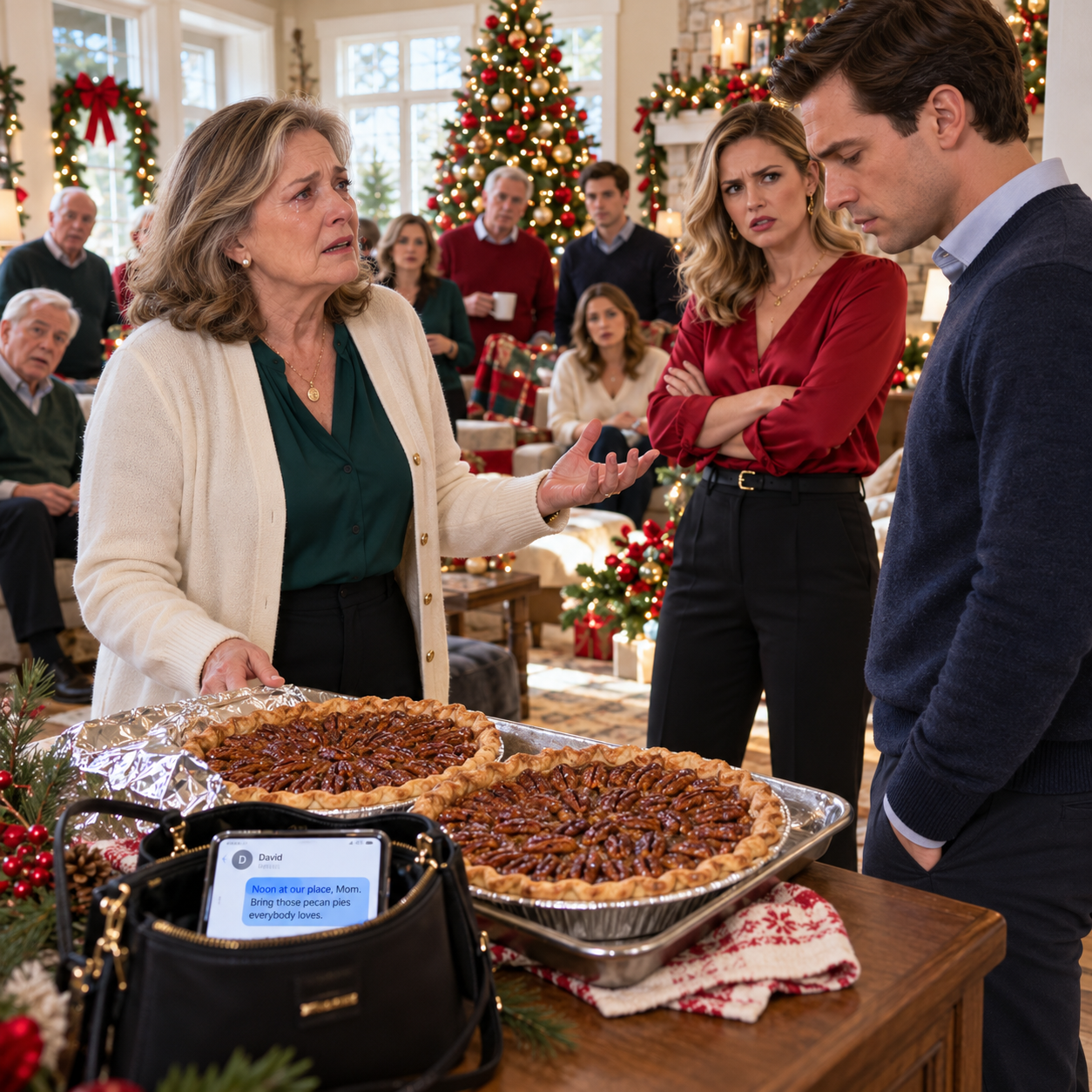
“I invited you. Sarah didn’t know I’d specifically asked you to bring the pies. She’d been stressed about hosting everybody, and we’d argued the night before about whether you would think she was doing things wrong.”
I remembered how carefully she’d decorated the dining room.
“I thought if you just showed up, she’d get over it,” he continued. “Then she said that horrible thing, and I didn’t know how to handle it.”
“You could have told her you’d invited me.”
“I know.”
“You could have walked me to my car.”
He looked down at the folded paper. “I know that, too.”
For a moment, I saw something familiar in his face. Not the frightened child I’d comforted years ago, but a grown man beginning to recognize the damage he’d caused by avoiding difficult conversations.
“I’m sorry, Mom,” he said again. “You didn’t deserve that.”
“Thank you for saying it.”
He nodded, then unfolded the paper.
It was an estimate from an extended-stay hotel. He explained that the insurance company was disputing part of their claim and that repairs would continue for at least another two months. Their savings were disappearing faster than expected.
“I wanted to ask whether you could lend us five thousand dollars,” he said. “Just until everything is settled.”
I looked at the estimate, then back at him. The paper trembled slightly in his hand.
“Is that why you came?”
His face reddened. “It’s part of it. I really did want to apologize.”
I believed him, at least partly. But I could also see the old expectation waiting beneath his words: once his mother understood the problem, she would make it hers to solve.
“I love you, David,” I said. “But I’m not lending you the money.”
He swallowed. “You have savings.”
“Yes. They’re my savings. They have to support me for the rest of my life.”
He folded the estimate again. “I wouldn’t ask if things weren’t bad.”
“I understand that. Have you spoken with the insurer about appealing the lodging decision?”
He nodded. “We’re working on it.”
“Then keep working on it. Ask the contractor about a payment schedule. Make a budget with Sarah. There are choices you can make together that don’t involve my checkbook.”
He looked toward his car, then back at me.
“Do you think you’ll ever forgive me?”
I considered his question. Forgiveness was possible, perhaps even necessary for both of us, but it couldn’t be another favor I handed over simply because he had arrived asking for it.
“I want us to have a relationship, sweetheart. I want you to visit because you miss me, not because something needs fixing.”
He pressed his lips together and nodded.
“I do miss you,” he said quietly.
That was the first thing he’d said all afternoon that asked nothing of me.
I reached through the doorway and squeezed his hand. He held mine for a moment before stepping down from the porch. I watched him drive away, hoping he’d return someday with nothing more urgent than a story to tell over coffee.
Inside, I found the old Christmas recipe card tucked into a cookbook. David had written his name across the bottom when he was nine, claiming he was the official pecan-pie tester. I smiled at the crooked letters and returned the card to its place.
I would probably make those pies again next Christmas. I might even share one with my son, if we had begun to find our way back to each other.
But I would no longer confuse giving everything with being a good mother.
I had spent thirty years keeping a place for everyone at my table. At last, I understood that I deserved a place there, too.
The End .
All characters and events in this story are fictional, created for storytelling and entertainment purposes. Thank you sincerely for reading. Your feedback and support are invaluable and motivate me to continue sharing more stories with you.


