
Part 2: Evidence Made My Parents Stop Calling It a Prank
Roberts returned with a detective from the department’s investigations unit.
Detective Lena Morris placed the toxicology report on the rolling tray beside my bed.
“Your doctors believe the substituted medication contributed directly to your condition,” she said.
I knew enough pharmacology to understand the implications without hearing every clinical detail.
Megan did too.
That was what bothered me most.
The previous year, she had completed a pharmacy technician certification. Our parents had celebrated with champagne.
She wasn’t a research scientist, but she wasn’t ignorant.
When Mom and Dad came back, Detective Morris explained what the lab had found.
Mom’s coffee cup remained suspended halfway to her mouth.
“No,” she said.
Dad took the report and read it himself.
“There has to be contamination.”
Morris didn’t argue.
“We’re continuing the investigation.”
By afternoon, she returned with security footage from my apartment building.
At 6:03 Friday morning, Megan entered through the side entrance using my spare key.
The key I’d loaned her months earlier so she could feed my cat during a conference.
She left seven minutes later.
My mother watched the footage three times.
“Maybe she came to talk to you.”
“I was asleep until six-thirty,” I said.
Mom looked down.
The next evidence was harder to explain away.
Police had recovered messages between Megan and an old friend.
In them, Megan complained that my illness had made me “the family project” since adolescence. She wrote that people admired me for succeeding despite being sick, while every mistake she made became proof that she was irresponsible.
One message read:
Maybe if she falls apart at work, people will stop acting like she’s perfect.
Another said she knew enough to make me ill without doing permanent damage.
Probably, she had added.
My father lowered the printed pages.
That one word—probably—seemed to age him.
Mom whispered, “She didn’t really understand the risk.”
I looked at her.
“How many times are you going to finish her sentences for her?”
Mom pressed her lips together.
I wasn’t yelling.
That seemed to make it worse.
Two days later, detectives obtained footage from the pharmacy where Megan occasionally worked weekend shifts.
She had removed prescription medication without authorization.
The date on the recording was several days before my hospitalization.
Dad sat beside me when Detective Morris showed us.
His elbows rested on his knees, hands hanging loosely between them.
For thirty years, my father had been a judge.
He had lectured us about responsibility when we were teenagers. He believed rules held society together.
Yet when Megan was involved, his principles had always developed exceptions.
“She planned this,” he said.
Nobody answered.
He looked at me.
“I kept telling myself she was impulsive.”
Mom covered her face.
“I kept telling you to forgive her.”
Her voice broke.
And there it was—not absolution, but recognition.
The family story was finally changing.
Megan wasn’t the unlucky daughter who made messy choices while her accomplished sister judged her.
She had entered my home before sunrise and tampered with medication I depended on to live.
Bellwood conducted its own internal review.
Anna brought me the results.
Megan had contacted two managers before my hospitalization and suggested I was becoming unreliable because of my health.
“She was building a story,” Anna said.
I stared at the printed emails.
“Before she even changed the pills.”
Anna nodded.
The following morning, my physician, Dr. Patterson, came in with another laboratory report.
She pulled a chair close instead of standing over me.
“We reviewed some of your earlier blood samples.”
I remembered those samples.
Routine tests.
Visits after unexplained nausea.
A strange episode of dizziness in March.
Another in April.
Dr. Patterson turned the page toward me.
“There are trace findings we can’t easily account for.”
“From Friday?”
“No.”
She tapped three dates.
“These are from months ago.”
Small amounts of medications I had never been prescribed had appeared in stored samples.
Not enough to cause the crisis that put me in intensive care.
Enough to make me sick.
I remembered missing a board dinner because I couldn’t stop vomiting.
A canceled date.
A research meeting where my hands trembled so badly that I knocked over a glass of water.
Megan had been nearby for two of those incidents.
I signed a new statement for Detective Morris that afternoon.
When I finished, my name looked shaky on the page.
Morris closed the folder.
“We no longer believe Friday was the first incident.”
I looked toward my parents.
Neither of them asked me to forgive her.
Part 3: Months of Small Accidents Became a Pattern of Harm
I stayed with Anna after leaving the hospital.
She changed the code on her building’s entry system, bought a lockbox for my medication, and pretended not to notice when I checked it three times before bed.
For weeks, ordinary objects felt suspicious.
An unsealed bottle of water.
Coffee left unattended.
A kitchen drawer that didn’t look exactly as I’d remembered it.
I hated that Megan had managed to move into my head without being in the room.
The investigation kept finding pieces of a history I hadn’t known I was living.
Police searched Megan’s apartment and found notebooks.
They weren’t dramatic manifestos. That almost made them worse.
They looked like planners.
Dates.
Short observations.
Notes about my meetings, dinners, travel, and relationships.
March 15 — Kate sick before leadership meeting.
April 23 — David canceled after she got ill again.
Beside several entries, Megan had written little comments about whether the result had been effective.
I met assistant district attorney Sarah Martinez in a conference room three months after my hospitalization.
My parents sat across from me.
Martinez spread photocopies across the table.
“Some of this could be interpreted as resentment,” she said. “Taken alone, it would not establish intent.”
Then she added procurement records.
Megan had used false explanations to obtain medications she had no legitimate reason to possess.
The records matched dates in the notebooks.
Mom’s eyes moved from page to page.
“Why didn’t she just tell us she was angry?”
Dad leaned back.
“She did.”
Mom looked at him.
He spoke quietly.
“We just kept calling it sibling rivalry.”
That stayed with me.
Megan had told us, in a hundred smaller ways, how much she resented me.
We had translated it into something easier to live with.
At the courthouse on the first morning of trial, I locked myself in a bathroom stall and counted backward from fifty.
Anna waited outside.
Then I heard Megan’s voice in the hallway.
“Kate?”
I stood perfectly still.
“Kate, please. Just talk to me.”
A deputy told her to step away.
Megan kept going.
“They’re making it sound like I wanted you dead. I didn’t. I was angry. I made a mistake.”
A mistake.
One key.
One apartment.
Months of notes.
Multiple incidents.
An entire campaign reduced to one convenient noun.
On the witness stand, I didn’t call her a monster.
I told the jury who she had been to me.
The little sister who slept on my bedroom floor when I was hospitalized at sixteen.
The teenager who threatened a boy for mocking the medication I carried at school.
The woman who later began measuring her life against mine until love and resentment became tangled beyond recognition.
Then I explained Friday morning.
The spare key.
The missing medication.
The blood tests.
The earlier unexplained illnesses.
Megan cried at the defense table.
Part of me wanted those tears to mean something.
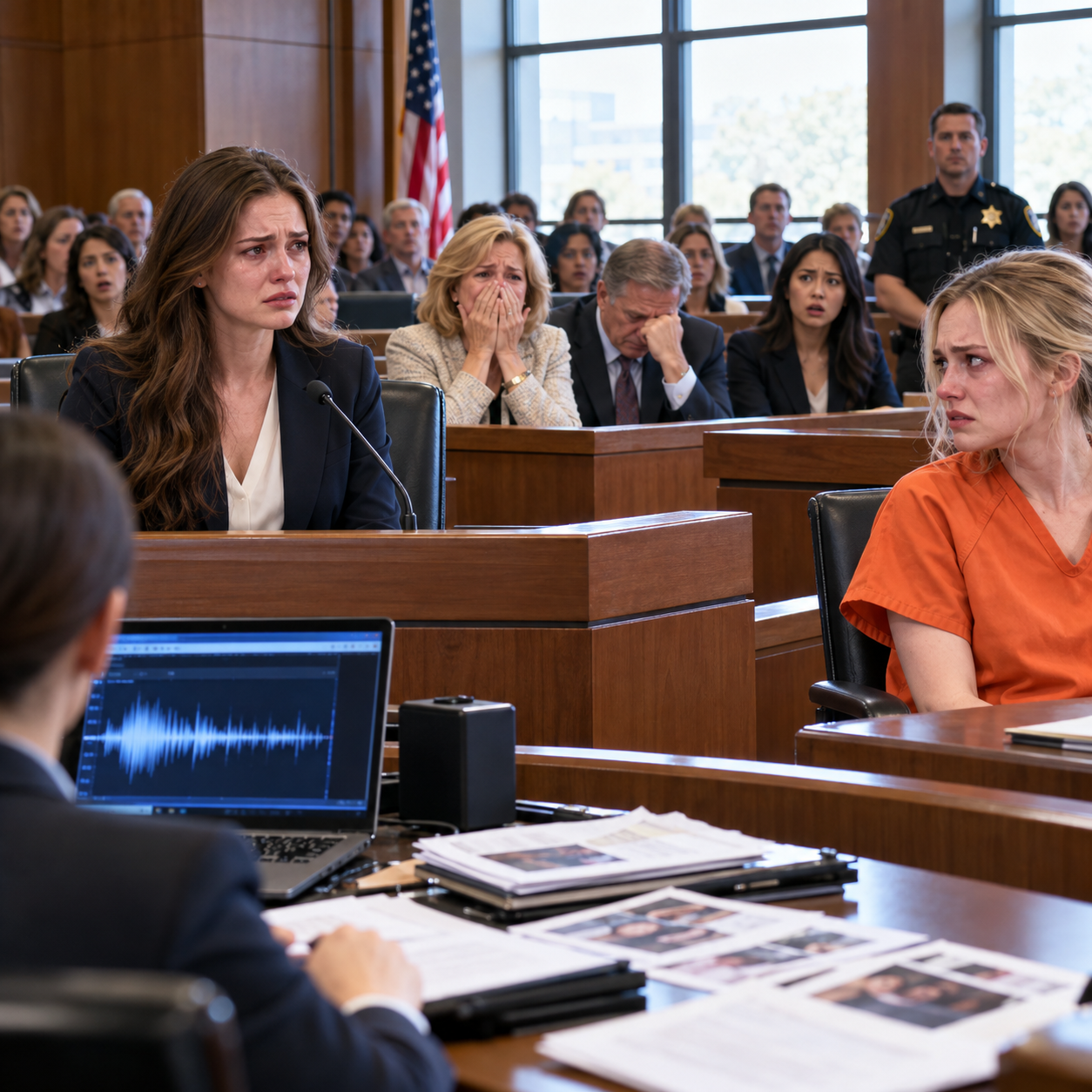
Then the prosecutor played a recorded jail conversation.
Megan had been speaking to another detainee.
Her voice sounded relaxed.
She complained that I had always received more sympathy, more praise, more attention.
Then she laughed about the moment I realized something was wrong.
Not loudly.
Not theatrically.
Just a small laugh from someone still treating my terror as evidence that she had finally managed to affect me.
My mother’s hand went to her mouth.
Dad looked down at the floor.
For the first time since this began, I stopped wondering whether Megan secretly understood what she had done.
She understood.
She simply believed her pain entitled her to do it.
Part 4: In Court, My Sister Finally Lost Control of the Story
The jury deliberated for less than a day.
Megan was convicted on the major charges related to poisoning me, tampering with my medication, and the repeated acts uncovered during the investigation.
At sentencing, her attorney talked about jealousy, depression, family dynamics, and a lifetime of feeling overshadowed.
I believed some of it.
Megan had spent years thinking our parents admired me more.
My illness had rearranged our childhood. Appointments, hospital stays, emergencies—attention often moved toward me because it had to.
Maybe no one had spent enough time asking what that felt like for her.
But explanation was not permission.
The judge sentenced her to a lengthy prison term.
Megan remained still until the deputies approached.
Then she turned toward me.
“You always win.”
Her voice wasn’t loud.
It sounded tired.
I studied the face I’d known almost my entire life.
“This wasn’t a competition,” I said.
Her expression tightened.
For once, I didn’t need her to understand.
Afterward, Mom sat on a courthouse bench and cried against Dad’s shoulder.
I stood a few feet away with Anna.
For years, I had imagined that if my parents ever truly saw what Megan was capable of, I would feel vindicated.
Instead, I felt grief.
There was no victory in watching your family finally believe you after almost losing you.
Recovery happened slowly.
Bellwood gave me another opportunity to present my research. The board promoted me later that year, though by then the title mattered less than it once had.
My company also tightened protections around employee medical information after reviewing how easily Megan had used rumors about my health to undermine me.
Mom began therapy.
She apologized without asking me to comfort her.
That mattered.
One afternoon, six months after the trial, she sat at my kitchen table while I prepared tea.
“I thought keeping the family together meant smoothing things over,” she said.
I placed her cup down.
“You usually smoothed it over on top of me.”
She nodded.
“I know.”
No excuses followed.
Dad struggled differently.
Retirement had always made him restless, so he began volunteering with an organization that helped victims navigate the court system.
He never described it as redemption.
I was grateful for that.
Some things shouldn’t be turned into a heroic second act.
A year after sentencing, I received a letter from a counselor working with Megan.
The message was careful and professional.
Megan still blamed me for the consequences of her actions. She continued to describe the poisoning as an attempt to “level the playing field” rather than deliberate harm.
The counselor recommended distance.
I obtained a long-term protective order.
Then I bought a small safe for my medication.
For a while, I felt ridiculous every time I opened it.
Eventually, I stopped.
Safety doesn’t have to look normal to anyone else.
One Sunday evening, Mom, Dad, and Anna came to my apartment for dinner.
Nothing dramatic happened.
Dad burned the garlic bread because he got distracted arguing with Anna about baseball.
Mom complained that I owned six wineglasses but only three matching dinner plates.
Anna stole roasted potatoes from the serving bowl before I put it on the table.
At one point, I stood at the kitchen counter listening to all three of them talk over each other.
My medication organizer sat inside the locked cabinet.
I noticed it.
Then I noticed something else.
I wasn’t afraid of the room.
That surprised me more than any verdict had.
I used to think forgiveness was the only respectable ending to a family conflict. My parents believed it too. We had confused forgiveness with access, mercy with silence, and keeping peace with refusing to name what was happening.
I don’t hate Megan.
That would require carrying her with me every day.
I also don’t speak to her.
Those truths can live together.
She is my sister. She hurt me deliberately. She may have loved me once, perhaps even while resenting everything she thought I represented.
And none of that requires me to unlock the door.
The End .
All characters and events in this story are fictional, created for storytelling and entertainment purposes. Thank you sincerely for reading. Your feedback and support are invaluable and motivate me to continue sharing more stories with you.

