
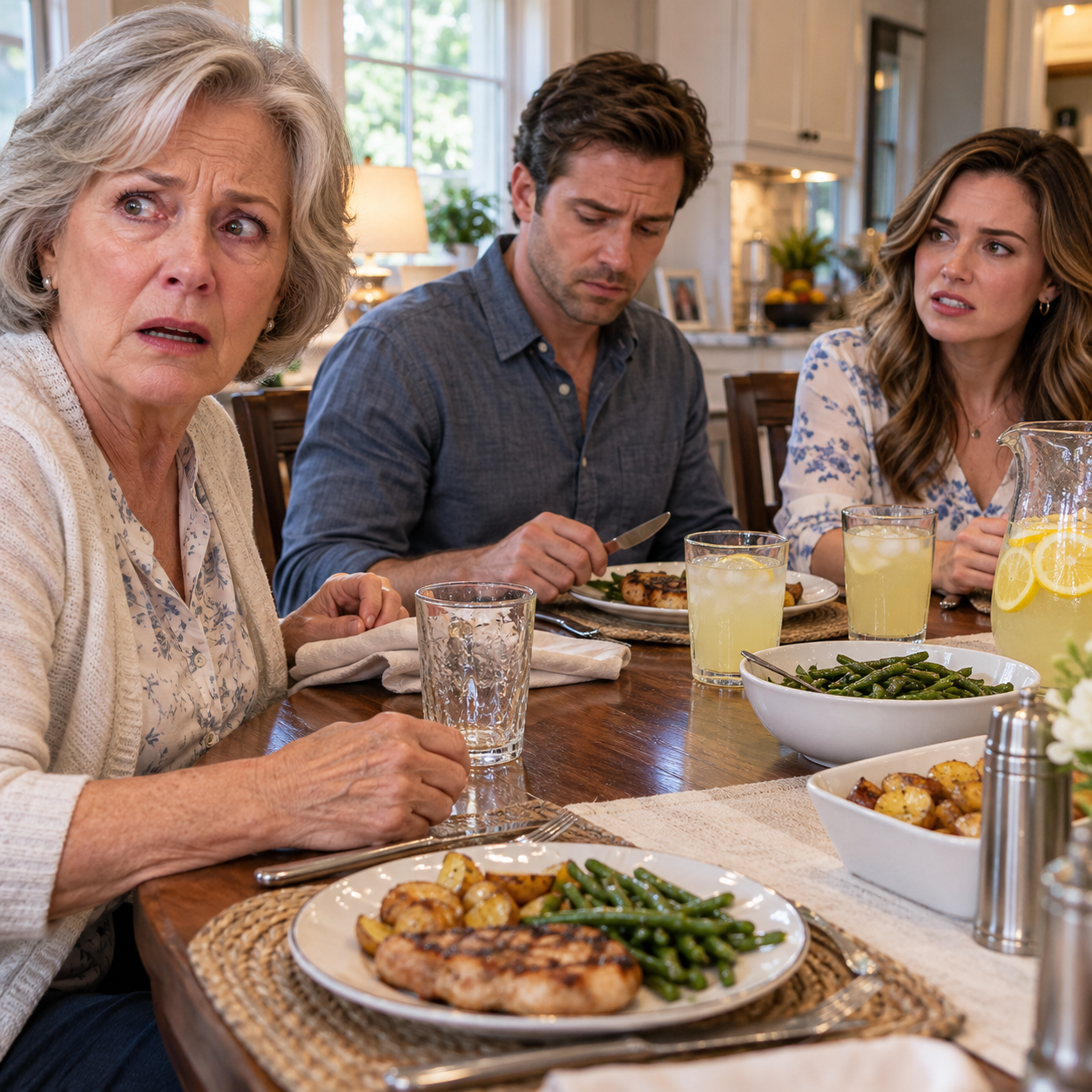
Part 2: Financial boundaries uncover the secret behind their missing savings
Sunday morning, Nathan came downstairs in socks and sweatpants while I was drinking coffee. He hovered near the bottom step, phone in hand, with the uneasy expression of someone who had been sent to negotiate.
“Claire’s grocery app isn’t working.”
“I canceled my membership.”
His eyebrows rose. “Why?”
“Because I don’t need a family grocery plan for one person.”
He looked away. “Okay. I know last night was uncomfortable.”
“Uncomfortable is when someone talks politics at Thanksgiving. Your wife told me I wasn’t family in the house I gave you rent-free.”
“She shouldn’t have said it.”
“No.”
“She was frustrated.”
“With what?”
Nathan rubbed his jaw. “Everything. Living arrangements. Money. Privacy.”
I let that settle between us. “Do you believe I’m the reason you don’t have privacy?”
He sank into the chair opposite mine. “I don’t know what I believe anymore.”
It was the first honest sentence he had offered me in months.
I slid the yellow legal pad across the table. “Then start with something measurable.”
He read the total at the bottom.
His forehead tightened. “You spent all this?”
“I’ve been spending it.”
“I thought the utilities were maybe three hundred a month.”
“Some months they are. Some months they’re five hundred. That total includes things you asked me to cover because you were saving for a house.”
He pushed the paper back. “We are saving.”
“How much?”
His eyes went to the window.
I waited.
Finally he said, “I don’t know exactly.”
That answer frightened me more than a low number would have.
On Monday, I called the electric company, water department, waste service, and internet provider. I did not shut anything off. I was not interested in making the house unlivable or interfering with Claire’s job. I simply arranged for the accounts serving the main household to be transferred into Nathan’s name at the end of the billing cycle, while I opened separate internet service for the downstairs suite.
Then I emailed Nathan a spreadsheet.
It listed every account, contact number, transfer date, average monthly cost, and due date.
He replied twenty minutes later.
Mom, can we talk before you change anything else?
I wrote back:
Yes. Tonight at seven.
Claire came with him.
She remained standing while Nathan sat at my small kitchen table. Her arms were crossed, but unlike Saturday, there was no smugness in her expression. She looked tired.
“Are you trying to push us out?” she asked.
“No.”
“It feels like it.”
“I’m asking you to pay for your own household.”
“We live together.”
“Do we?”
Claire’s lips parted, then pressed together again.
Nathan studied the spreadsheet. “We can handle utilities.”
“Good.”
“But why now?”
I looked at him. “Because I finally realized the arrangement never had an ending date.”
“It did.”
“What was it?”
He did not answer.
Claire pulled out the other chair and sat. “We were supposed to save enough for a down payment.”
“How much have you saved?”
Her gaze moved instantly toward Nathan.
That was when I understood they had discussed this question before coming downstairs.
Nathan leaned back and covered his mouth with one hand. “About eleven thousand.”
I thought I had misheard him.
“You’ve lived here thirty-four months.”
“Things happened.”
“I know things happened. I’m asking where the money went.”
Claire’s face reddened. “You don’t get to audit us.”
“You’re right. I don’t.”
That surprised her.
I continued, “But I do get to decide what happens with my house and my money.”
Nathan pushed his chair back slightly. “Mom—”
“I was expecting you to have forty or fifty thousand dollars by now. Even if you couldn’t buy yet, I thought you’d be close. Instead, you’ve saved less than four hundred dollars a month while living without rent.”
Claire stared at the table.
I noticed the engagement ring on her right hand—her original ring had been replaced the previous Christmas with a larger stone. I thought about their trip to Nashville, Nathan’s new SUV, Claire’s expensive exercise equipment, weekend restaurant photos, subscription boxes stacked near the recycling bin.
None of it was criminal. None of it was even shocking.
It was simply spending.
“We kept thinking we’d make it up later,” Nathan said quietly.
Claire turned toward him. “Don’t make this sound like it was all irresponsible.”
“I didn’t.”
“You wanted the SUV.”
“And you wanted Scottsdale.”
“That was networking.”
“It cost thirty-eight hundred dollars.”
She stared at him. His expression told me the argument was old.
I stood and walked to the cabinet above my refrigerator. Inside was an envelope I had prepared that afternoon after speaking with a local property manager and, more importantly, an attorney who advised me to put any future arrangement in writing.
I placed the envelope between them.
Nathan opened it.
Inside was a proposed six-month lease for the main portion of the house. The rent was $1,850 a month—well below comparable properties nearby—but no longer zero. They would pay their own utilities and groceries. At the end of six months, we would either renew under mutually acceptable terms or they would move.
Claire read the first page twice. “Eighteen fifty?”
“The property manager suggested twenty-four hundred.”
Her head came up.
“I reduced it because you’re my son and daughter-in-law, and because Lucy stays here.”
Nathan kept reading.
Claire whispered, “We can’t save for a house if we’re paying rent.”
I sat down again. “You haven’t been saving for one while not paying rent.”
That landed harder than I intended.
Nathan closed his eyes.
Claire looked toward the stairs, and for the first time I saw something beneath her anger that I recognized: embarrassment. Not because she had been caught plotting against me, but because the life she had been presenting as successful rested on more help than she wanted to admit.
“I didn’t mean what I said about the lemonade,” she said.
“Yes, you did.”
Her eyes met mine.
I kept my voice calm. “Maybe you didn’t mean it forever. Maybe you didn’t understand how cruel it sounded. But in that moment, you meant it enough to say it.”
She looked down at the lease.
Nathan asked, “What’s the other option?”
“You move.”
Claire gave a humorless laugh. “In this market?”
“I’m not asking you to leave tomorrow. If you don’t want the lease, I’ll give you sixty days to find another place. During those sixty days, you’ll cover utilities but no rent.”
Nathan glanced at Claire. “That’s fair.”
Her chair scraped backward. “Of course you think it’s fair. She’s your mother.”
“No,” he said, looking at the document instead of her. “I think it’s fair because we’ve been here almost three years.”
Claire stood very still.
That was the first time I had heard my son say the truth before waiting to see which woman in the room would be angrier about it.
She picked up her phone and walked upstairs.
Nathan remained at the table.
After a minute, he said, “I kept telling myself I was protecting everybody by not taking sides.”
“You were taking a side.”
He nodded once.
“I know.”
Part 3: Moving out forces my son to choose adulthood over avoidance
They did not sign the lease.
For the next two weeks, the atmosphere in the house changed from hostile to practical. Nathan called apartment complexes during his lunch breaks. Claire created a budget on her laptop. They canceled two subscriptions, sold the exercise bike, and traded Nathan’s SUV for a used sedan with a smaller payment.
I stayed out of it.
That was harder than it sounds.
Mothers are trained by years of repetition to step into every open space. Someone is short on money, we offer money. Someone forgets a deadline, we remind them. Someone makes a painful mistake, we rush to soften the landing until eventually no one can tell whether we are loving them or preventing them from feeling consequences.
Three weeks after our conversation, Nathan knocked on my basement door carrying two mugs.
“I made coffee.”
I accepted one. “Should I be nervous?”
“Probably.”
He smiled for the first time in days and sat across from me.
“We found an apartment.”
I tried not to let relief show too quickly. “Where?”
“Near Lucy’s school. Two bedrooms. Nothing fancy.”
“Can you afford it?”
He nodded. “If we stop pretending our income is higher than it is.”
There was no self-pity in his voice.
I took a sip. “That’s usually how budgets work.”
He laughed softly, then became serious. “Claire thinks you hate her.”
“I don’t.”
“She’s ashamed.”
“I can understand that.”
“She’s also still angry.”
“I can understand that too.”
He traced the handle of his mug with one thumb. “She said the lemonade thing because she’d been complaining that she never felt like this was really our home. She told me she felt like a guest in your house.”
I looked around my little basement kitchen.
“That’s interesting.”
“I know.”
“Did it occur to either of you that I might have felt like a guest too?”
His shoulders lowered.
“Not enough,” he said.
Moving day arrived on a cold Thursday morning in November. I stayed downstairs while boxes thudded across the floor overhead and the front door opened and closed a hundred times. Around noon, Claire came down alone.
She wore jeans, an old university sweatshirt, and no makeup. Without the polished clothes and controlled expression she usually carried like armor, she looked younger.
She held a small wooden recipe box.
“I found this behind the mixing bowls.”
I recognized it immediately. Daniel had built it for me during our first year of marriage.
Claire placed it on the table. “There are recipes in your handwriting. And some in his.”
“Most of the good ones are his.”
Her mouth tightened into something close to a smile.
She turned toward the stairs, then stopped.
“Eleanor.”
I waited.
“I was cruel that night.”
“Yes.”
Her eyes glistened, but she did not look away. “I kept telling myself this was our house because admitting it wasn’t made me feel like we’d failed. Every time you came upstairs, I felt reminded that we hadn’t gotten anywhere.”
“That wasn’t my intention.”
“I know.”
She folded her arms, then seemed to realize what she was doing and let them fall.
“I made you smaller so I could feel less embarrassed.”
There was no excuse hidden inside the sentence.
I respected that.
“I accept your apology,” I said. “But accepting it doesn’t mean we go back to the arrangement we had.”
“I don’t want to.”
That surprised me.
She glanced toward the ceiling where Nathan was moving furniture. “I think it was bad for all of us.”
When she left, she did not hug me. I did not ask her to. Some relationships heal better with honesty than forced affection.
Late that afternoon, Nathan carried the last box outside and returned with a ring of keys. He placed them in my palm one at a time: front door, back door, garage, shed.
Then he kept his hand over mine.
“I’m sorry I let you disappear in your own house.”
I swallowed before answering. “I’m sorry I made helping you so easy that neither of us noticed when help became dependence.”
His eyes filled.
“Those aren’t equal mistakes, Mom.”
“No. But they’re both worth learning from.”
He hugged me then, and for a few seconds he was six years old again, all elbows and trust, running into my arms because a thunderstorm had frightened him. Then he stepped back, wiped beneath one eye with his thumb, and smiled.
“Sunday dinner?”
“Give yourselves a week.”
“Two?”
“Call me.”
After the moving truck disappeared, I walked upstairs.
The house looked enormous.
There were pale rectangles on the walls where Claire’s pictures had hung and dents in the carpet from their furniture. The kitchen counters were bare except for the old ceramic fruit bowl Daniel and I had bought on our twentieth anniversary.
I opened windows despite the cold.
For the next several hours, I moved slowly from room to room. I brought Daniel’s photograph back to the mantel. I carried my favorite books upstairs in grocery bags. I returned the blue armchair to the corner beside the front window and put my mother’s quilt across the back.
Finally, I opened the wooden recipe box Claire had returned.
Daniel’s lemonade card was near the front, stained at one corner with an ancient splash of sugar water.
Four lemons. Six cups water. Sugar to taste. Mint if Eleanor remembers to grow it.
I laughed aloud.
A week later, Nathan came for dinner alone. Claire, he said, needed more time, and I told him that was fine. We ate roast chicken at my kitchen table and talked about Lucy’s school play, his new commute, and the surprise expense of buying shower curtains when you move into an apartment.
When I brought the pitcher from the refrigerator, Nathan looked at it.
“Lemonade?”
“Your father’s recipe.”
I poured his glass.
Then mine.
He stared at the two glasses for a moment, sadness and amusement crossing his face together.
“Mom.”
“Yes?”
“I’m really sorry.”
“I know.”
He lifted his glass.
I lifted mine.
Nothing dramatic happened after that. No grand speech. No miraculous reconciliation. Claire and I remained polite but distant for several months, and perhaps that distance was necessary. Nathan learned to manage his money without calling me whenever something went wrong, and I learned that saying no did not make me less of a mother.
The house became mine again gradually, through ordinary things. My shoes by the front door. My music playing in the kitchen. Daniel’s photograph staying exactly where I put it.
And whenever I make lemonade now, I think about how close I came to giving away not just money, but my place in my own life.
Love can open a door.
It does not require handing someone the deed to your dignity.
The End .
All characters and events in this story are fictional, created for storytelling and entertainment purposes. Thank you sincerely for reading. Your feedback and support are invaluable and motivate me to continue sharing more stories with you.

