
Part 2: My daughter defends one word and exposes years
By Wednesday, the messages had changed from worried to sharp. Claire told me emergency care was expensive, Matt had missed a conference call, and the girls kept asking why I was not picking them up. I answered only the last part: “Tell them Grandma loves them and will see them soon.”
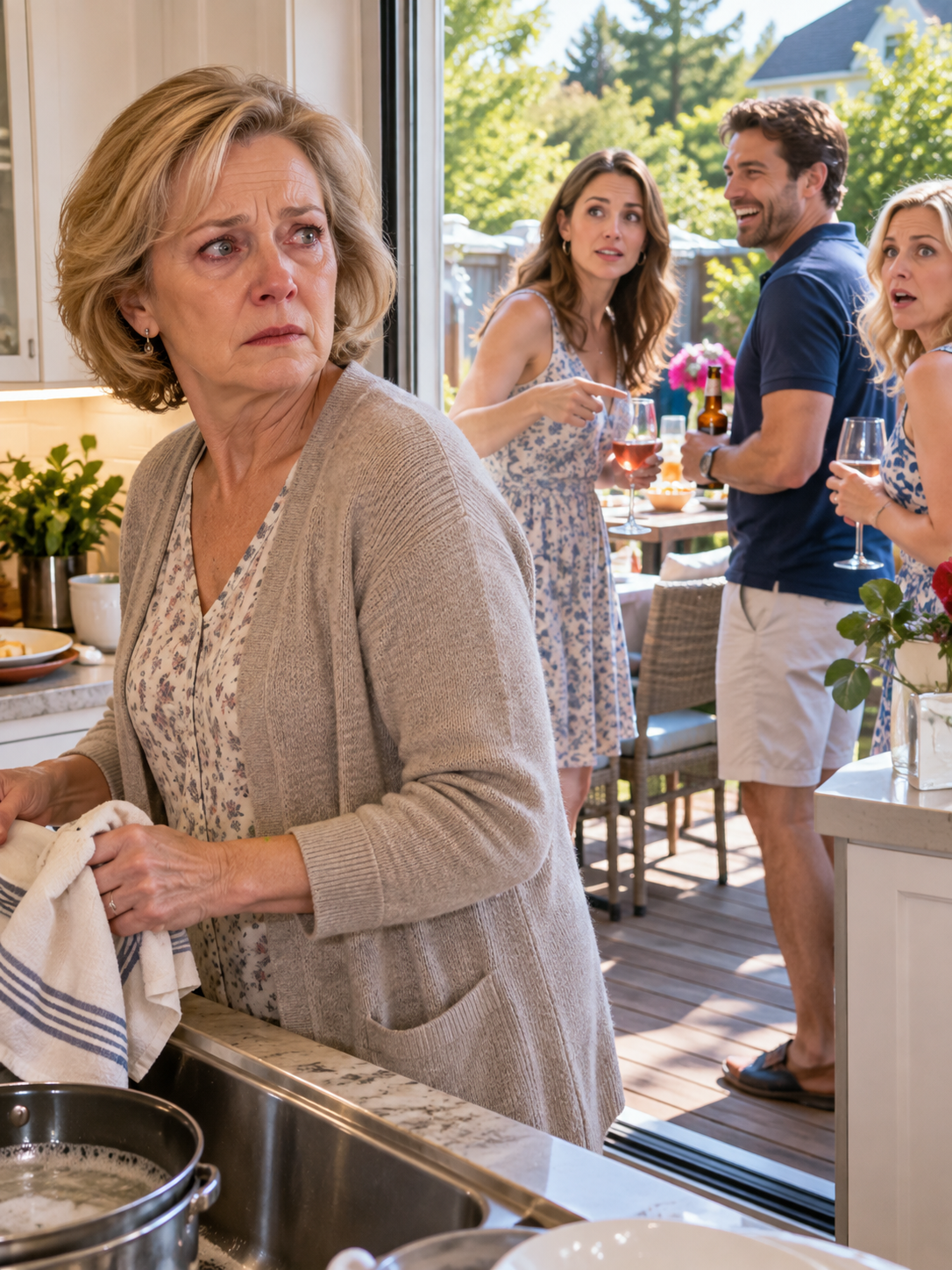
Friday afternoon, Claire’s SUV stopped in front of my house. Through the window I watched her sit behind the wheel for nearly a minute before coming up the walk, smoothing her hair with both hands as if neatness might help her control the conversation. When I opened the door, she looked exhausted enough that some of my anger loosened, but not enough to disappear.
“Mom, what is happening?” she asked after we sat in the living room. Her eyes moved over the vase of grocery-store tulips on my table, the open mystery novel, the folded blanket on the chair—evidence, perhaps, that my home continued to exist when I was not serving hers. “We’ve been rearranging everything all week.”
“Do you remember your friends on the deck Saturday?” I asked. Claire’s mouth tightened before she answered. “This is about that?”
“You called me your babysitter.”
She exhaled and leaned back. “It was shorthand. They don’t know our whole family history. I wasn’t going to give them a speech about how much you help.”
“You didn’t say I was your mother who helps,” I said. “You said I was the babysitter, and then everyone laughed.”
Claire rubbed her thumb along the seam of her purse. “So you stopped showing up to prove a point?”
“No. I stopped showing up because I finally understood the arrangement we had built.” I kept my voice low because raising it would have made the conversation easier for both of us; then we could blame temper instead of content. “I offered to help my daughter. Somewhere along the way, you began depending on a worker you didn’t have to pay, schedule, thank, or ask.”
Her face changed at that. “That’s not fair. You volunteered for most of it.”
The sentence hurt because it contained enough truth to be useful. I had volunteered for the first pickups and sick days, and I had trained everyone, including myself, to treat my availability as endless. “You’re right,” I said. “I helped create this. But volunteering once doesn’t mean I agreed forever.”
Claire looked toward the front window. “The girls are the ones who lose here.”
“No,” I said. “The girls still have a grandmother. What they are losing is a weekday caretaker you built your work life around without ever asking how long she could keep doing it.”
For the first time, Claire had no quick answer. Her eyes filled, but she blinked hard and stood instead of letting the tears fall. At the door she said, “I wish you had talked to me before just disappearing.”
I nodded. “I wish you had seen me before I had to.”
After she left, I opened the hall closet and pulled down the canvas tote I used for the girls. Inside were spare leggings, sunscreen, a child-sized water bottle, two library cards, and a pink sneaker that had been missing for three weeks. Tucked in the side pocket was a folded emergency-contact form from Nora’s dance studio, and under “relationship to child,” someone—probably Claire—had written “caregiver.”
Part 3: Recurring charges reveal the hidden cost of helping
That evening I carried the tote to my kitchen table and opened my laptop. The form had bothered me more than I wanted to admit, not because “caregiver” was technically false, but because I had never decided to become one. I pulled up my bank statements and searched Claire’s last name, then the girls’ activities, then the grocery delivery service.
The numbers were not enormous individually: dance shoes, a field trip deposit, Saturday art class, gymnastics tuition, groceries every other week. I had never kept score when the purchases were for children I adored, but the spreadsheet showed a pattern I could no longer call occasional.
I canceled the grocery subscription and removed my card from the activity accounts. At the gymnastics office, the receptionist said, “We’ll need a new payment method before next Tuesday.” I replied, “Their parents will handle it,” and felt no triumph at all, only the clean discomfort of returning something to its rightful owner.
The next morning Matt texted: “Claire and I want to talk about a sustainable plan. Saturday?” His language always sounded as if he were writing a memo to people he did not want to offend. I agreed.
They arrived together carrying coffee, which was such an obvious peace offering that I almost smiled. Matt began by saying they had “allowed the system to become overly dependent” on me; Claire shot him a look and said, “What he means is, we took you for granted.” That correction mattered more to me than the coffee.
“I don’t want an apology that turns into a new schedule,” I said. “I’m not negotiating for Tuesdays instead of five days.”
Claire looked down. “Then what do you want?”
“To be Grandma. I want sleepovers because we planned them. I want school plays, pancakes, maybe an afternoon at the zoo. I don’t want to be the person whose absence makes your jobs collapse.”
Matt folded his hands. “We priced after-school care. It’s a lot.”
“I’m sure it is.”
He looked at me, and there was a flash of resentment before embarrassment covered it. “That sounded worse than I meant.”
“It sounded expensive,” I said. “Which explains why my free labor was easy to get used to.”
Claire’s eyes moved to the tote by my chair. I pushed it toward her with my foot. “These belong at your house now.”
She opened it slowly and took out Nora’s water bottle, Lucy’s inhaler spacer, the pink sneaker, and finally the dance form. When she saw the word “caregiver,” she pressed her lips together. “I filled this out,” she said.
“I figured.”
“I didn’t even think about it.”
“That is the problem.”
She sat holding the paper with both hands. “I think I kept telling myself you liked being needed.”
“I did,” I said. “Until being needed became the only version of me you had time for.”
The sentence landed harder than I expected. Claire’s shoulders dropped, and Matt looked away toward the bookshelf, giving her privacy inside a room we all shared. After a long moment she said, “We enrolled them in the after-school program. Matt’s changing his travel days. I’m going to ask for one remote afternoon.”
“That sounds like a family plan,” I said.
Part 4: New boundaries give us back the family we lost
For the next three weeks, I picked up no one from school. I saw my dentist, had lunch with my friend Denise, joined a walking group, and spent a rainy afternoon sorting photographs I had not touched since my husband died. The quiet in my house no longer felt like emptiness; it felt like room.
Claire called on a Thursday evening. There was no urgency in her voice, no traffic noise, no muffled conference call behind her. “The girls made something for you,” she said. “Can we come Sunday? We’ll bring lunch.”
They arrived with lunch and both girls talking at once. Lucy handed me a drawing of us wearing crowns, while Nora presented a card reading “GRMMA” in purple crayon beside three hearts and a green dinosaur. I laughed, and Nora laughed too.
Matt took over my charcoal grill as if it required engineering permits. Claire followed me into the kitchen, then stopped when I reached automatically for the plates. “Sit,” she said. “I’ve got it.”
I watched her rinse strawberries and cut them into a bowl. She worked awkwardly in my kitchen, opening the wrong drawer twice, and I realized how many years had passed since she had done anything here except arrive tired, drink coffee, and leave. “The after-school program is going okay,” she said. “Lucy hates the snack, but apparently this is a constitutional crisis.”
“And work?”
“Messier. More honest.” She put the knife down. “I told my boss I couldn’t be available every evening just because I had family covering me. I should have said it years ago.”
After lunch, the girls ran through my backyard chasing soap bubbles Matt blew from a plastic wand. Claire and I sat on the porch steps with coffee, shoulder to shoulder but not quite touching. She stared at the yard for a while before saying, “I told someone at work why you stopped helping every day.”
I waited.
“She said, ‘Your mom didn’t stop being your mom. She stopped being your infrastructure.’” Claire gave a small, embarrassed laugh. “I hated hearing it because it was exactly right.”
I looked at Nora trying to catch a bubble on her elbow. “I wasn’t trying to teach you a lesson.”
“I know.” Claire wrapped both hands around her mug. “That made it worse at first. I wanted you to be punishing me, because then I could be angry back.”
There was enough self-awareness in that sentence to make me turn toward her. “I wasn’t blameless, Claire. I kept saying yes because after your dad died, being useful felt safer than being lonely. I let you believe I could keep doing it because part of me needed to believe it too.”
Her eyes softened. “I’m sorry I made your love feel like a service.”
That was the apology I had been waiting for, though I had not known its wording. I reached for her hand and squeezed it once. “Then let’s not do that again.”
We made rules without calling them rules. I would take the girls one Saturday a month if I was free, attend school events when invited, and occasionally help in a genuine emergency—not every deadline someone had forgotten to plan around. Claire and Matt would manage childcare, activities, payments, forms, transportation, and the thousand invisible details of raising their own children.
At dusk, Lucy and Nora put on their shoes by the front door. Nora wrapped both arms around my waist and asked, “Are you still our grandma if you don’t pick us up from school?” Claire looked stricken, but I crouched until Nora and I were eye to eye.
“I’m your grandma when I pick you up, when I don’t pick you up, when you’re asleep, when you’re mad at me, and when you’re ninety years old,” I said. “That job doesn’t have office hours.”
She considered this seriously. “Can grandmas have pancakes?”
“Excellent grandmas can.”
After they left, I found Nora’s purple card under my coffee cup and carried it to the refrigerator. I used the old magnet Claire made in second grade, a chipped clay strawberry, to hold it in place. For years, I had mistaken exhaustion for devotion and availability for closeness; now, in the quiet of my own kitchen, I could finally tell the difference.
The End .
All characters and events in this story are fictional, created for storytelling and entertainment purposes. Thank you sincerely for reading. Your feedback and support are invaluable and motivate me to continue sharing more stories with you.

