
Part 2: Hidden achievements reveal how deeply Derek’s resentment had spread
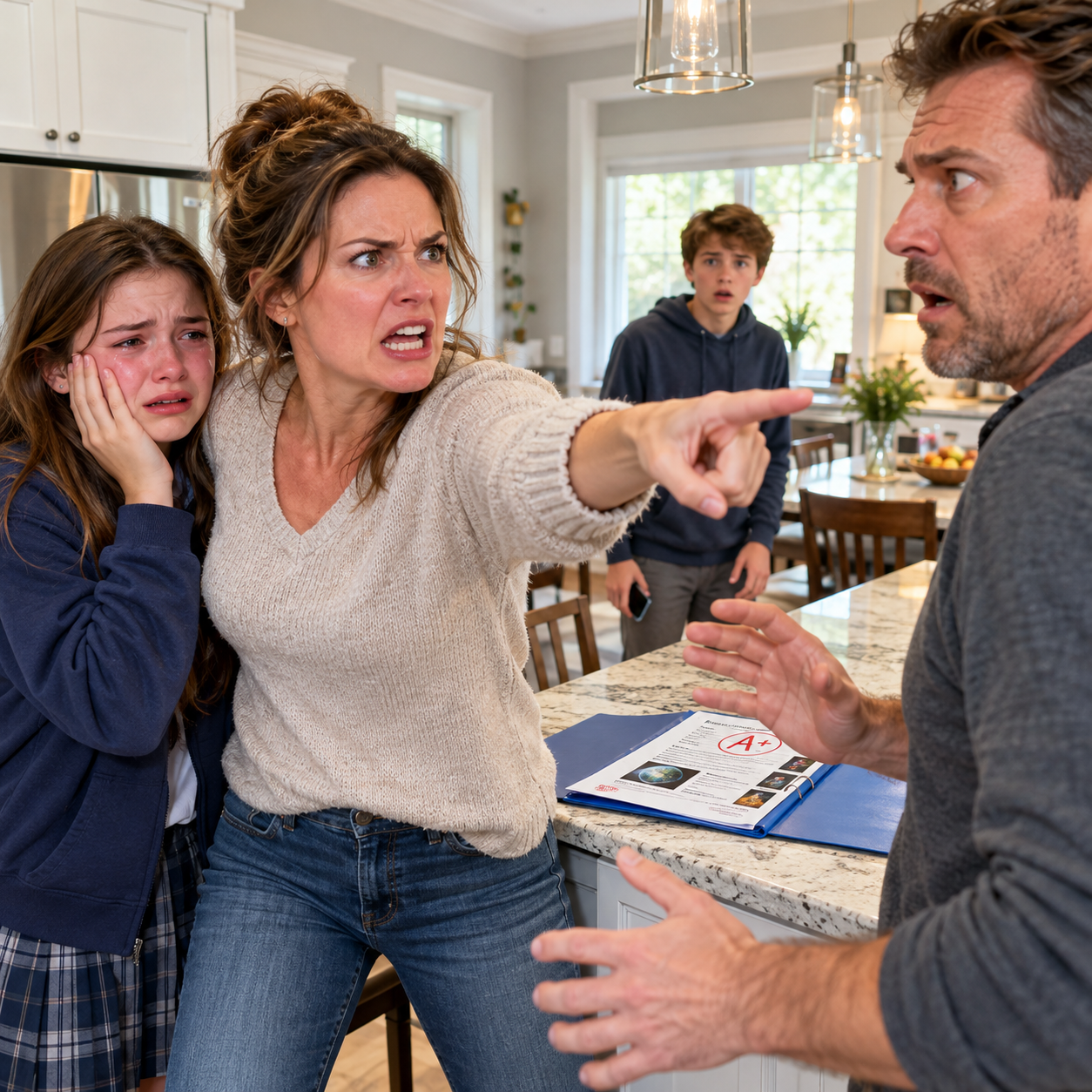
The next morning, Derek found a written notice waiting on the kitchen counter. He read it twice, then looked toward me with the exhausted contempt of someone who believed consequences were an overreaction. “You’re really doing this over one mistake?” he asked. I poured coffee and said, “I’m doing this because you struck Lena. The months of comments explain why I should have acted sooner.”
His expression shifted. “What comments?” I placed Lena’s blue folder beside my coffee mug. “She has been hiding her schoolwork because she learned being proud of herself makes life harder around you.” Derek stared at the folder but didn’t open it. “Kids are dramatic.” From the doorway, Owen said quietly, “She’s not lying.”
Derek turned. “Nobody asked you.” Owen’s shoulders drew inward. Watching him, I understood something I had missed before. Derek’s obsession with Lena’s grades wasn’t really about protecting his son. He was teaching Owen to interpret another child’s success as an accusation against him. Owen looked miserable, not angry.
My mother-in-law, Ruth, called before lunch. Six years earlier, she had practically carried me through the weeks after Daniel’s death, collecting Lena from school, bringing casseroles, sitting beside me when paperwork became impossible to read through tears. That history mattered, and Derek knew it. Ruth began gently. “Maya, I’m not defending what he did.” Then came the word I had expected. “But…”
“Where are they supposed to go?” she asked. “Derek says you’re putting them both out.”
“I’m ending his stay properly.”
“Owen has school.”
“So does Lena.”
“I know, honey. I’m only saying maybe everybody needs a few days to calm down.”
I looked across the bedroom at Lena, who was pretending to read but had not turned a page. “Ruth, your son hit Daniel’s daughter because she refused to apologize for an A-plus.”
Ruth exhaled slowly. “He says she was taunting Owen.”
“She wasn’t.”
“You know Daniel never would have wanted Owen homeless.”
That sentence would once have defeated me. I said, “Daniel also wouldn’t want Lena hiding her achievements in a desk drawer so his brother doesn’t punish her for them.”
Ruth went quiet. When we ended the call, Lena asked whether Grandma was angry with us. I told her Ruth was scared for Derek and Owen. “Because of me?” she asked. I sat beside her. “No. Derek created a situation, and now everyone else is uncomfortable with the consequences. That discomfort does not belong to you.”
Over the following days, Derek obeyed the new household boundaries, mostly because he knew I had documented the incident. Still, he found quieter ways to express his resentment. Cabinets closed with unnecessary force. Phone conversations moved to the garage, where he spoke loudly about “people forgetting who helped them.” Relatives began texting me based on whichever version had reached them first. I stopped trying to win a trial I had never agreed to attend.
On the fifth evening, Derek cornered me while I loaded the dishwasher. His voice was softer than it had been all week. “You really want Owen punished for what I did?” I shut the dishwasher and faced him. “Owen isn’t being punished.” Derek gestured toward the hallway. “He loses his room. His school routine. His family.”
“Because you are his parent and you need to provide another place for him.”
He looked genuinely wounded. “I made one mistake.”
“You spent months making my daughter feel guilty for doing well.”
“I teased her.”
“She stopped bringing achievements downstairs.”
Derek looked toward the floor. “You think I enjoy watching my kid struggle while yours collects awards? Owen comes home feeling like he’s behind everybody. I’m supposed to build him up.”
“By making Lena smaller?”
His mouth tightened. “You wouldn’t understand.”
I did understand more than he realized. Derek was living in the house his older brother’s widow owned, struggling to earn consistently while I paid bills on schedule. Lena’s academic confidence probably looked to him like another scoreboard he and Owen were losing. His pride had turned comparison into grievance, and grievance into entitlement. Understanding that made him more human, but it did nothing to make Lena safer.
Two days later, Owen asked if he could speak to Lena. I stayed in the hall while they sat several feet apart in her doorway. He kept both hands shoved into his sweatshirt pockets. “I didn’t tell Dad you were showing off,” he said. Lena answered, “He said you felt stupid.”
“I did feel stupid.” Her face hardened, and Owen quickly added, “Not because of you. I barely worked on my project, and then I got mad at myself when yours was good. Dad turned it into something else.”
“Why didn’t you tell him to stop?”
“I did before you got home.” Owen stared at the carpet. “After he hit you, I got scared.”
Lena’s anger softened without disappearing. “You could’ve said something.”
“I know.”
He swallowed, then said, “Dad does this all the time. If you’re good at something and I’m not, he acts like you’re trying to embarrass me. He says Aunt Maya looks down on him too.”
From the hallway, I felt the final pieces settle together. Derek hadn’t simply resented Lena. He had been using the children’s differences to explain his own shame.
That weekend, Ruth came to visit. She hugged Lena for a long time, then sat stiffly on the sofa asking ordinary questions about school until Lena mentioned another science assignment and immediately added, “It’s nothing important.” Ruth noticed. “Why do you always say that?”
Lena looked at me before answering. “Because Uncle Derek gets weird when I’m excited about grades.”
Derek walked through the front door just then and saw his mother’s expression. “Great,” he said. “Now she’s recruited you too.”
Ruth stood. “Don’t do that.”
“You came here to lecture me?”
“I came here because I spent the first week worrying about where you were going to live.” Ruth’s eyes filled, though her voice remained steady. “I should have spent the first week asking Lena whether she felt safe in her own house.”
Derek’s face went hard. “So I’m some kind of monster now.”
“No,” Ruth said. “You’re my son. And you did something I cannot defend. Those statements can exist together.”
For the first time since I had told him to leave, Derek had no family argument left to hide behind.
Part 3: Leaving forces our family to choose safety over guilt
Derek packed over the next several weeks. At first, every box announced itself with slammed drawers and muttered complaints. Gradually, the anger lost energy, and the practical problem of finding housing took over. Ruth helped him locate a small apartment he could share with a coworker, close enough that Owen could remain at his school.
One night, I found Derek standing in the spare-room doorway surrounded by half-filled boxes. He picked up an old framed photograph of Daniel that had been on the dresser. “Your husband kicked me out once too,” he said. I waited. “I was twenty-three. Blew my paycheck, got behind on rent, showed up at his apartment. He let me stay exactly three months.”
“I never knew that.”
“He told me helping me wasn’t the same as carrying me.” Derek gave a tired half-smile. “I hated him for about a year.”
“You’ve been here eleven months.”
The smile disappeared. “Yeah.”
I thought he might apologize then. A real apology—not one designed to preserve housing or quiet the family. Instead he said, “Daniel would’ve given me another chance.”
“You don’t know that.”
“Neither do you.”
“No,” I said. “But I know he loved Lena.”
Derek looked at the photograph for several seconds before placing it carefully in the box.
On his final morning, Owen carried bags to the truck while I helped with the heavier boxes because he was fourteen and his father’s mistake did not require me to treat him cruelly. When he came inside for his backpack, Lena was standing near the hallway. They looked at each other with the awkward sadness of cousins who had once been friends and weren’t sure what remained. Owen said, “Bye, Lena.” She answered, “Bye.”
Derek walked through the house one last time. At the door, I held out my hand. “The key.” He stared at my palm, then removed it from his ring. For almost a year, that key had meant he could enter without knocking because I wanted him to feel he still belonged somewhere. Somewhere along the way, he had mistaken belonging for authority.
“You feel better now?” he asked.
“No.”
That answer seemed to surprise him. I closed my fingers around the key. “I wish none of this had happened.”
He looked past me toward Lena. Something moved across his face—regret, shame, maybe both—but he still could not say the words she deserved. Then he stepped outside. I closed the door, turned the deadbolt, and stood there listening to the quiet house.
Quiet was not the same as healed.
For weeks, Lena still lowered her voice when talking about school. She kept looking toward the spare bedroom whenever she laughed loudly, as though Derek might appear and tell her she was showing off. I washed the sheets, opened the window, repaired a dent in the wall, and put the small folding desk back where it had been before he moved in. I wanted ordinary life more than any symbolic victory.
Ruth and I remained in contact, but our relationship changed. I stopped treating everything she had done for me after Daniel died as an unpaid debt. When she began asking whether I might help Derek with his new security deposit, she stopped midway through the sentence. “Sorry,” she said quietly. “Old habit.”
“Thank you for stopping.”
She nodded. Neither of us needed to make the moment bigger than it was.
The first important test came when Lena’s school emailed me about an academic recognition night. Her science teacher had nominated her for an achievement award. Lena read the email over my shoulder and immediately said, “We don’t have to go.”
I turned in my chair. “Do you want to?”
She shrugged. “Maybe.”
“That’s not what I asked.”
Her eyes stayed on the computer screen. “Yes.”
“Then we’re going.”
“What if Grandma tells Uncle Derek?”
“She might.”
“What if he gets mad?”
“He can have whatever feelings he has in his own home.”
Lena studied me as though waiting for the catch. There wasn’t one.
At the ceremony, she wore an old blue sweater Daniel had bought her shortly before he died. The sleeves were a little too short, but she refused to change. When her name was called, she walked onto the stage with a line of other students and accepted a certificate while I applauded hard enough that the woman beside me laughed.
On the drive home, Lena held the certificate across her knees. “Dad would’ve been obnoxious tonight.”
I laughed. “Your father would have yelled your name during the quiet part.”
“And taken fifty pictures.”
“Minimum.”
She smiled toward the passenger window, then asked, “Do you think Uncle Derek hates me?”
I kept my eyes on the road. “I don’t know what Derek feels. I do know you don’t have to hate him just because you don’t feel safe around him.”
“I don’t want him back.”
“You don’t have to.”
“I kind of miss how he used to be sometimes.”
“That makes sense too.”
She turned toward me. I said, “You can care about someone and still need distance from what they did. Those things don’t cancel each other out.”
At home, Lena carried the certificate into the kitchen and stood in front of the refrigerator. She opened the junk drawer, found one of our old magnets, then hesitated. After several seconds, she laughed nervously and said, “Not yet.”
“Okay.”
She took the certificate upstairs. I didn’t tell her to be brave. I didn’t make recovery another test she had to pass. The next morning, the certificate was on top of her desk instead of hidden underneath anything. A few days later, she pinned it to the corkboard beside her bedroom door.
About six weeks after Derek moved out, I came home from work and found Lena at the kitchen table eating cereal twenty minutes before dinner. “You’re going to ruin your appetite,” I said.
“I’m fourteen. I have backup appetites.”
That sounded like her old self. I opened the refrigerator and reached for a bottle of water, then noticed a sheet of paper attached to the door with the faded yellow magnet we had owned since elementary school.
Science Exam — 97% — A.
For a moment, I simply looked at it. Lena kept eating as if nothing unusual had happened. “You put this up.”
She glanced over her shoulder. “Yeah.”
“Nice work.”
“Thanks.”
That was all. No explanation about Owen. No apology. No careful checking of the hallway to see whether someone might resent her happiness. Just a good grade hanging on a refrigerator in her own home.
Derek had laughed when I told him he was leaving because he knew the version of me who absorbed things. Extra bills, uncomfortable jokes, delayed promises, family guilt—I had taught him that I would carry whatever made other people’s lives easier. He assumed I would carry one more thing.
But across the kitchen, Lena was already talking about her next project, words spilling out faster as she became excited. I sat down and listened.
Our family was more complicated than it had been before. Owen and Lena would have to decide what kind of relationship they wanted as they grew older. Ruth loved her son even while accepting that he had been wrong. Derek might someday understand what his pride had cost him, or he might not.
I could live without knowing.
What mattered was that Lena no longer believed somebody else’s insecurity was the price of her success. The refrigerator door had an A on it again. Her voice filled the kitchen without shrinking.
And this time, nobody asked her to apologize.
The End .
All characters and events in this story are fictional, created for storytelling and entertainment purposes. Thank you sincerely for reading. Your feedback and support are invaluable and motivate me to continue sharing more stories with you.

