### Part 2: The Dinner Invitation Hid Something Far Worse Than Reconciliation
Ruth listened without interruption while I spread the documents across her conference table. I showed her the mortgage, my boarding passes, the restaurant receipt, and photographs from Florida that placed me nowhere near Ohio on the date I supposedly appeared before a notary named Tessa Briggs. She examined the signature under a magnifying glass, then asked whether anyone had recently requested permission to borrow against my home. When I told her about Grant’s failed investment proposal, she took off her glasses and placed them carefully beside the papers.
We reported the suspected forgery to Detective Maria Alvarez, who worked financial crimes for the county sheriff’s office. Ruth also notified the lender that I disputed the mortgage and requested the complete loan file, including identification records and the address used for regular statements. The documents revealed that correspondence had been directed to a commercial mailbox rather than my residence. Someone had apparently expected me to remain unaware of the debt until the situation became difficult to conceal.
I couldn’t stop thinking about Clare. Perhaps Grant had lied to her, but perhaps she’d watched him arrange everything and decided my refusal had justified what followed. Ruth cautioned me against turning suspicions into conclusions, pointing out that Grant had controlled much of the family’s correspondence and finances. Still, when I lay awake at night, it wasn’t the possibility of losing my house that troubled me most; it was wondering whether my own child had helped someone steal it.
Early in October, Clare finally sent a message. “Mom, I’ve been thinking about how things ended. Would you come for dinner Sunday? Just us, please.” I sat on the edge of my bed, reading those words until the screen dimmed. For nearly a year, I’d imagined receiving an apology, yet the invitation felt strangely formal, particularly because Grant was usually present whenever Clare made family plans.
Ruth didn’t tell me to decline, but she suggested I approach the evening carefully. She knew the lender had probably contacted Grant about our dispute, and she warned that an invitation could be an attempt to obtain my signature on new documents. We agreed that I would tell her when I arrived, decline to sign anything, and leave immediately if the situation appeared arranged rather than spontaneous. On Sunday afternoon, I baked Clare’s favorite lemon pound cake because I couldn’t bear the thought of arriving at her door empty-handed.
I reached the Ellisons’ house shortly before six-thirty. A silver sedan occupied the driveway, and a small blue hatchback was parked farther down the curb, although Clare had promised we would be alone. Through the front windows, I could see that the dining room lights were on and several chairs had been pulled away from the table. I was reaching for the doorbell when the front door opened just enough for a woman in a faded blue apron to slip outside.
It was Rosa Delgado, the housekeeper who had worked for Clare and Grant for several years. She caught my sleeve with fingers that smelled of lemon cleaner and glanced behind her before speaking. “Mrs. Hartwell, please don’t come inside,” she whispered. “Mr. Grant has a doctor here, and a young lady brought papers for you, and I heard him say you must sign everything tonight.”
I asked whether Clare was there, and Rosa nodded anxiously. “She’s in the kitchen, but I don’t think she understands. He told her this dinner was going to help you both.” Footsteps sounded beyond the door, and Rosa released my arm, whispering one last warning before disappearing inside. I walked back to my car, locked the doors, and called Ruth instead of ringing the bell.
From across the street, I could see through the dining room window. Grant stood near the table talking to a heavyset older man, while a young woman in a gray jacket examined a stack of documents. She appeared deeply uncomfortable, shifting from foot to foot and looking repeatedly toward the hallway. Ruth told me to stay outside while she contacted Detective Alvarez, then remained on the telephone as I described what I could see.
A few minutes later, Clare hurried onto the porch with the young woman following her. My daughter looked thinner than I remembered, her hair coming loose from a clip, and her face had the strained expression I recognized from childhood whenever she was trying not to cry. She spotted my car and crossed the lawn without putting on a coat. “Mom, don’t drive away,” she said through my open window. “There’s something you need to hear, and I think it’s going to be terrible.”
The young woman approached slowly, gripping a canvas bag against her chest. She introduced herself as Tessa Briggs, an administrative employee at Grant’s company and the notary whose seal appeared on my mortgage. “I didn’t see you sign that document,” she admitted, her voice trembling. “Mr. Ellison said you had already agreed, that you’d sign later, and that I would lose my position if I made trouble over a technicality.”
She explained that Grant had brought her a completed mortgage the previous March. He had instructed her to notarize it despite my absence, then recently summoned her to the house to witness additional signatures that he claimed would correct an administrative problem. When Tessa recognized my name in the new paperwork, she’d confronted Clare in the hallway and admitted what she’d done. “I should have refused the first time,” she said, wiping her cheeks. “I’m going to cooperate with the investigation, whatever happens to me.”
Clare reached for the car door but stopped when she saw the folder lying on my passenger seat. I took out the certified mortgage and laid it across the hood, followed by my Florida travel records. She studied the documents under the streetlight, her fingers resting on the date, then stared at the signature for an uncomfortable length of time. “He told me you’d changed your mind,” she whispered. “He said you helped us privately because you didn’t want me knowing you’d given in.”
I asked whether that was why she’d stopped answering my letters, and Clare looked confused. She insisted I had never written to her, explaining that Grant regularly collected the mail while she worked around Theo’s school schedule. I told her the dates of the four cards and described the lighthouse drawing I’d made for Theo’s birthday. Her expression changed as she realized that the silence between us might not have belonged entirely to either of us.
Tessa opened her canvas bag and showed us a black notary journal. On the March 14 entry, my name had been recorded as someone personally known to her, but the space reserved for my acknowledgment was empty. She had retained the journal despite Grant’s instructions to replace it, and she agreed to surrender it directly to the investigators. When Ruth arrived and saw the pages, she immediately understood that we finally had evidence from inside the transaction itself.
### Part 3: Four Unopened Letters Revealed Who Had Destroyed Our Trust
Ruth advised against confronting Grant without support, so we remained outside until Detective Alvarez arrived. Clare asked the detective to accompany us into her home, and Tessa agreed to explain the notarization in Grant’s presence. I carried the cake because I’d left it on the back seat, although the thought of eating dinner had long since disappeared. As we entered, I noticed Rosa standing beside the kitchen doorway, twisting the edge of her apron.
Grant looked startled to see Detective Alvarez, but his familiar courteous manner returned almost immediately. He introduced the older visitor as Dr. Harold Weiss, a retired physician and family acquaintance who had supposedly come to discuss my well-being. Dr. Weiss explained awkwardly that Grant had expressed concerns about my memory since Daniel’s death and thought I might benefit from assistance with financial decisions. I asked whether he had ever examined me, and he admitted he hadn’t.
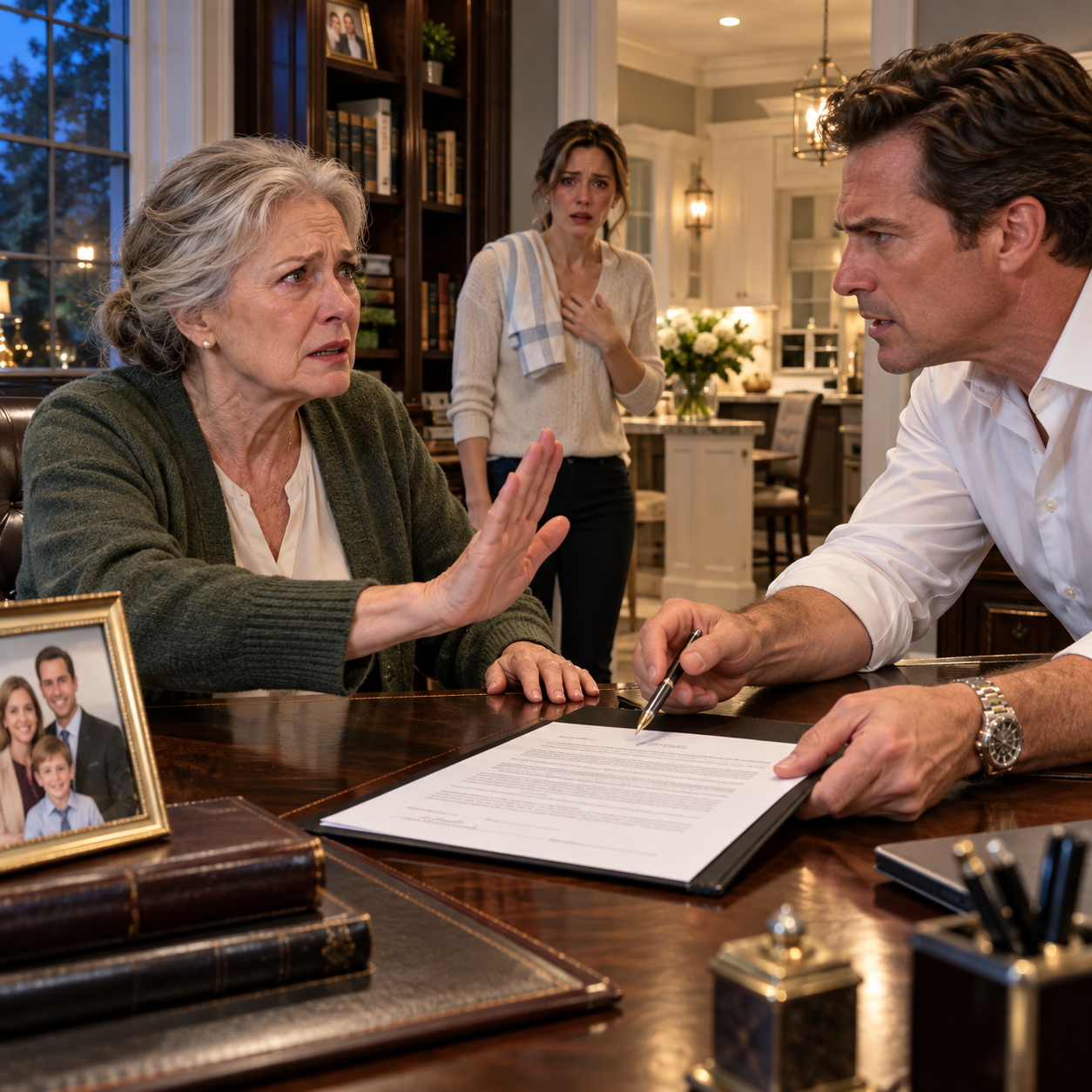
The documents waiting beside my place setting were labeled as a family financial protection agreement. I leafed through them while Ruth read over my shoulder, noticing broad language about estate administration, legal representation, and the settlement of previous family obligations. Buried several pages into the agreement was a provision acknowledging the validity of the March mortgage and waiving my right to challenge it. I turned the papers toward Dr. Weiss and asked whether that was what he believed he’d been invited to witness.
He leaned forward, adjusted his glasses, and read the provision twice. “Grant, you told me your mother-in-law wanted help organizing her affairs,” he said, pushing back from the table. Grant replied that the language was standard and accused us of turning a misunderstanding into an unnecessary legal dispute. Ruth explained that an alleged forged mortgage was already under investigation and that the proposed agreement could compromise my position if I signed it. Dr. Weiss stood, apologized for his involvement, and asked the detective to record that he’d been unaware of the loan dispute.
Tessa then placed her journal before Detective Alvarez. She identified the March entry and acknowledged that I had never appeared before her, adding that Grant had supplied the documents and directed her to complete the notarization. Grant’s expression tightened as he insisted Tessa had misunderstood his instructions, but she answered without raising her voice. “You told me Mrs. Hartwell would never see the original because the payments would be finished before anyone looked,” she said.
For several seconds, Grant watched her as though he might still persuade her to take back the statement. Then he turned toward Clare and spoke in the practical tone he used whenever a business arrangement went badly. “I was trying to keep the company operating, Clare. We had employees depending on those projects, and the bank was threatening to pull everything apart.” Clare asked why that required using my house without permission, and Grant rubbed his forehead rather than answering.
“I meant to repay it,” he finally said. “The developments were going to recover, but every time I found a way forward, somebody demanded another guarantee.” I could hear genuine exhaustion in his voice, and for a moment I recognized the charming young man who had once helped Daniel carry lumber into the garage. But exhaustion didn’t explain the false signature, the concealed statements, or the document he’d invited me to sign that evening.
Clare remained seated, her hands clasped tightly in front of her. “Grant, what happened to my mother’s letters?” she asked. He glanced toward the detective and said he didn’t see how family correspondence had anything to do with a financial investigation. Clare repeated the question, and Rosa made a small movement at the kitchen doorway. When Grant told his wife to stop creating more problems, Rosa stepped forward holding four envelopes tied together with kitchen string.
“I kept them,” she told Clare, placing the bundle on the table. She explained that Grant had instructed her to discard every card addressed to Clare or Theo from me, claiming the messages would only reopen painful arguments. She had retrieved them from the household trash because she couldn’t bring herself to destroy a grandmother’s words to her grandson. “I was afraid of losing my job,” Rosa said, looking down at her hands. “I am sorry I didn’t give them to you sooner.”
Clare untied the string and examined the envelopes. Each remained unopened, bearing the handwriting she’d recognized throughout her childhood on lunchbox notes, birthday cards, and Christmas presents. She opened Theo’s birthday card first, unfolded the drawing of his mother’s old lighthouse bookshelf, and pressed the paper against her chest. Grant started to speak, but she held up one hand and said, “I spent nearly a year believing she abandoned us because you made sure I never heard from her.”
Grant insisted he’d wanted to protect Clare from further arguments, then looked toward me. “You know how hard things have been,” he said. “If this becomes public, Theo could pay for something he had nothing to do with.” I told him Theo’s privacy mattered, but the solution was to handle the investigation properly, not ask everyone else to conceal his actions. Clare removed her wedding ring, set it beside the unopened letters, and asked Grant to leave the house for the night.
He didn’t argue again. After consulting briefly with Detective Alvarez, he took his keys and left, while Ruth arranged for the documents to be preserved and Tessa formally surrendered her journal. The detective explained that the investigation would continue and that no one should alter or dispose of records connected to the loan. Clare waited until the front door closed before coming around the table and kneeling beside my chair.
“I saw things I should’ve questioned,” she said, tears running freely down her cheeks. “Bills he wouldn’t discuss, accounts he said I didn’t need to worry about, and excuses whenever I asked why we couldn’t afford things we supposedly owned.” She admitted she’d been so frightened of discovering her marriage was failing that blaming me had become easier than examining what was happening at home. I held her hands and told her I loved her, but love alone couldn’t erase the year we’d lost or restore the trust she’d broken.
That night, Clare packed two suitcases while I helped Theo find his favorite dinosaur blanket. Rosa prepared sandwiches because nobody had eaten dinner, and even Detective Alvarez accepted a cup of coffee before finishing her notes. Clare and Theo came home with me, sleeping in the guest room where Daniel’s unfinished bookshelf still stood against the wall. Long after they were asleep, I sat at the kitchen table looking at the untouched lemon cake and wondering how many ordinary Sundays it would take for our lives to feel ordinary again.
The legal proceedings lasted several months. Investigators obtained the lender’s records, established that the loan proceeds had gone toward Grant’s business obligations, and compared the disputed signature with decades of my genuine handwriting. Grant eventually pleaded guilty to charges arising from the forged mortgage and received a custodial sentence with restitution obligations. Following the investigation and civil proceedings, Callaway released its claim against my property, and Ruth personally checked the county records to confirm the lien had been cleared.
Tessa also faced consequences for her role. She lost her notary commission and received probation after cooperating with investigators, while Rosa left her employment with the Ellisons and eventually found work caring for an older woman in the neighborhood. I helped Rosa obtain legal advice about unpaid wages, although she insisted that seeing Clare reunited with Theo’s grandmother was worth more than anything else. I disagreed about the wages and made sure she pursued what she was owed.
Clare filed for divorce and returned to part-time administrative work at a dental office. She and Theo stayed with me for two months, which brought both unexpected laughter and difficult conversations about the choices we’d made. She apologized more than once for accusing me of putting money ahead of family, and I admitted that my own pride had kept me from reaching out directly when our letters went unanswered. We began meeting with a family counselor because neither of us wanted another year of unspoken resentment.
I also changed my estate documents. Ruth helped arrange independent oversight of any future financial decisions, and Clare supported those safeguards without asking for special access. When she rented a small apartment nearby, she insisted on paying the security deposit and setting up the utilities herself. I was proud of that, although I was careful not to confuse her new independence with a promise that every old wound had healed.
Nearly a year after the dinner at Grant’s house, my phone buzzed while I was folding laundry. Clare had written, “Would you come over Sunday evening, Mom? I’d like to cook for you. Just us.” I stared at those last two words, remembering the silver sedan, Rosa’s trembling hand, and the papers waiting beside an empty chair. Then I typed, “I’d like that very much. Shall I bring dessert?”
She replied with a photograph of Theo grinning beside a mixing bowl, his face streaked with flour. “He’s helping me bake something for tomorrow, but we both know nobody makes lemon cake like you.” When I arrived Sunday evening, Clare opened the apartment door herself, kissed my cheek, and took the cake from my hands. We sat down together at her small kitchen table, where the only papers waiting were Theo’s school drawings, and for the first time in a long while, neither of us felt the need to explain why we were there.
The End .
All characters and events in this story are fictional, created for storytelling and entertainment purposes. Thank you sincerely for reading. Your feedback and support are invaluable and motivate me to continue sharing more stories with you.