
Part 2: The Truth Forced Me To Stop Financing Claire’s Excuses
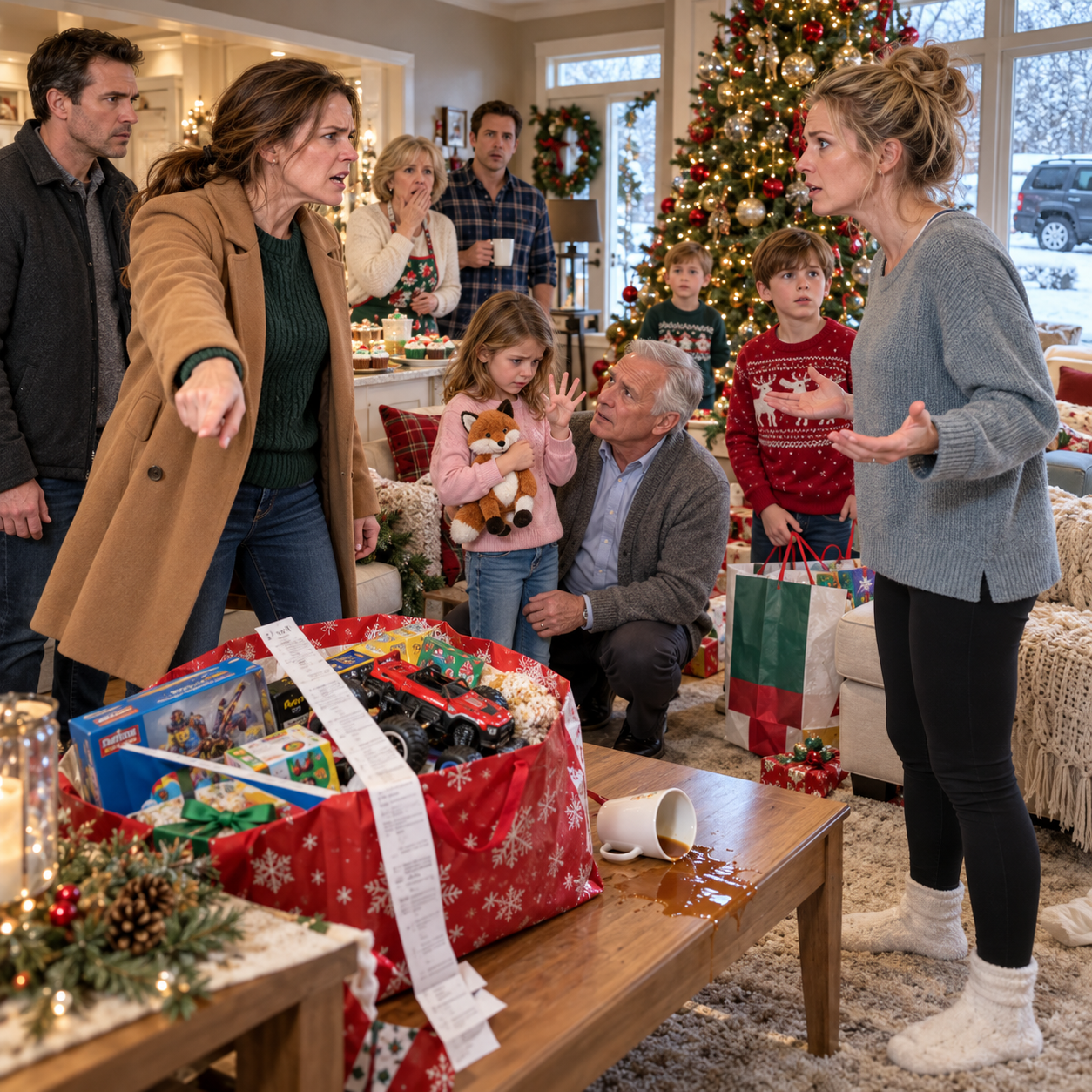
Mark drove us away before I said anything else I might regret.
Ava sat quietly behind us. Every few minutes, I checked the mirror and found her looking down at her fox.
“Are you mad at me?” she finally asked.
“No, sweetheart.”
“Because Auntie said you would be.”
I turned around as far as my seat belt allowed.
“I’m upset with Aunt Claire because she was responsible for keeping you safe. That’s an adult’s job, not yours.”
Ava considered that for a moment.
“Can we still have Christmas?”
Mark reached over and squeezed my hand.
“Of course we can,” I said.
We called the pediatrician’s after-hours service, then took Ava to be examined. Thankfully, she showed no signs of lasting physical injury, but the doctor reminded us that being left unattended in a cold vehicle could have ended very differently.
Ava answered the doctor’s questions in the same careful voice she’d used in the car.
That worried me more than her tears would have.
Afterward, we stopped at her godmother Beth’s house. Beth had been my closest friend for twenty years, and Ava loved spending time with her and her teenage daughter. We needed a little time to decide what came next without Ava listening to another adult argument.
Beth opened the door in slippers and a flannel robe.
She took one look at us and said, “Come inside.”
Ava disappeared beneath a blanket on Beth’s couch. Within minutes, she was watching a cartoon, her fox tucked beneath her chin.
I kissed her forehead before leaving.
“You’re safe here,” I whispered.
She nodded without looking away from the television.
On the drive home, I kept thinking about that tiny nod.
Ava had learned to make herself agreeable around my sister. She had learned not to complain when she was uncomfortable. Somewhere during those five days, she’d started believing that protecting an adult’s feelings mattered more than telling her mother she was scared.
I knew exactly where that lesson had come from.
In our family, Claire had always been the one who needed a little extra understanding.
When she quit her first job, Mom said she was still finding herself. When she fell behind on rent, Dad called it a rough patch. When she borrowed money and forgot to repay it, everyone agreed that keeping track would only cause resentment.
I had participated in that arrangement for years.
Three years earlier, when Claire was struggling financially, I’d helped her open a joint checking account. She used it for household emergencies, and I deposited money whenever she needed help.
I was supposed to be teaching her how to budget.
Instead, I had become her emergency fund.
That night, I opened my laptop at the kitchen table.
The transaction history told a familiar story.
Rent assistance. Car insurance. Grocery deliveries. Two birthday-party deposits. A payment for Mason’s soccer registration. Money transferred into the account before Claire’s debit card could be declined.
There were Christmas purchases, too, including several made during Ava’s visit.
Mark pulled out the chair beside me.
“How much have we given her this year?” he asked.
I looked at the figures.
“More than I want to say out loud.”
He nodded toward the screen.
“Then don’t. Just decide whether you’re going to keep doing it.”
I reviewed the balance, transferred the money that belonged to me into our household account, and canceled the automatic deposits. I contacted the bank about formally separating our shared account, making sure Claire’s own funds remained untouched.
Then I opened my phone.
There were messages from Mom, Dad, and Brian. Claire had sent six.
The longest began:
“You embarrassed me in front of my kids. You always have to make yourself look like the responsible one.”
Another read:
“You left Ava with me, Nancy. If you didn’t trust me, maybe you shouldn’t have.”
I saved the messages.
Not because I wanted to punish her, but because I already knew how family stories changed with time. A few weeks from now, someone would call it a misunderstanding. By Easter, perhaps Claire would have left Ava alone for only fifteen minutes.
I wasn’t going to let my daughter become an exaggeration that everybody politely corrected.
The following morning, Mom called again.
I answered while standing beside the kitchen sink.
“Claire told us more,” she said.
“Did she admit the four hours?”
“Yes. Eli remembered the time they left because they’d just finished lunch. Brian checked the receipts from the stores. It was almost four hours.”
I closed my eyes.
Mom continued, “Claire says she was overwhelmed. She wanted the boys to have a nice day, and she didn’t think Ava would enjoy the shopping.”
“Then she should have taken Ava home.”
“I know.”
It was the first time in years my mother hadn’t added a defense.
“Your father is furious,” she said. “He told Claire she had no business looking after Ava if she couldn’t treat her like one of her own children.”
I looked toward the Christmas stockings hanging above our fireplace.
I’d filled Claire’s boys’ stockings every year, along with bags of presents I bought whenever Claire said money was tight.
“I’m not paying her bills anymore, Mom.”
There was a pause.
“I understand.”
“And she won’t be taking care of Ava again.”
“I understand that, too.”
I spent Christmas Eve returning what I could from the gifts intended for Claire’s household. The unopened items that couldn’t be returned went to a local holiday donation program.
It wasn’t Eli or Mason’s fault. I knew that. They would still receive the presents already at their house, and I wouldn’t ask them to choose sides. But I couldn’t continue buying affection for a family in which my daughter had been treated as less important.
That evening, Ava came home from Beth’s.
We ate spaghetti in our pajamas, watched How the Grinch Stole Christmas, and let her fall asleep between us on the couch.
For two hours, nobody mentioned Claire.
Then, while I carried Ava upstairs, she opened her eyes.
“Mommy?”
“Yes?”
“Next time I say something is wrong, will you believe me right away?”
I held her a little closer.
“Every time, sweetheart.”
She closed her eyes again.
And I knew that keeping that promise would matter more than anything I could ever say to my sister.
Part 3: A Crumpled Christmas Gift Brought Claire Back To My Door
The day after Christmas, someone rang our doorbell just after noon.
Mark glanced through the front window.
“Your parents are here,” he said. Then his expression changed. “Claire’s with them.”
I opened the door.
Mom and Dad stood on the porch wearing their winter coats. Behind them was Claire, dressed in leggings and a sweatshirt, holding a small package wrapped in wrinkled silver paper.
Brian’s car was idling at the curb.
Claire looked exhausted. Her hair hung loose around her face, and her eyes were swollen.
“I brought something for Ava,” she said.
I didn’t reach for the package.
“Mom, Dad, come inside.”
Claire took a step forward.
“Not you.”
She stared at me while our parents passed through the doorway.
I shut the door.
Mom sat on the couch, rubbing her hands together. Dad remained standing beside the fireplace.
“She wanted to come apologize,” Mom began.
“Then why are you here speaking for her?”
Mom looked down.
Dad cleared his throat. “She lost her job last week. She didn’t tell anybody.”
That caught my attention.
“Even Brian?”
“He knew,” Dad said. “Apparently, they’ve been arguing about money for months.”
I thought about the toy-store purchases, the restaurant receipts, the Christmas gifts Claire had been so determined to buy.
“She’s terrified of looking like she’s failed,” Mom added.
I sat opposite them.
“That explains the shopping. It doesn’t explain Ava.”
Dad nodded.
“You’re right.”
The doorbell rang again.
Claire stood outside holding the package against her chest.
“I know I made a mistake,” she said when I opened the door. “But cutting me off financially? Returning presents? Keeping Mom and Dad away from me?”
“I’m not keeping anybody away from you.”
“They’re sitting in your house while I’m standing outside like a criminal.”
“They came to talk to me.”
Claire glanced over my shoulder.
“You know what? Fine. I messed up. But you act like you’ve never made a parenting mistake.”
I waited.
She looked down at the package.
“I wanted one nice day with my boys. I’d just lost my job. I didn’t know how we were going to afford Christmas, and I couldn’t stand seeing them disappointed.”
“So you left Ava in the car.”
“I thought we’d be quick.”
“You came back and checked on her. You knew she was cold.”
Claire swallowed.
“I know.”
“And you went shopping again.”
Her eyes filled, but she didn’t answer.
I watched her struggle to find words that would make her actions sound less deliberate.
“I didn’t want her complaining in front of the boys,” she finally admitted. “I needed one afternoon where somebody wasn’t asking me for something.”
There it was.
Not confusion. Not an emergency.
She had wanted a break, and my daughter had paid for it.
“You could have called me,” I said. “I would have driven there and picked her up.”
“I knew you’d be angry.”
“Claire, you were more afraid of my reaction than you were concerned about leaving Ava alone.”
She wiped her cheek.
“I don’t know what you want me to say.”
“Something about what Ava went through. Something that isn’t about you.”
For a moment, she looked at the present in her hands as though it contained an answer.
Then she whispered, “Can I at least give her this?”
“Not today.”
I closed the door gently.
Through the window, I saw Claire speak to Brian through his car window. He looked at her for several seconds before driving away.
She stayed.
Instead of calling someone to collect her, she sat on the curb with the present in her lap.
Snow began collecting on her shoulders.
Inside, my mother watched from the couch.
“She’s going to make herself sick.”
I picked up my phone and sent Brian a message asking him to return for her.
“She has somewhere warm to go,” I told Mom. “She doesn’t have to sit there.”
Mom stared at her daughter through the window.
“Your father told her he was ashamed of her,” she said quietly. “I’ve never heard him say that to either of you.”
Dad looked at the floor.
“I should have said something years ago,” he admitted. “Not those words, maybe. But something.”
Mom rubbed her wedding ring.
“We kept fixing everything for her because we thought we were helping.”
I looked at them both.
“So did I.”
For the first time, none of us tried to soften the truth.
When my parents eventually left, Claire stood up, expecting them to approach her. Dad paused long enough to say something I couldn’t hear.
Then he and Mom walked to their car.
Claire remained on the sidewalk, the silver package hanging from one hand.
About ten minutes later, Brian returned.
I watched Claire climb into the passenger seat.
The package stayed on my porch.
Part 4: I Chose My Daughter’s Safety Over Our Family’s Old Habits
The little gift remained outside for two days.
The snow softened its wrapping, and moisture seeped through one corner of the box. I didn’t open it. On the second morning, I placed it in the trash along with the torn ribbons and empty cardboard boxes left from Christmas.
A week later, an unfamiliar number sent me a message.
“I’m trying. Please don’t give up on me.”
I suspected it was Claire, but I didn’t answer.
For years, I’d responded to every crisis she brought to my door. I’d paid bills before she asked, smoothed things over with our parents, and persuaded myself that helping her was the same as loving her.
Now I was beginning to understand the difference.
Mark and I arranged for Ava to speak with a child counselor. We didn’t want her carrying the responsibility for what happened, or believing that adults might punish her for telling the truth.
At home, we practiced simple things.
She could say she was uncomfortable. She could ask to call us. She could tell another trusted adult if someone refused to help.
Most importantly, she didn’t have to keep secrets about her safety.
Over the following weeks, Ava slowly returned to herself.
She asked to have Beth’s daughter over for a sleepover. They made popcorn, built a blanket fort in the living room, and laughed so loudly that Mark came downstairs to see what was happening.
I stood in the kitchen listening.
It was an ordinary Saturday night.
I’d never been so grateful for one.
Mom and Dad continued visiting. Sometimes they mentioned Claire, but they stopped asking me to repair things. Dad told me she’d begun looking for steady work. Mom said Brian was encouraging her to get counseling.
I hoped she would.
I also knew that her progress, whatever it looked like, didn’t require Ava to become part of it.
Several months later, I found an envelope in our mailbox.
There was no stamp or return address. Across the front, Claire had written my full name in the careful cursive she’d used on birthday cards when we were girls.
I carried it inside and set it beside the kitchen sink.
For a long time, I looked at the handwriting.
I remembered teaching Claire to ride a bicycle. Sharing a bedroom when we were children. Driving her to her first job interview. Holding her babies when they were born.
I remembered a sister I had loved long before I became the person who paid her bills.
Perhaps the envelope held a genuine apology. Perhaps she’d finally found the words I had asked for.
I couldn’t know without opening it.
But I wasn’t ready, and I no longer believed I owed anyone access to my life simply because they wanted it.
I lit a match over the empty ceramic sink and burned the unopened letter, watching the flame consume the handwriting before running water over the ashes.
I wasn’t proud of every choice I’d made that Christmas. I wished I hadn’t slapped Claire. I wished I’d recognized sooner how differently she treated Ava when I wasn’t watching.
But I would not apologize for ending an arrangement that had allowed my sister to mistake my generosity for an unlimited second chance.
That evening, Ava came into the kitchen carrying her stuffed fox.
“Mom, can we make cookies?”
I smiled.
“Chocolate chip?”
“With extra chocolate.”
She pulled a chair toward the counter and climbed up beside me.
As we measured flour, she told me about school, her friends, and a book she wanted from the library. Her voice was light, her attention entirely on the cookie dough.
She didn’t ask about the envelope.
She didn’t ask about Claire.
And for once, I didn’t feel compelled to explain the absence.
My daughter was safe. She knew she could tell me the truth. Our home was peaceful again, and the people who loved her had learned to put her needs before their own comfort.
I couldn’t give Ava back those four hours in the parking lot.
But I could make certain she never had to earn her place in our family by staying quiet.
When the cookies were ready, she took the first one, broke it in half, and offered me the larger piece.
I took it.
Then we sat together at the kitchen table while the evening settled around our little house.
There was no dramatic reunion. No perfect apology. No promise that our family would someday look exactly as it had before.
There was simply a mother and her daughter sharing warm cookies, with nothing frightening left unsaid between them.
For us, that was enough.
The End .
All characters and events in this story are fictional, created for storytelling and entertainment purposes. Thank you sincerely for reading. Your feedback and support are invaluable and motivate me to continue sharing more stories with you.


