
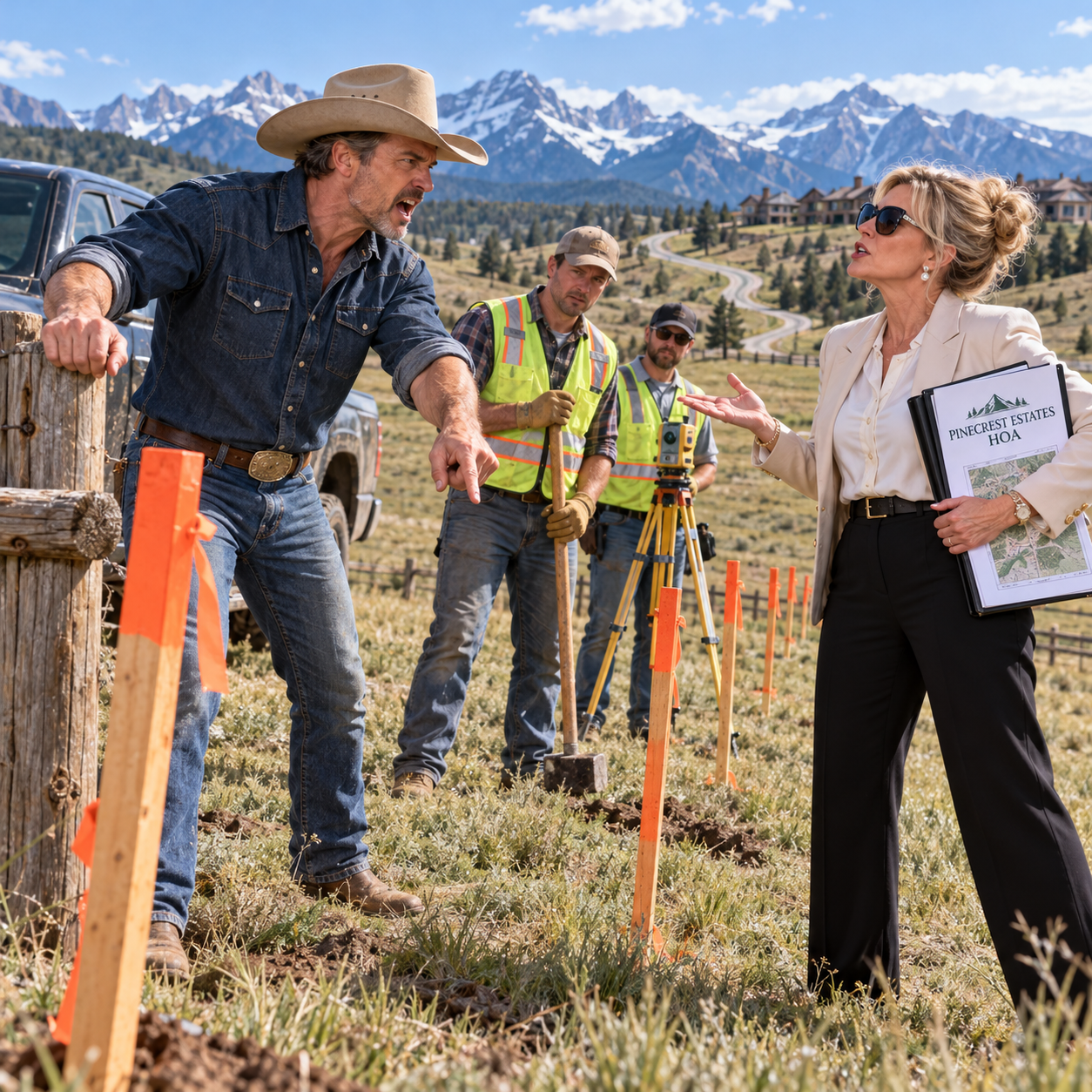
Part 2: Forgotten Survey Records Revealed A Dangerous Mistake Beneath Pinecrest
Michael met me the next morning beside the northern pasture, carrying a battered leather notebook and an old survey map. At seventy-two, he walked carefully over uneven ground but still recognized every ridge and creek crossing. We followed a cattle trail into a stand of lodgepole pines, where he brushed grass away from a weathered granite marker. “This is the original monument,” he said.
He compared the marker with Denise’s survey and pointed toward the county highway. The HOA’s contractor had apparently used a highway reference point established for a different purpose, then carried that error through several boundary calculations. “A survey is only as reliable as the evidence you use to establish its starting point,” Michael explained. He recommended that we hire an independent surveyor to verify both monuments and reconstruct the original property lines.
I commissioned that work immediately, but Denise refused to delay her claim. She called that afternoon and offered what she described as one final opportunity to cooperate before litigation. I told her a qualified surveyor was checking the historical boundaries, and she accused me of stalling. “You can’t make this disappear by refusing to accept the facts,” she said before ending the call.
Within a week, Pinecrest filed a civil action seeking a declaration that the disputed land belonged to the HOA. Denise circulated a neighborhood letter portraying me as a wealthy rancher trying to intimidate ordinary homeowners. She also claimed my family had benefited from an inaccurate boundary for generations. Laura read the letter in silence, then asked how people who barely knew us had become so certain we were dishonest.
Our attorney, Nathan Cole, examined the documents without offering immediate reassurance. He explained that old surveys could be complicated and that property rights required more than finding one suspicious coordinate. We needed original records, a professional boundary reconstruction, and evidence explaining how the competing descriptions had been created. “We’ll follow the evidence,” he told me, “and let the court decide what it supports.”
Rachel soon uncovered another name in an archived planning file: Linda Shaw. Linda had worked for the county planning department when Pinecrest was first approved, and she still lived about forty minutes away. Laura and I visited her on a rainy Thursday afternoon. When we explained the dispute, Linda disappeared into her study and returned carrying a thin cardboard folder.
Inside was a copy of an old county warning sent to Pinecrest’s original developer. The letter questioned the reference monument used in a subdivision drawing and instructed the developer to reconcile the conflicting survey information before proceeding with later phases. Linda remembered the disagreement because several revised drawings had circulated through her office. “Some corrections were made,” she said, “but I’m not convinced every later plan used the corrected reference.”
That discovery strengthened our concerns, although Nathan cautioned that a historical warning wasn’t itself proof of present ownership. The independent surveyor spent several days verifying monuments, comparing measurements, and preparing a detailed boundary report. When the findings arrived, they placed the disputed six hundred acres within Walker Ridge. More troubling, portions of the HOA’s proposed improvements also extended onto our land.
One improvement had already begun. Denise’s contractors had graded a small roadside turnout near the northern fence, apparently believing it fell within the association’s newly claimed property. Nathan obtained photographs, dated work records, and equipment-location information documenting the activity. He sent a formal request for construction to stop while the lawsuit proceeded. This time, the contractor complied.
Then Rachel uncovered something none of us had initially considered. While tracing every recorded document affecting the disputed boundary, she examined Cedar Pass, the road Pinecrest residents used daily. Its route lay almost entirely within Walker Ridge, and she couldn’t find a recorded permanent easement granting the HOA unrestricted access. My grandfather’s handwritten correspondence indicated that the original developer had been allowed to use the road by permission.
Nathan studied the records carefully and warned me not to assume that missing paperwork settled every access question. Decades of continuous use could raise additional legal issues, and Pinecrest might have other rights that required investigation. Nevertheless, the association had never formalized a road-maintenance agreement with our family. Suddenly, the conflict involved not only six hundred acres but the road nearly two hundred households depended upon.
I drove Cedar Pass that evening and watched residents returning from work. A delivery van passed me near the creek, followed by two pickups and a family SUV with bicycles strapped behind it. The pavement was worn where spring runoff crossed the shoulder, and several drainage culverts needed replacing. For years, those expenses had appeared on our ranch accounts while Pinecrest treated the road as ordinary subdivision infrastructure.
Laura joined me outside after supper, and I explained what Nathan had found. “You’re not thinking about closing the road, are you?” she asked. I told her I wasn’t going to punish families for a lawsuit most of them hadn’t understood. But if Pinecrest wanted to challenge my ownership, its board also needed to understand the responsibilities attached to using my property.
Several weeks later, Nathan arranged a meeting with the HOA’s attorney to discuss the conflicting surveys. Denise attended with two board members and repeated her belief that the newest map should control. When our independent surveyor explained the original monuments, she interrupted repeatedly and asked why anyone should trust records that old. The HOA’s own attorney eventually requested a private discussion with his clients.
Afterward, Nathan received a call from Pinecrest’s treasurer, Scott Marlow. Scott sounded troubled and admitted several board members had never seen the original planning warning or the details of our independent survey. He also revealed that an earlier property-management file had noted unresolved questions about the northern boundary. Denise, he said, had assured the board the lawsuit would pressure me into accepting a settlement.
I sat quietly after that conversation, trying to understand why she had chosen confrontation over verification. Nathan told me that whatever Denise had believed, the documents would matter more than her confidence. Our next court hearing would address the disputed evidence and requests for temporary relief while the case continued. As I watched headlights climb Cedar Pass that night, I wondered whether the homeowners understood just how much their board had put at risk.
Part 3: The Lawsuit Fell Apart But The Road Remained Open
The courthouse was crowded on the morning of our hearing. Pinecrest residents filled several benches behind Denise, who sat beside the HOA’s attorney with polished maps arranged across the table. Laura squeezed my hand as Nathan reviewed his notes. I had spent months defending land my family had owned for generations, yet I felt strangely calm when the judge entered.
Michael testified first about the original monument and the historical surveying records. Our independent surveyor then explained the incorrect reference point and presented a reconstructed boundary supported by field measurements. Rachel described the inconsistency she had found in the subdivision plat, while Linda’s archived county warning supplied important historical context. By the time their testimony was finished, the colorful map Denise had brought looked far less convincing.
The HOA’s attorney argued that residents and property professionals had relied on subdivision maps for many years. Nathan acknowledged that longstanding reliance deserved consideration but emphasized that it didn’t automatically establish ownership of neighboring land. He submitted the historical deeds and asked the HOA’s survey representative to explain the conflicting monuments. The explanation left several questions unanswered.
The judge also examined evidence of the turnout grading. Nathan explained that contractors had entered the disputed area before ownership was resolved, while the HOA’s attorney maintained his client had acted under a sincere belief about the boundary. The judge asked why construction had proceeded despite known uncertainty. Denise leaned toward her attorney, but he offered no clear answer beyond the information the board had relied upon.
During a recess, Scott approached us in the hallway. He apologized for the accusations circulating through Pinecrest and admitted that residents had been told the survey was conclusive. “Denise said you’d settle once the legal bills started adding up,” he said quietly. Laura looked at him and asked, “Did anybody on the board ever consider that Daniel might actually own the land?”
Scott lowered his eyes and admitted some members had raised questions before the lawsuit. He told Nathan about the earlier management note and offered to help locate the association’s complete survey correspondence. Nathan asked him to provide the information through the proper legal process. I could tell Scott was embarrassed, but I appreciated that he was finally willing to confront the uncertainty his board had ignored.
When the hearing resumed, the judge pressed both attorneys about the historical boundary evidence and the status of the pending claims. She did not deliver a dramatic ruling that afternoon or settle every question from the bench. Instead, she expressed concern about the inconsistencies and urged the parties to review the competing records before incurring more expense. Pinecrest’s attorney requested time to confer with his board.
Nathan then raised Cedar Pass as an additional issue requiring careful resolution. He explained the history of permissive access and the absence of a recorded permanent road agreement in the documents we’d located. The judge made no immediate determination about the residents’ legal access rights, but the discussion visibly unsettled several homeowners. One woman whispered that her children took the school bus along that road every morning.
I understood her fear immediately. Those families had homes, jobs, medical appointments, and ordinary lives that depended on getting through my ranch. Whatever the HOA had done, I wasn’t interested in trapping innocent neighbors behind a locked gate. When Nathan asked whether I’d support a temporary access arrangement while the matter was negotiated, I agreed without hesitation.
Over the following weeks, Pinecrest’s attorneys reviewed the independent survey and additional historical records. The association ultimately agreed to withdraw its six-hundred-acre ownership claim, and the parties completed a settlement that resolved the boundary dispute. The graded turnout would be repaired, the HOA would acknowledge the surveyed Walker Ridge boundary, and neither side would pursue further claims arising from that construction. After months of uncertainty, my family’s land was no longer under challenge.
Negotiations over Cedar Pass took longer. Nathan explained that any permanent agreement needed to address potential existing access rights rather than pretend those questions didn’t exist. Both sides eventually settled on a recorded road easement defining the route, permitted uses, maintenance obligations, insurance responsibilities, and procedures for future repairs. The arrangement protected reliable access for Pinecrest residents while recognizing Walker Ridge’s ownership of the underlying land.
The HOA initially resisted contributing to maintenance. Nathan produced years of receipts for grading, culvert replacement, winter plowing, and storm cleanup, all paid by my family. Scott studied the figures and admitted he hadn’t realized how much the work cost. “Your residents haven’t been using a road that costs nothing,” Nathan explained. “They’ve been using a road the Mercers have been paying to maintain.”
We agreed to an annual maintenance contribution based on documented expenses, with adjustments for unusually severe damage or winter conditions. The HOA also funded the turnout restoration and arranged its own snow-removal contractor. I wasn’t trying to profit from my neighbors; I wanted the responsibility shared fairly. For the first time, Pinecrest had a written agreement explaining what it could use and what it needed to maintain.
Denise did not attend the final settlement meeting. The board had placed her on leave while reviewing its handling of the lawsuit, and she resigned from the presidency two weeks later. I didn’t receive an apology from her, and I never asked for one. Her survey stakes disappeared, the lawsuit ended, and I had more important things to do than continue arguing.
On the first morning after the permanent agreement was recorded, I stood beside Cedar Pass as the school bus rolled over the cattle guard. Behind it came pickup trucks, delivery vans, and commuters heading toward the county highway. Some drivers waved, while others looked straight ahead. I didn’t mind either way, because the road was open and my family’s ownership was finally understood.
The first heavy snow arrived several weeks later. I woke before sunrise, prepared to bring out our ranch plow, but machinery was already working along Cedar Pass. Through the kitchen window, I watched an HOA-funded truck clearing the roadway while its headlights moved through the falling snow. Laura stood beside me and smiled. “Your dad would have enjoyed seeing somebody else handle that job.”
“He’d probably complain they were pushing the snow in the wrong direction,” I answered. Laura laughed because she knew exactly how my father would have reacted. He had been generous with neighbors, but he had also believed strongly in doing a job properly. I wished he could have seen how the road had finally become a shared responsibility.
About a month after Denise resigned, Nathan called with the results of the board’s internal review. Pinecrest’s survey contractor had apparently recommended additional monument verification before the HOA made a definitive ownership claim. That recommendation had been delivered before the lawsuit, along with other indications that the boundary was not fully reconciled. The board concluded that Denise had pursued the claim without adequately addressing those warnings.
I listened without saying much, then looked through the window toward the northern pasture. For months, I had wondered whether this entire ordeal came from an innocent mistake or an unwillingness to question an uncertain answer. The newly uncovered correspondence suggested Denise had been told there were reasons to slow down. Instead, she had treated pressure as a shortcut to getting what she wanted.
That evening, I walked to the old steel gate beside Cedar Pass. Beyond it, headlights moved between the pines as Pinecrest families returned home, just as they had throughout my father’s lifetime. The ranch was still 4,200 acres, the road still followed the same winding route, and the neighbors could still reach their homes. What had changed was the understanding that made those ordinary things possible.
My father had taught me that generosity was part of being a good neighbor, and I still believed him. But he also taught me to protect what had been entrusted to my care, even when doing so made people uncomfortable. Cedar Pass remained open, not because someone had demanded what wasn’t theirs, but because we finally had an agreement both sides could honor. For the first time in years, the headlights crossing Walker Ridge reminded me of neighbors instead of a dispute.
The End .
All characters and events in this story are fictional, created for storytelling and entertainment purposes. Thank you sincerely for reading. Your feedback and support are invaluable and motivate me to continue sharing more stories with you.


