
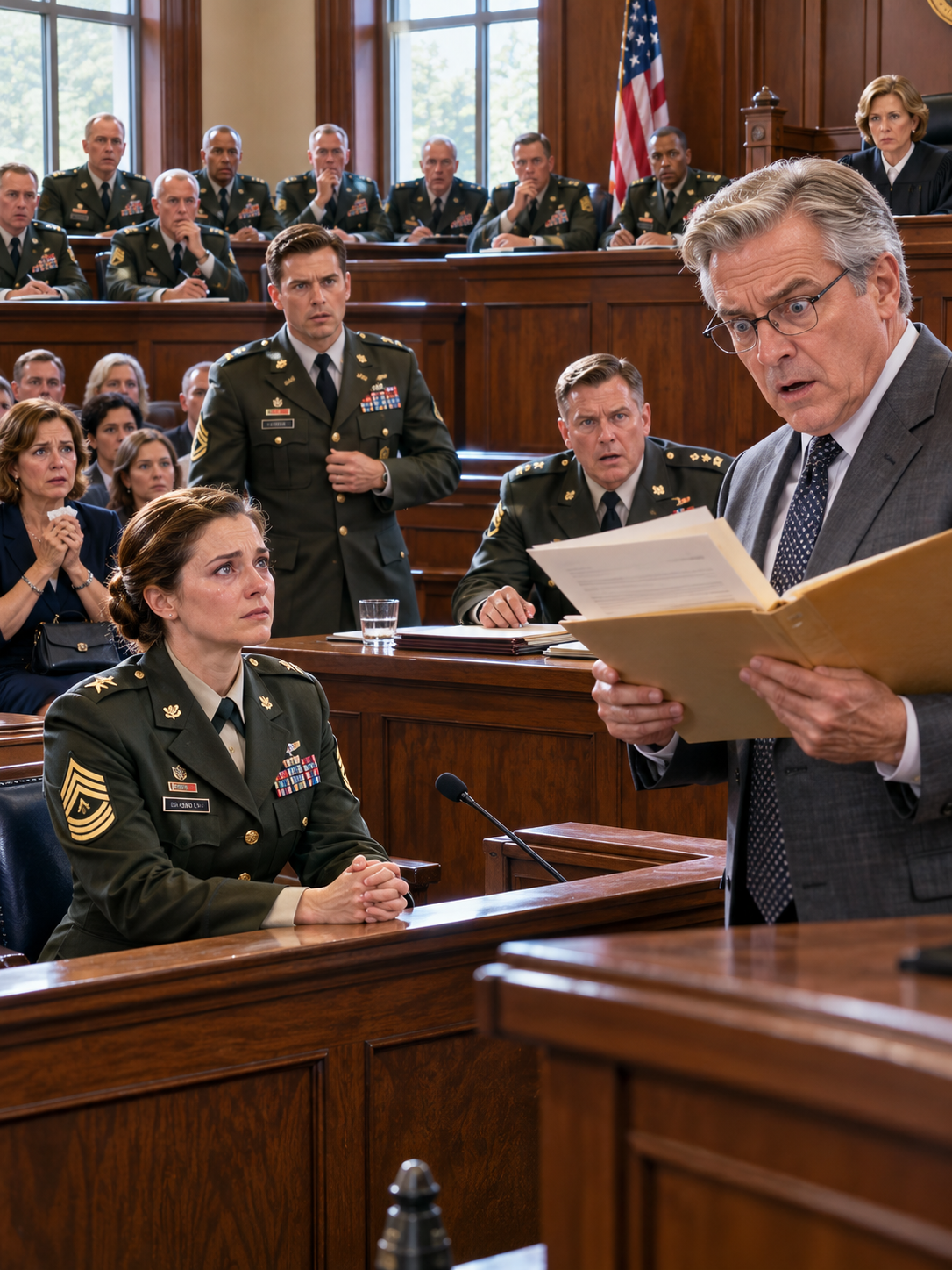
David Arnold raised my Army personnel file and read the word “disloyal” loudly enough for eight officers to hear. Across the courtroom, the commander who had destroyed my career leaned back with a satisfied smile. I locked my trembling hands together beneath the witness rail. The lawyer was about to turn a page neither of us understood.
### Part 1: Eight officers listened as my ruined military record became evidence
The courtroom at Fort Stewart, Georgia, was freezing despite the October heat outside. At 10:10 on Tuesday morning, eight senior officers sat in the panel box with legal pads balanced on their knees, watching David Arnold carry a manila folder toward the lectern. I was Sergeant First Class Jenna Pierce, thirty-six years old, sixteen years in the Army, and the government’s principal witness against Lieutenant Colonel Ryan Gardner. Gardner sat at the defense table in his dress uniform, his silver insignia catching the fluorescent light, looking more comfortable than I’d seen him in three years.
Arnold adjusted his glasses and smiled at the panel. “Members, the government wants you to believe this woman remembers one afternoon three years ago with absolute accuracy, so I think you deserve to know what her own Army thought of her.” He lifted the first sheet. “September 2023. Formally counseled for insubordination and disloyalty to her chain of command.”
A pen scratched across a legal pad. Then another.
“October 2023. Relieved of duties as battalion motor sergeant due to loss of confidence.” Arnold paused, giving the officers time to write. “November 2023. Reassigned to a holding detachment, followed by another transfer to an entirely different brigade.”
He lowered the paper and turned toward me. “Sergeant Pierce, is any of that inaccurate?”
“No, sir.”
“You were counseled for disloyalty?”
“Yes, sir.”
“Removed from your position?”
“Yes, sir.”
“And transferred twice?”
“Yes, sir.”
Arnold nodded as though he’d just proved something important. “Members, what you have here isn’t a heroic whistleblower. You have a soldier with a history of challenging commanders, who blamed her superior officer when a young man suffered a tragic accident.”
At the defense table, Gardner leaned back and folded his arms.
The young man’s name was Specialist Mason Allen. He was twenty-two, from Spokane, Washington, and he dreamed of opening a diesel repair shop with his name painted across the front window. He carried a hand-drawn sketch of that shop in his wallet. His mother, Michelle, sat in the second row behind the prosecution table, holding a small navy purse against her knees.
Arnold never said Mason’s name.
I kept my hands folded because if I loosened them, everyone would see them shake.
Three years earlier, on September 12, 2023, I had inspected a five-ton cargo truck scheduled for a training demonstration. Truck Seven had a leaking rear brake chamber and an air line chafed dangerously against its frame. I marked the maintenance worksheet with a red X, the Army’s unmistakable symbol that a vehicle was not mission capable.
That truck wasn’t supposed to move.
But Lieutenant Colonel Gardner wanted every vehicle rolling when a visiting corps commander arrived. At approximately eight that morning, my shop foreman, Sergeant First Class Chad Peterson, delivered Gardner’s instruction to put Truck Seven in the convoy. I walked straight to the commander’s office and explained the defect.
“The brakes will fade on that downgrade, sir,” I warned.
Gardner barely looked up. “Tell the driver to use the engine brake. Truck Seven rolls.”
“Sir, the vehicle is deadlined.”
He finally raised his eyes. “Sergeant, are you having difficulty understanding an order?”
I should have taken the keys. Instead, I returned to the motor pool, warned Mason to maintain a wide interval, and handed the keys to the dispatcher. Mason gave me his familiar crooked grin and said, “Roger that, Sergeant,” before I’d finished speaking.
At 10:20, his brakes failed on the second curve.
The truck left the road and rolled. I reached the cab while dust still drifted through the trees, and Mason kept telling me he could drive it out. I held his head steady and talked to him about Spokane, his mother, and the shop he wanted to build until he stopped answering.
He died two days later.
Now Arnold stood three feet away, holding the file that made me look like the villain.
He turned toward his next question, but Captain Brandon Nelson, the young prosecutor, rose from his chair and slowly buttoned his jacket.
“Your Honor, the government invokes Military Rule of Evidence 106, the rule of completeness. The defense has read selected portions of Exhibit F. Fairness requires the remainder be presented.”
Arnold frowned. “Judge, the remaining material is administrative.”
Military Judge Colonel Julie Olson leaned forward.
“Then it should be simple to read, Mr. Arnold. Continue with page two.”
Arnold looked down.
His smile disappeared.
“Your Honor,” he whispered, “may I have time to review the document?”
Judge Olson checked the clock and granted a recess until nine the following morning.
As the eight officers filed out, their pens remained motionless on the rail.
I watched Arnold close the folder with both hands.
And I realized something that frightened me more than his accusations.
In three years, I had never read page two either.
### Part 2: A fatal truck accident reveals the cost of refusing orders
The witness room smelled of old coffee and floor polish. Specialist Natalie Cook, a young paralegal, brought me water and told me Captain Nelson had released me until morning. I thanked her, but remained seated beneath a crooked Army Values poster, staring at the paper cup as if it contained an answer.
My mind kept returning to September 14, 2023, when Chad Peterson came into the motor pool carrying Mason’s leather tool roll. His initials, M. Allen, were stamped near the buckle. Chad didn’t have to explain what the hospital had called to say; I understood before he opened his mouth.
I placed the roll on a workbench carefully, almost gently, as though Mason might return to claim it.
Two days earlier, shortly after the ambulance left the accident site, I had returned to my office and found the original inspection worksheet in its tray. My red X was still there, beside the description of the defective brake line and my initials. I walked to the copier, made one duplicate, folded it into quarters, and tucked it behind my notebook.
Something inside me knew that piece of paper might be the last honest record of what happened.
On September 18, Gardner summoned me to his office. His command sergeant major stood at the window while Gardner pushed a clean, typed maintenance worksheet across his desk. It declared Truck Seven operational at the morning inspection, with an empty space where my signature belonged.
“Sign it, Sergeant. It protects everyone involved.”
I stared at the blank line. “Sir, I marked that truck with a red X.”
“You made a mistake during the inspection.”
“No, sir. I documented the brake failure, and I told you the vehicle couldn’t move.”
Gardner’s expression hardened. “A soldier has died, Sergeant. Do you really want to destroy more careers over a paperwork dispute?”
He extended his pen.
I didn’t take it.
“No, sir. I won’t sign something false.”
The following morning, I entered the Inspector General’s office with my photocopy and notebook. An officer listened without interrupting, examined both documents, and explained that my complaint was a legally protected communication. Reporting misconduct, he assured me, could not lawfully be used against my career.
Seventy-two hours later, Gardner handed me a formal counseling statement accusing me of disloyalty, insubordination, and conduct unbecoming an NCO.
I signed to acknowledge receipt, then wrote in the comments section: I disagree with this counseling.
Gardner watched me put down the pen. “You did this to yourself.”
By October, he’d removed me from the motor pool. In November, I was transferred to a holding detachment, where my responsibilities included distributing cleaning supplies and signing out brooms. I ate lunch alone in my car because soldiers who once respected me now looked away when I passed.
One afternoon, an old acquaintance spotted me sweeping concrete. “Heard you tried to ruin your commander’s career over a maintenance form.”
“That’s not what happened.”
He shrugged and walked away.
I could explain myself a hundred times, but the official counseling remained in my file. Anyone could read the accusation. Almost nobody could see the protected Inspector General investigation.
The lie was public. My defense was invisible.
Every week, the investigators called to say their work continued. I answered politely, studied logistics courses at night, and ran before sunrise because exhaustion was easier to manage than regret.
In February 2024, a major from the commanding general’s office called. He said my situation had been reviewed, corrective action had been approved, and I would receive orders transferring me to a training brigade. I asked no questions; by then, I’d lost faith that any official document would ever tell the truth about me.
I also never requested a copy of the memorandum.
Eventually, the investigation became a criminal case, and Gardner was charged. At the preliminary hearing in spring 2025, I encountered Michelle Allen in a hallway. She looked at me with eyes so painfully familiar that I nearly stepped backward.
“You were with him,” she said.
“Yes, ma’am. At the end.”
She nodded, but her attorney guided her away before either of us spoke again.
When Captain Nelson prepared me for the court-martial, he warned that Arnold intended to use my disciplinary history against me. He offered to object and try to prevent the personnel file from being presented.
“No, sir,” I told him. “Let him read it.”
“Even knowing what they’ll say about you?”
“People have believed those words for three years. I want the officers to hear everything.”
Nelson studied me for a moment. “Have you read the second page?”
I shook my head.
He didn’t tell me what it contained.
Now, on Wednesday morning, I returned to the witness chair at 8:58. Gardner sat stiffly beside Arnold, and the gallery was crowded with officers who hadn’t attended the earlier testimony. Michelle was in her usual seat, while Gardner’s wife sat behind her in a cream-colored jacket.
At exactly nine, Judge Olson looked over her glasses.
“Mr. Arnold, resume reading Exhibit F.”
Arnold opened the folder, and I saw his fingers tighten around page two.
### Part 3: The hidden memorandum turns a humiliating accusation into public vindication
“Department of the Army,” Arnold began, his once-confident voice unusually thin. “Headquarters, Fort Stewart. Office of the Commanding General. Memorandum for Record. Subject: Findings and Action, Inspector General Case Regarding Staff Sergeant Jenna Pierce.”
He stopped and cleared his throat.
“Continue, counsel,” Judge Olson instructed.
Arnold read the first finding: on September 19, 2023, I had made a protected complaint alleging that the maintenance records of Truck Seven were altered following Mason Allen’s fatal accident. The complaint identified the original red-X inspection and the replacement document falsely declaring the truck operational.
The officers leaned forward.
“Finding two,” Arnold continued. “The Inspector General substantiated that Lieutenant Colonel Ryan Gardner issued negative counseling to Staff Sergeant Pierce seventy-two hours after her protected communication.”
One pen stopped.
“That Lieutenant Colonel Gardner subsequently relieved Staff Sergeant Pierce from her position as battalion motor sergeant.”
Another pen fell silent.
“That he directed her reassignment to a holding detachment.”
Colonel Rice, seated at the front of the panel, set his pen flat and removed his glasses.
Arnold swallowed.
“Finding three. These adverse personnel actions constituted reprisal for a protected communication, in violation of applicable law and Army regulation. The counseling and relief actions are rescinded, and the derogatory records are to be expunged.”
My breath caught.
For three years, I’d believed those accusations still defined my official career. The people who’d humiliated me had treated them as permanent, and I’d never seen the document reversing them.
Arnold had been reading the punishment without knowing it had been officially condemned.
“Finding four. Staff Sergeant Pierce’s subsequent assignment to a training brigade was directed to protect her from further retaliation and restore her to a position of trust.”
He paused, but Judge Olson didn’t look away.
“Finish the document, Mr. Arnold.”
“Finding five,” he said quietly. “Staff Sergeant Pierce’s refusal to authenticate a falsified maintenance record, and her decision to report misconduct despite substantial personal consequences, represent the integrity and moral courage expected of every noncommissioned officer of the United States Army.”
He read the signature beneath it.
“Robin Palmer. Major General, United States Army. Commanding.”
No one moved.
Eight officers sat with their pens down.
Across the aisle, Gardner stared at the defense table, his hands spread flat against the wood. His wife had stopped shaking her head at me. Michelle Allen closed her eyes, pressing her purse against her lap.
I should have felt victorious. Instead, I could barely breathe, as though someone had removed a heavy weight I’d learned to carry so long ago that I no longer understood how to stand without it.
“Mr. Arnold,” Judge Olson asked, “anything further?”
The attorney closed the folder.
“No further questions, Your Honor.”
Captain Nelson rose. “Sergeant Pierce, had you read that memorandum before this morning?”
“No, sir.”
“Why not?”
I looked at the officers who had just heard my commanding general defend me more clearly than I’d ever defended myself.
“Because, sir, I didn’t believe there was anything good left in my record.”
Nelson nodded. “Nothing further.”
At Colonel Rice’s request, Judge Olson ordered complete copies of the exhibit distributed to the panel. I watched all eight officers read both pages, some turning backward to compare the accusations with the official findings.
Six hours and twenty minutes later, the panel returned its verdict.
I attended even though I wasn’t required to. Gardner stood at attention beside Arnold as Colonel Rice announced the findings: guilty of reprisal, guilty of making a false official statement, and guilty of dereliction of duty for ordering a vehicle he knew was unsafe into operation.
Gardner showed almost no reaction. His wife covered her mouth, while Michelle stared at the flag behind the judge.
I remained seated until everyone else stood.
In the hallway, Arnold approached me carrying his briefcase. He stopped several feet away and admitted he’d never examined page two before using the file against me. Gardner had supplied the document and assured him the remainder concerned routine administration.
“I accepted his explanation,” Arnold said. “I built my entire questioning around a page that wasn’t the truth.”
I looked at him without speaking.
“Thirty-one years practicing law,” he continued, “and I have never had my own evidence prove me so completely wrong. Yesterday, I described you as someone you aren’t. I owe you an apology.”
“Thank you, sir.”
He nodded and left.
Michelle approached next. Before she could speak, I forced myself to say what had followed me through every sleepless night.
“I handed Mason those keys. I could have stopped that truck, and I didn’t. I’m sorry.”
Her eyes filled, but her voice remained steady.
“I’ve read every report, Sergeant. Every radio transcript and maintenance record. I know exactly what happened.”
I lowered my gaze.
“Everyone else was telling my son to go,” she whispered. “You were the one person telling them that truck shouldn’t move.”
“It wasn’t enough.”
“No,” she answered. “Nothing would have been enough to bring him home.”
She reached out and touched my arm.
“But you refused to let them erase what happened to him. Don’t forget that part.”
For the first time in three years, I let myself cry.
### Part 4: A grieving mother’s final gift transforms justice into lasting purpose
That Saturday, my phone rang at seven in the morning. Sergeant First Class Chad Peterson was calling from Fort Campbell, Kentucky, where he’d been reassigned after the investigation. He had testified before I took the stand, but I hadn’t been allowed to hear his testimony.
“Jenna,” he said, “there’s something I should’ve told you years ago.”
I sat down at the kitchen table.
“When Gardner ordered Seven onto that road, I said yes. After Mason died, they brought me that replacement inspection sheet, and I signed my portion of it.”
I closed my eyes.
“I told the panel everything,” he continued. “I told them I signed because I was afraid, and you wouldn’t sign because it was wrong. I let you carry the consequences alone.”
“You told them the truth eventually, Chad.”
“Three years too late.”
We sat in silence until he asked whether I still ran in the mornings. I said yes, and he promised to start again. Neither of us pretended that running would undo what happened.
The following Wednesday, I returned to court for Gardner’s sentencing. His wife sat behind the defense table with a tightly folded tissue, and Michelle occupied the same seat she’d held throughout the trial.
When Judge Olson offered Gardner an opportunity to speak, he stood slowly and turned toward Michelle.
“Mrs. Allen, I’ve spent three years preparing explanations for what happened to your son. I’m not going to offer you one.”
His voice trembled.
“Sergeant Pierce told me that truck’s brakes were unsafe. She warned me twice. I ordered it onto the road anyway, and after Mason died, I tried to falsify the record. When she refused, I retaliated against her because protecting my career mattered more to me than telling the truth.”
His wife began crying quietly.
“Mason Allen should be alive,” Gardner said. “I was wrong, and there is no excuse.”
He turned toward the back of the courtroom and found me.
“Sergeant Pierce, you did your duty. I punished you for it. That is my failure, not yours.”
Michelle rose before the judge could continue.
“I wanted to hear you say my son’s name,” she said. “You finally did.”
Then she sat down.
After deliberating, the panel sentenced Gardner to dismissal from the service, four years of confinement, and forfeiture of all pay and allowances. Military police approached the defense table, and Gardner stood quietly while they secured his wrists. His wife whispered, “Ryan,” as he turned toward the side door.
I expected satisfaction when it closed behind him.
Instead, I thought about Mason’s unused drawing of his repair shop.
No sentence could build that shop. No finding could return a son to his mother.
That evening, I opened the cardboard box I’d kept on my closet shelf since leaving the motor pool. Inside lay my old shop coat, its patch faded from years of work. Beneath my socks, I found a small leather strip I’d cut from the corner of Mason’s tool roll before his belongings were returned.
M. Allen.
I’d kept it hidden because I thought it represented my failure. That night, I placed it beside the coat, where I would see his name whenever I opened the closet.
The following week, the commandant of the post NCO Academy emailed me. They were revising their maintenance safety instruction after the trial and wanted someone with firsthand experience to teach the new block.
I accepted.
Forty young mechanics and motor sergeants filled the classroom on my first morning. I carried an approved eleven-page lesson plan to the lectern, then set it aside and drew a large red X on the whiteboard.
“What does this mean?” I asked.
A staff sergeant raised his hand. “Vehicle is deadlined. Not mission capable.”
“That’s the regulation. What does it mean in practice?”
A woman near the back answered. “It means the vehicle doesn’t move.”
“Exactly. Write that down.”
Forty pens began scratching.
I listened to the sound and remembered eight pens falling silent in a courtroom.
“There may come a day,” I told them, “when an officer orders you to release equipment you know is unsafe. That officer may outrank you, may threaten your career, and may have an entire mission depending on your answer.”
Nobody looked away.
“You’ll have seconds to decide whether you care more about your orders or the lives depending on your judgment. I made that decision badly once, and a soldier died.”
A young staff sergeant raised her hand.
“Were you the sergeant from the trial?”
“Yes. I inspected that truck, marked it unsafe, and still handed over the keys. Afterward, I refused to sign a false record.”
“Did you know the truth would eventually come out?”
“No,” I answered. “I only knew I couldn’t change what I’d written.”
She copied that sentence into her notebook.
After class, the commandant offered me the opportunity to teach the block every five weeks, with a possible permanent instructor position the following summer. I drove home thinking about the students who’d been taking notes, especially the quiet young woman in the back who’d understood the meaning of the red X before anyone else.
A padded envelope was leaning against my apartment door.
The return address was Spokane, Washington.
Inside was a folded letter and something heavy wrapped in a dish towel. I recognized Michelle Allen’s handwriting before I finished reading the first line.
Sergeant Pierce,
I’m sending you something Mason treasured. He saved for eight months to buy this socket set, and he kept it in his leather tool roll. He always said good tools deserved careful hands.
Captain Nelson told me you kept a piece of that leather. I understand why now.
Mason wanted to open a shop. He won’t get that chance, but perhaps someone else will. You can keep these tools, or give them to a young mechanic who needs them.
I trust you to decide.
Michelle Allen.
I unwrapped the towel.
Inside lay Mason’s socket set, every steel piece polished and arranged in its proper place. The numbers on the ratchet were worn from use, and one handle bore a shallow scratch I remembered seeing whenever Mason worked beneath a truck.
I held it against my chest.
Then I walked to the closet, brought down the shop coat, and placed the tools beside the strip of leather bearing his name.
For three years, I’d believed that shelf held nothing but the evidence of what I’d lost.
Now I saw something else.
The coat belonged to a job I had loved. The leather belonged to a young man who had trusted me. The tools belonged to a future he never got to live.
I couldn’t return that future to him.
But I could make sure his name remained attached to the lesson that might protect someone else’s.
The next morning, I called the academy commandant and accepted the permanent instructor position. I also asked permission to establish a small equipment scholarship for promising young mechanics, beginning with a carefully restored socket set belonging to Specialist Mason Allen.
Before the first class of the new term, I placed the original photocopy of Truck Seven’s inspection worksheet inside a protective sleeve. The paper was worn at the folds, and the red X had faded slightly, but every word remained legible.
On the classroom wall, beside the official maintenance safety guidance, I hung the document that Gardner had once tried to erase.
Below it, I placed a small photograph of Mason smiling beside a military truck.
I stood back, adjusted the frame, and heard students entering the room behind me.
“Sergeant,” a young mechanic asked, “who’s the soldier in the picture?”
I looked at the photograph.
“His name was Mason Allen,” I said. “And he taught me why some orders must never be followed.”
Then I picked up my marker and drew a red X on the whiteboard.
Forty pens moved together.
This time, every stroke sounded like a promise.
THE END.
All characters and events in this story are fictional, created for storytelling and entertainment purposes. Thank you sincerely for reading. Your feedback and support are invaluable and motivate me to continue sharing more stories with you.


