
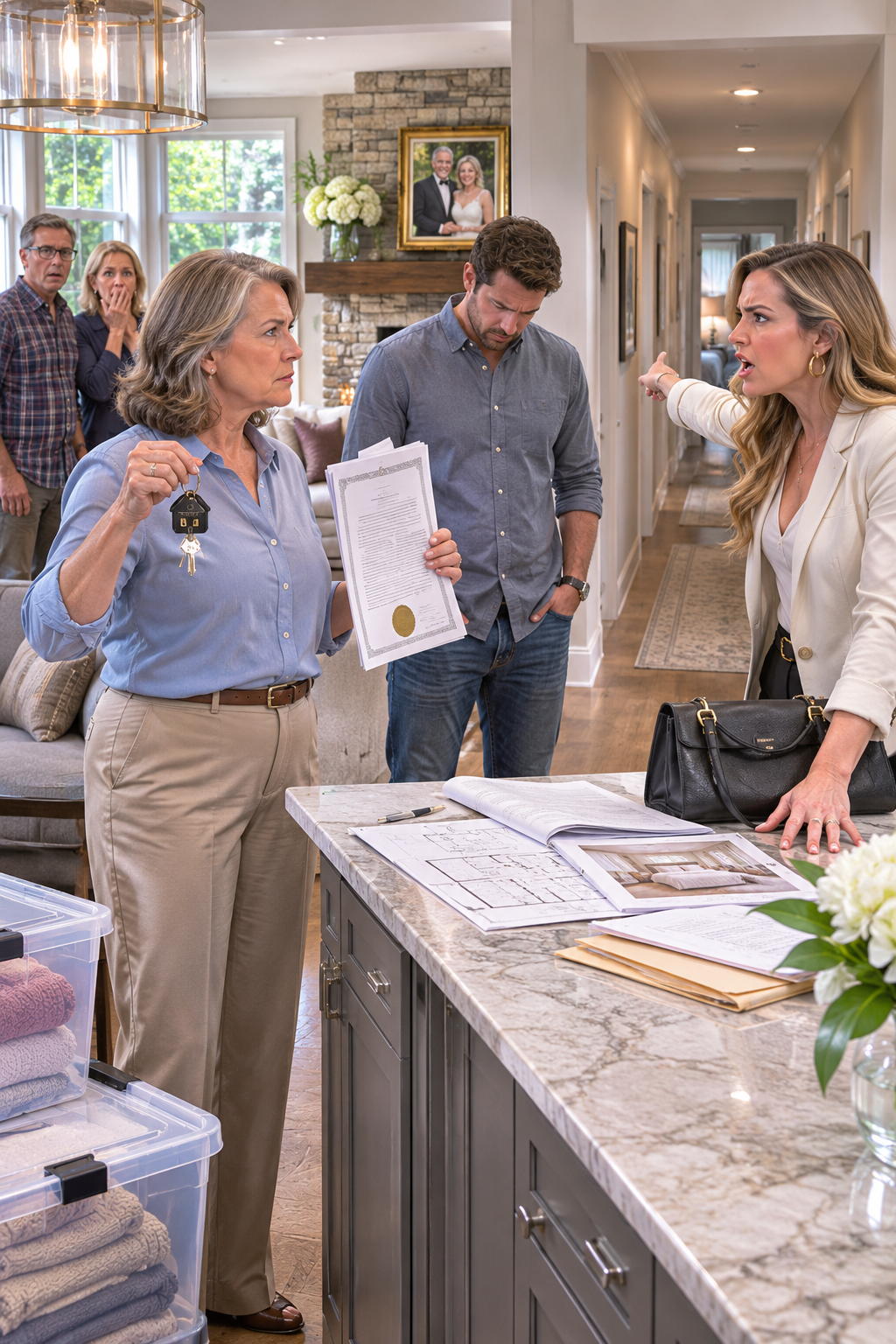
### Part 2: A changed lock exposes the plan they never asked about
Saturday morning, my telephone rang six times in less than an hour. Three calls came from Dylan and three from Carrie. I let them go to voicemail while I folded towels in the laundry room, the same room beside which Carrie had decided I should sleep.
Her final message sounded controlled and furious. “Karen, we came over with more belongings, but our key doesn’t work. You need to call me today.”
I returned the call Sunday morning.
“Yes, Carrie, I changed the locks.”
A sharp silence followed. “Well, Dylan needs a key.”
“Dylan doesn’t live here.”
“Our lease ends in three weeks,” she snapped. “We’ve already started packing. You can’t suddenly change your mind.”
“I haven’t changed my mind. I never agreed to your arrangement.”
She interrupted, but I continued. “You walked into my kitchen, announced you were moving in, and assigned me a bedroom. That wasn’t a conversation, Carrie. It was a decision you made without me.”
“You’re being impossible.”
“No. I’m being clear. You and Dylan will not be moving into this house.”
I asked her to put my son on the telephone.
“Mom?” His voice sounded exhausted.
“I love you, Dylan. But I watched you stand beside your wife while she told me where I would sleep in my own home. You said nothing. I need you to understand how much that hurt.”
“She was just being practical.”
“There’s a difference between being practical and treating someone else’s property as your own.”
He didn’t answer.
“When you’re ready to have a proper conversation, call me.”
I hung up, carried my watering can onto the back deck, and tended the last tomatoes of the season. My hands were steady, although my heart wasn’t.
The following week, I went to my Tuesday watercolor class, had Thursday dinner with my friend Marilyn, and walked beside Okanagan Lake on Friday morning. I watched sunlight break across the water and realized how wrong Carrie had been about my loneliness. I missed Terry terribly, but my life hadn’t stopped when his did.
Then, eleven days before their lease expired, I found Carrie waiting on my front porch.
She stood with her arms folded, watching me unload groceries from the car.
“We need to talk.”
“Hello, Carrie.”
“Don’t ‘hello’ me, Karen. Do you realize what you’ve done? We had a financial plan, and you’ve ruined it because you’d rather sit alone in this house being miserable.”
I carried my groceries inside, returned to the doorway, and faced her.
“I’m not miserable. I’m actually quite content.”
Her expression tightened. “Our lease ends in eleven days. We have nowhere to go. We were counting on you.”
“Then you counted on something I never promised.”
“You didn’t say no!”
I held her gaze. “Not saying yes isn’t the same as saying yes.”
For the first time, she seemed uncertain.
Her voice softened. “Look, I know I came on too strong. Dylan’s job situation has been difficult, and the rental market is brutal. We only need a few months. Surely you can help us for a few months.”
I remembered my parents allowing a relative to stay with them temporarily. Four years passed before that relative finally moved out.
“I’m sorry things are difficult,” I said. “But you’ll need to find another rental. Even something smaller or temporary.”
Carrie’s face hardened again.
“Fine. Then I want my storage tubs.”
“Of course. They’ve already been delivered.”
She blinked. “What?”
“I arranged for a local hauling service to take them back to your condominium. The concierge confirmed receiving them.”
Two young men with a pickup truck had completed the delivery three days earlier. I’d paid the bill myself, kept the receipt, and made certain every container remained sealed.
Carrie stared at me. Her lips parted, but nothing came out.
Finally, she turned and marched down the walkway without another word.
I closed the door and slid the deadbolt into place.
For ten more days, Dylan called repeatedly. He accused me of being inflexible and reminded me that families were supposed to help one another. Each time, I told him I loved him, understood his difficulties, and would not surrender my home.
Then Carrie sent a message that struck harder than anything she’d said on my doorstep.
She wrote that I had sabotaged their future, that they would remember what I’d done, and that if I continued refusing, I shouldn’t expect a place in the lives of the children they might someday have.
I read those words twice.
There were no grandchildren yet. Still, she was threatening to take away people I hadn’t even met.
I placed my phone beside Terry’s photograph and sat silently at the kitchen table.
Carrie had finally found something I couldn’t protect with a new lock.
But I could decide whether fear would make my choices for me.
### Part 3: Their last ultimatum forces me to choose love with boundaries
I picked up my phone again and typed a reply slowly. “I hope when you have children, they grow up in a home that is truly yours. I wish you both well.”
I read it once, pressed send, and set the telephone facedown.
For the rest of the evening, I stayed in Terry’s old armchair, watching the cedar branches move beyond the window. What frightened me wasn’t the possibility of losing the house. It was realizing how much my son had changed while I wasn’t paying attention.
Dylan had once been a gentle boy who cried when the neighbor’s cat disappeared. Now he was a grown man who could watch his widowed mother being pushed into a spare bedroom and convince himself that silence was kindness.
I didn’t believe Carrie had created that weakness. She had simply learned to depend on it.
Three weeks passed.
One Sunday evening, I was reading in the sunroom, a glass of wine beside me, when Dylan’s name appeared on my phone. The October sunset had painted the mountains gold.
“Hi, Mom.”
“Hello, sweetheart.”
“We found an apartment.”
I closed my book.
“West Kelowna,” he continued. “It’s small. Smaller than we’d hoped. But it’s ours.”
“I’m glad.”
He breathed out slowly. “I know you probably don’t believe me.”
“I believe you found a place, Dylan.”
He gave a tired little laugh. Then his voice grew serious.
“Could Carrie and I visit next Saturday? Not to ask for anything. We just want to talk.”
Something in his voice sounded different. He wasn’t reciting Carrie’s arguments or asking me to reconsider. For the first time in weeks, he sounded like my son.
“All right,” I said.
Saturday afternoon, I brought out the good ceramic cups Terry and I had purchased at a potter’s market in Penticton when Dylan was twelve. I placed shortbread on a plate, straightened the tablecloth, and listened for their car.
Carrie entered behind Dylan.
Her shoulders were less rigid, and the practiced certainty I’d always associated with her was gone. She sat down without commenting on the furniture or the size of the kitchen.
Dylan wrapped both hands around his cup.
“Mom, I need to say something first.”
I waited.
“What happened in this kitchen was wrong. I watched Carrie tell you which room you could have in the house you’ve lived in for thirty-one years. I stood there while she talked about changing Dad’s bathroom.”
His mouth tightened.
“You took care of Dad here. You raised me here. And I let somebody treat you as though you were in the way.”
He looked directly at me.
“I’m sorry, Mom.”
For a moment, I couldn’t speak. I saw the boy who’d practiced multiplication at that table, the teenager who’d complained about washing dishes, and the young man Terry had been so proud to send to university.
“Thank you,” I whispered. “I needed to hear that.”
Carrie placed her cup on its saucer.
“I owe you an apology, too.”
She looked at her hands before continuing.
“I walked into your house and behaved as if everything had already been settled. I talked about renovations, told you where you’d sleep, and assumed you wouldn’t challenge me.”
“Why?” I asked quietly.
Carrie swallowed.
“Because I thought you’d be too polite to say no.”
There it was. No excuse about rental prices, no claim that she’d misunderstood me.
“I knew I was taking advantage of you,” she admitted. “I told myself that because we were family, you’d eventually accept it. I was wrong.”
I looked at her for a long time.
“Yes, Carrie. You were.”
She nodded, accepting the answer.
“I’ve started trying to understand why I act that way,” she said. “But that isn’t your problem. I shouldn’t have put you in that position.”
I glanced toward the hallway. The closed door to the little guest bedroom seemed suddenly unimportant.
“I appreciate your apology,” I told her. “But accepting it doesn’t mean pretending nothing happened.”
“I understand.”
We spent the next hour talking about their new apartment, the running trail Dylan had discovered near the water, and a small restaurant they liked. Nobody mentioned moving into my house.
When they prepared to leave, Dylan hugged me tightly. It wasn’t the distracted embrace he’d given me for years. He held on long enough that I felt his shoulders tremble.
Carrie stopped on the front step.
“Thank you for letting us come.”
“Take care of yourselves,” I replied.
It wasn’t a perfect reconciliation. I still had questions, and apologies couldn’t restore trust overnight. But for the first time, all three of us had acknowledged what had happened.
After their car disappeared, I carried the cups into the kitchen.
At the bottom of Dylan’s cup was a small brown tea stain. I washed it carefully, remembering how many times I’d cleaned up after him when he was little.
I could still love my son without cleaning up every mistake he made.
And perhaps he was finally beginning to understand that, too.
### Part 4: My son finally confesses the lie behind our family crisis
Spring arrived slowly in Kelowna. The snow disappeared from the mountains, Terry’s cedar hedges began showing fresh green tips, and the tomato seedlings filled the kitchen windowsill. I hadn’t changed the locks again or given anybody a new key. My house remained exactly where it belonged—in my care.
One Friday, Dylan called and asked whether he could come for dinner alone.
I bought salmon, soaked a cedar plank, and prepared the meal the way Terry liked it, with lemon, fresh herbs, and roasted potatoes. When Dylan arrived, he brought a small pot of basil and stood awkwardly in the doorway.
“Thought you could use this.”
I smiled. “Your father would’ve insisted we grow it ourselves.”
“He probably would’ve made me build a planter.”
We laughed, and for a few minutes the years seemed to fold together.
During dinner, Dylan told me that he and Carrie were attending couples therapy. It wasn’t easy, he admitted. They’d argued about money, communication, and how often he agreed to things merely to avoid confrontation.
“She’s trying, Mom. So am I.”
“I’m glad,” I said.
He moved a piece of salmon around his plate, then put down his fork.
“There’s something I haven’t told you.”
I looked up.
“When we came here that Wednesday, our lease was already ending. We’d given notice before we ever talked to you.”
I slowly set down my glass.
“Before you asked me?”
He nodded.
“I told Carrie you’d agree. I said you were lonely and that the house was too much for you. I made it sound like moving in would be doing you a favor.”
My fingers tightened around the edge of the table.
“So when Carrie walked in and announced your plans, you both believed the decision was already made?”
“Yes.”
He swallowed.
“And there’s something worse. The little bedroom at the end of the hall—that was my suggestion.”
For a moment, the kitchen seemed unnaturally quiet.
I glanced toward the hallway, remembering the afternoon when Carrie had pointed toward that room. All those weeks, I’d believed she had chosen it and Dylan had simply lacked the courage to object.
But my son had chosen it.
The boy I’d tucked into bed, the man I’d supported through university, had decided where his mother should sleep in the house she’d built with his father.
“Why, Dylan?”
He covered his face with one hand.
“I thought if we took the master bedroom, we’d have more space. And I figured you’d never agree unless we made it sound practical. I let Carrie do the talking because I didn’t want you angry with me.”
There was no villain standing between us now, no convenient explanation involving his wife’s personality.
“Then you didn’t just stand there and let it happen,” I said. “You helped plan it.”
His eyes filled.
“Yes.”
I rose from the table and carried my plate to the sink. Outside, the cedar hedges swayed gently in the breeze. I remembered Terry planting them in uneven rows, insisting they’d grow straight eventually.
“Your father and I spent thirty-one years making this place a home,” I said. “After he died, there were mornings I could barely get out of bed. But I stayed because I wanted to stay. Not because I couldn’t imagine another life.”
Dylan looked down.
“You decided I was lonely without asking me. You decided I needed less space. You decided my memories were an inconvenience. And you decided I wouldn’t stop you.”
“I know.”
I turned toward him.
“What hurt most wasn’t Carrie’s attitude. It was discovering that you could look at everything your father and I built and see an opportunity instead of our home.”
A tear slid down his cheek.
“I’ve been ashamed of it ever since.”
“Then why didn’t you tell me when you apologized?”
“Because I was afraid you’d stop speaking to me.”
I pulled out my chair and sat across from him again.
“I might have needed some time. But telling the truth is how you earn trust back, Dylan. Not by waiting until it feels safe.”
He nodded.
“I’m sorry I didn’t tell you sooner.”
I didn’t immediately forgive that final deception. I needed him to understand that admitting the truth was a beginning, not a shortcut to absolution.
“Are you happy in your apartment?” I finally asked.
He seemed surprised.
“Actually, yes. It’s crowded, and the kitchen’s tiny, but we can afford it. We’ve started saving. Carrie even found a little balcony where she grows flowers.”
“That’s wonderful.”
He gave a fragile smile.
“And I think we’re learning how to make decisions together instead of just panicking about everything.”
I reached across the table and covered his hand with mine.
“That’s what I wanted for you all along. A home you build together, not one you take from somebody else.”
We stayed at the table until the evening light stretched across the floorboards. Before he left, Dylan helped carry the dishes to the sink. He dried the good cups and returned them to the cabinet without being asked.
At the front door, he stopped beside the photograph of Terry.
“I used to play in the backyard every day,” he said.
“You certainly did. You ruined quite a few tomato plants.”
He smiled through tears.
“I miss Dad.”
“So do I.”
He turned toward me.
“I’m glad you kept the house, Mom.”
I looked at the man standing before me and felt something soften. He had disappointed me deeply, but he had also taken the difficult first steps toward becoming someone who could admit when he was wrong.
“It was never in question,” I said.
Dylan hugged me goodbye, and this time there was no request hidden inside the embrace.
When he drove away, I carried his basil plant to the kitchen window. The little green leaves caught the last of the sunlight, and I placed the pot beside my tomatoes.
Then I walked down the hallway.
I opened the guest bedroom door and looked inside. The bed was neatly made, the curtains were freshly washed, and the narrow window overlooked the fence. Nothing about that small, ordinary room had changed.
Except the meaning it held for me.
A few months earlier, someone had tried to turn it into the place where I would spend the rest of my life, pushed aside to make room for other people’s plans.
Now it was simply a guest bedroom again.
I closed the door and returned to my own bedroom, where Terry’s photograph still stood on the nightstand.
For years, I’d believed being a good mother meant keeping my door open whenever my son needed something. What I’d finally learned was that love didn’t require surrendering the life I’d built.
My son could visit. Carrie could sit at my kitchen table. Perhaps one day, grandchildren would race across the backyard where Dylan once played.
They would all be welcome when invited.
But none of them would ever need to wonder who owned this home, who chose its occupants, or who decided which room belonged to me.
I switched off the bedside lamp and settled beneath the quilt Terry and I had chosen together.
The house grew quiet around me.
Not empty. Not lonely.
Peaceful.
And for the first time in a long while, I knew my son understood the difference.
THE END.
All characters and events in this story are fictional, created for storytelling and entertainment purposes. Thank you sincerely for reading. Your feedback and support are invaluable and motivate me to continue sharing more stories with you.


