
## Part 2: I Discovered How Carefully My Family Had Planned My Generosity
The following morning, I called The Willow Room and asked to speak privately with someone responsible for reservations. The manager, a woman named Elena, was patient as I explained that my card had been used for family dinners in the past but that I had not authorized the upcoming event. She checked the account and confirmed that Mother had requested the same payment arrangement used for earlier celebrations. When I asked whether my mother had provided my permission, Elena paused before saying, “She indicated it was your family’s customary arrangement.”
I remembered the first time I’d agreed to leave a card on file. It was Dad’s seventieth birthday, and I’d arranged a surprise luncheon that I had explicitly offered to pay for. The restaurant had retained my card for convenient repeat payments afterward, something I’d accepted on a few later occasions without considering how broadly my parents might interpret that permission. I asked Elena to remove it from the family account immediately and confirmed that future reservations would require payment from the diners themselves.
Afterward, I called Denise Carter, an attorney who had helped me establish my company. She reviewed the recurring payments and the financial arrangements I had made for my parents. Most were voluntary expenses I could discontinue, although she advised me to notify everyone of changes and check for any accounts still held in my name. “You can be generous without giving someone permanent access to your bank balance,” she said.
That evening, I sat beside Sam and made a practical list. The electricity account was in Dad’s name, with my card used for automatic payments, so I arranged to remove it after the next billing cycle. Kate’s car insurance required more care because I had been paying premiums directly, and I sent her a written notice giving her thirty days to establish her own payment arrangement. I also stopped the small monthly transfers Mother had begun treating as household income.
I sent one message to our family group chat. “I’ve reviewed my finances and will no longer pay family expenses unless we’ve discussed them and I’ve agreed beforehand. I’ve removed my payment card from The Willow Room. I’m happy to see everyone Friday, but I’ll be paying only for my own dinner.” Kate responded twenty minutes later with a question mark. Mother wrote, “We can discuss this like adults when we’re together.”
Dad called that night. His voice sounded tired, and I could hear the television playing behind him. “Your mother says you’re upset about the anniversary bill,” he began. I told him I was upset about being invited after dinner was finished and about another reservation being charged to my card without my knowledge. He listened, then said, “She’s proud of having a daughter who can afford nice things. I think sometimes she gets carried away.”
“Being proud of me isn’t the same as asking me to pay, Dad.”
He was quiet long enough that I thought the call had disconnected. Finally, he said, “Your mother’s had a hard time adjusting to retirement. People we know still travel and go out, and she doesn’t want us to feel like we’ve fallen behind.” I looked at the figures on my laptop. “Then maybe you and Mom need to decide what fits your budget instead of deciding what fits mine.”
Friday arrived without anyone canceling the reservation. I considered staying home, but I wanted a conversation that couldn’t be reduced to another argument over text. Sam offered to come, and I accepted, partly because he deserved to understand what had been happening and partly because I had spent years confronting my family’s expectations alone. Before entering the restaurant, I reminded him that I wasn’t interested in embarrassing anyone. “I just want them to hear the answer the first time,” I said.
Inside, my parents and Kate were seated with Kate’s boyfriend, Ryan. Mother greeted Sam warmly but barely acknowledged me, while Dad stood to shake our hands. A server appeared almost immediately and explained that the others had already selected the chef’s premium menu. “Actually,” I said, “my husband and I will order separately, and we’d like separate checks, please.”
Mother’s expression changed. “Mara, we’ve already arranged everything.” I looked at the menu and ordered grilled salmon, while Sam chose chicken. The server confirmed that our meals would be billed separately and stepped away. Kate leaned toward Mother and whispered something I couldn’t hear.
For most of the evening, we managed ordinary conversation. Dad asked Sam about a renovation project, Ryan described a difficult client at work, and Mother spoke about a couple from her church who had recently bought a vacation condominium. But every time a server brought another expensive course to the table, her eyes briefly followed him toward me. When Kate ordered a second glass of wine, Mother murmured that we were celebrating family being together again.
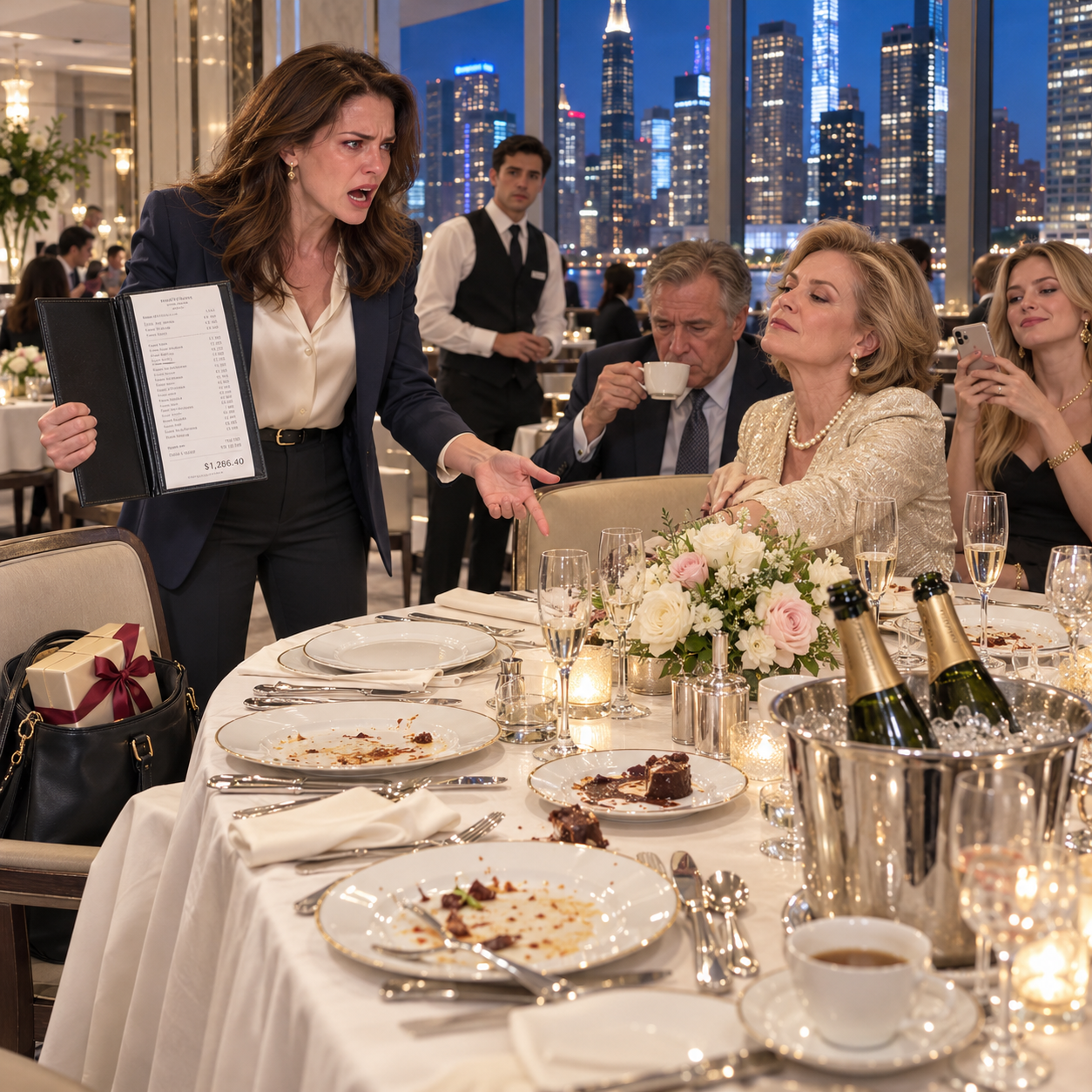
After dessert, the server returned with two check folders. He placed a smaller one beside Sam and me and the other near Dad. Mother stared at them before looking across the table. “I thought we were settling this together,” she said. I answered quietly, “We are. Sam and I are paying for what we ordered.”
Kate gave a strained laugh. “You can’t be serious about splitting bills like college students.” Ryan looked at her and said, “Kate, we can pay our share.” She pushed her chair backward slightly. “It’s not about the money. It’s about Mara deciding to make some kind of statement.”
Dad opened the larger folder. His eyebrows moved when he saw the total, and he reached for his reading glasses. Mother turned toward me. “You’ve always handled these occasions. Why change now, when everyone is sitting here?”
“Because I didn’t agree to pay for either dinner, Mom. And because I found the instructions on the reservation.”
She glanced toward Dad. “I assumed the same arrangement would be fine.” I asked her why she hadn’t mentioned the cost when she invited us. She rubbed her thumb along the edge of her napkin. “I didn’t think you’d come if I brought up money.”
There it was, said so softly that she almost seemed to be speaking to herself. I waited, hoping she would hear the meaning of her own answer. Instead, she added, “We just wanted a lovely evening without everyone worrying about prices.”
Sam placed his hand over mine beneath the table. “Ruth,” he said gently, “Mara wanted an evening with her family. She wasn’t given a chance to agree to anything else.” Dad removed a credit card from his wallet, and Mother watched him hand it to the server. Nobody raised their voice, but I could see how heavily that small exchange rested on the table.
When we stood to leave, Kate caught me near the coatroom. “You could’ve warned us you were actually going through with it,” she said. I took my coat from the attendant. “I did warn you. Last Saturday.” She shook her head. “Mom thought you’d cool off.”
“That’s part of the problem, Kate.”
Outside, Dad came after us carrying his coat over one arm. He looked older beneath the restaurant’s bright entrance lights. “Your mother isn’t going to understand this tonight,” he said. I touched his sleeve. “Then please help her understand, Dad. Because I can’t keep buying the version of our family she wants everyone to see.”
He looked down at the receipt still folded in his hand.
“I should’ve said something a long time ago,” he admitted.
## Part 3: The Bills Finally Reached The People Who Made Them
The first week after that dinner brought six calls from Mother, three messages from Kate, and a long email from Dad. Mother’s messages alternated between hurt and irritation. She said she had never imagined her own daughter would become so concerned with keeping score, and that she and Dad had sacrificed too much to deserve such treatment. I replied once, telling her that I loved them but would not resume the old payment arrangements.
Kate’s response was less restrained. She called while I was reviewing contracts at work and demanded to know why her car insurance payment had been discontinued. I explained that the thirty-day notice had been sent before the next billing date and that she still had time to arrange coverage. “You know my business has been slow,” she protested. I reminded her that she’d purchased a new camera lens the previous month and taken a weekend trip to Nashville.
“Those are business expenses,” she snapped. Then her voice changed. “You have no idea what it’s like having everyone compare you to the sister who always gets everything right.”
I sat down at my desk. Until that moment, I hadn’t understood how differently we’d experienced the same household. Kate had received attention for every crisis, while I had received praise for requiring none. “Kate, I don’t need you to be like me,” I said. “I need you to stop expecting me to finance choices I wasn’t part of making.”
She didn’t apologize. But she didn’t ask me for another payment, either.
Dad’s email was different. Attached was a household budget he had assembled using bank statements, pension records, credit card bills, and the expenses I had been covering. He had discovered that he and Mother were spending almost $1,100 more than their retirement income each month. The gap had been concealed by withdrawals from savings, credit card balances, and my regular contributions.
He asked whether we could meet at the house the following Sunday.
I arrived alone, carrying a folder of payment records. Their familiar living room looked much as it had during my childhood, with family photographs above the fireplace and a ceramic bowl of wrapped candies on the coffee table. Mother sat rigidly in her favorite chair. Dad had arranged his papers on the dining table, where we had once completed school projects and counted coins for summer trips.
“I didn’t realize the total had gotten this high,” Dad said. He pointed to the amount I had contributed over the years. Mother looked at my spreadsheet, then away. “We never asked you for all of that,” she said. I showed her several messages asking me to cover bills and two emails containing restaurant receipts. “Sometimes you asked, Mom. Other times you simply made plans assuming I would take care of them.”
She picked up one of the receipts, studying it as though the words might offer a different explanation. “I suppose I liked being able to take everyone somewhere nice,” she admitted. “Your aunt Carol and her husband go on cruises twice a year. I didn’t want people thinking we couldn’t afford dinner with our own children.”
Dad rubbed his forehead. “Ruth, nobody was thinking about our money except us.”
Mother’s cheeks reddened, but she didn’t argue. I remembered how she’d once borrowed my graduation dress for a friend’s daughter because she didn’t want to admit we couldn’t afford a new one. Appearances had always mattered to her, sometimes more than she realized. Understanding that fear made me sad for her, but it did not make the unpaid expenses disappear.
We spent nearly two hours reviewing the household budget. Dad agreed to cancel an expensive club membership and sell the second car he rarely drove. Mother decided to reduce their travel plans, and I offered to help them compare utility providers and insurance costs without paying the bills myself. I made it clear that I wasn’t withdrawing from their lives, only from the role of automatic financial backup.
Near the end, Dad reached into a desk drawer and handed me a small envelope. Inside was a check for $600. “It’s not much compared with what you’ve given us,” he said. “But I want to start returning the money we borrowed.” I looked at the amount, then at his carefully written signature. For once, he wasn’t asking me to make a difficult number easier.
I accepted it.
Mother watched quietly before asking about the anniversary gift I’d carried to the restaurant. I told her I still had it. She lowered her eyes. “I wondered why you never gave us anything that night.” I answered, “I didn’t feel as though I had been invited to celebrate with you.”
That seemed to reach her in a way the figures hadn’t.
Over the following months, our family changed slowly. Kate arranged her own insurance and began accepting smaller photography jobs between weddings. She remained distant for a while, though she eventually sent me a photograph of a newborn she’d taken for a client, asking what I thought of the lighting. I replied with a suggestion, and our conversation ended there, without a request for money.
Dad kept sending small repayments, accompanied by updates about the budget. Mother called less often, but her calls gradually became less transactional. She asked about my employees, remembered Sam’s upcoming birthday, and once spent twenty minutes describing a neighbor’s new vegetable garden without mentioning a single expense. I learned that I could still enjoy hearing her voice when I wasn’t bracing myself for the next favor.
One Sunday in early spring, Mother invited Sam and me to dinner at their house. She told me exactly what time to arrive and mentioned that Dad was making his old-fashioned pot roast. I offered to bring dessert. “Only if you’d like,” she said. “We’ve got everything else.”
When we arrived, the dining table was set with the blue plates from my childhood. Kate had come too, carrying a salad she’d made herself. There was no expensive wine, no elaborate centerpiece, and no conversation about restaurants where somebody famous had eaten. Dad came out of the kitchen with his sleeves rolled up and asked Sam to help carve the roast.
After dinner, Mother brought out the restored wedding photograph I’d finally given her. She had placed it in a silver frame beside the family pictures. “Your father told me you spent a long time finding this,” she said, brushing an imaginary speck of dust from the glass. I nodded. “I wanted you to have something from a day when being together was enough.”
She stood beside me, examining the younger versions of herself and Dad. “I think somewhere along the way, I got confused about what made an evening special,” she said. Her apology came awkwardly, without a speech or an excuse. She told me she was sorry for putting me in that position at the restaurant and for taking my help for granted.
I thanked her, but I didn’t pretend that one apology could undo seven years of resentment. We were still learning how to talk without old expectations entering the conversation. Some subjects remained difficult, and I no longer assumed every invitation would be innocent of financial pressure. Trust returned in small, ordinary moments, not through a single perfect family dinner.
Later that evening, Dad handed me a container of leftover roast for Sam. As we stepped onto the porch, Mother called after us, “Mara, next Sunday we’re thinking of making lasagna. Would you and Sam like to come?”
I smiled. “That sounds nice. Just let me know what time.”
Driving home, I remembered the first anniversary dinner, the empty plates, and the bill waiting beside my chair. For years, I’d mistaken being needed for being valued, and I’d helped my family make that mistake by never telling them where my generosity ended. Now they were learning to invite me because they wanted my company, not my credit card.
I wasn’t sure our family would ever become entirely uncomplicated. But the next time we gathered around a dinner table, I wanted to arrive while the food was still warm, pull out a chair that had been saved for me, and know I belonged there without having to pay for the privilege.
The End .
All characters and events in this story are fictional, created for storytelling and entertainment purposes. Thank you sincerely for reading. Your feedback and support are invaluable and motivate me to continue sharing more stories with you.


