
Part 2: The money stops, and hidden debts begin surfacing everywhere
At 8:17 the next morning, my mother tried to buy three thousand dollars’ worth of clothing at a boutique she frequented downtown. I knew because at 8:21 she called me six times, and at 8:26 she left a voicemail insisting there was “something wrong with the bank.”
By nine, Jocelyn had started texting.
Viv, call me.
My card isn’t working.
The school says you’re no longer listed as guarantor.
What did you DO?
At 9:43, another message arrived.
This is insane. The children have nothing to do with whatever mood you’re in.
That one nearly made me respond. Instead, I forwarded it to Marcus and asked him to make certain the school understood that no child should be discussed or embarrassed publicly over the account change. The administration confirmed that Jocelyn and Grant had been contacted privately and given a payment deadline.
My mother called again at 10:02. I answered.
“Vivian.” Her voice came fast and thin. “Thank God. Something has happened to my card.”
“Nothing happened to it. I canceled it.”
A pause followed. Then she laughed once, cautiously. “Why would you do that?”
“Because it was my account.”
“Well, yes, technically, but—”
“And because last night clarified something.”
She lowered her voice. “If this is about Lily, I already told you I was joking.”
“You haven’t spoken to Lily.”
“Because you rushed her away before anyone could settle down.”
“She was eight years old, Mom. She shouldn’t have needed to settle down after being told her grandmother wished she weren’t there.”
“That is not what I said.”
“It is almost exactly what you said.”
I heard movement in the background, then a car door closing. “I was irritated. Jocelyn had been needling me, the children were noisy, you were staring at me like I’d committed some crime over a little book—”
“Stop.”
My mother stopped.
For years, I’d let her talk until her version of an event filled all available space. That morning I didn’t.
“The card is canceled,” I said. “The household accounts end this month. Marcus is sending formal notice regarding the house.”
“What notice?”
“You’ll receive it today.”
Her breathing changed. “Vivian, this is my home.”
“It belongs to Bellhaven.”
“Your father bought this house.”
“Dad sold it before he died to cover medical and business debts. I bought it back two years later.”
“You said you handled the mortgage.”
“I did.”
“You never said you owned it.”
“You never asked.”
She whispered my name differently then, no irritation left in it. “Where am I supposed to go?”
It was the first honest question she’d asked me.
“We can discuss a reasonable transition. But you won’t stay there indefinitely at my expense.”
She began to cry, and I hated that the sound still activated an old reflex in me. I wanted to fix it before I remembered Lily asking whether her grandmother meant what she’d said.
“I can’t talk anymore this morning,” I said.
My mother’s next words came out small and defensive. “Your father would hate this.”
I looked at his photograph on my shelf. “I think Dad would hate what we’ve become.”
I ended the call.
By afternoon, Marcus had assembled enough records to show that the attempted mortgage wasn’t an isolated lapse. My mother’s expense card had been used to make payments on accounts belonging to Jocelyn. Jocelyn had used transfers from a household account to cover losses from a speculative investment Grant had made with a friend. There were also checks written against a reserve account intended for repairs on the Bellevue property.
The signatures were my mother’s.
At three, Jocelyn came to my house.
I saw her through the front window before she rang. She wore leggings, an expensive camel coat, and no makeup, which told me more about her state of mind than any text could have. Lily was upstairs painting with headphones on, so I stepped outside and closed the door behind me.
“What is wrong with you?” Jocelyn demanded.
“Keep your voice down.”
“Oh, now you care about manners?”
I folded my arms against the October wind. “What do you want?”
“My kids’ tuition is due. Mom has an eviction notice taped to her refrigerator. Grant’s card got declined at the grocery store because our automatic payment didn’t go through after you shut off the transfer.”
“Your grocery card isn’t connected to me.”
“No, but the account that paid our other bills was.”
“Then you need to prioritize your bills.”
She stared at me as though I’d begun speaking another language. “You’ve been helping us for years.”
“Helping is not the same as becoming responsible for your household.”
“Nobody forced you!”
That landed between us with more truth than she intended.
I nodded. “You’re right.”
Jocelyn looked momentarily uncertain.
“Nobody forced me,” I continued. “I chose it. And now I’m choosing to stop.”
Her eyes filled, but her anger stayed intact. “So this is punishment because Mom hurt Lily’s feelings?”
“No. Last night made me finally look at an arrangement I should have ended years ago.”
She laughed bitterly. “You always do this. You act so calm that everybody else looks crazy.”
“And you always get louder when you don’t want to answer a question.”
“What question?”
“Why is your name on a five-hundred-thousand-dollar mortgage application for a house you don’t own?”
The color left her face.
She looked toward the driveway.
“Jocelyn.”
“It wasn’t like that.”
“Then tell me what it was like.”
She rubbed both hands over her face. “Grant lost money.”
“How much?”
“Enough.”
“How much?”
“Seventy-two thousand at first.” She stared at the ground. “Then more, trying to make it back.”
“And Mom agreed to mortgage my property.”
“Mom thinks of it as her house.”
“Thinking doesn’t alter a deed.”
“She was scared!” Jocelyn snapped. “Do you know what it’s like for her? Dad dies, and suddenly every single thing she has depends on you. You decide what gets paid, what doesn’t, which contractor comes, which car lease gets renewed. She hates feeling like a charity case.”
I stared at my sister.
For the first time in years, I understood part of what had gone wrong. My silence had spared them embarrassment, but it had also allowed everyone to pretend there was no dependency at all.
“So instead of telling me that,” I said, “she signed false paperwork.”
Jocelyn’s shoulders sagged. “She thought we’d repay it before anybody knew.”
“With what income?”
She didn’t answer.
I reached for the front door.
“Viv.” Her voice softened. “Please don’t destroy us over this.”
I turned back. “I’m not destroying you. I’m stopping myself from financing the version of your lives that neither of you can afford.”
She wiped at her cheek angrily. “Are you taking Mom to court?”
“Not if she cooperates.”
“And me?”
“Marcus is documenting everything. I haven’t decided what happens next.”
That frightened her more than shouting would have.
Two days later, my mother asked to meet.
Not at the mansion.
At my office.
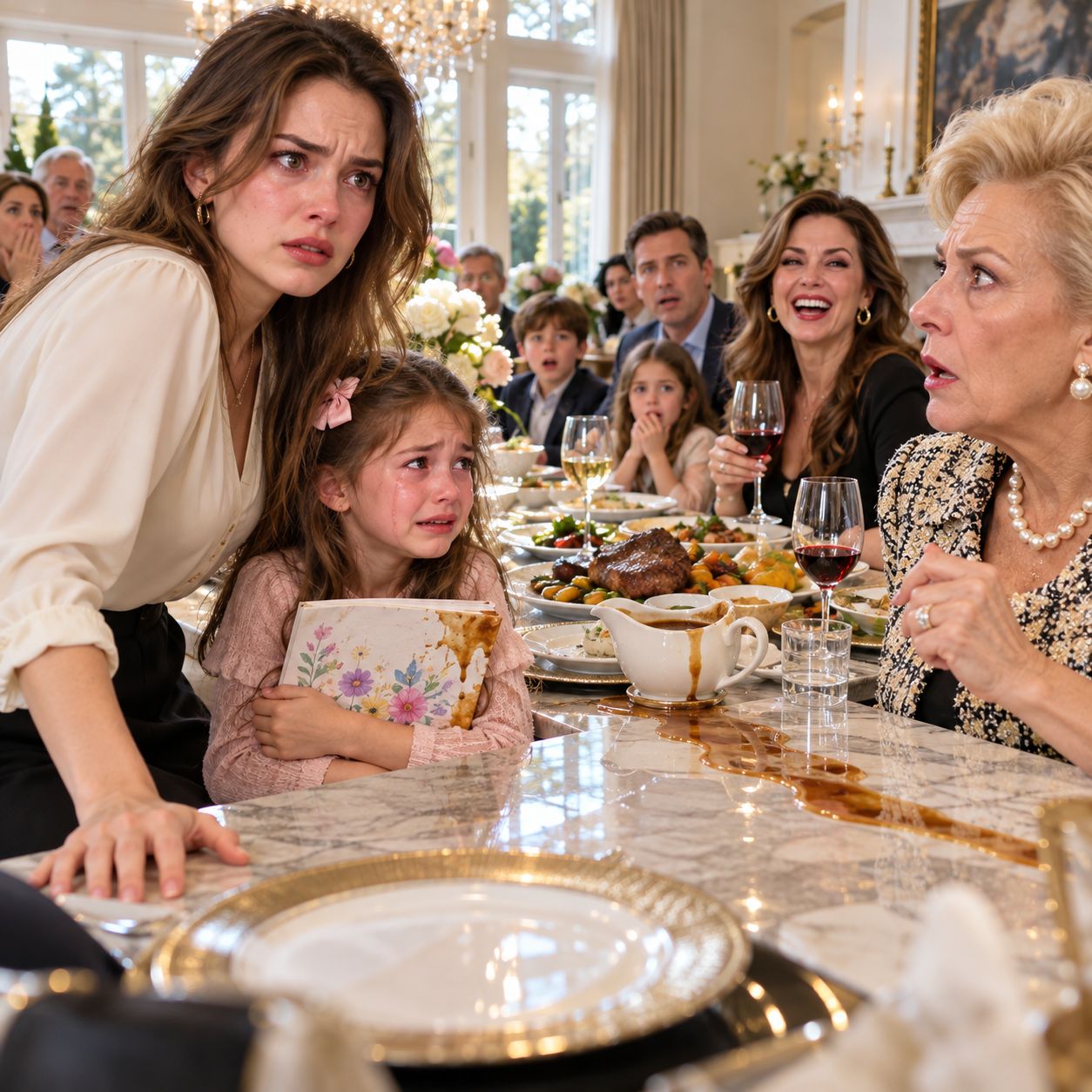
She arrived carrying Lily’s damaged book.
The gravy stain was still visible in one corner.
Part 3: A damaged little book forces our family to face everything
My mother sat across from me with the memory book resting on her knees. Without the Bellevue house around her, without the flowers and polished marble and staff quietly appearing when she pressed a button, she looked smaller than I remembered.
“I cleaned the pages,” she said.
I didn’t respond.
“Some of the paint ran.” She touched the book’s edge. “I shouldn’t have put it on the floor.”
“No.”
Her mouth tightened. “You don’t make this easy.”
“I’m not trying to.”
For several seconds she studied my office: the client awards she had never seen, framed articles she’d apparently never read, a photograph of my team at a conference in Chicago. “I didn’t know your company had this many people.”
“Twelve full-time. More contractors.”
“Jocelyn said you mostly worked by yourself.”
“Jocelyn doesn’t know much about my business.”
Mom looked embarrassed by that, which surprised me.
Marcus arrived a few minutes later and placed a thin folder on the desk. He wasn’t theatrical about it. There were no threats, no dramatic accusations, just numbered pages: account statements, transfer records, the failed mortgage application, copies of signatures.
My mother stared at the mortgage form for a long time.
“I signed what Jocelyn brought me,” she said.
“You also signed an ownership affidavit,” Marcus replied.
“She said it was routine.”
“Did you read it?”
“No.”
“Did you believe you legally owned the property?”
My mother looked at me. “I believed Vivian would never take it away.”
The distinction mattered.
Marcus closed the folder. “Ms. Carroway, my client has elected not to pursue a fraud complaint provided there are no further attempts to borrow against company property and you cooperate with an accounting of the misused funds. That decision can be revisited if new information appears.”
Mom nodded slowly.
After Marcus left, she continued staring at the folder.
“Your father used to handle everything,” she said. “Bills, insurance, investments. I complained that he controlled too much, and then when he was gone, I realized I didn’t know how any of it worked.”
“You could have learned.”
“I know.”
“You could have asked me.”
Her eyes sharpened. “And admit to my thirty-two-year-old daughter that I couldn’t manage my own life?”
“Instead, you let your thirty-two-year-old daughter manage it secretly.”
She gave a tired laugh, and for once it contained no mockery. “Yes. Apparently pride makes people very creative.”
I leaned back.
She ran her thumb over Lily’s painted cover. “I was jealous of you.”
That was not the sentence I expected.
“You built a business. You raised Lily alone. You never seemed frightened. After your father died, people called you when they needed answers. They called me to ask how I was holding up.” She looked toward the window. “I became the widow. Jocelyn still needed me. You didn’t.”
“So you favored her.”
“I told myself she needed encouragement.”
“And Lily?”
My mother’s face crumpled slightly. “Lily reminds me of you at that age.”
I waited.
“You were quiet. Always making things. Watching everybody.” She pressed her lips together. “Your father understood you better than I did. Jocelyn was easier for me. She wanted what I wanted. Dresses, parties, attention. With you, I always felt judged even when you hadn’t said a word.”
“I was a child.”
“I know that now.”
I looked down at Lily’s book.
“What you said to her can’t be unsaid.”
“I know.”
“An apology doesn’t buy back access.”
“I know.”
That answer finally sounded real.
My mother moved out of the Bellevue house twenty-six days later. She rented a two-bedroom apartment fifteen minutes away, using money from the sale of jewelry and a smaller retirement account Dad had left in her name. I offered to pay for a financial planner—not her rent—and she accepted after two days of pretending she didn’t need one.
Jocelyn’s adjustment was rougher.
Grant found work with a commercial equipment company through an old colleague, and Jocelyn took a part-time administrative position at the dental practice where she’d once worked before having children. They withdrew the children from their private school at semester break and enrolled them in a well-regarded public school near their home. I paid the remaining balance through the end of the semester because I refused to make children absorb consequences overnight for decisions adults had made.
Jocelyn didn’t thank me.
I didn’t need her to.
Three months passed before my mother asked whether she could see Lily.
I didn’t answer immediately.
Instead, I went upstairs, where Lily was painting at the small desk by her window. Her grandmother’s repaired memory book sat on the shelf beside a row of watercolor jars. Mom had mailed it back with a handwritten note, but I’d let Lily decide whether to read it.
“Grandma wants to know if she can visit,” I said.
Lily kept painting a green roof onto a little house. “Here?”
“If you want.”
“Will Aunt Jocelyn come?”
“No.”
She thought about it.
“Can Grandma stay for one hour?”
“Yes.”
“And if she says something mean?”
“Then she leaves.”
Lily nodded. “Okay.”
My mother arrived the following Saturday carrying nothing.
No toy. No expensive clothes. No oversized present meant to turn remorse into a transaction. She stood awkwardly in our entryway holding her purse with both hands until Lily came downstairs.
“Hello, sweetheart,” Mom said.
Lily stopped on the bottom stair. “Hi.”
My mother crouched, then seemed to reconsider and remained standing. “I owe you an apology. A real one.”
Lily looked at me.
I stayed near the kitchen doorway.
“What I said at dinner was cruel,” Mom continued. “It wasn’t a joke. I called it a joke because I was ashamed after I said it.”
Lily’s fingers curled around the stair rail.
“You made me think you didn’t want me.”
“I know.” Mom’s eyes filled. “And I understand if it takes a long time before you believe I do.”
Lily glanced toward the living room. “Did you look at my book?”
“Every page.”
“What was your favorite?”
My mother smiled through tears. “The picture of Grandpa wearing the purple hat.”
Lily’s mouth twitched. “It was supposed to be blue.”
“I know. Your mother told me your blue paint ran out.”
For the first time, Lily smiled.
It wasn’t forgiveness. It wasn’t a reset. It was only a small opening, and I had finally learned that small openings were healthier than pretending cracks didn’t exist.
My mother stayed fifty-three minutes.
After she left, Lily climbed onto the couch beside me and leaned against my shoulder. Outside, rain tapped quietly against the windows, and the house felt pleasantly ordinary.
“Mom?”
“Yeah?”
“Are we rich?”
I laughed softly. “That’s a complicated question.”
“Grandma said you bought her house.”
“I did.”
“So we’re rich.”
“We’re comfortable.”
Lily considered that. “Then why don’t we have a giant house?”
I looked around at our three-bedroom home with paintbrushes drying beside the sink, a basket of unmatched socks near the stairs, and a small crack in the baseboard I’d been meaning to repair for six months.
“Because I like this one.”
She leaned against me again. “Me too.”
The Bellevue property sold that spring. I put most of the proceeds back into the company and created a separate education fund for Lily. I also rewrote every family financial arrangement with Marcus, replacing vague promises with boundaries that could be understood on paper.
Jocelyn and I still aren’t close. We speak at birthdays and occasionally exchange messages about Mom, who now complains about grocery prices, attends budgeting classes at her bank, and has developed an almost aggressive interest in coupons. Some weeks she resents me. Some weeks she’s grateful. Most families, I’ve learned, live somewhere between those two things.
The greatest change wasn’t the cancelled cards, the house, or the audit.
It was the night Lily brought home a new painting from school.
She had painted our house under an enormous yellow sky, with herself standing between two tall sunflowers. In the upstairs window, she’d painted me at my desk.
“What’s this?” I asked, pointing to a tiny shape beside the front door.
“A lock.”
“A lock?”
She nodded seriously. “Because people can’t just come in unless we let them.”
I looked at my daughter, then at the little painted house.
For years, I thought love meant keeping every door open, paying every bill, swallowing every insult, and making myself useful enough that nobody had to confront what was broken. Lily taught me something simpler.
A home is not loving because everyone is allowed inside.
It is loving because the people inside are safe.
I framed her painting beside the repaired memory book.
This time, nothing touched the glass.
The End .
All characters and events in this story are fictional, created for storytelling and entertainment purposes. Thank you sincerely for reading. Your feedback and support are invaluable and motivate me to continue sharing more stories with you.

