
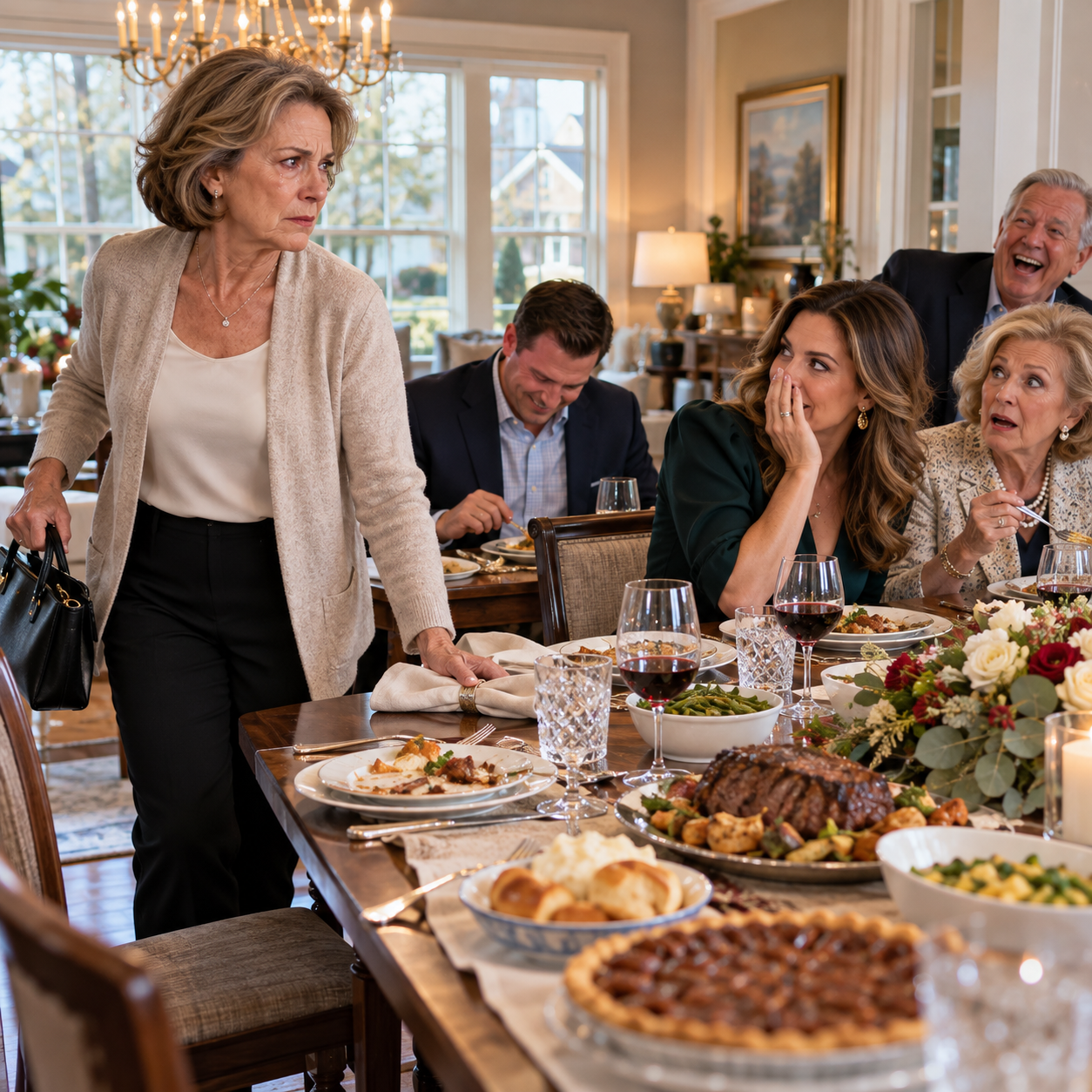
Part 2: The Missed Payment Reveals What My Daughter Never Told Me
Jenna called Monday morning while I was trimming dead flowers from the pots behind my house.
“Something’s wrong with your bank.”
I switched the phone to my other ear. “No.”
“The lender says the payment was stopped.”
“That’s right.”
A pause.
Then, quieter, “You actually canceled it?”
“Yes.”
“Mom, the grace period ends Wednesday.”
I pulled off one gardening glove with my teeth and set the clippers on the patio table.
“You called me dead weight,” I said. “I thought I should stop behaving like a load-bearing wall.”
“That isn’t fair.”
“No?”
“I was uncomfortable. Elaine was asking about your finances, and I panicked. I made a stupid joke.”
“And Mark laughed.”
“He didn’t know what to do.”
“He could have done nothing. That would have been better.”
Her breath sharpened through the speaker. “Can we not turn one bad moment into a financial emergency?”
There it was. My dignity was a moment. Their car payment was an emergency.
“I’m not creating your emergency,” I said. “I’m stepping out of it.”
The next morning, their SUV appeared in my driveway before nine.
Jenna marched up the front walk. Mark followed more slowly in work boots and a faded company jacket.
When I opened the door, I left the security chain fastened.
Jenna stared at it. “Why is that on?”
“Because I’d like you to knock before coming in from now on.”
“I always use my key.”
“I’d like the key back.”
Her eyebrows lifted. “Are you serious?”
Mark rubbed his forehead. “Harriet, we came to work something out. I’ve got money coming in. Two deposits, maybe three. If you cover this month, I’ll reimburse you.”
I believed that he intended to. Mark had always worked hard. His flaw was not laziness. It was the habit of treating tomorrow’s income like today’s money.
“Elaine mentioned the Heritage District project Saturday,” I said.
Mark stopped rubbing his forehead.
Jenna’s eyes moved toward him.
“Your mother seemed proud,” I continued. “She said the city signed six weeks ago. Biggest job your company has had.”
Mark looked at the porch boards.
Jenna answered for him. “That money is committed.”
“To what?”
“Payroll. Equipment. Taxes. The boys’ college accounts.”
“College accounts?”
She folded her arms. “We’re finally trying to get ahead.”
I almost admired the sentence.
For eight months, I had been paying their vehicle loan from savings my husband and I built over four decades. They had received a major contract and decided their future deserved protection before my present deserved honesty.
Mark spoke softly. “We should have told you.”
“Yes.”
Jenna turned toward him. “Mark.”
“No,” he said. “She’s right about that.”
The anger left Jenna’s face for a second. What replaced it was fear.
“If we start using contract money for everything,” she said, “we’ll be right back where we were.”
I understood then. This was not greed in its simplest form. Jenna was terrified of slipping backward. She had two children, a husband with an unpredictable business, and a taste for looking more secure than she felt.
But fear did not make my bank account hers.
“Then change what you spend,” I said.
Her jaw tightened.
I held out my hand. “The key.”
She didn’t give it to me.
So after they left, I called a locksmith.
By late afternoon, every exterior lock in my house had been changed.
Part 3: New Boundaries Force Us to See What Dependence Cost
Three days later, I heard a key scrape uselessly inside my new front lock.
Then came a knock.
Jenna stood on the porch beside a plastic storage bin packed with winter clothes. For years, she had rotated her off-season wardrobe through my attic because her closets were “impossible.”
“The lock’s broken,” she said.
“It’s new.”
She looked at me, then at the key in her hand. “You changed the locks?”
“I asked for the key.”
Her face flushed. “Fine. Can I put this upstairs?”
“No.”
She actually laughed once, but there was no humor in it. “You’re kicking my coats out now?”
“I’m clearing the attic.”
“For what?”
I thought about that.
“For me.”
The answer seemed to offend her more than anything else.
She set the bin down too hard. The lid popped loose, and a cream sweater slid over the edge.
“You’re punishing me.”
“I’m changing an arrangement I should have changed years ago.”
“Because of one sentence.”
“No. The sentence just made the arrangement visible.”
She stared at me.
Then she reached for the place she knew was tender.
“Noah keeps asking why you’re not coming over.”
My grandson was nine, serious-eyed and forever carrying some project in pieces.
“I love Noah.”
“Well, he thinks you’re mad at all of us.”
“I’m not involving him.”
“You already are.”
That landed because there was some truth in it. Adults like to imagine children cannot feel the weather changing inside a family.
“I’ll call him,” I said.
Jenna dragged the bin back toward the driveway.
A week later, I removed her household from the streaming service and warehouse membership I had been paying for. I canceled the small monthly transfer I sent “just in case.”
Then I did something I should have done much earlier.
I printed two years of bank statements.
At my kitchen table, with a yellow legal pad and Harold’s old calculator, I listed every payment I could identify: car installments, groceries, subscriptions, emergency cash, school clothes once, a plumbing repair another time.
The total came to $14,380.
I circled it.
Not because I wanted repayment.
Because I needed to see the size of the habit.
Harold and I had never been wealthy. We had simply been careful. He packed lunch for work for thirty-two years. I drove cars until mechanics began speaking of them with pity. We paid our house off early and celebrated with grocery-store cheesecake.
I had told myself helping Jenna was what the money was for.
But help had quietly become expectation, and expectation had become entitlement.
The following Saturday, an older sedan stopped at my curb. Noah jumped out in soccer clothes, holding a paper bag.
“Coach Miller’s dad brought me,” he said. “Mom knows.”
I raised an eyebrow.
“She knows now.”
That sounded more accurate.
He pulled two chocolate doughnuts from the bag and handed me one.
We sat on the porch while he described his science fair project about rainwater and tap water. Halfway through his doughnut, he looked at me.
“Mom says you’re going through something.”
I smiled despite myself. “I’m changing some things.”
“Like Dad changed his company?”
“Maybe.”
He nodded as if that settled it.
Then he pointed toward my backyard.
“Can I use your tomatoes for the experiment?”
“They’re not going to survive November.”
“Then we need faster plants.”
For the first time in weeks, I laughed without feeling guilty afterward.
Part 4: Respect Returns Only After Help Stops Being Expected
Two months later, Mark sold the SUV.
He called me himself.
“We bought a used minivan,” he said. “It’s not glamorous.”
“I’ve survived many unglamorous vehicles.”
He laughed, then grew serious.
“The Heritage project is going well. I hired two men.”
“I’m glad.”
Another pause.
“Harriet, I should have said something that night.”
“Yes.”
“I knew Jenna was embarrassed. My parents make her feel like we’re always being measured. I thought laughing would keep it from getting awkward.”
“It did not.”
“No.”
He cleared his throat. “I’m sorry.”
I thanked him.
Jenna took longer.
Our conversations became brief but civil. She stopped calling with problems before asking how I was. I stopped solving problems she had not asked me to solve.
Near Christmas, she came by alone.
This time, she knocked.
I opened the door without the chain.
She held my old spare key between two fingers.
“I found it in the side pocket of my purse.”
I stepped aside, and she came in.
At the kitchen table, she wrapped both hands around a mug of coffee.
“I was angry at you,” she said.
“I know.”
“I still think you pulled everything at once.”
“I did.”
“That scared me.”
“I know that too.”
She looked toward the window. “I’ve spent years being scared we’re one bad month away from losing everything. Mark’s business looks better from the outside than it feels from the inside. His parents think he’s more successful than he is. I let them think that because…” She shrugged. “I liked being the daughter-in-law who was doing well.”
I waited.
“At dinner, when Elaine started asking about your house, I thought she was about to figure out how much help we’d needed from you. I made you the joke before I could become one.”
There it was.
Not an excuse. A confession.
“You could have told her the truth.”
“I know.”
She looked down into her coffee. “I was ashamed.”
“So you handed the shame to me.”
Her eyes filled, but she did not cry.
“Yes.”
I reached across the table and covered her hand.
“I don’t want repayment.”
She looked up quickly.
“But I won’t fund your household again. Not like before.”
She nodded.
“And I want my home to stay my home.”
Another nod.
“You and the boys are welcome here. But welcome is not ownership.”
“I understand.”
I wasn’t sure she fully did. Understanding sometimes arrives in installments.
That Christmas, we did not return to the old version of our family.
We built something smaller and sturdier.
Jenna brought a casserole instead of asking what I had cooked. Mark helped me replace a loose porch rail and refused gas money. Noah set three jars of seedlings along my kitchen window for his revised science project.
At dinner, Jenna caught me watching him explain pH levels to his younger brother.
“What?” she asked.
“Nothing.”
She smiled. “You’re doing that mom look.”
“What mom look?”
“The one where you act like you’re not pleased when you’re pleased.”
I let her have that one.
Later, after everyone left, I walked through the quiet house and checked the front door.
The new deadbolt turned with a solid click.
The canceled payments had not destroyed my family. They had forced us to stop confusing support with obligation and access with love.
I was still Jenna’s mother. I was still Noah’s grandmother. I could still be generous.
But generosity, I finally understood, is only generous when it is freely given.
The End .
All characters and events in this story are fictional, created for storytelling and entertainment purposes. Thank you sincerely for reading. Your feedback and support are invaluable and motivate me to continue sharing more stories with you.

