
### Part 2: A Police Visit Exposes the Story My Son Told
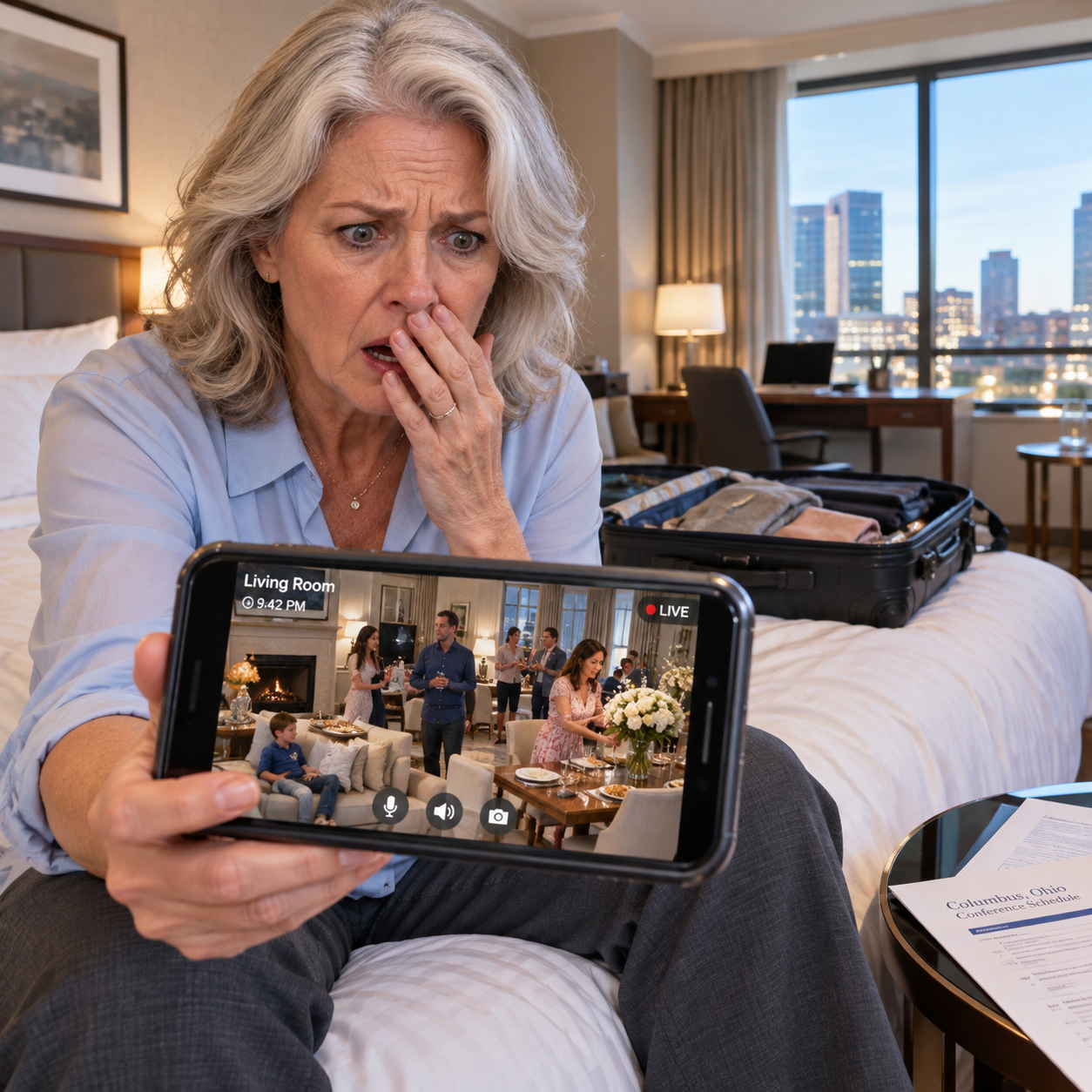
I watched the recording again, concentrating on Garrett’s hand. There was no forced lock, no hesitation, and no possibility that he’d mistaken the house for somewhere else. He had entered exactly as a homeowner would, then held the door for Renata and the children. A few minutes later, their guests began arriving with food, flowers, and wrapped packages.
I called Bev and asked her to remain at home. “It’s Garrett,” I explained. “He’s inside with his family, but I never invited them.” She exhaled slowly and told me that Renata had introduced herself earlier as the woman who would soon be spending much more time at the house. That was the first indication that the gathering involved something beyond a casual dinner.
I called the local police non-emergency number, explaining that I was out of state and could see people entering my property without authorization. The dispatcher asked whether I recognized them and whether anyone appeared in danger. I gave her Garrett’s name, described the adults, and explained that children were present. She said officers could investigate, establish who had permission to be there, and contact me if necessary.
While I waited, I received a notification from our family group chat. Bernice had sent a photograph of Garrett and Renata standing together in my dining room, smiling beneath a string of white paper decorations. The caption read, “So happy the kids finally have a place where everyone can gather.” Below it, Renata had responded with three red hearts and the words, “One step closer.”
I enlarged the photograph. Behind Garrett, on my sideboard, stood a framed picture of his children that Renata had brought from their apartment. My framed photograph of my parents, which normally occupied that spot, had been moved onto a lower shelf. It was a small thing, almost ridiculous to focus on, but I had spent years preserving that picture because it was one of the few taken before my mother became ill.
Two officers arrived shortly after ten. Through the camera, I saw Garrett open the door with a drink in his hand and begin explaining something with an apologetic smile. When one officer stepped into the foyer, Renata appeared behind him and folded her arms. Garrett reached for his phone, and a moment later his name lit up my screen.
I didn’t answer because the police already had my number. Soon an officer called and asked whether I had authorized a family celebration or agreed to let anyone use the house temporarily. I told her I had done neither. “My son knows I am away,” I added. “But knowing that doesn’t give him permission to bring people inside.”
The officer spoke with Garrett again, then asked everyone to collect their belongings. I watched the guests leave in small groups, several carrying serving dishes and leftover food. Oliver clutched a stuffed dinosaur, and his younger sister, Emma, held Renata’s hand as they walked to the car. Their expressions troubled me more than the adults’ anger because they had no reason to understand why the evening had ended that way.
My phone filled with messages before the officers had even departed. Garrett wrote that I’d embarrassed him in front of friends and frightened the children unnecessarily. Renata said they’d cleaned the kitchen and intended to leave everything as they’d found it. Bernice called twice, then sent a message asking why I couldn’t simply have handled a misunderstanding privately.
I typed several answers and erased them. At midnight, Garrett finally wrote something that deserved preserving: “I told Renata you’d eventually see how much sense this arrangement makes. She didn’t know you’d react like this.” I saved the message beside the camera recordings, turned off the bedside lamp, and lay awake listening to trucks pass outside my window.
When I returned to Virginia on Thursday, the first thing I noticed was the smell of lilies. Renata had left a large arrangement in my kitchen, along with a grocery-store cake box containing two untouched slices. There were water rings on my dining table, muddy footprints near the back entrance, and someone’s cardigan hanging behind the guest-room door. My parents’ photograph remained on the lower shelf.
I carried the flowers outside, then examined the ceramic bowl in the entryway. A few coins, a bent paper clip, and an old receipt remained, but the spare key I’d placed there after moving in was missing. I remembered Renata walking through the house during Sunday dinner, asking where I stored serving platters while Garrett occupied me with questions about the backyard fence. I couldn’t prove which of them had taken the key, but someone had.
The following morning, I met with an attorney named Caroline Hayes. She listened without interrupting while I showed her the camera recordings, family messages, and police incident number. She explained the available options for documenting the unauthorized entry and formally notifying Garrett and Renata that they had no standing permission to access my property. I wanted a clear boundary, not a family spectacle or a punishment that would needlessly involve my grandchildren.
Caroline recommended replacing the locks immediately and documenting anything missing or damaged. I arranged for a locksmith that afternoon, then requested copies of the police report. As I was reviewing my notes, Garrett called again, and this time I answered. He began by asking whether I had changed the locks, as though that was the most urgent issue between us.
“Yes,” I told him, and he gave a short, disbelieving laugh. “Mom, you can’t keep treating us like strangers.” I asked where he’d gotten the key. He replied that we needed to talk about the bigger picture, but I repeated the question until his breathing became audible through the receiver.
Finally, he admitted he’d taken the spare from my entryway during the family dinner. “I meant to put it back,” he said. “Then things got complicated, and Renata thought we could use the house while you were gone to show everyone how well it would work.” I asked him what he meant by work, and he said, very quietly, “Us living there for a while.”
### Part 3: The Missing Key Finally Forces Us to Choose Boundaries
I asked Garrett to meet me the following Saturday at a small diner near the courthouse. Renata came with him, looking exhausted, her hair tied back without the careful styling she usually preferred. I had deliberately chosen somewhere neutral because I didn’t want another argument on my porch. When they sat down, Garrett immediately began studying the menu as though we were simply having lunch.
Renata spoke first. She explained that their rent had risen again, Garrett’s contracting work had slowed, and their mortgage preapproval had expired. She’d recently learned that the owner of their rental intended to sell, leaving them uncertain about whether their lease would be renewed. Garrett had told her I’d purchased a larger home partly because I wanted the family closer together.
“I never told him that,” I said. Renata looked toward her husband, who folded the menu and admitted he’d suggested it because he believed I would eventually agree. He had imagined they could move into the upstairs bedrooms, help with expenses, and save toward another house. Instead of asking, they’d invited relatives and a few friends over to see the property, hoping everyone would encourage the arrangement.
“Bernice knew?” I asked. Garrett rubbed his forehead and admitted he’d told my sister the house was supposed to become a family solution. Renata added that the gathering had started as a small meal but grown after Bernice offered to invite two relatives. Neither of them had expected me to find out before they could explain how their plan might benefit everyone.
I looked at my son, remembering the boy who used to leave drawings on my pillow when he knew I’d had a difficult day. “You told people I was giving you a place to live,” I said. “Then you took a key from my house and invited them in while I was gone.” Garrett replied that he’d assumed I’d refuse if he asked, and for once he didn’t try to soften the sentence.
The waitress brought our coffee, and we waited until she moved away. Garrett said he felt ashamed that he couldn’t provide the home he’d promised his children, especially knowing how hard I’d worked to give him stability growing up. He’d been avoiding conversations with Renata about their finances, and the house had begun to seem like a solution already sitting in front of him. I understood his fear, but I couldn’t understand why he’d decided that my consent was an inconvenience rather than a requirement.
Renata twisted her wedding ring and apologized for bringing people into the house. “I knew you hadn’t said yes,” she admitted. “I thought if you saw how happy everyone was, you’d understand why we wanted it.” I asked whether it had occurred to either of them that I might be happy living alone, and neither answered immediately.
I told them I would not let them move in, not for a trial month or until they found something better. I also explained that the incident had been documented, my locks had been changed, and a written notice from my attorney would follow. Garrett straightened in his seat and asked whether I was really prepared to involve the law over a family disagreement.
“This wasn’t a disagreement,” I told him. “You didn’t ask me a question and dislike my answer. You made the decision for me, then waited until I was out of town to act on it.” He stared into his coffee for a long time before nodding. It wasn’t an apology, but it was the first moment that morning when he stopped defending what he’d done.
I asked about the children. Renata said they’d been told that Grandma hadn’t expected visitors and the adults had made a mistake, which I was relieved to hear. I said I wanted to see Oliver and Emma, but for now those visits would happen at parks, restaurants, or their home after we arranged them together. My relationship with my grandchildren would not be used to negotiate access to my property.
Before we left, Garrett told me he still loved me. I believed him, even though it didn’t repair the trust he’d damaged. I reached across the table and touched his hand briefly. “I love you too,” I said, “but I need you to learn that those two things can be true without one excusing the other.”
Over the next week, Caroline prepared formal written notices specifying that Garrett and Renata could not enter my property without my explicit permission. I chose not to pursue criminal charges for the incident, although I kept the police report and the recordings. The locksmith installed new deadbolts, and I added security alerts that would notify me whenever an exterior door opened. None of those precautions felt especially satisfying; they were simply things I should not have needed to do.
Bernice visited one Sunday afternoon, carrying an apple pie and a practiced expression of concern. She said she’d believed Garrett when he told her we’d reached an understanding about the house. I asked why she hadn’t checked with me, and she admitted she’d thought talking to me directly might jeopardize the arrangement. We sat at the kitchen table for almost an hour, with the pie untouched between us.
“I’ve spent so long thinking Garrett needed more help than you did,” she finally said. I reminded her that not needing assistance wasn’t the same as having nothing to lose. Bernice apologized for involving herself, and I told her I wanted some distance while I worked out what our relationship could look like without constant judgments about my choices. She left the pie, but she didn’t argue.
Autumn brought cooler mornings and the first yellow leaves across my driveway. Garrett and Renata found another rental, smaller than the house they’d hoped for but close enough to the children’s school. They worked out a repayment plan for some outstanding bills and began saving again, although Garrett admitted it would take longer than he’d wanted. We spoke occasionally, keeping our conversations limited at first to ordinary things like the children’s grades and his latest work projects.
One Saturday, Garrett brought Oliver and Emma to a playground near my house. The children ran ahead, and he handed me a paper bag containing the photograph of my parents that had disappeared from its original frame during the party. Renata had accidentally packed it among the decorations, he explained, and they’d only recently found it. I took the photograph out, checked that the glass was undamaged, and thanked him for returning it.
Before the children called us over to the swings, Garrett told me he’d started talking with a financial counselor. “I should have told Renata how bad things were instead of making promises I couldn’t keep,” he said. I nodded, unsure whether he wanted advice or forgiveness. When he added that he was sorry for taking the key, I accepted the apology without pretending our relationship had returned to normal.
That afternoon, after the children went home, I placed my parents’ photograph back on the sideboard. Sunlight moved across the hardwood floor, catching the small scratches left by decades of previous owners. I had once imagined that buying a house would make me feel safe because the mortgage and deed were mine. Now I understood that protecting a home also meant being willing to disappoint people I loved.
In October, I planted burgundy chrysanthemums along the front walk. Bev came over with two mugs of coffee and watched me struggle to straighten a stubborn root ball. She asked whether I’d heard from Garrett recently, and I told her about the playground visit and his apology. She nodded, then knelt beside me and helped press the soil around the final plant.
We sat on the porch afterward, watching a pair of squirrels chase each other across the oak tree. My phone buzzed with a photograph Renata had sent of the children building a blanket fort in their new rental. I smiled and answered that it looked wonderful, then set the phone facedown beside my coffee.
Inside, my books stood where I’d chosen to put them, my parents’ photograph was back in its proper place, and the front door closed securely with a lock only I controlled. I hoped that one day Garrett and Renata might visit again as welcome guests, without treating my home as a solution to their problems. For now, I had an ordinary Saturday, a garden beginning to bloom, and the quiet satisfaction of knowing that the life I’d worked so hard to build still belonged to me.
The End .
All characters and events in this story are fictional, created for storytelling and entertainment purposes. Thank you sincerely for reading. Your feedback and support are invaluable and motivate me to continue sharing more stories with you.


