
Part 2: One Cruel Seat Reveals What My Family Truly Values
Margaret called while I was upstairs helping Lily fix a loose ribbon on her Christmas dress.
I stepped into the hallway.
“Chloe,” she said, “do not sign anything else your parents give you.”
“I haven’t signed anything.”
“I know.”
That answer made me grip the phone harder.
She had received electronic copies of two authorizations supposedly signed by me months earlier. She had questioned them, but my father had insisted I was aware of Austin’s investment.
“I’m contacting counsel tonight,” she said. “Keep those photographs. Don’t confront anyone if you feel unsafe.”
I looked through the bedroom doorway.
Lily was turning in front of the mirror, inspecting the green velvet skirt Grandma Evelyn had bought her the previous Christmas.
“I’m safe,” I said. “I’m just finished pretending.”
Dinner was called at six-thirty.
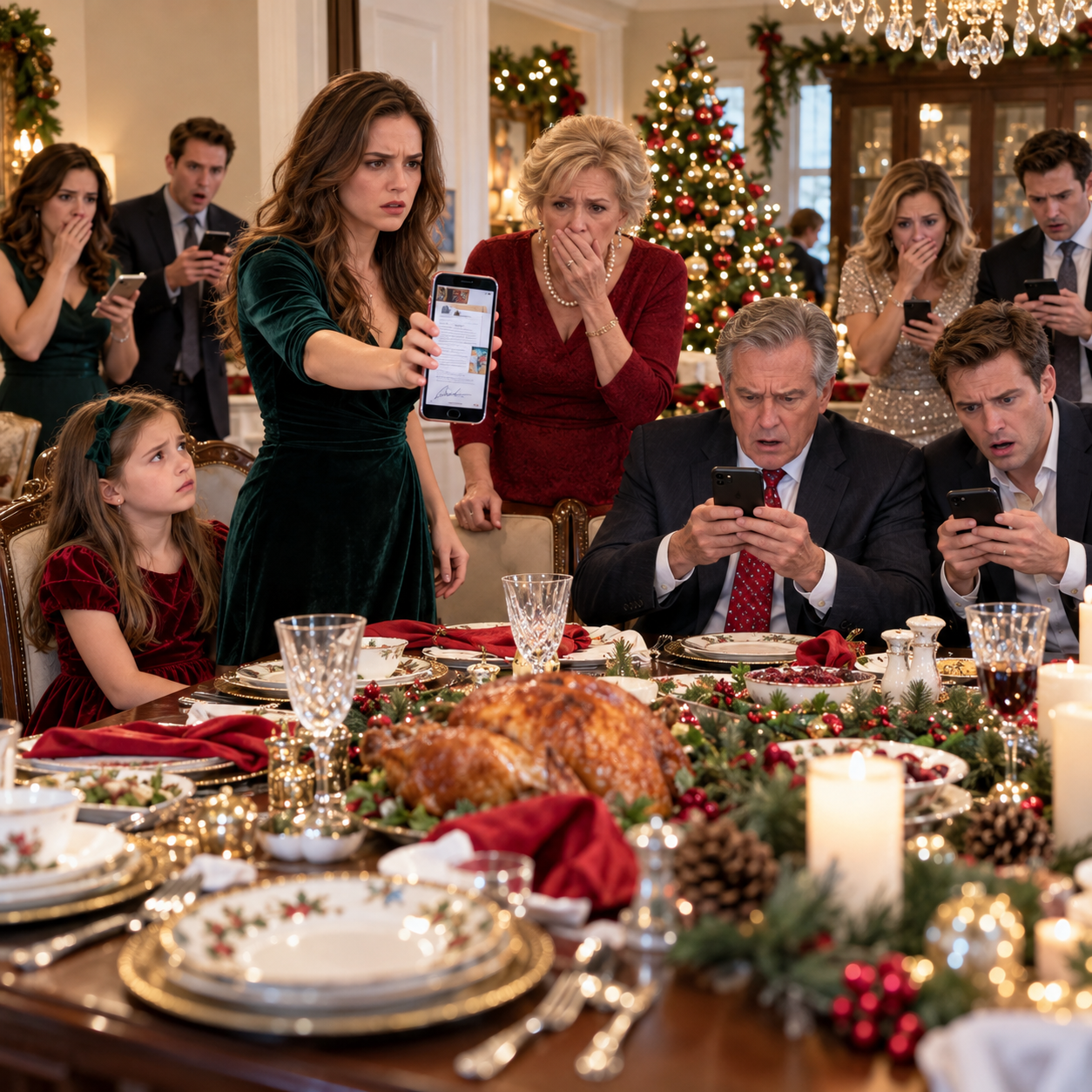
Mom had arranged the dining room like a magazine spread. Pine branches curled around brass candlesticks. Grandma’s china sat at every place. Small handwritten cards marked the adults’ seats.
The children had no cards.
Lily wandered around the table and chose a chair halfway down, beside me. A little knitted stocking had been tied to its back.
She sat and touched it.
“This one’s cute.”
Mom entered carrying gravy.
Her expression changed immediately.
“Lily, get up.”
Lily looked at me.
“There are other chairs,” I said.
Mom set the gravy down harder than necessary.
“That’s Leo’s place.”
“He doesn’t have a place card either.”
“Chloe.”
It was a warning, the same tone she had used when I was fifteen and embarrassing her in front of company.
Leo came into the room behind Austin.
“I can sit anywhere,” he said.
For one brief second, I thought that might end it.
Mom crossed to Lily instead.
“No. This is where my grandson sits.”
She caught Lily by the upper arm and pulled her from the chair.
Lily’s heel snagged against the rug.
She went down on one knee, knocking her apple juice from the table. The glass hit the floor and broke near the baseboard.
“Lily.” I was beside her immediately.
“I’m okay,” she whispered, though her eyes had filled.
Dad stayed at the head of the table.
“For heaven’s sake,” he said. “There are eight other chairs.”
I looked up at him.
“She fell.”
“She tripped.”
“Because Mom pulled her.”
Mom pressed her lips together. “I moved her. Don’t dramatize everything.”
Austin stared at his plate.
Clara unfolded Leo’s napkin and said quietly, “Maybe we should just switch the boys—”
“The boys?” I asked.
She stopped.
Lily was the only girl among the children at dinner.
Clara’s cheeks reddened. “I meant the kids.”
There it was again. Not one grand betrayal, but a hundred tiny corrections required before my daughter could even be included in a sentence.
Leo stood beside the disputed chair looking miserable.
“I don’t want it,” he said.
Mom softened instantly. “Honey, it’s your special chair.”
I helped Lily stand.
She brushed at the wet spot on her dress.
Then, so softly only I heard, she asked, “Did I do something bad?”
That question decided the rest for me.
“No,” I said. “You did nothing wrong.”
I took her hand and led her to the chair beside mine.
Mom sighed. “Can we please have one holiday without you making some statement?”
I looked at her.
For years I had imagined the speech I might someday give my parents. It would be devastating and eloquent. It would explain every birthday, every comparison, every time Austin’s needs became a family emergency while mine became an inconvenience.
None of it seemed useful anymore.
I pulled out my phone.
The family group chat included everyone at the table—my parents, Austin, Clara, two aunts, an uncle, and three cousins.
I attached six photographs from Grandma’s folder.
Then I added a screenshot of my email to Margaret.
Dad noticed me standing.
“What are you doing?”
“Check your phone.”
Austin gave a tired laugh.
“Come on, Chloe.”
Phones began vibrating across the table.
Aunt Denise opened hers first.
Her forehead creased.
“What is this?”
Dad reached for his phone.
Austin stopped chewing.
Mom didn’t move at all.
Dad enlarged one of the photographs with two fingers.
His face hardened.
“Where did you get these?”
“The kitchen.”
“You went through private papers?”
“My name is on them.”
Austin pushed back his chair.
“Chloe, this isn’t what it looks like.”
I looked at the forged signature.
“Then tell me what it is.”
He rubbed both hands over his face.
Dad pointed toward the hallway. “Study. Now.”
“No.”
“This is a private family matter.”
Aunt Denise lifted her eyes from her phone.
“You sent a quarter of a million dollars from Evelyn’s trust into Austin’s company?”
Dad’s jaw tightened.
“It was temporary.”
I glanced at Austin.
He finally looked at me.
And in a voice barely above a whisper, he said, “I was going to put it back.”
Part 3: The Documents Turn Christmas Into an Estate Reckoning
Nobody ate.
The turkey cooled beneath the chandelier while Austin tried to explain how his company had lost two major contracts and how twelve employees might have been laid off.
He had gone to Dad for help.
Dad had gone to Grandma’s trust.
“It was a bridge loan,” Austin said.
“A loan requires permission,” Aunt Denise replied.
Mom finally spoke.
“We were protecting him.”
I almost laughed, but there was nothing funny in it.
“From what?”
“Losing everything.”
I gestured toward Lily.
“And who was protecting her five minutes ago?”
Mom looked away.
Dad leaned toward me. “Do not mix two unrelated issues.”
“They’re not unrelated to me.”
I showed him the photograph of my forged signature.
“You decided Austin’s future mattered enough to steal from mine. Mom decided Leo’s chair mattered enough to drag Lily out of it. It’s the same rule. He belongs. We adjust.”
Mom flinched.
For once, she didn’t have a quick answer.
Austin stared at his hands.
“I asked for money,” he said. “I didn’t ask Dad to forge your name.”
Dad turned sharply. “Don’t start separating yourself from this now.”
“I’m not.”
“You were happy to take the transfer.”
Austin’s shoulders sagged.
“Yes.”
That single word sounded more truthful than anything he had said all evening.
My phone rang.
Margaret.
I answered on speaker.
She identified herself and said the estate’s attorney had already reviewed the photographs. All remaining distributions were being suspended until the documents could be authenticated and the trust accounts audited.
Dad rose.
“You had no authority to—”
“I am the executor, Frank,” Margaret said. “And I have more than enough authority to freeze an estate account when a beneficiary reports a forged authorization.”
Nobody spoke over her after that.
I took Lily’s coat from the hall closet.
Mom followed me.
“You’re leaving?”
“Yes.”
“On Christmas Eve?”
I looked at her hand resting on the closet door.
She had pulled that same hand away from Lily minutes earlier as though touching her too long might imply something.
“You keep saying Christmas like it excuses what happens during it.”
Her eyes filled, but I felt no victory.
“Chloe, I love you.”
“I know you believe that.”
She recoiled slightly.
That was the cruelest thing I said all night, and I still believe it was true.
In the car, Lily was quiet until we reached the interstate.
Then she asked, “Are Grandma and Grandpa mad at us?”
“They’re upset.”
“Because I sat there?”
“No.”
I kept both hands on the wheel.
“None of this happened because of you.”
She watched the lights pass outside.
After a while she said, “Leo didn’t even want the chair.”
I smiled despite myself.
“No. He didn’t.”
The audit took eleven weeks.
During that time, I ignored most calls from my parents and answered only messages related to the estate through my attorney.
The final report was worse than I expected and less dramatic than Dad had feared.
There had been no elaborate criminal empire.
There had been panic, entitlement, falsified paperwork, and a family convinced it could repair the damage before anyone noticed.
Dad had copied my signature from an old property document. Austin had accepted the money knowing I had not approved the transfer. Mom had signed as a witness on one form despite not seeing me sign it.
The money had gone into Austin’s failing company.
Most of it was gone.
Austin sold his second car, liquidated investments, and agreed to a structured repayment backed by his share of the estate. My portion of the trust was restored through a combination of recovered funds, withheld distributions, and a settlement.
My parents also faced legal costs and penalties tied to the false documents.
Their greatest loss, however, seemed to be the one they could not list on a financial statement.
Control.
Part 4: I Stop Chasing Family and Start Protecting Mine
In March, Dad asked to meet me at a coffee shop.
Not the house.
Not his study.
Neutral ground.
I went alone.
He looked older than he had at Christmas. His coat hung loosely at the shoulders, and for several seconds he stirred coffee he had not sweetened.
“I thought I was saving your brother,” he said.
I waited.
He looked up.
“That sounds pathetic now.”
“It sounded convincing to you then.”
“Yes.”
He rubbed his thumb along the paper cup.
“Austin always needed more help.”
“He learned that if he needed enough, everyone else would be asked to sacrifice.”
Dad closed his eyes briefly.
“That may be true.”
It was the closest he had ever come to admitting what our family had been built around.
“What about Lily?” I asked.
His face changed.
“Your mother shouldn’t have grabbed her.”
“That isn’t the question.”
He knew it.
After a long pause he said, “We never adjusted the way we should have.”
“Adjusted to what?”
His gaze dropped.
“To you adopting her.”
I leaned back.
“She was six months old.”
“I know.”
“She’s ten.”
“I know.”
There was nothing left for him to hide behind.
I told him he would not see Lily until I believed he could treat her as his granddaughter without qualifiers, comparisons, or special rules. I told him apologies were not admission tickets back into our lives.
He nodded.
Then he asked, “Do you think you’ll ever forgive me?”
“I think I may stop being angry.”
He waited for more.
“That’s not the same thing.”
Mom took longer.
Her first letters defended herself. Her second group of letters explained herself. By May, she finally wrote one that did neither.
She described the chair.
Not the inheritance.
Not Dad.
Not Austin’s company.
The chair.
She wrote that she had replayed Lily’s face after being pulled away and understood, finally, that Lily had been asking for nothing except a place at the table.
I kept the letter.
I did not answer it immediately.
Austin called in June.
His company had closed.
He was working for another firm and making repayments each month.
“I spent my whole life thinking Dad helped me because I was capable,” he said. “Now I think he helped me so much I never had to find out whether I was.”
“That sounds like something you need to work through.”
“Yeah.”
He paused.
“Leo misses Lily.”
That mattered more to me.
The children had never created our family hierarchy. They had only been forced to live inside it.
So Lily and Leo began seeing each other again—at parks, movies, and my apartment. No grandparents. No formal dining room. No special chairs.
By the following Christmas, Lily and I had moved into a small townhouse with a narrow kitchen and a dining table that barely seated six.
She insisted on decorating every chair differently.
One had silver ribbon.
One had bells.
Mine had a ridiculous paper snowman taped to the back.
On Christmas morning, she carried in two mugs of cocoa and nodded toward the table.
“Which seat is mine?”
I looked around theatrically.
“I don’t know. Which one do you want?”
She chose the chair at the head.
Of course she did.
Then she grinned.
I sat beside her.
For years, I thought family peace meant learning to tolerate the place other people assigned me.
I understand it differently now.
Peace is knowing I no longer need their permission to build a table of my own.
And in my home, Lily never has to wonder whether there is a seat for her.
The End .
All characters and events in this story are fictional, created for storytelling and entertainment purposes. Thank you sincerely for reading. Your feedback and support are invaluable and motivate me to continue sharing more stories with you.

