
Part 2: I Stopped Funding My Family And Built A Different Life
The first month without my family felt less like freedom than withdrawal. I caught myself reaching for the phone whenever something important happened, then remembered how often conversations with Dad turned toward Tyler’s achievements or somebody else’s expenses. I missed Mom’s Sunday calls, even though they usually ended with a request for help. It surprised me how deeply I’d come to associate being useful with being included.
I worked with my accountant to end recurring payments I wasn’t legally obligated to maintain, giving appropriate notice where needed. My parents would need to arrange their own insurance premiums, taxes, and household services, and Tyler would have to manage his expenses. None of those changes affected contracts or obligations I’d personally agreed to honor. I wanted clear boundaries, not a financial mess that would pull me back into their lives.
A month after the dinner, my company landed the largest contract in its history. We were hired to modernize several outdated business systems for a national logistics client, work that required expanding our engineering and project management teams. I nearly called Dad when the agreement was signed, imagining what it might feel like to hear him say he was proud. Instead, I ordered dinner for my employees and celebrated with the people who understood what we’d accomplished.
Three months later, a private investment firm approached me about purchasing a minority stake in the business. The transaction took weeks of negotiations, financial reviews, and legal work before it closed. I retained control of the company while receiving enough money to pay outstanding business obligations, strengthen our reserves, and make long-term investments. For the first time, I didn’t feel that any unexpected success needed to become somebody else’s emergency fund.
I had rented apartments since college, always telling myself I’d buy a home when my business was more predictable. After the investment closed, I began looking at properties north of Dallas. Most felt beautiful but impersonal until my realtor showed me a limestone house on nearly four acres. It had tall windows, a library, a pool surrounded by mature trees, and a detached guesthouse that could become a comfortable place for visiting friends.
The asking price was just over $3 million. I reviewed the purchase with my financial adviser rather than treating it as a reward I deserved regardless of cost. Once the numbers made sense, I bought the property and moved in several months later. I kept my old desk in the library because I wanted to remember the apartment where I’d signed my first client contract.
On my first evening, I walked barefoot through the kitchen as sunset turned the windows orange. The house was larger than I needed, and I knew some people would consider it extravagant. Yet what mattered most was the absence of expectations attached to it. Every room belonged to a life I’d built without waiting for someone to decide I was worth helping.
Over the following months, I heard occasional family news through acquaintances. Tyler had closed on his house, purchased an expensive SUV, and left another job after disagreeing with management. Dad complained that retirement was becoming costly, while Mom quietly stepped away from several social commitments. I wondered whether the loss of my financial support had affected them, but I resisted the impulse to investigate.
My own routines became steadier. I took early morning walks around the property, invited friends to dinner, and spent evenings reading in the library. My employees continued building the company, and I learned to delegate without feeling that everything might collapse if I rested. I was no longer trying to prove that I could survive without help, although I remained proud of how far I’d come.
Nearly a year after the restaurant dinner, I was outside by the pool while contractors installed shelving in the guesthouse. My phone buzzed with a notification from the security camera at the front entrance. A black SUV had slowed near the iron gates, then stopped beside the stone wall. I opened the camera feed and recognized Tyler behind the wheel.
He leaned forward, staring at the house beyond the trees. After driving a little farther, he reversed and parked directly in front of the gate. He stepped out, looked around, and raised his phone to his ear. The camera captured him saying, “Dad, you need to come here right now.”
I watched him pace along the roadside for several minutes. He seemed unable to decide whether he was more interested in the house, the guesthouse, or the cars beneath the covered driveway. I didn’t open the gate because we hadn’t spoken in nearly a year and he’d made no attempt to arrange a visit. Eventually, he settled against his SUV and waited.
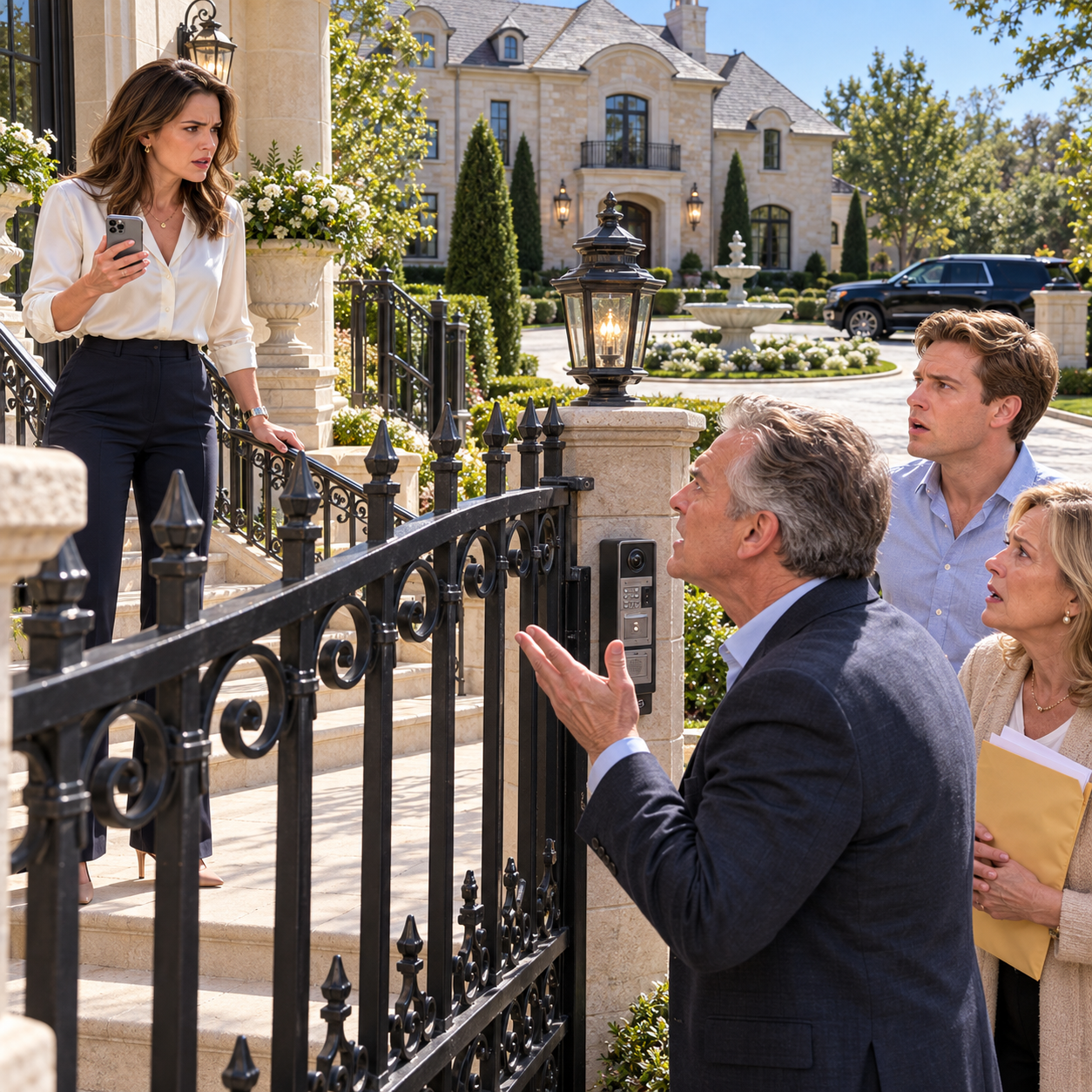
About forty-five minutes later, Dad’s silver Mercedes arrived with Mom in the passenger seat. Both climbed out, and Dad stood looking toward the house for a long time. Mom noticed me on the front steps and pressed a hand against her mouth. When Dad rang the intercom, I answered from inside.
He asked whether I owned the property, and I said yes. Tyler wanted to know how I’d managed to afford it, while Dad asked what had happened with my company. I reminded him that I’d been running the business for years, even when he treated it like a minor side project. He seemed embarrassed but quickly returned to asking questions about the house.
Mom said they’d worried about me during our year apart. I told her I’d needed distance after the restaurant dinner and the bank transfer attempt, and that none of them had acknowledged what happened. Dad said they hadn’t come to argue through a gate. When I asked why they’d come, nobody answered immediately.
Then I noticed a thick envelope in Mom’s hands. She held it against her coat and kept looking at Dad as though waiting for permission to speak. I asked what it contained. Her expression changed, and she said there was something I needed to know about the $350,000 Dad had given Tyler.
Part 3: The House They Discovered Exposed A Secret Inheritance
Dad told Mom that the documents had nothing to do with my new house. She ignored him and said the money he’d presented as a personal gift had actually come from a trust created by my grandmother. I remembered Grandma Evelyn as a practical woman who had taught me to balance a checkbook when I was twelve. She’d died several years before the restaurant dinner, and Dad had told me her estate was straightforward.
Mom explained that Grandma had established a fund for Tyler and me, with instructions for equal distributions once we were both adults. Dad had been appointed trustee and handled the account after her death. According to the papers Mom carried, the account had held approximately $350,000 shortly before Tyler bought his house. Dad had arranged for the balance to be transferred toward Tyler’s purchase without telling me that I was also a beneficiary.
I felt my hand tighten around the intercom control. For a year, I’d believed the dinner was about Dad favoring Tyler with his own money. Now Mom was suggesting he’d presented money intended for both children as though it belonged entirely to him. Tyler stared at her and asked whether she was saying part of his down payment should have gone to me.
Dad insisted the trust language gave him discretion and that he’d been trying to help the child who needed it more. Mom shook her head, saying she’d consulted someone after discovering copies of the trust documents while organizing their financial records. The attorney believed the distribution required a proper accounting and might have violated the trust’s instructions. She said she’d tried to raise the issue with Dad privately, but he kept postponing the conversation.
Another car pulled up behind them, and a man in a gray suit stepped out carrying a leather briefcase. He introduced himself through the intercom as Daniel Reeves, an attorney Mom had retained to review the trust paperwork, and offered to provide his professional details so I could verify them independently. Dad looked furious when he realized Mom had invited him. I told Mr. Reeves I wouldn’t discuss legal documents through a security gate but would have my own attorney contact him.
Tyler turned toward Dad and demanded to know whether the money had ever been his to receive. Dad said he’d wanted to give Tyler the kind of start he’d never needed to give me because I was already successful. I listened as the explanation that had governed my childhood returned in a new form. He had decided I didn’t deserve help because I’d learned to manage without it.
I told them I would review the records independently and that they needed to leave until we could arrange a proper conversation. Dad asked whether I was really refusing to let my parents inside after a year apart. I said I wasn’t comfortable opening my home for an unexpected confrontation, especially one involving financial documents I hadn’t seen. Mom nodded reluctantly, and within a few minutes, they drove away.
The next day, I met with an attorney specializing in trusts and estates. She obtained copies of the original trust agreement, account statements, and documents supporting the house purchase. The records confirmed that Grandma had intended the trust assets to benefit Tyler and me equally once the distribution conditions were satisfied. They also showed that the entire remaining balance had been transferred for Tyler’s benefit.
My attorney explained that Dad’s responsibilities as trustee were separate from his personal opinions about which child needed assistance. We requested a formal accounting and repayment of the portion that should have been distributed to me. I was entitled to ask for the records and seek appropriate remedies, although resolving the matter would require time and careful legal review. I told her I wanted accountability without making Tyler’s family homeless.
Tyler called several weeks later after receiving advice from his own lawyer. He admitted he’d believed Dad was giving him personal funds and had never seen the trust documents before the confrontation. I couldn’t know whether he’d questioned the source of the money, but I could hear genuine discomfort when he asked how much of the gift had belonged to me. I told him the attorneys would determine the amount and that I wasn’t asking him to guess what he’d known.
Our conversation remained awkward. Tyler said he’d assumed I disliked him because Dad always praised him more, and I told him I’d never wanted our parents to love him less. What I wanted was to stop being punished for managing my own life. He was quiet before admitting that he’d grown accustomed to Dad solving problems and had rarely questioned where the assistance came from.
Months of correspondence followed, along with a full review of the trust and the disputed distribution. Eventually, Dad agreed to restore my share of the funds, together with an amount negotiated to address the delay. He arranged repayment through a settlement rather than forcing a sale of Tyler’s house. The final agreement resolved the financial claim, but it didn’t pretend that Dad’s decision had been acceptable.
Mom wrote me a letter acknowledging that she’d let Dad make decisions without asking enough questions. She said she’d been proud of my independence but had confused that pride with the belief that I didn’t need support or encouragement. I appreciated her willingness to take responsibility, though I wasn’t ready to return to weekly family dinners. We began speaking occasionally, with the understanding that my finances were no longer a family resource.
Dad’s apology came later and was less comfortable. He admitted he should have disclosed Grandma’s trust and consulted both beneficiaries before making any distribution. He also said he’d been wrong to expect me to cover Tyler’s mortgage after giving Tyler such a large sum. I thanked him for acknowledging those decisions but explained that restoring the money couldn’t immediately restore my trust.
Tyler eventually asked whether we might have lunch together without our parents. We met at a small restaurant, talked about work and ordinary life, and managed to avoid turning every conversation into a competition. He was still learning to handle his own finances, and I was still learning not to solve every problem he mentioned. The relationship remained cautious, but for the first time, we were getting to know each other without Dad deciding which one of us deserved attention.
One evening, almost two years after the dinner that changed everything, I sat in my library reviewing a proposal from a potential client. Beyond the windows, the sun was setting over the trees, and the guesthouse lights glowed softly across the lawn. I thought about Tyler standing outside my gate, astonished that his older sister owned a house he’d never imagined she could afford. It struck me that my family had needed to see a $3 million property before they became curious about the life I’d built.
But the house wasn’t the greatest thing I’d achieved. I’d created a business, cared for people who worked with me, survived setbacks, and learned to ask for fair treatment without apologizing. None of those things required a mansion as proof. I would have deserved the same respect if I still lived in my old apartment.
I kept Grandma’s trust documents in a file beside the records from my first year in business. They reminded me that independence wasn’t a reason for other people to disregard my rights. I no longer felt obligated to keep my family comfortable at the expense of my own peace. Any closeness we rebuilt would have to come from honesty, consistency, and respect rather than money.
The following morning, I walked through the garden with coffee in my hand and stopped near the front gate. A delivery truck passed along the road where Tyler had parked his SUV, and I remembered the camera alert that brought my family back into my life. That day hadn’t ended with me opening the gate to them, but it had opened a path toward a different kind of relationship. For once, I was free to decide how far that path would go.
The End .
All characters and events in this story are fictional, created for storytelling and entertainment purposes. Thank you sincerely for reading. Your feedback and support are invaluable and motivate me to continue sharing more stories with you.


