Part 2: A Christmas Eve Signature Turned Our Family Against Itself
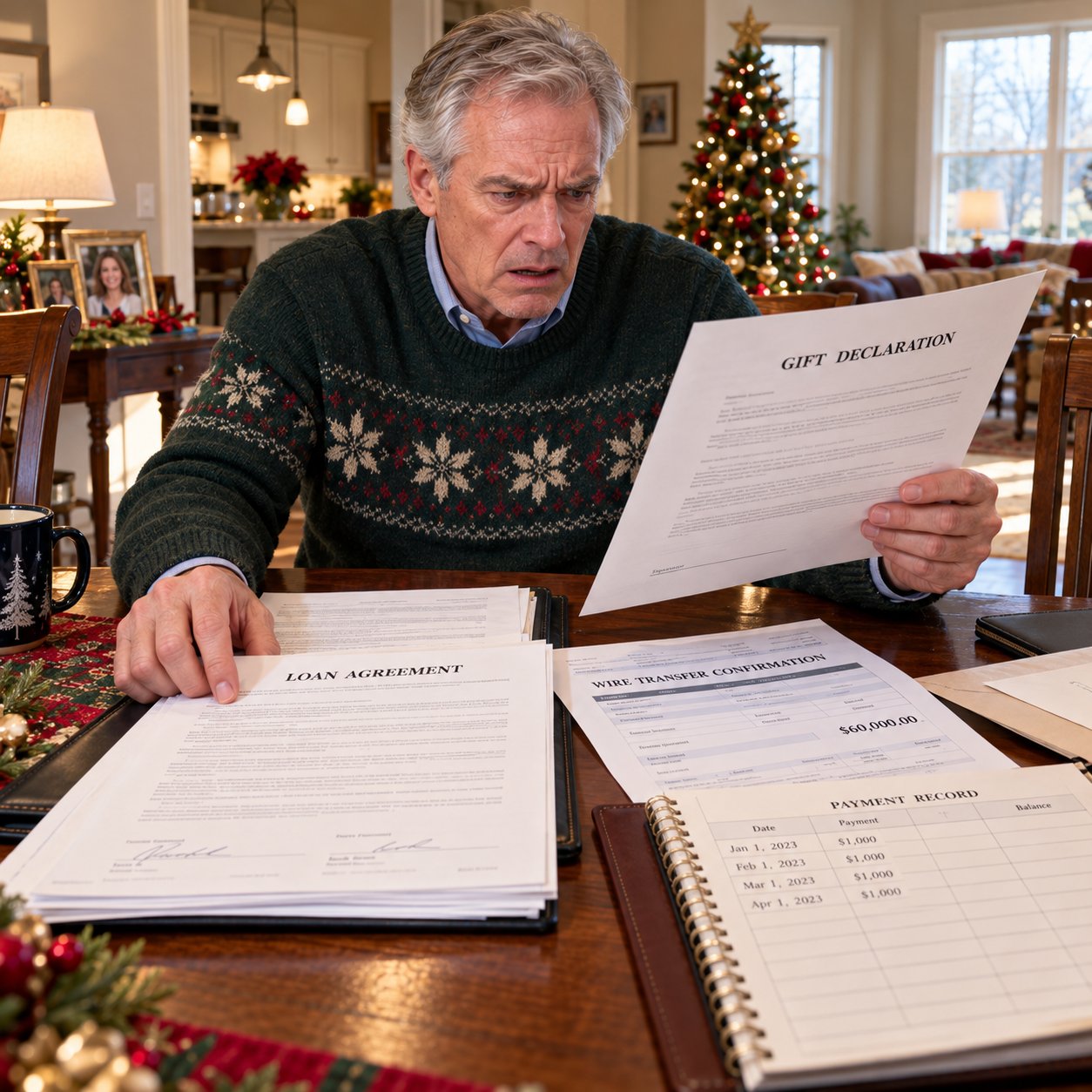
Susan had warned me about this possibility when I’d visited her the previous week. She’d studied my ledger, the agreement, and the notes I’d made after Lauren’s call. “Daniel, if someone submits a false gift declaration to a mortgage lender, that isn’t a harmless family favor,” she’d explained. “Your signature could be used as evidence that you surrendered your right to repayment.” She recommended speaking directly with Ethan before taking any formal action. I wanted that conversation more than anything.
When I called him, he sounded distracted. A television played in the background, and I could hear Lauren giving instructions about decorations. “I can’t sign the gift statement,” I told him. “But I’m happy to talk about changing your payment schedule if you’re having trouble.” He exhaled sharply. “You’re really doing this now? Two days before Christmas?”
“It’s not about Christmas.” He interrupted before I could finish. “Come on, Dad. You’re upset we didn’t invite you, and now you’re making us pay for it.” I looked toward the living room, where the tree lights reflected in Margaret’s photograph. “I would have loved to spend Christmas with you,” I said. “But I wouldn’t exchange my signature for an invitation. I’m asking you to tell the truth about the money.”
Lauren took the phone a moment later. She accused me of treating Ethan like a child and insisted her father had always helped his children without demanding documents. There was something frantic beneath her irritation, but I couldn’t tell what had frightened her so badly. I offered to meet with Susan and rewrite the repayment schedule. Ethan refused. “We don’t need another meeting with your lawyer. We need you to trust us.”
After that call, I sat at my desk and organized every financial record. I printed the agreement, the transfer confirmation, the three completed payments, and the unanswered reminders I’d sent Ethan. Susan confirmed that the missed installments placed him in default under our contract, although I had no security interest in his house and no legal basis to threaten foreclosure. I could demand the overdue payments formally. I told her I wanted to give him until after Christmas before making that decision.
On Christmas Eve, I ate dinner alone while my neighbors’ houses glowed with lights. I cooked a small pork roast, made more potatoes than I could finish, and called my old coworker Walt. We talked about football and his upcoming knee surgery. Neither of us mentioned that he had lost his wife three years earlier or that the holidays could make a perfectly comfortable house feel enormous.
Just before one in the morning, another email arrived from Lauren. Richard had been copied, along with Ethan. The message said the lender needed the signed gift declaration as soon as possible. I tried Ethan’s number twice, but he rejected the calls and sent a text instead: “Please stop making this difficult. Richard is reviewing everything tonight. Just sign it so we can move forward.”
I opened a blank reply and began writing. The first version contained too many things I’d been carrying around for months, including a sentence about the Christmas invitation. I deleted it. Richard was being asked to provide money based on documents that involved me, and he deserved accurate information. I addressed the final message to all three of them.
“Ethan and Lauren, I cannot sign the declaration because the sixty thousand dollars was a loan, not a gift. We have a signed agreement and a repayment history documenting that obligation. I remain willing to discuss revised terms after Christmas through Susan Whitaker’s office. I hope you understand that I cannot certify something untrue. Merry Christmas, Daniel.”
I checked the recipients, attached a copy of the original agreement, and sent the message. Then I closed my laptop and washed the dinner plate that had been sitting in the sink. I had no desire to embarrass my son in front of his in-laws. But if his financial future depended on Richard believing something false about me, I couldn’t protect him by helping to tell the lie.
Part 3: One Honest Email Revealed What My Son Had Concealed
Lauren called about twenty minutes later. At first, all I could hear was wind and her uneven breathing. “Dad, what did you do?” she asked. I told her I’d answered the email and included the agreement so nobody would misunderstand it. “My father just stopped everything,” she said. “He was going through the refinance papers, and when he saw your message, he started asking Ethan questions.”
She was outside on their back deck, wearing slippers and a sweater she’d grabbed on her way out. Richard had asked why the sixty thousand dollars was marked as a gift. Ethan said it was temporary wording and promised to correct it later. Then Richard opened a financial disclosure form Ethan had completed two weeks earlier. Beneath the section asking about additional debts, my son had entered one word: “None.”
“And Ethan signed it,” Lauren whispered. “He knew your loan existed. He knew the payments were overdue.” I could hear a door opening behind her, followed by someone calling her name. She moved farther into the yard. “I knew about the loan, Daniel. I thought we’d get the gift letter signed and straighten everything out later. I didn’t know Ethan had stopped paying you for three months.”
Richard hadn’t shouted or threatened anyone. He’d simply closed his laptop and said he would not contribute another dollar until he understood their actual financial position. Lauren told me her mother had stood near the dining room doorway, holding a dish towel, while Ethan tried to explain why the missing debt shouldn’t matter. When Richard asked what else they had failed to disclose, Ethan had no answer.
“Would you call Dad and tell him it was a misunderstanding?” Lauren asked. “He respects you. Maybe he’d reconsider.” I sat down at my kitchen table. “Lauren, I can tell him that nobody’s trying to take your house away. I can confirm every payment Ethan made. But I can’t tell him the documents were misunderstood when we all know what they were intended to say.”
She cried quietly for a moment, then said something I hadn’t expected. “We thought you’d eventually give in. You’ve always helped Ethan.” I looked at the empty chair across from me, the one Margaret had occupied for thirty years. “Helping someone and agreeing with everything they ask aren’t the same thing,” I said. Lauren wished me Merry Christmas before ending the call, and I spent the remainder of the night listening to the heat cycle through the house.
Richard called at eight the next morning. He asked whether I’d ever described the money as a gift, whether Ethan had signed voluntarily, and how many payments I’d received. I answered each question and offered to send the bank records. “I already have what I need for now,” he said. “I wish I’d asked these questions earlier.” There was a pause before he added, “You did the right thing by putting it in writing.”
On December twenty-sixth, Ethan and Lauren met me at Susan’s office. Ethan arrived with dark circles beneath his eyes and barely acknowledged me. “You could’ve handled this privately,” he said before sitting down. I reminded him I’d asked to meet several times. “I didn’t send Richard an accusation, Ethan. I sent him the agreement because he was being asked to rely on paperwork that contradicted it.”
Susan explained our choices: Ethan could pay the overdue installments, negotiate a revised schedule, or receive formal notice of the amount owed under the original contract. None of those options involved taking his home. I offered him until the end of January to decide. He stared at the contract for a long time, then asked, “Why can’t you just forgive it? I’m your son.” I told him I loved him, but sixty thousand dollars was too much to pretend had never existed.
Richard called again in early January. The refinancing was suspended until Ethan and Lauren produced accurate records and demonstrated that they could manage their obligations. He wasn’t withdrawing his love or permanently ruling out assistance, he explained. But he wouldn’t finance renovations while the household’s debts were being concealed. “They need to know what they can afford without either of us rescuing them,” he said. For once, the two fathers found themselves in complete agreement.
Part 4: The Promise He Finally Kept Brought Us Home Again
The changes began without announcements. Ethan sold the new SUV, traded his watch for a fraction of what he’d paid, and bought an older Honda. Lauren canceled their spring vacation, and the expensive dinner parties disappeared from their calendar. One Thursday afternoon, she arrived at my house carrying a tin of cookies. Over coffee, she admitted that excluding me from Christmas had been partly her idea. “I wanted my parents to see how well we were doing,” she said, twisting her wedding ring. “I treated you like someone who might spoil the picture. I’m sorry.”
A week later, Ethan called. He confessed he’d spent years comparing himself to Richard’s family, embarrassed by his ordinary upbringing and desperate to appear successful. “I thought if Richard knew I needed money from you, he’d think I couldn’t take care of Lauren.” His voice faltered. “Then I started believing it myself.” I told him about an accounting mistake I’d concealed early in my career, and the promotion I’d lost when I finally admitted it. We talked for an hour, not to excuse his decisions, but because I wanted him to know shame didn’t have to become a permanent address.
On January thirtieth, we returned to Susan’s office. We agreed to smaller monthly payments, with the missed installments added to the end of the schedule. The debt remained intact, and every change was documented. Ethan read each page carefully before signing. When he finished, he looked directly at me. “I’ll do better, Dad.” I didn’t ask for another promise. I shook his hand.
The first payment arrived in February. Lauren started inviting me to Sunday dinners, and I accepted, though our conversations were awkward at first. When she later asked whether I could cover an unexpected plumbing bill, I declined gently. She looked disappointed, then nodded. “We can figure it out.” By summer, Ethan sometimes called simply to talk about work or ask whether I’d watched the baseball game. Those calls meant more to me than any check.
By October, Richard had reviewed their finances again and agreed to help with a smaller refinancing package. They could remodel the kitchen, but the basement renovation would have to wait. Ethan accepted that without an argument. Richard and I had begun meeting occasionally for breakfast, and one morning he told me, “I used to think you were being difficult.” I smiled into my coffee. “Most people do, when I bring out a spreadsheet.” He laughed, and we ordered another pot.
The following December, Ethan called while I was washing dishes. “Dad, would you come for Christmas Eve dinner this year? Not a quick visit. The whole evening.” I asked whether he needed anything from me. After a moment, he said, “I understand why you’d ask. But no. We just want you here.” Then he added, almost shyly, “Could you bring the old star?”
I wrapped the crooked clay ornament in tissue paper and carried it to their house beside a homemade apple pie. Lauren greeted me with a long embrace. Richard shook my hand, and Patricia quietly apologized for standing by the previous Christmas without saying anything. Inside, Ethan had left the highest branch of their tree empty. He climbed a small ladder, placed the star where it belonged, and stepped down to inspect it. The ornament leaned slightly to one side, just as it had throughout his childhood.
After dinner, Ethan followed me onto the porch. Snow drifted beneath the streetlights, and he stood beside me with his hands deep in his pockets. “I made you feel like you didn’t belong here,” he said. “You shouldn’t have had to ask your own son for a place at Christmas.” I rested a hand on his shoulder. “I never needed the best seat, Ethan. I only needed to know there was room for me.” He nodded, his eyes bright in the cold air.
When I returned home, my own Christmas tree stood without its familiar star. For the first time in thirty years, I didn’t feel compelled to replace it. I sat beneath Margaret’s photograph, remembering how she’d taught our son to shape that crooked little ornament with his hands. I wished she could have seen him place it on his own tree, not because he’d finally learned to repay a debt, but because he’d begun to understand that love and responsibility belonged together.
The End .
All characters and events in this story are fictional, created for storytelling and entertainment purposes. Thank you sincerely for reading. Your feedback and support are invaluable and motivate me to continue sharing more stories with you.