
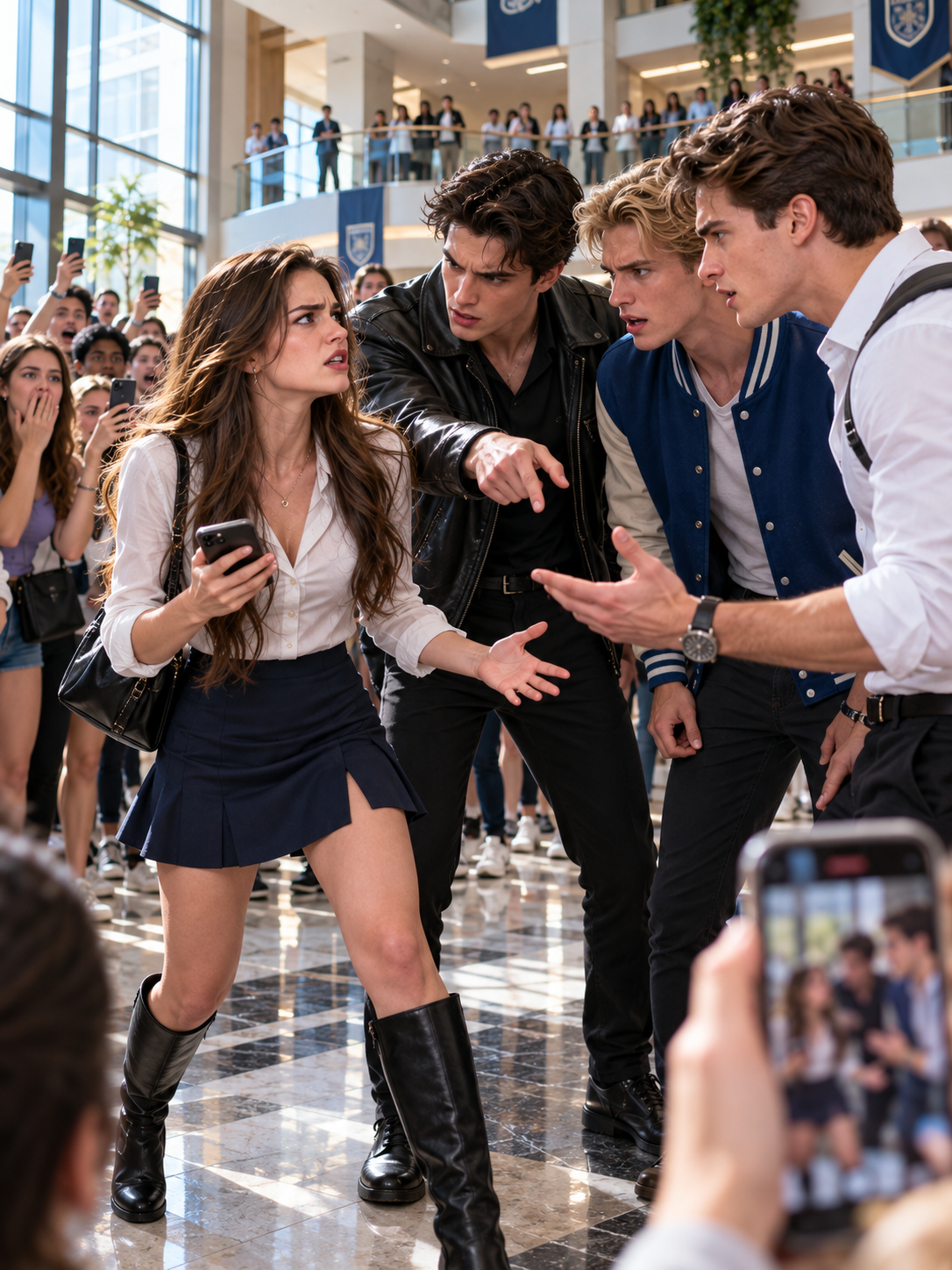
Three Campus Heartthrobs Accused Me of Dating Them All—Then Their Childhood Sweetheart’s Darkest Secret Came Out
Three of the richest, most popular guys at my university publicly accused me of secretly dating all three of them. Their childhood sweetheart stood in front of me, smiling as hundreds of students called me a liar. What nobody knew was that I’d suddenly begun seeing mysterious messages revealing the truth behind everyone’s actions. When I forced the three guys to confront what had happened, their precious childhood friend turned against me. But the biggest shock came when I discovered why one of them had been protecting her for ten years.
Part 1: Three Golden Boys and One Very Convenient Lie
The first time I saw words floating in midair, I assumed I needed more sleep. I was sitting in Briarfield University’s dining hall, drinking an iced vanilla latte, when a line of glowing blue text appeared above my coffee. “The poor roommate has no idea she’s about to become the villain.” I blinked twice, but the words remained, moving across my vision like comments on a livestream nobody else could see.
Across the table, Sloane Whitcomb was smiling at something on her phone. She had perfect blonde curls, a pink cardigan that probably cost more than my monthly rent, and three childhood friends who happened to be the most famous guys on campus. Adrian Vale, Nolan Price, and Julian Keene came from families whose names appeared on buildings around the university. Sloane mentioned them so often that our roommates could recite their birthdays without ever meeting them.
“June, explain this,” Sloane demanded, suddenly turning her phone toward me. On the student forum, three verified accounts had posted photographs accusing me of secretly dating all three boys and accepting expensive gifts from them. One photograph showed the back of a girl with dark hair entering the library. The girl might have been me, or any of two thousand students who owned a black coat.
Before I could respond, another glowing comment floated past my eyes. “Sloane only borrowed their accounts for a harmless prank. She doesn’t know June will nearly lose her scholarship.” My fingers tightened around the plastic cup, and I stared at Sloane with a new understanding. Those impossible words were describing things that hadn’t happened yet.
“It’s the back of someone’s head,” I said, sliding her phone away from my lunch. “Where exactly is the proof that it’s me?” Sloane raised her voice until students at three surrounding tables stopped eating. “Are you denying it because you’re embarrassed, or because you finally got caught?”
I had never dated Adrian, Nolan, or Julian. The only time I’d been in the same room with all three was when they helped Sloane move into our dormitory in August. Adrian had carried two suitcases, Nolan had complimented our ridiculous floral curtains, and Julian had refused the offered cafeteria cookie. Apparently, that brief encounter had somehow become my imaginary romantic empire.
Sloane folded her arms and smirked. “Fine, I’ll ask them to post the full photograph right now.” She tapped Adrian’s name first, then froze when the login screen appeared. She tried again, more quickly, and switched to Nolan’s account. By the time Julian’s account rejected her password, her confident smile had disappeared.
The glowing comments multiplied. “Wait, why did all three guys change their passwords?” another message asked. “That’s not supposed to happen until chapter thirty!” I nearly laughed, although my stomach was still twisting. Someone was changing the story, and for the first time that morning, Sloane didn’t know what came next.
Students began recording as she repeatedly called her three famous friends. Adrian didn’t answer, Nolan sent her to voicemail, and Julian declined the call immediately. Sloane’s cheeks turned pink, but she recovered enough to announce that the boys were simply busy. Then she leaned toward me and whispered, “People like you don’t win against people like me.”
I came from a small Pennsylvania town, worked at the university library, and relied on an academic scholarship. Sloane knew all of that because she’d spent our first month as roommates asking questions that sounded friendly. Now she called me desperate, suggested I had chased wealthy men for money, and laughed when several nearby students joined in. I kept my phone beneath the table, waiting for three messages I’d sent earlier to receive their replies.
The first response arrived from Adrian. “We didn’t authorize those posts. Our accounts were accessed without permission.” Nolan confirmed the same thing, and Julian asked whether I’d saved screenshots before the originals were removed. I had, including timestamps and Sloane’s accusation in the dining hall.
Three new posts appeared almost simultaneously, each from one of the boys’ verified accounts. They denied the rumors, apologized for the damage, and asked other students to stop spreading photographs of me. A hush moved through the room as phones lit up around us. Sloane stared at the screen as though someone had erased the ground beneath her feet.
“I expect you to apologize,” I told her, standing beside the table. “You knew those posts weren’t true, and you made sure everyone heard your accusation.” She grabbed her handbag and laughed, but her voice sounded thin. “Go complain to the dean, June. My family practically built this university.”
She hurried away, and our two roommates, Brooke and Hannah, approached with guilty expressions. They had watched everything without speaking because Sloane frightened them as much as she angered me. I didn’t blame them for being scared, but I wasn’t going to pretend their silence had helped. As I gathered my things, another message flashed across my vision: “Sloane has already prepared her next move. June’s scholarship is the real target.”
Part 2: The Boys Who Came Looking for Me
Adrian Vale was waiting outside my economics lecture the following afternoon. Tall, dark-haired, and wearing a tailored navy coat, he looked like someone who had never worried about the price of groceries. Students slowed down when they recognized him, whispering behind their phones. I considered taking the other staircase, but he stepped forward before I reached it.
“June, I owe you an apology,” he said, keeping his voice low. “Those accusations should never have appeared under my name.” I asked whether he knew who had accessed his account. His jaw tightened, and the answer came slowly: “Sloane knew the passwords from an old shared tablet.”
He explained that their families had vacationed together since childhood and that nobody had bothered changing certain logins. When I asked why Sloane believed she could humiliate a stranger without consequences, Adrian looked uncomfortable. “She can be impulsive,” he said. “She doesn’t always understand how far things go.”
“That’s an explanation you’ve probably given your entire life,” I replied. “It isn’t an apology from her.” Adrian watched me for a moment before admitting that he had already asked Sloane to stop contacting me. The glowing comments above his shoulder immediately complained that the male lead was supposed to defend his childhood sweetheart.
He offered to cover any expenses caused by the scandal, but I shook my head. I didn’t need a wealthy stranger handing me money so he could feel better about his friend’s behavior. I needed an honest written statement confirming that the accusations were false. Adrian agreed, though he seemed genuinely surprised that I wasn’t interested in his generosity.
That evening, Nolan Price appeared beneath the enormous oak tree outside my residence hall. His reputation was different from Adrian’s; where Adrian intimidated people, Nolan charmed them until they forgot what they’d intended to say. He handed me an iced matcha latte and sat on the bench beside me without waiting for an invitation. “You’re much harder to impress than Sloane predicted,” he said.
“Did she send you?” I asked, leaving the drink untouched. Nolan smiled, then admitted he’d come because he was curious about the girl who had made Adrian apologize publicly. He offered to take me to dinner, promising he’d keep Sloane away. I told him that treating a woman’s harassment as an opportunity to win a date wasn’t particularly charming.
For the first time, Nolan looked embarrassed. He admitted that Adrian and he had competed over almost everything since childhood, including who could best defend Sloane. “I used to think being loyal meant never questioning her,” he said, staring at the falling leaves. I asked him to prove he’d changed by cooperating with the university investigation, not by buying me coffee.
When I returned to my dormitory, Sloane was waiting inside with her arms crossed. Brooke and Hannah stood near the window, their expressions tense, while a ceramic mug sat beside Sloane’s computer. “You think you can steal my friends?” she demanded. I put down my backpack and told her that people weren’t possessions.
She swept the mug off her desk in my direction. I stepped aside, but it struck the doorframe and shattered against the floor, leaving a shallow cut along my ankle. Brooke immediately called our resident adviser, and Hannah took photographs before anyone disturbed the pieces. Sloane began crying as soon as she realized other people had witnessed what happened.
“You threatened me first!” she insisted when the resident adviser arrived. I stood beside my desk, holding a clean towel against the small cut, while Brooke explained exactly what she’d seen. Sloane offered to pay for the broken mug and any cleaning expenses, as though replacing an object would settle everything. Our resident adviser arranged for campus security to document the incident and helped me obtain medical care.
Julian Keene appeared outside the campus clinic thirty minutes later, carrying a small bag of supplies. He wore silver-rimmed glasses and spoke with the measured precision of someone who disliked unnecessary conversation. “I saw Hannah’s message,” he said, then asked whether I was all right. When I told him the clinic had already treated my ankle, he simply sat beside me.
I expected him to defend Sloane, but instead he showed me an email he’d sent to university information security. His account activity included a login from a device he hadn’t used in months, and he had requested preservation of the access records. He also offered to provide a statement about the unauthorized posts. I thanked him, surprised by how much more useful that was than another grand apology.
Then my university email chimed. The subject line read “Notice of Student Conduct Review,” and the attached complaint accused me of impersonating the three boys and harassing Sloane through anonymous accounts. Julian read the notice over my shoulder, his expression hardening. Someone had turned the investigation against me, and the complaint included screenshots supposedly showing messages sent from my own laptop.
Part 3: The Trap Hidden Behind Her Perfect Smile
I barely slept that night. Every time I closed my eyes, I saw the university’s disciplinary notice and imagined my scholarship disappearing because someone with expensive shoes had decided to destroy me. At eight the next morning, I took my laptop, screenshots, and clinic paperwork to the student conduct office. Julian insisted on accompanying me, although I warned him I wasn’t interested in becoming another one of his personal projects.
The assistant dean, Dr. Rebecca Porter, listened while I explained the forum posts and the dormitory incident. Sloane’s complaint contained cropped screenshots of threatening messages supposedly sent from my account, but no original message links or technical records. Dr. Porter confirmed the accusations hadn’t been established and that the university would review both sides. She also assured me that filing a complaint didn’t automatically suspend my scholarship.
I had expected instant vindication, which was probably foolish. Instead, I received a list of documents to provide, an interview date, and instructions not to confront Sloane. Julian offered to retrieve his original account activity records and contact Adrian and Nolan about doing the same. When we left, he said, “Screenshots can lie. Account histories are harder to explain away.”
Over the next several days, all three boys submitted written statements confirming that their accounts had been accessed without permission. Adrian remembered leaving an old tablet at Sloane’s family lake house, where the four childhood friends used to spend summers. Nolan admitted Sloane had asked him not to change his password after the dining hall confrontation. Julian supplied the unfamiliar session information and his original security notification.
Meanwhile, Sloane told everyone I was orchestrating a campaign against her. She appeared on campus with watery eyes and a carefully worded social media post about being betrayed by people she trusted. The floating comments insisted she was the misunderstood heroine of a romance novel. According to them, the three boys would eventually regret turning their backs on their precious childhood friend.
I started paying attention to those comments instead of being frightened by them. They predicted Sloane’s reactions, but their descriptions of me were often wrong, calling me calculating when I was exhausted and arrogant when I was simply refusing to apologize. Whoever was writing them seemed determined to force everyone into familiar roles. I decided their opinions were no more reliable than the rumors on the student forum.
Hannah helped me reconstruct the afternoon of the alleged messages. The screenshots placed me in our dormitory at 2:15, but I had been working at the library circulation desk under a supervisor’s camera. My timecard and the supervisor’s statement supported my account. When I submitted those records, Dr. Porter said the university’s technical review had found no corresponding messages originating from my account.
That should have ended things, but Sloane still had one advantage: her family sponsored the university’s largest annual charity gala. The Whitcomb Foundation funded student leadership awards, and Sloane was scheduled to announce a major contribution to the campus legal assistance program. Her parents had already purchased an entire table for their friends. She treated the evening like her personal coronation.
Nolan approached me outside the library with an invitation to the event. “Come as my guest,” he suggested, explaining that Sloane expected all three boys to escort her. I asked whether he was trying to make her jealous. He admitted that the thought had occurred to him, and I handed back the invitation. “I’m not interested in becoming your weapon in a competition you’ve been playing since childhood.”
His smile faded, and he finally stopped pretending everything was a game. He promised to attend the investigation interview and speak truthfully even if it damaged his family’s relationship with the Whitcombs. That was the first thing Nolan had offered that I actually wanted. He walked away without asking for a date.
Two days before the gala, Adrian found me outside the student union. He said Sloane had been his closest friend since childhood because she’d once rescued him from an accident at his family’s lake property. I noticed how carefully he avoided discussing the details. When I asked whether that meant he would overlook her behavior forever, he looked genuinely troubled.
“She was there when I needed someone,” he answered. I thought about Brooke and Hannah, who had finally spoken up despite being frightened. “Then you should understand how important it is to tell the truth when somebody needs help,” I said. Adrian nodded slowly, but his expression suggested I had touched something much older than the scandal.
That afternoon, the student legal assistance club invited me to speak briefly at the gala about the importance of accurate evidence in online harassment cases. I agreed after confirming that the university would review my remarks to protect the ongoing investigation. Sloane apparently learned about the invitation before I did. The next morning, a student volunteer quietly forwarded me a draft presentation Sloane had submitted for the event.
One slide contained my photograph beneath the title “The Cost of Dishonesty,” accompanied by the same allegations the three boys had already denied. The charity gala was supposed to celebrate students who needed assistance, but Sloane intended to use its enormous audience to humiliate me again. This time, however, she had made one enormous mistake: she had submitted her plan in writing.
Part 4: The Night Her Perfect World Fell Apart
Founders’ Hall looked like a palace when I arrived on Saturday evening. Crystal lights glittered above white linen tables, and a string quartet played near the staircase while guests in formal clothes exchanged expensive compliments. I wore a simple emerald dress borrowed from Hannah, with my hair pinned loosely behind my shoulders. My ankle had healed, but I still felt uncomfortable walking into a room filled with people who might have believed Sloane.
Adrian, Nolan, and Julian were waiting near the entrance. Sloane spotted them from across the ballroom, then froze when all three walked toward me instead. Her mother, Patricia Whitcomb, stared openly as Adrian offered to escort me to the student speakers’ table. I declined his arm but thanked him for showing up, and for once he understood that supporting me didn’t require possessing me.
Sloane hurried over, her pink evening gown sweeping across the polished floor. “You’re actually here?” she whispered, gripping her handbag. I told her the university had invited me, then stepped around her to find my seat. Her smile returned when she noticed several donors watching, but the glowing comments overhead had begun flashing warnings: “The heroine is losing control of the plot.”
Before the program began, Dr. Porter and the event coordinator confirmed that Sloane’s proposed slide had been removed. The coordinator also showed me the email in which Sloane had insisted the accusations were verified. Her attempt to manipulate the presentation was being preserved as evidence for the conduct review. I felt relieved, though I knew preventing a public humiliation wasn’t the same as obtaining accountability.
During dinner, Patricia approached our table and demanded to know why her daughter was being excluded by friends she’d known since childhood. Adrian explained that false accusations had been posted under their accounts. Nolan added that Sloane had continued accusing me after learning the truth. Patricia dismissed the situation as an unfortunate misunderstanding, then turned to me with a smile that felt colder than the room.
“Surely you can accept that young people make mistakes,” she said. I looked at her diamond bracelet, remembering how Sloane had mocked my hometown and my scholarship. “Mistakes deserve honesty,” I answered. “What happened to me involved repeated choices, and I won’t pretend otherwise just because your family supports the university.”
The university president opened the program by discussing fairness and access to education. When I was invited to speak, I told the audience about watching a false rumor spread faster than anyone could correct it. I didn’t name Sloane or reveal confidential investigation details. Instead, I explained why preserving original records, checking sources, and listening to witnesses mattered more than popularity.
As I returned to my seat, Sloane stood abruptly and demanded the microphone. “She’s making herself sound innocent,” she announced, ignoring the moderator’s attempt to redirect her. “You have no idea how she manipulated people to attack me!” Several guests exchanged startled looks, and Patricia rose from her chair. I remained still, letting Sloane decide what she wanted everyone to hear.
Adrian stood beside our table. “June didn’t impersonate us,” he said clearly. “Our accounts were used without our permission, and we have already confirmed that to the university.” Sloane’s expression twisted, and she snapped, “I borrowed your accounts because you were supposed to help me! You were supposed to believe me!”
The microphone carried every word across the ballroom. Sloane stared at it, realizing what she’d admitted, then insisted she hadn’t meant to hurt anyone. The event coordinator gently escorted her away from the stage while Patricia followed, furious and embarrassed. I watched the crowd settle into uneasy conversation, realizing that Sloane’s public image had finally collided with her own words.
But the evening wasn’t finished. As we sat down, Patricia returned and accused Adrian of abandoning someone who had once saved his life. She mentioned a fire at the Vale family’s lakeside boathouse ten years earlier. Adrian’s face went pale, and for the first time all evening, Julian looked visibly startled.
Golden comments suddenly flashed across my vision. “The biggest secret in the original story is about to surface. Sloane never rescued Adrian. The real girl broke the boathouse window and helped him escape.” Another comment described a silver locket with a blue stone and a small scar near the rescuer’s left shoulder.
My hand moved instinctively toward my collarbone. When I was ten, I’d helped a frightened boy escape a smoky boathouse during a summer trip, and I’d lost the silver locket my grandmother had given me that day. Adrian turned toward me, his eyes following my hand. “June,” he asked, his voice shaking, “where did you get that scar?”
Part 5: The Girl Who Saved Him Was Me
For several seconds, I couldn’t answer Adrian’s question. The ballroom lights seemed suddenly too bright, and I remembered the smell of lake water, wet wood, and smoke from a summer afternoon I’d spent years trying to forget. I had been ten, visiting my aunt near Lake Bellwood, when I’d heard a boy calling for help inside a small boathouse. The door wouldn’t open, so I’d climbed through a damaged window and helped him find another way out.
“I was at Lake Bellwood that summer,” I finally told Adrian. “There was a fire near the marina, and I helped a boy escape.” His chair scraped against the floor as he stood. He asked whether I’d worn a silver necklace with a blue stone, and my heart nearly stopped. Only the boy I’d helped, or somebody who knew him afterward, could have remembered that detail.
The next morning, I brought my old silver locket to Adrian’s apartment. Its chain was broken, and the blue stone had a tiny chip along one edge. I’d lost it during the fire, but a rescue worker had returned it to my aunt after finding it near the window. Adrian stared at the necklace, then showed me an old photograph of himself recovering at the hospital.
“I remember your voice,” he said, sitting heavily on the couch. “You kept telling me to follow you and not look back.” He explained that Sloane had approached him afterward and claimed she’d found the key that opened the boathouse. His family had believed her, and he’d spent ten years treating her like the person who saved his life. I looked at the locket between us and realized how thoroughly she’d taken credit for something she hadn’t done.
Adrian contacted the former summer camp director, who still had an incident report describing a young girl who’d helped him escape through the window. My aunt also found my childhood clinic paperwork and confirmed the date. The records supported my account and showed that Sloane hadn’t been identified as the rescuer. When Adrian confronted her privately, she finally admitted she’d let his family believe something she knew wasn’t true.
What frightened me most was that Sloane had apparently understood how valuable that lie would become. She’d used Adrian’s gratitude as a guarantee that he would always defend her, no matter what she did. Adrian apologized repeatedly, his voice breaking as he realized how unfairly he’d treated me. I told him I appreciated his honesty, but I wouldn’t turn an old rescue into a new obligation.
Three weeks later, the university completed its conduct investigation. The account records, witness statements, dining hall video, and Sloane’s own admissions established that she’d deliberately spread false accusations and continued targeting me afterward. The dormitory incident was also considered, including Brooke’s statement and the security report. Following the disciplinary hearing, Sloane was dismissed from the university, subject to the available appeal process.
Her family’s donations couldn’t erase the documented evidence, and my scholarship remained secure. The university required corrections to the public record and offered me a different room while the remaining administrative matters were resolved. Sloane sent one final message claiming I’d ruined her future. I didn’t answer because I had spent enough time defending myself against consequences she had created.
Patricia Whitcomb contacted Adrian’s family, furious that her daughter had lost her place at Briarfield. Adrian later told me he’d refused to pressure the university on her behalf. Nolan stopped treating the situation like a competition, and Julian helped me organize the records I might need later. For the first time, the three famous boys seemed to understand that money and popularity didn’t make them responsible for everyone else’s decisions.
Adrian asked whether we could start over, perhaps with dinner somewhere away from campus. His expression was hopeful, and I knew the mysterious comments would have called this the beginning of his redemption. I thanked him for asking but declined. “You don’t owe me a romance because I helped you ten years ago,” I said, “and I don’t owe you one because you’ve finally learned the truth.”
The floating comments erupted in outrage. “She’s rejecting all three male leads!” one complained, while another insisted I was supposed to move into Julian’s penthouse and let them compete for my affection. I laughed for the first time in weeks. I’d survived enough of their predictions to realize that none of those imaginary endings belonged to me.
By spring, I had moved into a quiet apartment with Hannah and accepted a paid summer internship at a legal advocacy nonprofit. We bought inexpensive kitchen chairs, argued about which coffee maker to keep, and spent Friday evenings watching terrible movies. Sometimes Nolan waved when he saw me on campus, and Julian occasionally recommended books. Adrian respected my distance, which was the most meaningful apology he could offer.
At the end of the semester, I passed the dining hall where everything had begun. The same sunlight spilled across the tables, and someone had left a half-finished iced latte beside the window. For a moment, one last glowing sentence appeared above the crowd: “The story cannot end without the heroine choosing one of the three.”
I stopped beneath the doorway, smiled, and whispered, “Then I guess I’m writing a different story.” The words flickered once before disappearing completely. I walked outside into the warm afternoon with my scholarship intact, my name cleared, and my future finally belonging to me.
Legal Notice: This story is a work of fiction. Names, characters, businesses, events, and incidents are the product of the author’s imagination or are used fictitiously. Any resemblance to actual persons—living or dead—or to actual events is purely coincidental. Thank you! 💓


