The Woman Who Threw My Bag Out of First Class Didn’t Know Why the Captain Was Running Toward Me
I boarded my delayed flight with a first-class ticket, a canvas bag, and the last photograph I had of my father. A woman in an expensive suit took my seat, laughed when I protested, and hurled my bag into the aisle hard enough to crack the photograph’s glass. The flight attendant sided with her, and the passengers watched me kneel on the carpet. Ten minutes later, the captain came running toward me, terrified by a message from the ground. But the broken picture was only the beginning.
Part 1
The first thing I noticed about seat 2A was the woman’s white leather heels. Meridian Crown Flight 214 had spent six hours delayed in Atlanta. All I wanted was to sit down, close my eyes, and get home to Charlotte before midnight. Instead, a stranger in a cream suit was sipping coffee from the cup holder beside my window.
“Excuse me, I think that’s my seat,” I said, holding out my boarding pass. She glanced at the paper, then at my navy sweater and scuffed loafers, and smiled without warmth. “Then somebody made a mistake,” she replied, returning to her phone. Behind me, the boarding line stopped, and the overhead bins snapped shut one after another like impatient fingers.
A flight attendant wearing a silver name tag stepped between us. “I’m Morgan Pike, and I can help you find another seat,” she said, with the kind of rehearsed cheerfulness that usually means the conversation is already over. The woman in cream was apparently Celeste Ralston, a priority customer whose requests received special attention. I showed Morgan the large black 2A printed beside my name and asked her to check the reservation.
Morgan scanned my pass, and I saw a green confirmation light appear. She turned the scanner away so quickly that I almost wondered whether I’d imagined it. “There’s been a cabin adjustment,” she announced, offering me 6D and a promise that customer service could discuss compensation later. “I paid for this seat three weeks ago,” I said, and she lowered her voice to tell me not to hold up the flight.
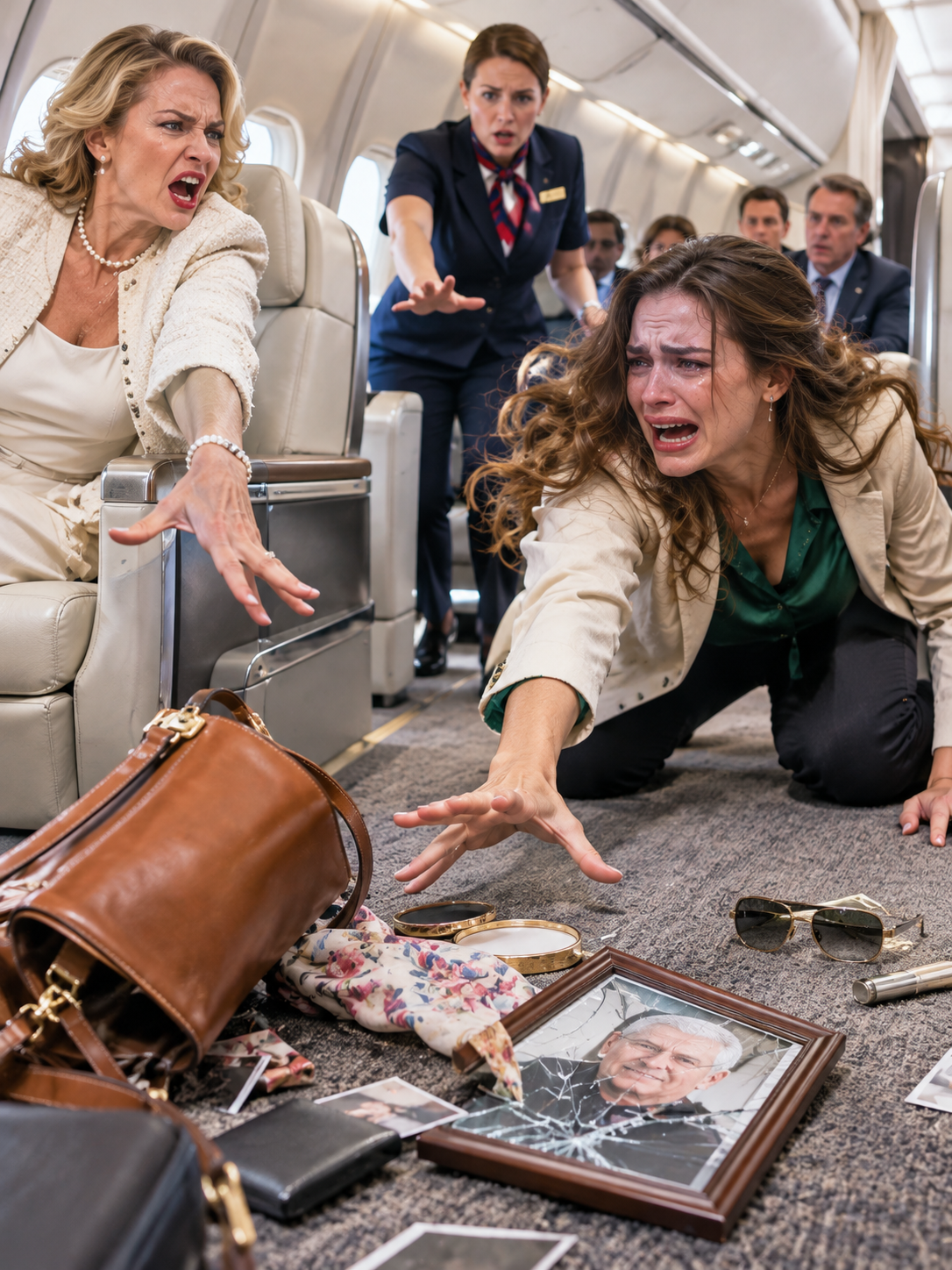
My canvas bag was hanging from my shoulder, its strap rubbing against a sore spot beneath my collarbone. Celeste stood, reached past Morgan, and grabbed it before I realized what she was doing. “Move your junk out of the way,” she snapped, throwing it toward the aisle. My notebook skidded under a seat, my glasses case struck a metal chair leg, and a framed photograph landed face down with a sharp crack.
Someone gasped; somebody else muttered, “Come on.” I dropped to my knees and lifted the frame, watching a crooked line split the glass across my father’s face. He was wearing his old maintenance coveralls in the photograph, grease on one cheek and a ridiculous birthday hat on his head. He had died seven months earlier, and that picture was the one thing I refused to pack in checked luggage.
“There,” Celeste said, straightening her jacket. “Now we can all get moving.” Morgan didn’t ask whether I was all right; instead, she pointed toward the rear cabin. I slid the picture into its padded sleeve and heard my father’s voice as clearly as if he were standing beside me: Never let somebody else’s hurry make you careless. It was advice he’d given me around airplanes since I was little.
A teenager in a red sweatshirt crouched to retrieve my notebook. “My mom got it on video,” he whispered, nodding toward a woman holding her phone against her chest. His mother, Elena, gave me a small, worried look and offered to send me the recording. I thanked them, but something beyond Morgan’s shoulder had caught my attention. The cockpit door was open, and an amber advisory glowed above a row of switches.
I couldn’t read every character from the aisle, but I’d seen a maintenance notation earlier through the gate window on a ground crew tablet: P27 CHECK OPEN. The phrase wasn’t proof of a dangerous airplane; sometimes the problem was a delayed electronic update. Still, a check showing open after repeated assurances that maintenance was complete deserved a closer look. My father’s lessons made that distinction feel more important than the fight over 2A.
I pulled out my phone and opened a number I knew by memory. The airline’s operations desk answered on the third ring, beneath the rumble of luggage carts outside. I gave the agent the flight number, aircraft registration, and maintenance notation, then asked whether the required release had actually been recorded. There was a pause before the agent said, “Please don’t hang up. That item isn’t supposed to be open.”
Part 2
The operations agent transferred me to a maintenance controller named Aaron Bell, whose voice sounded tired enough to belong to everyone working that delayed flight. He asked exactly where I’d seen the notation, and I explained the gate tablet and the cockpit advisory without pretending I could diagnose an aircraft from a doorway. “We have a completed release in the system,” he said, “but the status from the airplane isn’t matching it.” Then he asked me for my full name.
“Lena Mercer,” I told him. “I’m also an FAA aviation safety manager, but I’m speaking to you first because this is your company’s operating decision.” The silence that followed was brief and deliberate. Aaron confirmed my contact information and said he was alerting the captain and the airline’s safety office. I added that I would document what I’d observed independently, regardless of whether the airplane departed.
“She wants special treatment,” Celeste announced from 2A. “I know the people running this airline, and I won’t miss another connection because of her.” Morgan nodded toward the rear seats, but before she could answer, the cabin telephone rang. She lifted the receiver, listened for three seconds, and straightened so abruptly that her shoulder struck the galley wall. “Yes, Captain,” she whispered.
The sound outside changed as the jet bridge moved back toward the aircraft. A gate agent hurried to the forward door, talking into a headset, and the passengers turned from their phones to watch. Morgan replaced the receiver with a shaking hand. “The captain wants to see you,” she told me, her eyes fixed on the badge I had just clipped inside my jacket.
The cockpit door opened, and Captain Daniel Voss stepped out with his first officer behind him. He looked straight past Celeste and came toward the galley, carrying a printed dispatch sheet covered in handwritten marks. “Ms. Mercer?” he asked. I nodded, and he said, “We’ve stopped the departure. Maintenance has found a conflict in the release records.”
“Who is she supposed to be?” Celeste snapped. Daniel looked at me, giving me the chance to answer for myself. “I work in aviation safety for the FAA,” I said, “and I noticed a status that needed verification. The airline made the decision to stop departure.” I could almost feel everyone reassessing my sweater, my shoes, and the place where my bag had landed.
Morgan’s face went pale. “If you’d told me who you were, I would have—” she began, but I interrupted gently. “That’s the problem. You shouldn’t need my job title to check a boarding pass or stop someone from throwing my property.” Elena, still seated with her teenage son, nodded so firmly that I saw it from across the aisle. Celeste sat back down, lips pressed into a thin, angry line.
Daniel asked me to recount the maintenance observation to him and Aaron, now on the aircraft interphone. I told them what I knew and, just as carefully, what I didn’t know. Aaron reported that a technician was coming back to inspect the relevant system and reconcile the records. The captain thanked me without guessing how serious the discrepancy might be.
Then I showed him my boarding pass. “There’s another issue,” I said, pointing to the green scan confirmation I’d seen and explaining how my bag had been thrown. Daniel asked Morgan for the seating log, but she said the gate had changed it and she no longer had access. A gate supervisor named Priya Shah entered moments later carrying a tablet, and one glance at her screen made her stop walking.
“That’s strange,” Priya said, turning the tablet toward Daniel instead of Morgan. “Seat 2A wasn’t reassigned by the gate.” She scrolled down, looking first confused and then troubled. “The change came from a cabin override after boarding started, and there’s a note attached to it.” Morgan whispered, “Please don’t read that out loud,” and suddenly the seat dispute sounded like something much larger than a favor for a rude passenger.
Part 3
Priya moved us toward the forward galley, away from the passengers who were already listening too closely. She showed Daniel the override history while I waited beside a drawer full of unopened water bottles. The entry listed Morgan’s crew identifier and a request tagged EXECUTIVE COURTESY, but it didn’t show any legitimate replacement assignment for my seat. “I was told to make it work,” Morgan said, staring at the floor.
“By whom?” Daniel asked. Morgan looked at Celeste, then shook her head. “A message came through before boarding,” she said. “It said Ms. Ralston expected the window seat and that we couldn’t disappoint her again.” Priya said the message was not a normal seat-assignment authorization, and she began saving the records. I watched Morgan twist her wedding ring as though it might explain how she’d allowed the situation to get this far.
A maintenance technician in dark blue coveralls climbed aboard carrying a compact tool case. His name was Luis Ortega, and he paused when he saw the photograph in my hand. “My dad had the same company patch,” he said quietly, pointing to the old emblem on my father’s uniform. I told him the picture was of Thomas Mercer, a technician who’d spent thirty-four years teaching people to check their work twice. Luis’s face changed, and he said, “I remember him. He signed off a training session I took when I first started.”
The inspection took longer than anyone wanted. Through the window I could see Luis and another technician working near an access panel while a ground supervisor checked a digital checklist. Passengers were offered water, and the captain announced that the departure would remain on hold. Then Aaron called with a detail that made the earlier error harder to dismiss: the release attached to Flight 214 referred to a completed check on a different aircraft.
It was a registration mismatch, one character different from the aircraft outside our window. That did not establish sabotage or prove the equipment would have failed, but it meant this airplane’s verification could not be assumed complete. Daniel asked for the original job card and an independent sign-off, and nobody argued. My stomach tightened as I imagined how easily a tired person could miss one character while trying to clear a six-hour delay.
“This wasn’t because of my seat,” I said to Priya when we were alone for a moment. “Please keep the maintenance investigation separate from the way I was treated.” She agreed and opened a customer-incident record, noting the damaged photograph and the witnesses. Elena came forward to offer her video, while her son Eli retrieved the glasses case I’d missed under the seat. His kindness made me feel less alone than any official title ever could.
Morgan finally admitted that she’d removed my name from the active seating display so Celeste could stay in 2A. “I thought you’d accept a refund,” she said, tears filling her eyes. “I’ve had complaints before about not taking care of premium customers.” I told her I understood pressure at work but not why she had helped humiliate someone who’d done nothing wrong. She didn’t have an answer, and I wasn’t interested in inventing one for her.
Priya arranged to remove Morgan from the flight pending a company review, with another attendant taking over her duties. Daniel asked Celeste to move to her actual assigned seat, 6D, or speak with the gate team about traveling later. Celeste marched down the aisle with her carry-on and refused to look at me. The cabin was quiet except for the rustling of coats and the soft beeping from a device outside.
I thought that would end the confrontation, but Priya’s tablet vibrated again. She frowned at a new message and turned it so Daniel and I could read the first line: DO NOT RELEASE THE SEAT OVERRIDE HISTORY. It was signed by an executive office, and underneath was a second instruction concerning the maintenance discrepancy. Someone who hadn’t been on the airplane apparently wanted both stories buried before we reached Charlotte.
Part 4
Priya locked her screen and looked toward the passengers as if the message might have come from one of them. Daniel asked her to preserve it, then called the airline’s operations control center on a recorded line. I had no authority to direct the company’s personnel decisions, and I wasn’t going to pretend otherwise. But I could document the facts, refer the safety concern for independent review, and make sure the evidence wasn’t casually erased.
A manager from the airline’s safety office joined the call, sounding measured and alert. When Daniel read the second instruction aloud, we learned it had urged the crew to treat the maintenance record mismatch as an administrative issue and depart if the aircraft showed no active fault. The safety manager rejected that shortcut and instructed the team to complete the required checks before making any release decision. The word shortcut hit me harder than the executive’s title.
Years earlier, my father had refused to sign a maintenance form he couldn’t personally verify. Another worker called him stubborn, and the argument cost Dad a promotion he had wanted for years. “A signature is a promise to people you’ll never meet,” he told me afterward over dinner, picking at a plate of cold spaghetti. I remembered rolling my eyes because I was nineteen and thought every lecture lasted too long.
The executive message turned out to have come from Victor Sloane, a customer-relations vice president who knew Celeste socially. Priya discovered that he had requested the courtesy override after Celeste complained about her assigned seat, and later sent his instruction about the records when the delay threatened to generate complaints. His messages were evidence of pressure, not proof that he knew about a mechanical defect. The difference mattered, because carelessness was serious enough without exaggerating it.
Celeste overheard Victor’s name when Priya stepped into the aisle. “He told me I would be taken care of,” she said, suddenly sounding less confident than she’d been with my bag. Daniel replied that a promise from a friend did not replace a valid boarding pass. She looked toward me and tried a smaller voice. “I didn’t realize the picture was important,” she said, gesturing at the frame.
I stared at her for a moment, remembering the satisfied smile she’d worn when it cracked. “You didn’t need to know who was in the picture,” I answered. “You only needed to know it belonged to somebody else.” She offered to pay for a new frame as though the problem were a price tag, then sighed when I didn’t thank her. I asked Priya to handle any reimbursement through the incident report.
Outside, Luis and his coworker finished their tests, but the captain still waited for a properly documented release. The safety office confirmed that the records error had been corrected and the check completed satisfactorily. Daniel informed the passengers that the aircraft was cleared to depart, while also explaining that a separate review would examine the documentation mistake. A few people complained about losing more time, but nobody suggested ignoring the sign-off now.
I could have boarded the delayed flight again and tried to forget the afternoon. Instead, I asked for a short written record of my original seat assignment, the override, and the property complaint. Priya printed a receipt and sent the preservation request to the company’s compliance team while I watched. I also sent my own factual report through the FAA’s normal channels, keeping the cabin incident separate from the safety information.
I expected to feel triumphant when I walked back into first class and found 2A empty. Instead, all I felt was tired, with a headache behind my eyes and the taste of bitter coffee lingering on my tongue. As I slid the photograph into the seat pocket, my phone lit up with a message from an unknown number. “You embarrassed people who can make your career difficult,” it read, followed by a demand that I delete my complaint.
Part 5
I took a screenshot before the message disappeared from my lock screen. Priya helped me attach it to the incident record, and I forwarded it to my own agency’s ethics office rather than responding. I didn’t know who had sent it, and I wasn’t going to accuse someone just because the threat sounded like Victor Sloane. An investigator could follow the evidence; my job was to keep the facts straight.
The flight left Atlanta after the new release was verified, almost an hour later than our already miserable schedule. When we climbed above the clouds, the cabin lights dimmed, and the empty cup in my tray holder rattled softly against the plastic. I kept Dad’s photograph on my lap instead of trying to sleep. From the window, the city lights looked like scattered gold pins pressed into black velvet.
Daniel stopped by before landing to apologize for the experience his crew had allowed. I told him the next passenger shouldn’t have to prove she mattered. “I should have been told about the seating conflict before it reached you,” he admitted. It wasn’t a dramatic speech, but I believed he meant it.
At Charlotte, Elena and Eli walked with me toward baggage claim. Elena sent me the video, and we exchanged numbers after Eli announced that he wanted to study aerospace engineering. I told him to learn from teachers who respected questions and technicians who checked their answers. His mother laughed, and for the first time all day, I laughed too.
The following week, an airline investigator interviewed me and requested the original boarding pass, the photograph of the damaged frame, and Elena’s recording. The company confirmed that the seat override had been unauthorized and that Morgan would face an internal disciplinary process. It also acknowledged that Victor’s messages had improperly pressured staff, although it would not share private employment details with me. I accepted that limit; accountability didn’t require me to watch anyone lose a paycheck.
The maintenance review found an incorrect aircraft identifier in a transferred record and a failure in the airline’s cross-check process. The actual inspection did not reveal a defect requiring repair, but the aircraft should not have been released on paperwork belonging to another registration. The airline changed how the records were validated and required additional training for dispatch and maintenance coordinators. My agency’s separate review proceeded through established channels, without any special favor from me.
The threatening message remained under investigation. No one could reliably attribute it, and I refused to turn a suspicion into a public accusation. Celeste, meanwhile, sent a letter through customer relations saying she’d acted while stressed and hadn’t understood the personal significance of the photograph. She included an offer to replace the frame and asked if we could “move past an unfortunate misunderstanding.”
I read it at my kitchen counter while the dishwasher hummed behind me. Nothing about grabbing a stranger’s bag and throwing it into an aisle was a misunderstanding. I wrote back that I wanted no contact from her and that any restitution should go through the documented claim. Then I made tea and went back to the ordinary work of living my life.
I found a small framing shop near my apartment, where an older man named Simon examined the photograph under a bright lamp. He offered to replace the glass completely, but I asked him to preserve the broken piece in a separate envelope. “Sentimental reasons?” he asked, and I nodded. The repaired frame looked simple and sturdy, exactly the sort of thing Dad would have liked.
A few days later, I set the picture beside his favorite brass flashlight on my bookshelf. His smile was clear again, no crack dividing his face, and I could almost smell the machine oil that always followed him home. I hadn’t won anything grand on that airplane; I had simply insisted on the truth when other people wanted convenience. The seat had been mine all along, but Dad’s real inheritance was knowing when to hold my ground—and when to let the right people do their jobs.
Legal Notice: This story is a work of fiction. Names, characters, businesses, events, and incidents are the product of the author’s imagination or are used fictitiously. Any resemblance to actual persons—living or dead—or to actual events is purely coincidental. Thank you! 💓