
The Sheriff Handcuffed Me Over Lunch—Then My Federal Judge ID Changed Everything
I let a sheriff handcuff me in a crowded Georgia diner while my catfish went cold. He claimed I resembled a thief, but he couldn’t describe what had been stolen, and nobody dared challenge him. I could have shown him the federal judge credentials in my purse. I didn’t, because my aunt had sent me letters about people who had no such protection. At the station, a young deputy opened my wallet and turned white. What he revealed next was even worse than my arrest.
Part 1
The first handcuff clicked shut while I was reaching for my iced tea. Sheriff Everett Rusk stood over my booth at the Willow Creek Diner, his badge almost touching my shoulder, and ordered me to put my hands behind my back. Forks stopped scraping plates, and the fry cook stared through the serving window. “What offense am I suspected of?” I asked, keeping my voice low.
“Don’t play lawyer with me,” Rusk snapped, pulling my other wrist behind me. He said I matched the description of someone wanted for a robbery, but he offered no details when I asked where or when it happened. I had entered alone, ordered fried catfish, and spent fifteen minutes reading a newspaper. Yet he spoke as though my silence proved something.
I’m Naomi Bennett, forty-five, and I’ve served as a federal district judge in Georgia for six years. That afternoon I wore worn jeans, a green cardigan, and the sneakers I use for grocery shopping; my hair was pulled back with a cheap clip. Rusk saw no reason to treat me carefully. I didn’t tell him who I was.
I had come to Larkin County to help my Aunt Evelyn recover from a broken hip. Her farmhouse sat beyond a pecan grove, with a porch that smelled of rain-soaked wood and peppermint tea. She’d mailed clippings about questionable arrests and missing property. Then she’d sent thirty handwritten letters, one penned on the back of a grocery receipt.
A judge cannot personally investigate people who might someday appear in court, and I hadn’t tried. I’d passed the letters through the proper channels to federal authorities, disclosed my family connection, and arranged to have no role in any resulting case. I thought the matter was out of my hands. Evelyn insisted the diner served excellent cornbread.
Rusk hauled me to my feet, bumping the table and spilling ice across the red vinyl seat. A waitress reached for a towel, but he barked at her to get back to work. “You’re resisting,” he said, although I’d followed each instruction. Behind him, a white-haired man half rose from his booth before sinking back down, eyes fixed on his plate.
Outside, hot sunlight flashed off the patrol car windshield. Rusk pushed me into the back seat while a young deputy, whose name tag read BELL, carried my purse as if it might break. “You really arrest someone without asking her name?” I asked. Rusk laughed and said, “Around here, I know trouble when I see it.”
The trip to the station took seven minutes, past boarded shops and a field of bright yellow weeds. Deputy Bell watched me in the rearview mirror, opening his mouth once before Rusk ordered him to stop staring. My wrists ached, and I could still smell fried fish on my sleeve. I counted the intersections, determined to remember every detail.
Inside the sheriff’s office, fluorescent lights buzzed over a booking desk scarred by old coffee rings. Rusk told a clerk to enter an obstruction charge and disappeared behind a glass door to make a call. Bell asked whether I needed water; when I nodded, another deputy muttered, “Don’t make the boss look soft.” Bell put a paper cup beside me anyway.
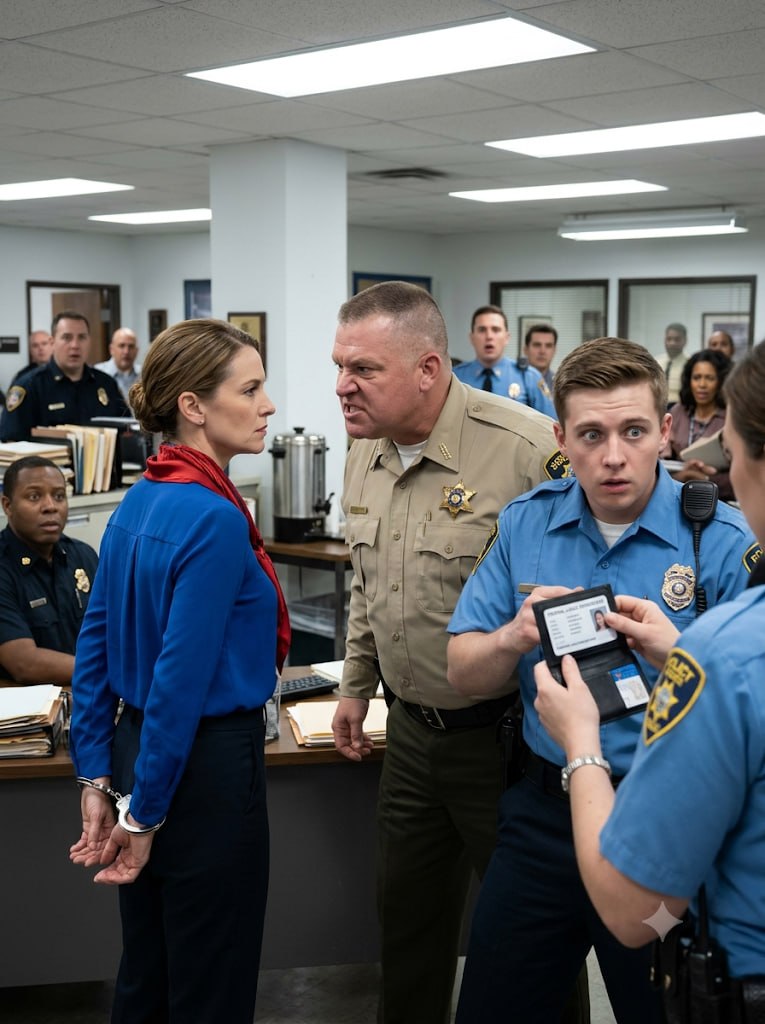
He began inventorying my belongings and unfolded my wallet to locate identification. Behind my driver’s license was a separate leather case, its seal catching the pale overhead light. Bell stared at it, checked my photograph, and stared again. “Ma’am,” he whispered, “are you Judge Naomi Bennett?”
The clerk stood so suddenly her chair rolled backward. Rusk emerged, irritated by the sudden silence, and demanded to know what was happening. Bell held out the credential case, his fingers visibly trembling, while my phone vibrated inside the evidence tray. The sheriff glanced at the seal, then at my face, and for the first time his confident expression disappeared.
Part 2
“Those could be fake,” Rusk said, turning the credentials over beneath the desk lamp. Deputy Bell quietly suggested verifying them through official channels instead of arguing with me. The sheriff’s face reddened, but the clerk had already reached for the station telephone. I watched the room discover that a person’s status could change how quickly its staff became concerned.
Rusk offered to “straighten out this misunderstanding” privately. I asked him to document the grounds for my arrest and preserve the diner and station recordings. “You weren’t interested in a misunderstanding when you put these on me,” I said, lifting my cuffed hands. Bell glanced at the marks on my wrists and looked away.
Before anyone could answer, two dark vehicles stopped outside. Special Agent Lena Mercer entered with another federal investigator and an assistant U.S. attorney carrying a document folder. They had not come because someone recognized me; their visit had been scheduled as part of an investigation that began months earlier. Seeing me in handcuffs made Mercer stop midstep.
“I was told you were visiting family,” she said, looking at my wrists. I explained the arrest in three sentences, then asked her to record my account independently because I was now a witness, not a participant in the investigation. She ordered nothing on my behalf; her team handled the evidence under its existing authority. That separation mattered more to me than any apology Rusk could offer.
The prosecutor presented a warrant signed by an independent judge. It covered arrest records, seized-property logs, and communications connected to several named complaints, not everything the sheriff owned. Rusk protested that his office had already cleared those complaints. Mercer answered, “That’s one of the things we’re here to verify.”
Bell moved toward the records room, then stopped beside the booking counter with his hand against his pocket. He had the frightened look of someone about to jump into deep water. Rusk noticed and ordered him to bring out the files, but Bell remained where he was. “There’s something you won’t find in the official reports,” he told Mercer.
He produced a small blue spiral notebook, its cover bent and a grocery-store price sticker still attached. He’d recorded dates when arrests did not match what he saw, along with instructions he’d been ordered to follow. Mercer asked him not to read the entries aloud in front of his supervisor; she brought him to a separate room and arranged to preserve the notebook properly. Through the glass, I saw Bell’s shoulders finally drop.
A clerk named Mrs. Lyle offered water and asked about my wrists. She had been silent when Rusk brought me in, and her embarrassment showed in the way she avoided my eyes. “I should have asked what happened,” she said. “Yes,” I replied, “you should have.”
An investigator returned to photograph the marks left by the cuffs and collect my statement. Rusk insisted he’d been following a description from dispatch, but no one had located a matching report with the details he’d claimed. His story kept changing: first a robbery, then suspicious behavior near the pharmacy, then an alleged refusal to identify myself. Every version was preserved.
Late that afternoon, Mercer told me Bell’s notebook corroborated several complaints my aunt had mailed. One involved a mechanic whose business cash disappeared after a traffic stop; another involved an elderly church volunteer arrested after objecting to a search. But a different entry concerned the same property address that appeared in three of the letters. It was a farmhouse on Cypress Road.
I recognized the address from a photograph on Evelyn’s kitchen wall. The owner, eighty-two-year-old Martha Ellis, had been her closest friend and had died after a brief stay in the county jail. Her family believed the official account had left out repeated requests for medical attention. When Mercer said Bell had written down those requests before anyone told him to keep quiet, I felt the cold weight of what his silence might have concealed.
Part 3
Evelyn was waiting with a blanket when I returned that evening, my wrists bandaged after a medical examination. She’d turned off the television’s coverage of my arrest. I told her about Bell’s notebook, and she gripped the arms of her chair at Martha’s name. “She kept asking them to call her family,” Evelyn said. “They told us she was being difficult.”
Martha’s grandson, Adrian Ellis, came to the porch the next morning carrying a cardboard folder of letters. He showed me receipts for property taxes, unanswered requests for jail records, and a notice claiming the family’s land had been sold. I couldn’t advise him in a matter tied to the investigation, but I gave him contact information for an independent legal-aid organization. As he left, he said, “We never wanted money. We wanted somebody to tell the truth.”
Over the following months, investigators reconstructed something far more deliberate than a pattern of bullying. Several landowners had been detained on questionable charges around the time a proposed highway bypass made their property valuable. A county employee had redirected tax notices, and a development company connected to Rusk’s brother-in-law acquired parcels at disputed sales. Records also showed unexplained payments to a business tied to Rusk’s household.
The findings shook me, but I kept my distance. I had forwarded concerns, not opened the case, and my arrest made me a witness whose words would be tested like anyone else’s. The federal investigation belonged to agents and prosecutors, not my chambers. My chief judge reassigned cases that could create conflicts and reminded me that being a victim did not give me a special place at anyone else’s trial.
That didn’t stop Rusk’s supporters from claiming I’d staged everything. Someone had filmed the diner arrest, and the short recording spread online, showing my untouched lunch and the sheriff’s rough handling of my arms. Radio callers argued that I’d hidden my identity to embarrass him. I stopped listening when Evelyn heard a caller suggest I should have known better than to eat there.
Bell struggled too. He gave investigators the original notebook and testified before the grand jury, but he’d kept his notes private for more than a year. He admitted fearing for his job and his mother’s health insurance. “I should’ve spoken up when Martha was alive,” he said, his gaze fixed on the floor, and I had no comforting answer.
A state review followed the federal search, and Rusk was eventually suspended pending the outcome of the criminal proceedings. A temporary sheriff ordered independent review of seized property and a new system for complaints. It was a beginning, not a repair. At a county meeting, Adrian held up Martha’s photograph and asked who would return the years his family had spent being ignored.
When an indictment finally came, it described civil-rights violations, financial fraud, and interference with records. Prosecutors also charged the developer and the county employee implicated in the property transactions. My arrest was one piece of the case, supported by the diner video and dispatch records, but the deeper charges rested on bank statements, land deeds, and witnesses. The distinction mattered when Rusk’s lawyer accused me of manufacturing a scandal.
At the pretrial hearing, the lawyer suggested my trip had been bait. The judge, who had no connection to my court, noted that the federal inquiry started before I came to visit Evelyn. He declined to dismiss the case on that theory, leaving factual disputes for the jury. I felt no triumph, only exhaustion at the idea that ordering lunch could be described as a plot.
Then a legal-aid attorney called Adrian with unexpected news: the development company had tried to sell Martha’s land again, even while the ownership dispute remained open. A buyer had already paid a deposit, and a closing date was approaching. Adrian sounded as if he could barely breathe when he called Evelyn. The criminal case might prove what happened, but could the family save the farmhouse before it changed hands again?
Part 4
Lawyers sought an order halting the disputed sale. Adrian collected his grandmother’s tax receipts, and neighbors supplied letters showing where the notices should have been delivered. The court halted the transfer pending review. When Evelyn heard, she closed her eyes and whispered, “Martha would have baked a pie for every one of them.”
At Rusk’s trial, I wore a plain navy suit and answered questions about the diner without embellishment. His attorney asked why I hadn’t announced I was a judge the moment the cuffs appeared. “I could have identified myself sooner,” I said, “but my profession isn’t a requirement for being treated lawfully.” I described the spilled water, the missing explanation, and Bell carrying my purse.
The defense tried to suggest that I had refused to cooperate to provoke Rusk. The video showed me seated, asking what offense I was suspected of, then following his instructions. It also captured a waitress moving to help before Rusk told her to stay back. When the footage ended, I noticed the courtroom was quiet in exactly the way the diner had been quiet.
Bell testified three days later, holding the blue notebook open beneath a document camera. He described contradictory arrest reports and the requests for medical help he had recorded during Martha’s detention. His voice faltered, but he finished and acknowledged under cross-examination that he should have reported his concerns sooner. Adrian sat behind the prosecutors with both hands clasped around his grandmother’s photograph.
The records made the larger scheme impossible to dismiss as gossip. A county employee testified about redirected notices; bank documents linked property proceeds to Rusk’s associates. The jury convicted Rusk on multiple counts, though not every allegation prosecutors had brought. Months later he received a substantial prison sentence, and his associates received sentences for their proven roles.
Rusk sent a letter through counsel before sentencing, saying he regretted how events had “been perceived.” I declined to respond because he still hadn’t acknowledged the people his choices had harmed. The judge read statements from families whose homes and livelihoods had been disrupted. Listening to Adrian describe Martha’s garden, I understood how inadequate a prison term alone could feel.
Separate civil proceedings took longer. Some disputed sales were overturned, including the transfer of Martha’s property, while other families received negotiated compensation where reversal was not possible. Adrian walked through the farmhouse on the day his family regained possession and found his grandmother’s recipe tin still above the stove. He called Evelyn before he called anyone else.
I directed much of my civil settlement toward legal aid and a scholarship in Martha’s name. Those choices did not make me more deserving than the people whose claims received less attention. I simply wanted practical help to outlast the headlines. Adrian told scholarship recipients, “Keep your records. Ask questions. Don’t mistake silence for an answer.”
The new sheriff made complaint tracking public, reviewed past arrests, and required clear records for seized property. Bell stayed in the department after an independent review of his conduct, though he declined a promotion to help rebuild its evidence procedures. He bought another blue notebook, this time to record cases in which someone spoke up early enough to prevent harm. I hoped he would fill it.
Evelyn recovered enough to attend the opening of a monthly legal clinic in her church’s fellowship hall. She wore her lavender Sunday hat and laughed when the ribbon scissors stuck. A waitress from the diner approached me afterward and apologized for freezing when Rusk grabbed my arm. “I was scared,” she said, and I answered, “I know. That’s what he counted on.”
Back in Atlanta, I returned to hearings, deadlines, and the ordinary work of deciding cases on the evidence before me. I keep no photograph of Rusk, but I have one of Evelyn and Adrian standing beneath Martha’s pecan tree, both smiling into the sun. The sheriff had promised that no one in his county would hear me. He was wrong about what silence meant: thirty letters, one notebook, and a roomful of frightened witnesses had been speaking all along.
Legal Notice: This story is a work of fiction. Names, characters, businesses, events, and incidents are the product of the author’s imagination or are used fictitiously. Any resemblance to actual persons—living or dead—or to actual events is purely coincidental. Thank you! 💓