
The Morning My Mother Tried to Take My House—and Found the Police Waiting
Eight days after giving birth, I spent my first night with my daughter in the house I’d bought just days earlier, believing the hardest part of our new life was behind us. Then my mother announced that seven relatives were moving in, assigned herself my bedroom, and told me to take my newborn to a hotel if I objected. Before sunrise, someone was already testing my back door. By ten the next morning, my mother would discover that I had finally stopped confusing family with permission.
Part 1
At 9:15 p.m., my phone buzzed against a stack of clean burp cloths, and I almost ignored it. My daughter, Iris, was eight days old and asleep in the bassinet, fists beneath her chin. The house smelled of fresh paint, baby laundry, and the chicken soup my neighbor had dropped off that afternoon. I had finally begun to feel safe.
My mother’s name lit up the screen. “Delaney, your stepfather and I are coming tomorrow,” she said before I could say hello. “Brianna and Scott are bringing the children, so make sure the driveway is clear by ten.” I sat upright, careful not to knock the bassinet. “Coming to visit?” I asked, although something in her tone told me that wasn’t what she meant.
“Moving in, obviously. Brianna’s lease situation has become impossible, and you have all those empty rooms.” My sister had three toddlers, an inconsistently employed husband, and mounting bills. I loved her kids, but the last time they visited my apartment, Scott left a broken bathroom cabinet and called it normal wear. I had not offered them a place to live, not even for a weekend.
“Mom, I bought this house for Iris and me,” I said. “We’re not accepting overnight guests right now.” After a difficult delivery, Iris’s pediatrician had urged us to limit visitors. My mother made a clicking noise with her tongue, the one she used whenever she thought I was being inconvenient. “You worry too much. Babies grow up around noise.”
She assigned bedrooms like a hotel manager. She and Vernon would take the primary suite because their backs couldn’t tolerate a smaller mattress; Brianna and Scott would get the guest room. “The kids can sleep on air mattresses in the nursery,” she added. “You and the baby can manage in the den until everyone settles.” I stared at Iris’s pale green nursery door.
“Absolutely not,” I said. “Nobody is sleeping in her nursery, and nobody is moving into my house.” There was a pause, followed by my mother lowering her voice. “Listen carefully, Delaney. I will not be following a bunch of rules made up by a girl who just became a mother.” At thirty-one, I was still a girl whenever she wanted something.
“If you dislike the arrangement, take your baby to a hotel,” she continued. “We’ll be there at ten sharp.” Then she hung up, leaving me staring at a dark screen and listening to the refrigerator hum downstairs. In my old apartment, I would have called back to explain myself more politely. I looked at my unpacked boxes and decided otherwise.
I had spent six years saving the down payment while working as an operations manager for a medical supply company. Every extra shift, every skipped vacation, every Saturday spent eating leftovers had been for a door I could close without someone else claiming the key. I started messaging my closing attorney, Elena Ward, when an alert appeared. MOTION DETECTED: BACK PATIO.
The camera showed a woman in a gray sweatshirt standing beneath the porch light, trying the handle with both hands. She leaned toward the keypad, pressed several buttons, and glanced over her shoulder at the empty yard. Even through grainy night footage, I recognized my sister’s bright white sneakers. Brianna had arrived almost twelve hours ahead of the family convoy, without luggage or an invitation.
I turned on the speaker. “Brianna, step away from my door.” She stumbled backward so quickly that her shoulder struck a patio chair. “Delaney? Mom said you’d leave it open,” she hissed at the camera. “I’m calling the police to report this, and you need to leave now,” I replied, already reaching for the nonemergency number on my other phone.
Before leaving, she held up a manila envelope. “Go ahead and call whoever you want,” she said. “Mom has the paperwork. By tomorrow, you’ll have to let us in.” The gate clicked shut, and Iris stirred in her bassinet. I stood motionless beneath the blue light of the security feed, wondering what kind of paperwork my mother thought could take away my home.
Part 2
The dispatcher listened without interrupting while I described the woman at my back door. I gave Brianna’s name, explained that no one had permission to enter, and saved the recording before the app could overwrite it. An officer confirmed the report and advised me to call if anyone returned. Then I checked every window twice, even though the locks were already latched.
I called Elena at six forty, expecting voicemail. She answered over a coffee grinder. “Is the baby okay?” “Asleep,” I said. “I’ve barely rested.” Elena had handled my closing earlier that week, and she remembered exactly why I’d chosen a house with a separate nursery. “Your mother has no ownership just because she’s your mother,” she said. “Send me whatever she’s claiming.”
I forwarded the patio video and the voicemail my mother had left after midnight. In it, she complained that Brianna had been “treated like a criminal” and warned me not to embarrass the family again. Elena suggested that I send one clear written notice refusing entry and save the delivery confirmation. She offered to bring the deed and notices before ten.
By seven thirty, I had texted every adult involved: “I do not consent to anyone moving into or entering my property. Do not come here. Any future attempt to enter will be reported.” Brianna read it; Mom replied with a thumbs-up. That tiny yellow hand felt worse than an insult. She had seen my refusal and treated it as a minor scheduling annoyance.
Next I called the locksmith whose number was printed on my closing packet. He agreed to fit new deadbolts and reset the entry codes that morning. Feeding Iris, I watched a school bus stop outside. Other people were packing lunches and hunting for missing shoes. I was preparing to defend a front door I’d owned for less than a week.
At eight ten, Brianna sent me a photograph of a printed sheet titled FAMILY TEMPORARY OCCUPANCY AGREEMENT. Beneath the heading, someone had listed all seven relatives, assigned bedrooms, and written that occupancy would begin at ten that morning. On the signature line was my name in looping cursive. My stomach tightened because I recognized those loops, but I had never signed that document.
I zoomed in and saw the tail of the final letter, a flourish I had stopped using years ago. It was the signature from an old emergency-contact form that my mother had kept in a kitchen folder. A second message appeared: “Mom says she has everything arranged. Please don’t make the kids scared.” Had they used my name for anything else?
Elena arrived with a folder and two coffees. She studied the photograph beside Iris’s unfinished high chair. “A page somebody typed up and signed without your permission doesn’t give them rights to your home,” she said. “But keep every copy. We need a clean record of what actually happened.” She helped me send another message stating plainly that the signature was not mine.
Her next question was harder. “How did they know any of your entry codes?” I remembered sending our family chat a video tour after closing. For half a second, the camera had caught a temporary code written on a contractor’s tag beside the door. My mother had replied with a row of heart emojis. I deleted the old code while Elena watched.
At eight forty-five, the new lock clicked securely. My mother texted, “Don’t be childish. Vernon is bringing groceries, and the movers cost money.” She attached a picture of a loaded rental van. I looked at the tiny folded onesies on the couch and realized they hadn’t planned a conversation at all; they had planned to make refusing them physically and emotionally exhausting.
Elena updated the officer about the forged page. We were advised to call immediately if the family appeared and refused to leave. I put my phone on the charger by the entryway, set Iris’s carrier where I could reach it, and tried to breathe through the knot in my chest. Then the doorbell camera showed Brianna’s minivan circling the block, followed by something much larger.
Part 3
A white rental truck rolled past my mailbox slowly enough for its driver to inspect the house numbers. It kept going, then turned down the next street, as if someone had told him not to arrive before ten. Mom recruited people without telling them the truth. I wondered what the driver had been told about the woman inside with a newborn.
Brianna called at nine twelve. I answered on speaker while Elena listened from the kitchen, her legal pad open beside two cooling mugs. “Can’t you just let us stay for a month?” Brianna asked, sounding different from the woman at my back door. “The kids need stability.” I told her the children deserved stability, but forcing their way into my house would not create it.
“Mom said you agreed after the baby shower,” Brianna insisted. That startled me because at the shower, I’d said they could come meet Iris after we were settled and cleared for visitors. Nothing about staying overnight. “She showed us a plan and told us you were just being shy about accepting help,” Brianna said. I heard uncertainty beneath her anger.
“If you thought I agreed, why were you testing my back door last night?” I asked. Children argued behind her silence. “Mom said you’d changed your mind because you were emotional,” she finally admitted. “She said once we got our things inside, you’d calm down.” The answer made my shoulders go cold; they had known I objected and intended to outlast me anyway.
I asked about the agreement. Brianna said Mom prepared it, then asked whether Iris slept well. “Who put my signature on it?” I pressed. “You’ll have to ask Mom,” she replied, and disconnected. Elena wrote that sentence down, underlined it once, and told me not to spend another minute trying to reason with them by phone.
Sunlight revealed dust drifting above the hardwood. I’d chosen these floors myself because my mother said pale oak was impractical for a single woman with a baby. That memory brought back dozens of smaller moments: the apartment she insisted was too expensive, the job she called temporary, the savings she expected me to lend Brianna. For her, no merely meant later.
At nine twenty-eight, officers arrived following our updated report. Two officers reviewed the recordings. Officer Harris said they could document the dispute, explain the family’s need to leave if they appeared, and take further action if someone refused a lawful order. “We won’t decide family arguments,” she said, “but nobody gets to walk into your home against your wishes.”
I thanked them and felt my knees wobble after the words left my mouth. Elena suggested I sit down, but Iris began squirming in her wrap, her cheek warm against my collarbone. I moved into the hallway and rocked gently, matching my breathing to hers. Fear was allowed. I only needed to remain the adult in charge of our door.
At nine forty, Vernon’s SUV stopped outside. He saw the patrol car and called someone. He had been my stepfather since I was twelve, and his usual response to my mother’s demands was a shrug followed by “You know how she gets.” This time he didn’t shrug. He paced the sidewalk and spoke into the phone with his back to the house.
A text from Brianna appeared: “Mom says the police will make you let us in because of the kids.” I showed it to Officer Harris, who shook her head. Then came another: “Please don’t tell Scott about the signature.” I reread those seven words as a dreadful possibility settled into place: my sister knew exactly who had put my name on that document, and she was afraid of her own husband finding out.
At nine fifty-five, two more vehicles pulled into the driveway, doors banging over the steady idle of the rental truck. Scott carried a bag; Mom marched up with two totes. Elena stood beside me with the printed notices; the officers stepped back into the hall so the entry stayed clear. At exactly ten, my mother reached for the handle without knocking—and pushed.
Part 4
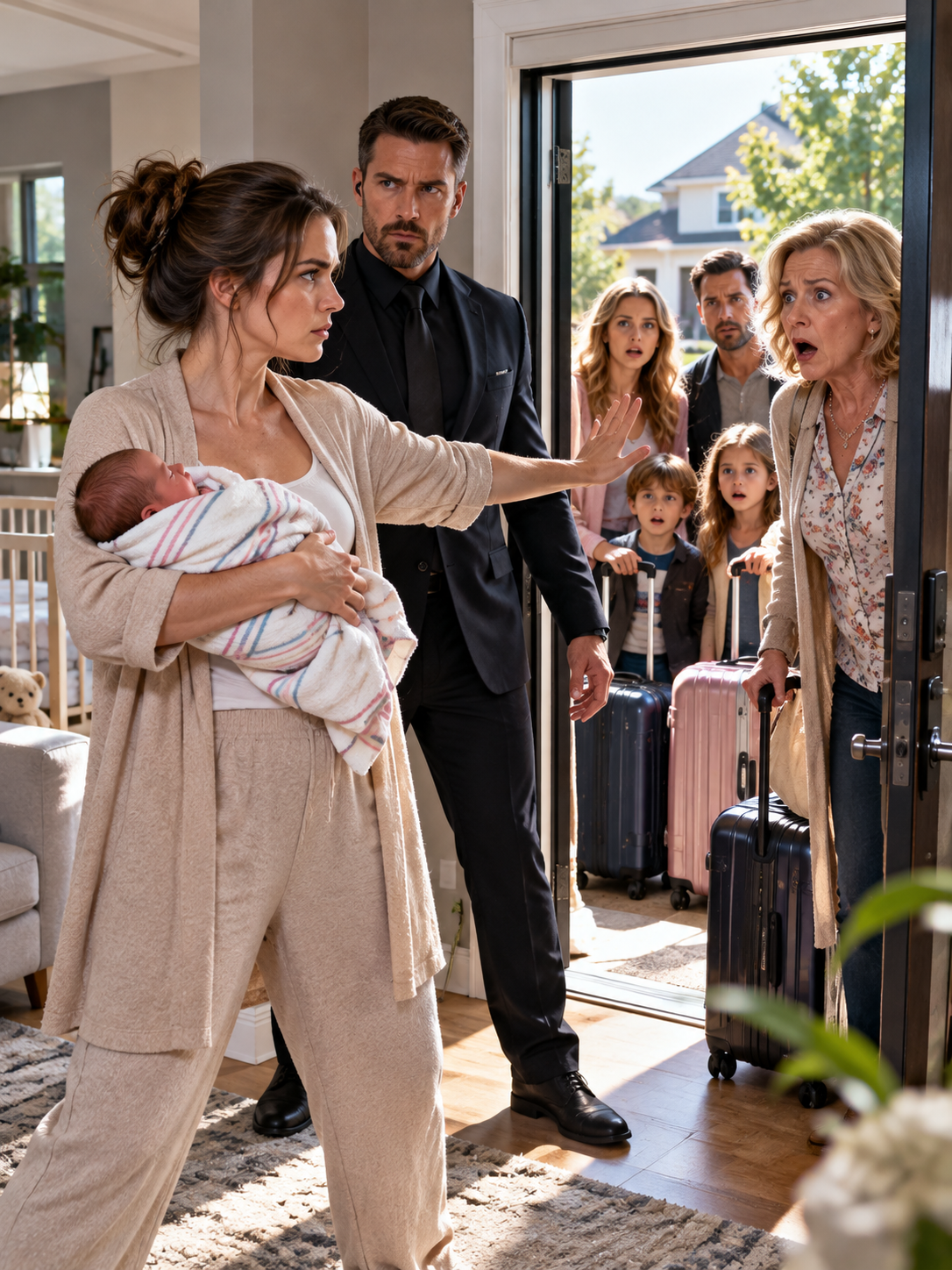
The door moved only because I’d opened it a few inches to speak to them; the new deadbolt had been locked until that moment. Mom treated the gap as an invitation. “We’re here, Delaney. Tell Vernon to bring the cooler,” she announced. Then she saw the two officers standing just beyond the entry rug, and the smile vanished from her face.
Elena held her folder; the locksmith looked up from his tools. Behind my mother, Brianna stopped with a diaper bag slipping off her shoulder; Scott nearly bumped into her. The children remained by the minivan with Vernon, who had been asked to watch them while the adults unloaded. For a moment all I heard was the buzz of a fly against the screen door.
“What is this?” Mom whispered. “It’s my home,” I said, keeping one hand beneath Iris’s back. “You don’t get to decide who lives here, Mom, and you certainly don’t get to decide where my newborn sleeps.” She looked past me toward the nursery as though checking whether I’d already moved the furniture she wanted. Her eyes flicked back to the officers.
“She’s exhausted,” my mother told them, recovering her voice. “She doesn’t understand that her family is helping.” Officer Harris answered evenly, “The homeowner has told you not to enter. You need to stay outside.” Mom looked to Elena for support. Elena introduced herself and held out written notices confirming that my family had no permission to enter or remain on the property.
Brianna showed the agreement on her phone. Elena asked her to show the full page, then placed my signed denial beside it. “My client did not authorize that signature, and this paper doesn’t replace her consent,” she replied. Scott leaned toward the screen, squinted, and said, “Bree, I thought Delaney signed it when you two talked.” Brianna’s lips parted, but nothing came out.
My mother stepped toward the threshold again. Officer Harris lifted a palm, and she stopped. “You can’t leave them with nowhere to go,” Mom said, startling a neighbor mowing. “They already gave notice on their apartment.” Brianna spun toward her. “You told me you spoke to the landlord and we had until next Friday,” she said. My mother avoided her eyes.
Scott stared at Mom. “We moved our savings to cover the deposit,” he said. “Marlene, you told us Delaney wanted a payment to make everything official.” Mom tightened her grip on the bags. “I was organizing a family arrangement,” she insisted. “Someone had to make decisions.” And there it was: she’d demanded money from my sister for rooms that weren’t hers to rent.
“Where is the deposit?” Brianna asked. My mother said the movers were expensive, and nobody should focus on money when there were children involved. Brianna’s face reddened. I felt a brief flash of sympathy before remembering her hands on my back door and her message about keeping Scott ignorant. Whatever lies she’d believed, she had helped push this plan forward long after hearing my no.
Officer Harris repeated that they needed to leave the property and take their belongings with them. Vernon saw the notices and said, “Can’t everybody just calm down?” “Everyone is calm,” I answered. “You’re simply not moving in.” Scott went back to the minivan without arguing, and Brianna followed, still holding her phone as if it might suddenly provide a different ending.
My mother lingered on the porch, her expression shifting from outrage to something almost pleading. “After everything I’ve done for you, this is how you repay me?” she asked. I thought of my sleepless nights, the mortgage, and her indifference to Iris. “You can leave now,” I said. The officers remained until everyone had returned to their vehicles and the truck pulled away.
As I closed the door, Mom pointed at me through the narrowing gap. “You’ll regret humiliating me,” she said. “People are already expecting to live at this address.” The lock clicked into place, but her last words stayed with me. Somehow, even after being turned away, she’d found another way to make my house the center of her plans.
Part 5
At eleven twenty, I finally laid Iris in her bassinet and poured myself the cup of tea I’d forgotten on the counter that morning. It had gone cold and bitter, but I drank it anyway. Elena helped file the recordings and notices. She was leaving when the doorbell camera showed a delivery driver leaving a package addressed to Brianna on my porch.
The shipping date was four days earlier, before my mother had called to announce the move. Another package arrived from a home-goods store, also bearing Brianna’s name and my address. I forwarded photographs to Elena. It was suddenly obvious that the rental truck, forged document, and nighttime door check were pieces of the same plan, not a spontaneous family emergency.
That afternoon, Brianna called from a motel. I listened to her voicemail. “Mom told the school district we were moving into your neighborhood,” she said, her voice rough. “She used your address on the registration forms. Scott found out about the deposit, and we’re trying to get the money back.” She paused, then added, “I knew you didn’t want me at your patio. I’m sorry.”
I sent one reply: “I hope you find safe housing for the children. You may not use my address, and you may not come to my property.” It wasn’t the comforting message she wanted, but it was the only one I could give honestly. They could work with their landlord or find a temporary rental. I was not their emergency housing plan.
On Elena’s advice, I notified the school office about the unauthorized address claim and returned the unopened deliveries through their carriers. We saved copies of every document. I also asked my home security provider to flag any further attempts to enter, without treating every passing car as a threat. The process was dull and practical, which made it feel strangely powerful.
That evening my aunt called, angry because she’d heard I’d “thrown three babies into the street.” I asked her one question: “When did they ever live here?” She fell silent. I explained Mom’s promises and that the kids stayed safely with Vernon. My aunt said she’d been told I invited everyone and changed my mind at the last minute.
I offered to send her the timestamped refusal I’d texted hours before the truck arrived. She accepted it, then apologized for calling me cruel. I asked her not to intervene. For years, my family had used other people’s opinions as another way to pressure me into giving in. I no longer needed to win a family vote to own my front door.
Three days later, an envelope arrived in Mom’s handwriting. Inside was a note saying she’d only wanted us all under one roof, that grandmothers deserved time with their grandchildren, and that I had embarrassed her before strangers. Not once did she apologize for the forged signature, the attempted entry, or telling me to leave with a newborn. She ended with, “Call me when you’re ready to be reasonable.”
I placed the note in the folder with the other records and blocked her number. Vernon emailed that she missed us; I told him we were done. Brianna sent occasional updates through Elena about correcting the address and pursuing her deposit; I didn’t reopen a personal conversation. Their problems were real, but that didn’t turn my home into a debt I owed them.
As autumn settled over the neighborhood, ordinary life finally filled the rooms. I learned which floorboard creaked by the nursery, which window caught the softest afternoon light, and how the house sounded when the washing machine stopped and rain began tapping the roof. I took Iris to a neighborhood parents’ coffee. Nobody asked to take over my kitchen or rearrange my child’s crib.
One evening, Iris reached toward the wooden moon on her nursery wall. I remembered Mom’s bags at the door, without wanting her back. The peace I’d bought wasn’t in the deed or the deadbolt alone. It was in knowing that the next time someone said, “We’re moving in,” my answer could still be no—and that would be the end of it.
Legal Notice: This story is a work of fiction. Names, characters, businesses, events, and incidents are the product of the author’s imagination or are used fictitiously. Any resemblance to actual persons—living or dead—or to actual events is purely coincidental. Thank you! 💓


