
The Morning After Grandpa’s Funeral, My Parents Came for His House
My parents abandoned me at five, then returned seventeen years later with a moving truck before the funeral flowers had even wilted. My mother handed me garbage bags and ordered me out of the only home I had ever known, while my younger sister claimed Grandpa’s bedroom. I said nothing because he had warned me this would happen. But when his locked study opened, a woman my mother had spent years pretending didn’t exist stepped into the hallway—and the real reason I had been left behind began to surface.
Part 1
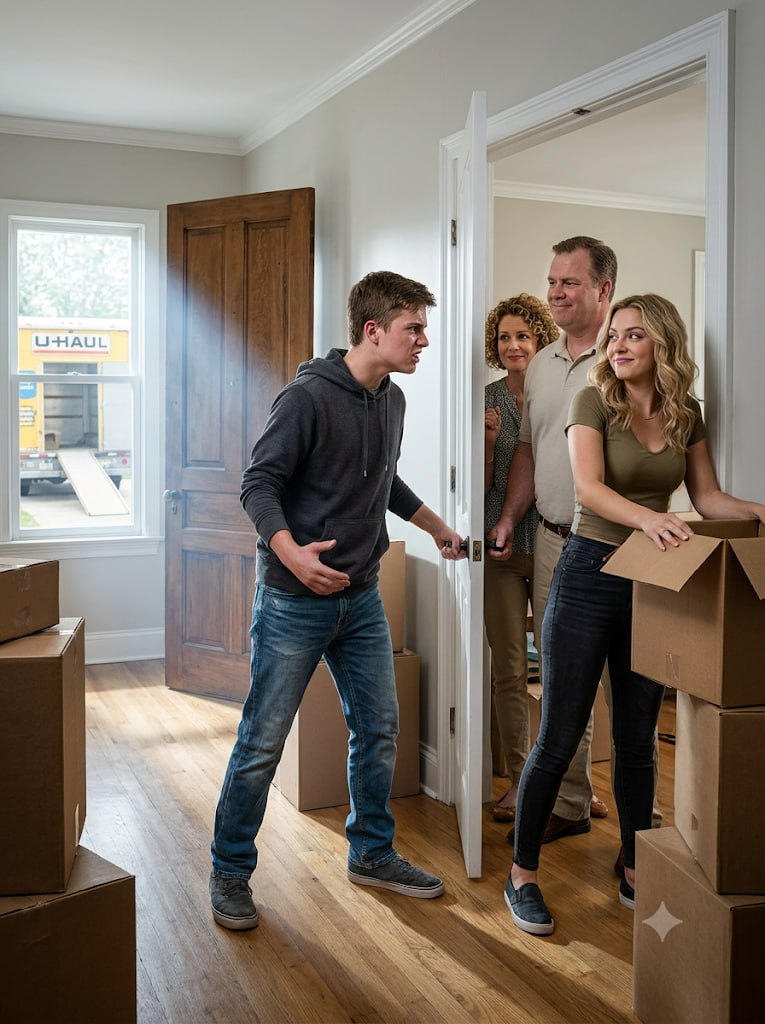
At 8:17 Thursday morning, a moving truck rattled into our gravel driveway. We had buried Grandpa yesterday, and funeral lilies still filled the porch with their sharp smell. I stood in his faded plaid shirt, holding cold coffee. Then my father climbed out of the cab and started directing two movers toward the front steps.
“Take the upstairs furniture first,” he called, pointing through the open door. My mother, Linda Bennett, followed in heeled boots that clicked against the porch boards Grandpa had repaired himself. She looked me up and down and said, “Nora, you look terrible,” as though my appearance were the morning’s greatest inconvenience. My nineteen-year-old sister, Tessa, announced, “I’m taking the master bedroom.”
I hadn’t seen any of them in seventeen years. When I was five, they brought me to Grandpa Arthur’s house with a purple raincoat, a stuffed rabbit, and the promise of a weekend visit. That weekend stretched through every birthday and Christmas. Grandpa learned to braid my hair and worked extra shifts to pay for braces.
Now my mother shoved two black garbage bags against my chest. “Pack your clothes and whatever else is yours,” she said, glancing toward the staircase. “You’ve lived here long enough. This property belongs to Arthur’s daughter now.” When I didn’t move, she added quietly, “You were his responsibility, not ours. Don’t make this unpleasant.”
I set the bags beside Grandpa’s cane. Dad interpreted that as defiance and stepped toward me, his jaw tightening. “Your grandfather believed in keeping property in the family,” he said. From upstairs came the thump of Tessa opening drawers and complaining about the dark wooden walls.
I didn’t argue, because six days earlier, Grandpa had squeezed my hand in his hospital bed and given me strange instructions. “When they arrive,” he’d whispered, “let them inside. Let them say what they came to say.” When I asked what happened next, he smiled with painful effort and answered, “Then open the study.”
His study had always been the one room I entered only with permission. As a child, I imagined its locked drawer held treasure. That morning, I had left two people inside reviewing his estate documents.
A hinge creaked behind us. A silver-haired woman in a gray cardigan emerged carrying Grandpa’s chipped blue mug, and Mom went so still I could hear the grandfather clock ticking in the dining room. I knew her as Martha, Grandpa’s hospice nurse, but she and Mom clearly weren’t strangers. “Hello, Linda,” Martha said. “It’s been a long time.”
My mother dropped the garbage bag she had picked up again. “What are you doing here?” she demanded, her voice suddenly thin. Martha looked toward me, then took a slow breath. “Nora, I should have told you sooner. I’m your mother’s sister.” Before I could speak, Grandpa’s attorney, Julian Price, stepped out behind her with a leather folder beneath his arm.
Julian asked the movers to put down a dresser drawer and produced the trust paperwork. Three years earlier, Grandpa had placed the house in a trust naming me its successor trustee and sole beneficiary. “This is Nora’s home,” Julian told my father, “and nobody has permission to remove her belongings.” The movers carried the empty drawer back to the truck while Dad threatened lawsuits and Tessa stared at me as if I’d changed faces.
At the door, Mom said to Martha, “Ask your precious aunt why our mother died while she was supposed to be looking after her.” Martha gripped the blue mug so tightly I thought it might break. Then Mom drove away, leaving tire tracks through Grandpa’s flower bed. When I turned to Martha for an answer, she whispered, “Your grandfather believed that story for seventeen years, too.”
Part 2
In Grandpa’s kitchen, the kettle whistled long after the water boiled because none of us wanted to be first to speak. Martha sat beneath the window where Grandpa used to leave tomatoes to ripen, turning his blue mug between her palms. “Your grandmother Evelyn had a stroke when you were three,” she finally said. “I was staying here to help her, but that morning I went out for groceries, and she became ill while I was gone.”
The shame in Martha’s face was real, but the accusation was not. A day before the stroke, Grandma had discovered unauthorized withdrawals from her account and planned to confront Linda. After the funeral, my mother told Grandpa that Martha had taken the money, even producing a handwritten note supposedly confessing it. Grief had made Grandpa willing to believe his older daughter, and he told Martha to leave.
“I moved west and trained as a nurse,” Martha said, studying the chipped glaze on the mug. “I sent letters, but he returned them unopened.” She glanced at Julian, whose expression remained grim. “Two years ago, he finally found the old bank records. The missing checks had been deposited into an account belonging to Linda and your father.”
I thought of Martha quietly changing Grandpa’s sheets, brushing his forehead, and sitting with me when I couldn’t bear the sound of his breathing at night. “So you weren’t just assigned here?” I asked. She shook her head. “He called and apologized, and I came back because he was my father. I wanted to know my niece before we ran out of time.”
I had loved Grandpa with the uncomplicated certainty of someone who knew who showed up for her. Learning that he’d cast Martha out hurt in a different way, because it left room for mistakes inside the person I’d trusted most. Julian didn’t defend him. He only said, “Arthur spent his last years trying to repair what he could, and he knew an apology wouldn’t undo the rest.”
A sharp knock sounded at the front door. My father had returned alone, carrying a letter from a lawyer in Columbus and demanding that we sign an agreement freezing all estate transactions. “Arthur was old and confused,” Dad said, standing in the hallway without removing his coat. Julian showed him medical evaluations confirming Grandpa’s capacity when he signed the trust. Dad looked past him at me and said, “You have no idea what your grandfather kept from you.”
“Neither do you,” Martha replied, and for the first time my father’s confidence slipped. He insisted there would be another will, one favoring Linda, then left when Julian asked him to put his claim in writing. Outside, his car stalled twice before starting. I watched through the window, annoyed by how satisfying that small embarrassment felt.
Julian returned to the kitchen and placed a cream envelope on the table. My name was written across it in Grandpa’s crooked capitals, the same handwriting that had marked every lunch bag I carried to elementary school. “He asked me to give you this only after they came back,” Julian said. Inside was a brass key and a short letter.
Grandpa wrote that he’d wanted me to grow up without feeling purchased or abandoned, but that silence had forced me to invent reasons of my own. He apologized for letting that happen and asked me to open the bottom drawer of his desk. I read the next sentence once, then twice, unable to match it with the man who taught me to count pennies at the grocery store. “Your parents didn’t simply forget you, sweetheart. I paid them to stay away.”
Martha leaned closer, but I folded the letter before she could read the last line. The house suddenly seemed full of ordinary objects I no longer understood: patched chair cushions, a furnace that rattled all winter, shoes Grandpa had repaired with glue. Every small sacrifice had acquired a terrible new possibility. I took the brass key down the hallway, wondering whether I was about to learn that my childhood had been protected—or bought.
Part 3
The key turned reluctantly, scraping against metal that hadn’t moved in years. In the drawer lay a green accounting ledger, an old photograph of me in my purple raincoat, and a thick envelope. Page after page of the ledger recorded monthly checks to Linda Bennett, beginning the summer I turned five. Beside one entry Grandpa had written, “Sold truck; payment still covered.”
Most payments were five hundred dollars, a fortune to a man who saved bread bags and patched his winter coat. Then, three years later, the figures doubled, with a note beside the date: “Linda came back. Wanted more.” I remembered being eight and waiting at a school talent show with an empty chair beside Grandpa. I had never known my mother was in town that same week.
The envelope held a guardianship agreement, a signed statement from Linda acknowledging that she’d falsely accused Martha, and records of money taken from an education fund Grandma had created for me. Grandpa hadn’t paid because the law required him to; he’d paid because Linda had threatened to reclaim custody and turn my life upside down. The agreement showed that my parents had accepted the arrangement voluntarily, while Julian confirmed that the transfers could be traced through bank records. When I reached Grandpa’s final handwritten note—“I wanted you safe, not grateful”—I finally cried.
That night, the rear-door camera sent an alert just after two. Tessa stood on the steps in a thin sweatshirt, mascara streaked along her cheeks, holding up her phone. I let her into the kitchen, where she showed me a photograph of a newly discovered will leaving everything to Mom. It was dated the day Grandpa had been hospitalized with pneumonia, and it claimed he’d signed the document ninety miles away.
“Dad’s dealership collapsed,” Tessa whispered. “They’re losing their house, and Mom says this place is our only way out.” She swallowed and studied my face. “She told me you didn’t want us. She said Grandpa kept sending birthday cards back.” I told her I’d never received one, and the silence afterward sounded louder than the refrigerator humming behind us.
At dawn, the green ledger vanished from Grandpa’s desk. Martha was furious, convinced Tessa had lured me into trusting her, and for one ugly hour I believed it too. Then an email arrived from Mom’s attorney accusing Martha and me of manipulating a dying man, followed by a complaint that led Martha’s employer to place her on leave pending review. I stared at the empty drawer and wished, briefly and fiercely, that I’d never opened it.
By noon, our elderly neighbor Agnes Holt arrived clutching a folded letter. She explained that Dad had paid her to sign what he called insurance paperwork, though she’d never witnessed Grandpa sign anything. Julian took her statement and asked her to preserve the envelope she’d received. Suddenly the supposed will looked less like an inheritance claim and more like a trap my parents had built for themselves.
Tessa called from a number I didn’t recognize. “I took the ledger because I heard Dad planning to destroy it,” she said before I could accuse her. “Meet me at the diner.” She returned it inside a paper grocery bag, along with an audio recording she’d made while arguing with our parents about the will. On it, Mom snapped, “I practiced Arthur’s signature for two weeks. Don’t tell me it looks wrong.”
I thanked my sister, but I didn’t promise her instant forgiveness for her cruelty at the house. She nodded, looked at Grandpa’s photograph tucked into the ledger, and said, “I think I’ve been told the wrong story my whole life.” We were still standing beside my car when Julian phoned to say Mom had reported me for stealing Grandpa’s savings. A hearing had been set, and suddenly the truth was no longer just something we knew; it was something we would have to prove.
Part 4
The county courthouse smelled of floor polish and burnt coffee, and the fluorescent lights made everyone look tired. Mom sat in a cream suit beside her attorney, her expression as composed as it had been when she handed me garbage bags. Dad wouldn’t meet my eyes; the week before, he’d demanded money in exchange for turning on Mom, and I’d refused. Tessa waited in the hallway with Martha, twisting a paper napkin into pieces while Julian arranged our evidence.
Mom’s lawyer argued that Grandpa had been vulnerable and that Martha and I had isolated him to secure the house. Julian began with the date on the disputed will: hospital records placed Grandpa in a monitored room that day, far from the notary’s office where he supposedly signed. Agnes testified that she’d signed papers at her own kitchen table without seeing Grandpa. The notary declined to answer questions about his involvement, and Mom’s lawyer began making frantic notes.
Then Julian played Tessa’s recording. My mother’s voice filled the room, sharp and impatient, describing how she had copied Grandpa’s signature. Tessa testified that she’d delivered an envelope for Dad without knowing its purpose, then explained what she’d overheard and why she’d finally decided to tell the truth. She shook so badly that she gripped the edge of the witness stand, but she finished every answer.
Julian’s last exhibit was a video Grandpa had recorded at his desk months before his death, found in an account he’d arranged with his lawyer. He looked thinner than I remembered, his reading glasses crooked, but his voice was unmistakable. “This home belongs to Nora when I’m gone,” he said. “If Linda arrives with some other paper, ask where I was when I supposedly signed it.”
The judge ruled that the purported will was invalid and that Grandpa’s trust controlled the house. She rejected the claims against Martha and me on the evidence presented and referred the apparent forgery to investigators. Mom stood so suddenly her chair scraped the floor. “He always chose someone else,” she shouted, pointing at Martha and then at me, as though love had been a prize we’d stolen from her.
In the courthouse hallway, Mom leaned close enough for only me to hear. “I came back for you once,” she whispered. “He never told you.” For a moment I wanted to believe her. Then I remembered the doubled payments.
Months later, Mom accepted responsibility in the forgery case, Dad faced penalties for his role, and Martha was cleared by her employer. It didn’t restore my childhood, but they could take no more. My parents wrote letters asking me to understand their desperate circumstances. I read them once, then put them away without answering.
I didn’t forgive them. Tessa and I began meeting for Sunday dinners, slowly and awkwardly, and I made it clear that trust would be rebuilt through actions, not shared blood. Martha moved into Grandma’s old sewing room, where she taught us to make apple pie from a recipe stained with butter. Sometimes we laughed until the kitchen windows fogged, and sometimes grief caught us halfway through dinner.
With the first restitution payment, I started a scholarship for students raised by grandparents, in Arthur Whitcomb’s name. Luke, the neighbor who had fixed our porch steps for free, helped me restore the vegetable garden, and somewhere between planting tomatoes and replacing the fence, friendship became something gentler and new. On the anniversary of Grandpa’s death, I found him waiting on the porch with two mugs of coffee. He didn’t ask if I was ready to move on; he simply stayed beside me as the morning brightened.
I still kept my purple raincoat photograph in Grandpa’s study. Once, I thought it showed a little girl waiting for people who would never come back. Now I could see the open front door behind her and the hand reaching out from inside. My parents had left me there believing they’d given me away, but the man on the other side had spent seventeen years showing me the difference between being unwanted and being chosen.
Legal Notice: This story is a work of fiction. Names, characters, businesses, events, and incidents are the product of the author’s imagination or are used fictitiously. Any resemblance to actual persons—living or dead—or to actual events is purely coincidental. Thank you! 💓