
The Cruise My Father Took While My Stepmother Was Dying Cost Him Everything
When I returned from deployment, my father had taken my siblings on a luxury cruise, leaving my dying stepmother alone in a freezing house. His note ordered me to clean her up before they returned. The money meant for her care was gone, and a bottle beside her bed held something that wasn’t medicine. Then she pressed an old Marine Corps ring into my palm and whispered a number my father never knew existed. By the time his ship docked, nothing would be waiting for him.
Part 1
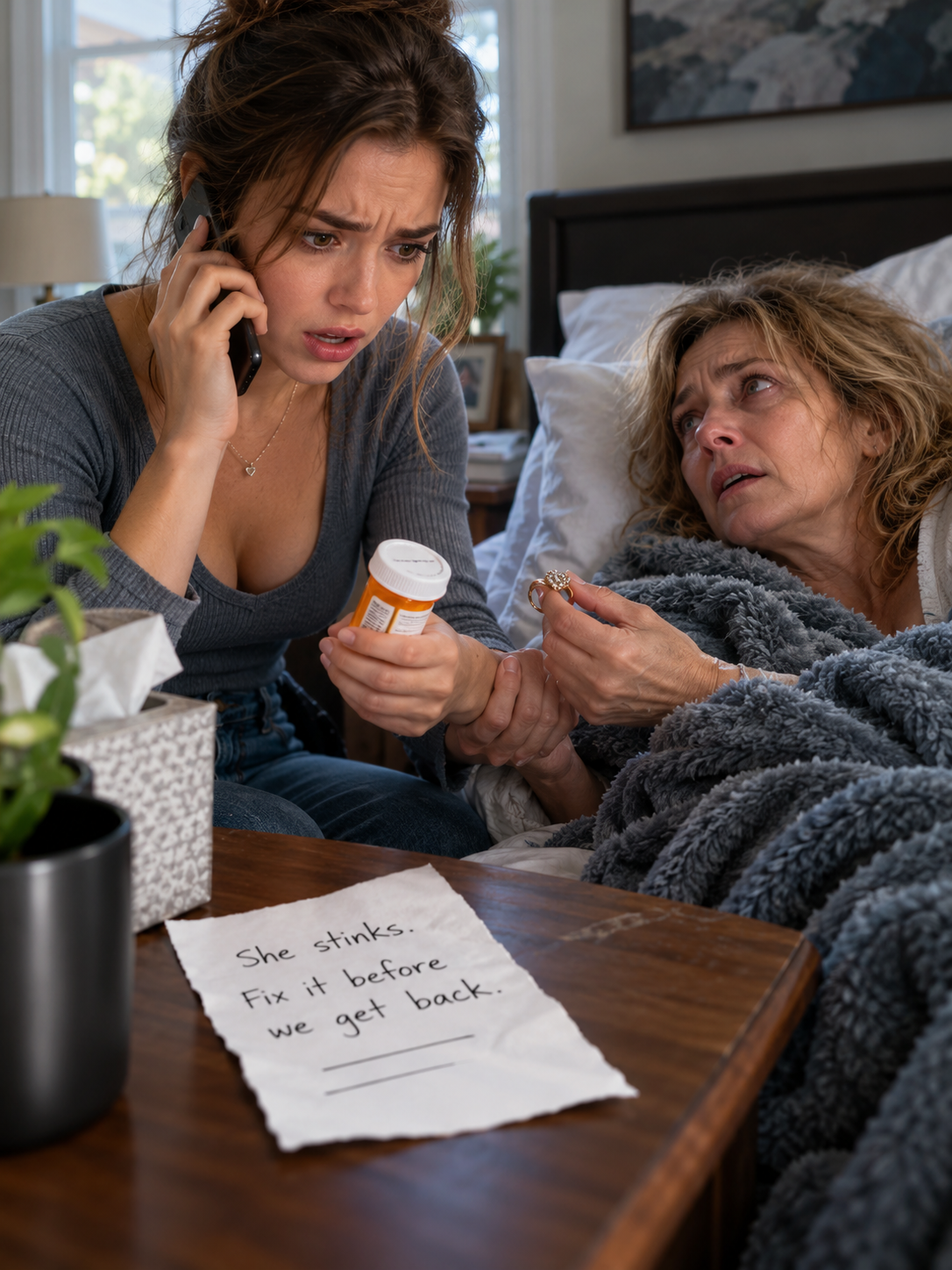
The kitchen smelled of spoiled milk when I opened our Virginia Beach house. I’d imagined coffee brewing and my stepmother humming to the radio. Instead, the thermostat read fifty-eight degrees, unopened mail littered the table, and a note waited beside an empty glass. In my father’s handwriting, it said, “Celia smells terrible. Clean her up before we get back. We deserve this vacation.”
I read it twice, convinced I had missed a sentence that would make it less cruel. My suitcase tipped over as I hurried down the hallway, its wheels clattering against the hardwood. “Celia?” I called, and somewhere behind her bedroom door came a sound like someone trying to answer through a pillow. I pushed inside and found the woman who had raised me curled beneath a single faded quilt.
Celia Harper had once been a Marine who could carry two grocery bags in each hand and still open the door with her elbow. Now her face was gray, her lips cracked, and her hands shook so badly she couldn’t pull the blanket to her chin. The room smelled of stale sheets and an untouched bowl of soup. She blinked at me and whispered, “Elise, you’re really home.”
I’d been gone nine months, serving as a Navy surgeon overseas, and her cancer had worsened faster than anyone admitted in our calls. I knelt beside the bed and checked her breathing, trying to keep my voice from cracking. “I’m here, Mom. We’re getting help, and you’re not staying like this another minute.” Her fingers closed weakly around mine, but she glanced toward the door as though someone might punish her for answering.
While I spoke with her oncology team’s emergency line, I warmed the house and found clean blankets. I helped her sip water slowly, changed the bedding, and moved an untouched soup bowl. There were no groceries, and her appointment calendar had three dates crossed out without explanation. When I asked where Dad was, she said only, “On the water.”
My phone connected to the house Wi-Fi, and a family photo popped into our shared message thread. My brother, Connor, stood on a cruise deck beside his girlfriend, both holding enormous drinks; my younger sister, Brianna, waved from a hot tub. Beneath it Dad had written, “Finally enjoying what we earned.” The timestamp was from that morning, while Celia lay helpless in a darkened room.
Celia had told me Dad was managing the household care account, where I’d been transferring money from every paycheck. I opened the banking app to check whether I could pay for urgent private nursing without waiting for my next deposit. The balance read fourteen dollars and sixteen cents. My stomach tightened as I scrolled past cruise bookings, resort upgrades, expensive clothing, and several withdrawals totaling almost ten thousand dollars.
Celia suddenly gripped the sheet, struggling against a wave of pain, and asked me not to use the bottle on the nightstand. Its label was intact, but the liquid looked wrong, and she flinched when I reached toward it. “He took what was in there,” she whispered. “He left water so nobody would ask questions.” I set the bottle aside for the medical team and called emergency services, telling the dispatcher exactly what I’d found.
As the ambulance siren grew louder outside, Celia tugged a chain from beneath her nightgown. A heavy gold ring hung from it, its face worn smooth around an old military insignia. She pushed it into my hand and tapped the tiny marks engraved inside the band. “Call the man whose number is there,” she said. “And whatever your father tells you, don’t let him sign anything for me.”
I looked at the inscription, then back at her face. “What has he been trying to make you sign?” She swallowed, closed her eyes, and whispered, “Four million, two hundred thousand dollars.” Before I could ask what she meant, the paramedics entered, and Celia squeezed my hand as if that number were the last secret holding her together.
Part 2
At the hospital, the nurses rolled Celia beneath clean white sheets while I answered questions I hated hearing. How long had she been without regular care? Who had been responsible for her meals and transportation? Did she feel safe returning home? When a social worker asked the last question, Celia turned toward the wall, and I knew silence was an answer, too.
Her doctor arranged continuous symptom management and documented her condition, including the questionable bottle I’d brought in a sealed bag. Nobody rushed to promise she would recover from her cancer; the immediate goal was comfort, hydration, and safety. By midnight her breathing had eased enough for her to sleep. I sat in the corridor beneath a buzzing fluorescent light, holding the ring against my palm until its edges left marks.
Inside the band were a telephone number and six small characters. A woman answered my call with a cautious, “Calder and Associates.” I asked for Maeve Calder, and when I mentioned Celia’s name, the receptionist stopped asking questions and transferred me. “Elise?” the attorney said. “I’ve been trying to reach your stepmother for six weeks. Is she somewhere Richard can hear us?”
I told Maeve about the house, the missing money, and the ambulance, expecting shock. Instead she asked me to send photographs of the note and preserve the bank statements and family messages. She arrived before dawn wearing a wool coat over a wrinkled blouse and carrying a leather folder. When I showed her the ring, she touched its worn insignia and said, “Celia’s grandfather gave her that when she received her commission.”
Celia woke after sunrise and asked the doctor whether she was clearheaded enough to make decisions. Then she asked everyone except Maeve and me to step outside. “The number I told you wasn’t a bank balance,” she said. “It’s the estimated value of my grandfather’s commercial properties and investments. I’ve kept them in a trust separate from the marriage, and Richard has never been a trustee.”
My father had spent twenty years telling us he owned our home because he paid the utility bills. Maeve opened the folder and showed me the recorded deed: the property belonged to Celia’s trust, which also held several leased buildings in Norfolk. Its beneficiaries could change according to Celia’s wishes, and a previous estate plan had provided generously for Dad and his children. “I wanted them looked after,” Celia said quietly. “I thought if I gave them enough, they’d finally stop resenting me.”
I remembered my father mocking Celia for saving grocery coupons while he bought expensive fishing equipment. When she became ill, he’d complained about how much it cost him to keep her comfortable, so I started sending money. I had believed I was helping a family short on cash. Now I realized he’d been protecting the lifestyle he wanted while denying his wife necessities he could have afforded to arrange.
Maeve explained that Celia could change her estate plan and choose who would act for her, but we needed medical assessments, careful records, and lawful protections. Celia signed updated instructions after the hospital confirmed she understood their meaning. I agreed to coordinate her care and asked the hospital to restrict information shared with Dad. Even then, Celia kept looking at the door, as if expecting him to appear and demand the paperwork.
When I returned to the house to retrieve her favorite cardigan, I noticed a rectangular patch of dust inside her display cabinet. Her Marine Corps medals were missing, along with the commendation she treasured most. In Dad’s desk I found a pawn ticket and a packet labeled “Family Property Review.” Beneath the forms was a printout of Celia’s signature, enlarged and repeated across an entire sheet.
My phone rang while I was photographing the papers. It was a real estate agent asking whether “Mr. Harper” could still meet her about transferring the house the following Monday. She forwarded an authorization bearing Celia’s name and a signature so shaky it barely resembled her usual handwriting. The date beside it was from the previous afternoon, when Celia had been too weak to lift a drinking glass.
Part 3
Maeve was on speakerphone before the agent finished. She told the woman to freeze all activity and preserve every email and attachment she’d received from my father. Then she asked me not to confront him, despite my anger. “A forged signature is not just a family argument,” she said. “The evidence must speak for itself.”
We reported the care account to a bank investigator. Dad had been permitted to pay Celia’s household expenses from it, but the statements showed travel purchases and a transfer to Connor’s personal account. Someone had also tried accessing the trust account with outdated documents. The bank had refused that request, explaining their sudden search for money.
At home, I sorted Dad’s abandoned paperwork beneath the kitchen light. A receipt from a shop on Virginia Beach Boulevard listed jewelry and military collectibles. I showed it to a detective already reviewing the neglect report, who began checking whether the items matched Celia’s belongings. Seeing her medals reduced to a price made my fingers ache.
The next discovery came from a tablet Connor had left charging beside the television. Our shared family group displayed messages I’d missed overseas. Dad had written, “Leave Celia enough food until Elise lands,” and Brianna had answered, “She’ll complain either way.” Connor’s reply was worse: “Take the good cabin. We aren’t wasting this trip worrying about her.”
I photographed the messages visible on the screen and forwarded them to the detective. I almost called Brianna, who once watched baking competitions with Celia. Instead, I remembered my sister leaning across our Thanksgiving table, accepting an envelope of cash from the woman she’d later abandoned. Her kindness always seemed to end in someone else’s pocket.
When I returned to the hospital, Celia was awake, watching rain slip down the window. I told her about the forged authorization, but she looked relieved. “He brought me papers last Tuesday,” she said. “Told me signing would keep us from losing the house to medical bills. I refused, and he said he might have to find another way.” She stared at her hands. “I thought he was bluffing.”
Maeve pulled the previous estate documents from the secure records associated with the reference inside the ring. They showed that Celia had intended to leave Dad income from the properties for life, with substantial gifts to Connor and Brianna. Celia listened without interrupting, then asked Maeve to replace those provisions with support for veteran caregivers and a small educational fund in my name. “Don’t make it a punishment,” she told us. “Make it something useful.”
The hospital’s social worker connected us with protective services while Maeve sought a temporary court order limiting Dad’s access to Celia and the house. I arranged paid nursing care with Celia’s approval and used my own money to cover immediate expenses. We preserved everything: the note, account records, photographs, and the altered bottle. It was painstaking, unglamorous work, nothing like the instant justice I wanted.
On Friday, Connor posted a photo of himself beside the ship’s pool with the caption, “Family comes first.” I nearly threw my phone across the room, then noticed Brianna had tagged the location and written that they’d be home Sunday. Their cruise still had two more days, and they had no idea a detective wanted to speak with them. For the first time since arriving, I felt something firmer than rage: I had a plan.
That evening, Maeve called with news that a judge had granted temporary protection for Celia, including an order excluding Dad from the house once he was served. She paused before telling me the next part. The real estate agent had forwarded an email in which my father promised a buyer that his “incapacitated wife” would soon be under his legal control. Attached was a draft request asking the court to appoint him over Celia’s affairs—and to bar me from seeing her.
Part 4
Sunday arrived bright and brutally humid. I checked Celia’s house for the photographs, cedar chest, and quilt she wanted protected. With Celia’s consent and the court order, Maeve had arranged new locks. Dad could collect his belongings under supervision, but not enter her bedroom.
At three, I asked Celia whether Dad should know her location. She watched a fishing boat drift across the view beyond her window. “Not unless the court requires it,” she said. “I spent twenty years making excuses for Richard, and I’m tired.” Then she asked if the medals had been found, and I told her the detective had located them at the shop.
The taxi pulled into the driveway shortly after five. I watched Dad emerge in a floral shirt, followed by Connor, Brianna, and Tessa. Shopping bags spilled beside their suitcases. Connor laughed about something, but Dad stopped smiling when his key failed to turn in the lock.
“Elise!” he shouted, hammering the door. “What did you do to my house?” I stepped onto the porch, smelling sunscreen on his breath. He glanced at my Navy uniform and gave an irritated snort. “Don’t stand there playing officer. Get these bags inside and tell me where Celia is.”
“She’s receiving care,” I said. “You won’t be going inside, and the arrangements for collecting your property will come through the attorney.” Brianna pushed forward, dragging a wheeled suitcase across the porch boards. “Are you serious? We have laundry in there.” Connor waved his phone at me and demanded to know why the card connected to our care account had stopped working.
I looked at all three of them, remembering the fourteen dollars. “That account is under review because you used it for a vacation while Celia missed medical appointments,” I said. Dad’s face reddened, and he pointed a finger inches from my chin. “I worked for everything in this house. Your stepmother doesn’t get to turn you against me just because she’s sick.”
Two sheriff’s deputies arrived with Maeve, who carried the certified court documents inside a blue folder. She introduced herself and asked Dad to step away from the doorway. He laughed at the first page, until she explained the protection order and the fact that the house was held by Celia’s separate trust. “That woman hasn’t earned four walls of this place without me,” he snapped, and Maeve answered, “Ownership isn’t decided by who shouts loudest.”
Dad demanded to see Celia’s signature and threatened to have me removed from the property. Maeve explained the court had addressed the immediate safety concerns and that any challenge belonged in a hearing, not on the porch. Connor suddenly stopped trying to connect to the Wi-Fi. “Wait,” he said. “If Celia owns the house, what else does she own?” His priorities hadn’t changed.
A detective stepped out of an unmarked car that had stopped behind the deputies. She informed Dad that investigators had obtained a warrant relating to the alleged neglect and financial misconduct, including the documents submitted in Celia’s name. When she asked him to accompany her, he turned to me as though I were still twelve. “Elise, tell them your father would never hurt anybody,” he said.
I thought of Celia’s shaking hands and the note on the kitchen table. “I told them what I found,” I answered. “I didn’t have to invent a thing.” Dad was escorted away, protesting that our family was being destroyed, while Connor and Brianna stood beside the luggage with no idea how to repair what they’d helped break. Tessa quietly ordered her own ride.
Brianna began crying and asked whether she could stay with me until things settled down. I told her the attorney could arrange access to her belongings but that I wouldn’t be providing money, housing, or another excuse. As I went inside, Connor called after me, “You’re really choosing her over us?” Before I could answer, my phone vibrated with a call from Celia’s hospital, and the nurse’s first words were, “Elise, she needs you here tonight.”
Part 5
I drove to the hospital with cold air stinging my face. Celia’s nurse met me beside the elevators and explained that her pain had intensified, although the team had settled her comfortably again. Celia reached for my hand. “Did you keep him out?” she whispered, and I said, “Yes, Mom. He can’t come here.”
Her doctor joined us to discuss the time she had left, speaking gently but without pretending that treatment could reverse her disease. Celia listened, then said she had one request: she didn’t want to spend her remaining weeks surrounded by machines and hallway announcements. She wanted to hear the water in the morning. Maeve helped arrange a fully staffed cottage overlooking the Chesapeake Bay, paid for from the trust Celia had spent decades keeping private.
The cottage smelled of clean linen and coffee. A nurse helped Celia into a comfortable chair beside the window while I brought her breakfast on a tray. Some days she could manage half a piece of toast; on others, we simply sat together watching gulls circle above the boats. There was no miracle recovery, but there was no more fear of being abandoned.
The detective returned Celia’s medals after they had been documented as evidence. I arranged them in a wooden case lined with navy velvet, matching the order Celia had shown me in an old photograph. When I carried the case onto the porch, she touched the ribbons as carefully as if they were living things. “I thought he’d turned my whole life into something he could sell,” she said. “You proved he couldn’t.”
A week later, Maeve brought a letter sent through Dad’s attorney. He claimed the cruise had been a misunderstanding, blamed Connor for the purchases, and asked whether Celia would help pay his legal expenses. At the bottom: “After everything we’ve been through, she owes me a chance to explain.” Celia read the sentence, folded the paper once, and handed it back.
“Tell him my lawyer will handle what the law requires,” she said. “Nothing more.” I asked whether she wanted me to keep the letter, worried she might someday regret refusing to answer. She shook her head. “Elise, forgiveness is mine to give or withhold, and I’m not giving it to a man who measured my suffering against the price of a vacation.”
Connor asked for money disguised as apologies; Brianna claimed ignorance. I remembered their cruise photographs, their messages, and the cancellation of Celia’s appointment rides. I answered each once: “You knew enough to help, and you chose not to.” I ignored the childhood photographs they sent afterward.
Celia lived seven more weeks, long enough to watch summer fade into the first cool mornings of fall. On her last clear evening, she asked me to return her grandfather’s ring to the chain around her neck. “I kept it because he told me a person’s worth isn’t something another person can grant or take away,” she said. Before going to sleep, she squeezed my hand and thanked me for coming home.
She died the next morning with me beside her. For a long time, I listened to the water tapping the shore and tried to understand how a room could feel peaceful and unbearably empty at once. We held a small service with veterans, nurses, and friends whose names Dad had never bothered to learn. Nobody mentioned the cruise.
The legal case continued after her death. Months later, Dad pleaded guilty to neglect and property fraud and was sentenced; Connor and Brianna agreed to repay the care money. The attempted property transfer never happened, and Celia’s updated estate plan stood. The trust began funding home-care assistance for veterans with serious illnesses, exactly as she’d requested.
I stayed in the Navy, returned to the operating room, and learned to make room in my life for people who didn’t confuse love with access to my paycheck. Celia’s medals stood beside a photograph of her laughing. I still remember Dad’s note ordering me to clean up his mess. I took Celia out of that room and out of his reach—and never opened my door to him again.
Legal Notice: This story is a work of fiction. Names, characters, businesses, events, and incidents are the product of the author’s imagination or are used fictitiously. Any resemblance to actual persons—living or dead—or to actual events is purely coincidental. Thank you! 💓

