
The Carry-On My Mother-in-Law Packed to Destroy Me
I told my mother-in-law I was flying to Chicago at dawn, then pretended to fall asleep. Just after midnight, she slipped into my bedroom, opened my carry-on, and hid something beneath the lining. Then I heard her whisper, “Call airport security at six. She’ll never get through.” My husband was supposed to protect me, but the second voice on that call sounded terribly familiar. I didn’t scream or confront them. Instead, I made one quiet phone call that would tear their perfect family apart.
Part 1
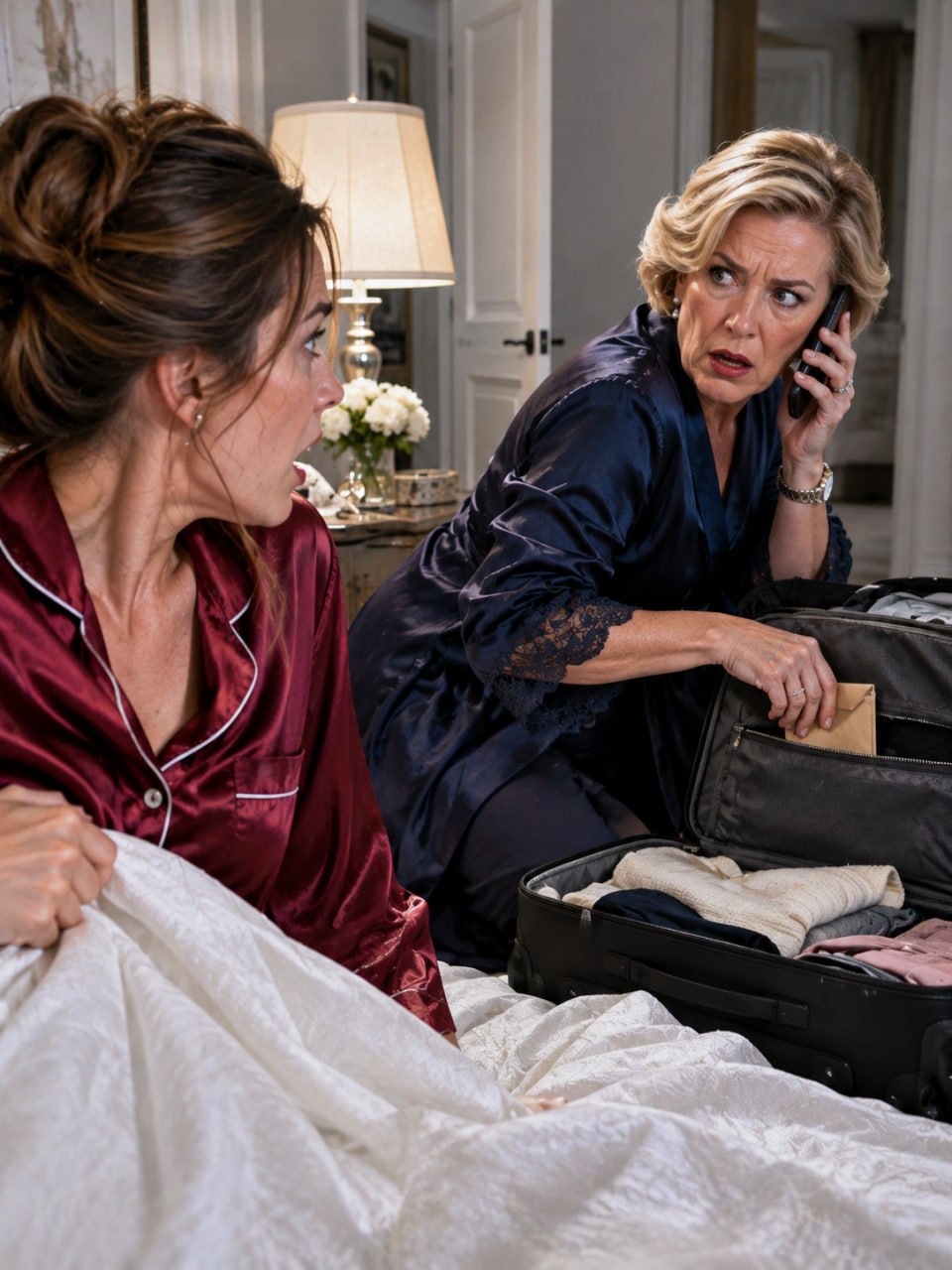
At 12:11 a.m., the hallway floorboard outside my bedroom squeaked. I lay on my side beneath a cotton quilt, watching the doorway reflected in the television. My mother-in-law, Vivian Whitcomb, eased inside in a silk robe, phone pressed to her chest. I expected snooping, not this. Lemon polish lingered in the silent house.
She knelt beside my open carry-on, moved a cardigan, and hid something dark in a pocket. The zipper caught, and metal tapped against the frame. “It’s in her bag,” she whispered into her phone. “Make the call at six, before she reaches the checkpoint.” My passport lay on the dresser.
I kept my breathing slow until her slippers shuffled down the hall. Then I sat up, legs shaking, and reached for the tablet beneath my pillow. My bookshelf camera showed Vivian clearly, along with the object from her pocket. A compact firearm lay tucked inside my bag, and my first instinct was to run out of the house. I knew not to touch it.
I didn’t, because Vivian and my husband, Grant, were expecting me to react without thinking. For seven years, they made me look unreasonable whenever I questioned them, even in front of our friends. At dinner, Grant had laughed when I mentioned my Chicago meeting, saying, “Try not to confuse the lawyers with your little spreadsheets.” Vivian had patted my hand, her bracelet cold against my wrist, and asked whether I needed help packing.
My name is Elise Whitcomb, though the company documents still call me Elise Keene. My father grew Keene Hospitality from one motel to fourteen properties, and when he died, he left me fifty-two percent of the shares. Grant became chief executive two years after our wedding, while I was grieving and could not bear to walk into Dad’s empty office. I’d spent eleven years examining financial records for a living, yet I had confused trusting family with loving them.
That changed in August, when a housekeeping supervisor named Rosa called about missing retirement contributions. Grant blamed payroll, but three employees had the same problem, leading me to unexplained consulting invoices. I hired an outside attorney, Marisol Vega, and began reviewing records quietly. By October, I’d found roughly $2.4 million in questionable transfers, but something else frightened me more. Somebody had accessed the audit files on my laptop while I was out.
Two days before my flight, Grant slid a purchase agreement across the breakfast table beside my untouched toast. It offered to buy most of my shares for an insulting price, and strip my voting rights. When I refused, he folded it and said, “Things will get difficult if you insist on being stubborn.” Now I understood his meaning.
I left the suitcase exactly where it was and saved the footage to two secure accounts. Then I called Detective Daniel Reyes, who investigated a break-in that had disturbed only my office files. He listened without interrupting, then told me not to touch the bag and asked whether I could move somewhere safe until the officers arrived. I locked my door and sat on the floor with my back against it, smelling the lavender sachet in my closet.
“Did you hear who she was talking to?” Reyes asked. I replayed the muffled recording and heard a man answer. The clipped cadence sounded like Grant ending a business call, but I forced myself not to mistake recognition for proof. “I think my husband knows,” I said, and the words hurt more than I expected.
Outside, a car rolled slowly through our circular driveway, throwing headlights across the ceiling. Reyes said officers were on their way, but when my phone lit up with a message from Grant, my stomach dropped. He was supposedly asleep in the guest suite, twenty feet away, and his message read, “Whatever happens tomorrow, remember you had a chance to sign.” Was the airport only their beginning? My own home felt like a trap.
Part 2
Detective Reyes arrived at 1:37 a.m. with Officer Melanie Brooks; both wore plain jackets. They watched my recording at the kitchen island beside anniversary roses, their faces lit blue by the tablet screen. Brooks asked me to confirm which suitcase was mine, then photographed it untouched. Once they secured the object as evidence, she looked at me and said, “You did the right thing by leaving it alone.”
The officers took my statement and copied the unedited video, including Vivian’s six o’clock instructions. They also photographed the threatening message from Grant and asked who could enter my room. Reyes said they would coordinate with airport police before confronting anyone. He advised me to stay at a hotel. His calm voice nearly made me cry.
Brooks escorted me through the service entrance with a clean overnight bag; I feared Grant would appear demanding an explanation. In the car, the heated seat felt absurdly comfortable for someone escaping her marriage. Marisol answered my call on the second ring and said my Chicago meeting could be handled remotely if necessary. “No,” I told her, watching the house vanish. “I’m done changing my plans because of them.”
At 5:18, I returned for my laptop and documents while Brooks waited outside; I wanted to see their faces. Grant was already in the kitchen, grinding coffee, and Vivian stood by the counter buttering untouched toast. “Sleep well?” she asked, watching me lift my replacement bag. “Like a baby,” I said, and her smile sharpened when she noticed it wasn’t the same suitcase.
“Where’s your other bag?” Grant asked. I said a wheel had broken, and he frowned as his phone buzzed; he turned its screen down before I could see it. How many warnings had I ignored? Vivian offered me a ride, but I said I’d ordered a car; Grant shouted as I left, and I kept walking.
At the airport, Reyes met me in the public terminal hall, far from security. He told me the planted item was secure and airport police had been notified; I would never approach screening with anything dangerous. I could finally breathe. I could travel with my clean bag, he said, though I might be asked to help confirm a report. The crowd smelled of espresso and wet wool.
At 6:03, a report came in describing a woman in my clothes, headed for my flight, allegedly carrying a weapon. Reyes showed me the documented summary, listing my coat, hair, and departure time precisely. Grant’s texts arrived seconds apart: “Security may want a word. Don’t embarrass us.” Then, “You could have avoided this.”
Their trap had failed, but I wasn’t relieved. Their effortless lying frightened me. Instead I felt something cold settle behind my ribs, because Grant had never once asked whether I was safe. Reyes asked me to identify him from a distance when he arrived at the terminal with Vivian, and I pointed them out near the coffee stand. She held a folded tissue ready in one hand, while he kept scanning the security entrance like a man waiting for a curtain to rise.
The officers approached them quietly and asked to discuss the report privately. Grant smiled the smile he used on investors and said, “We’re only here to see my wife off.” Vivian turned toward me, her face arranged into concern. “Elise, darling,” she said loudly, “tell them you would never do such a thing.”
Reyes didn’t raise his voice. He asked Vivian whether she had been in my bedroom after midnight, and she answered, “Absolutely not,” instantly. Then he turned his tablet around, showing her a single frozen frame from the recording. Her tissue slipped to the tile, and Grant’s hand darted toward her arm as if he could hide her expression. I watched him realize I had been watching back.
Part 3
A departure announcement echoed overhead, listing flights as my life came apart. Grant recovered first, demanding to know who had filmed his mother. Reyes answered that the video came from a camera I had placed in my own bedroom, then asked to speak with them separately. Vivian looked at me as though being awake was my crime. For once, she had no rescuing expression.
I didn’t follow them into the interview rooms. Marisol met me at a quiet airport café, where I could not swallow breakfast and kept stirring the same cold coffee. She brought a yellow legal pad and had scheduled an emergency board meeting to suspend Grant’s authority and appoint an interim executive. “Whatever happens,” she said, “he won’t touch another dollar.” I signed the board notice.
That afternoon, Reyes called to say Vivian had changed her account with her lawyer present. She acknowledged putting the object in my bag but claimed she only intended to frighten me into selling my shares. “Grant told me you’d ruin the family,” she reportedly said. That was their favorite accusation whenever I refused to write another check. Why did a family living in my father’s house need my inheritance too?
Grant denied directing anything, but his own messages and the report’s recorded details contradicted him. Investigators compared his finances with Marisol’s records. Relatives called to ask why I’d “sent police after Vivian.” None of them asked why she had been inside my bedroom with my luggage. A cousin suggested I apologize.
I spent the next week in my father’s old office on the fourteenth floor, where Grant displayed magazine profiles of himself. Rosa helped our controller find archived payroll statements downstairs. On the back of one folder, in my father’s slanted handwriting, were the words, “Keep this separate.” Inside lay an old employment agreement and letters predating my marriage. The paper yellowed, but Dad’s notes remained clear.
I sat beside the window and read them one by one. Grant’s father, now deceased, had once worked for my father before leaving over disputed expenses. Vivian had repeatedly demanded a larger payment from the company, claiming he was owed more. My father had refused because the records contradicted her. Vivian had described him to me as a man who cheated her family, but she never mentioned the missing receipts.
The final letter was addressed to a lawyer, not Vivian. It referred to an attempt to approach me through mutual acquaintances shortly after my father’s funeral, while I grieved. I remembered meeting Grant at a charity auction that spring and believing our conversation was spontaneous. Now I stared at a list of invited guests with our names paired and a request to seat us together. I remembered Grant offering his jacket when I shivered beneath the ballroom air-conditioning.
Marisol checked the archive against other records but warned a guest list proved nothing. I agreed, but Grant had always known how to speak about my father and my fears. At the time, I called it understanding; lately, it had begun to feel like research. He even knew Dad’s private nickname for me. I asked Reyes what Vivian had said about our marriage.
He couldn’t share interview details, but told me to preserve the letters. Months later, I obtained Vivian’s statement through the proceedings. One line made me set it down and walk into the hallway to catch my breath, as I pictured our wedding as a transaction: “He was supposed to marry her, get control of the shares, and make sure she never had to worry about the books.”
I had spent years blaming myself for trusting the wrong people. The statement forced me to consider something worse: maybe they hadn’t simply exploited a marriage that went bad. Maybe my marriage had been the strategy from the beginning, and the night Vivian opened my suitcase was only the moment they finally stopped pretending otherwise.
Part 4
The financial investigation lasted eleven months, through winter and into spring. Auditors traced nearly six million dollars through Grant’s associates, and we recovered much of it. No single discovery explained it all. The truth came from invoices and employees ordered to stay silent. One manager described fearing she would lose the job that supported her elderly mother if she spoke up.
Grant was removed as chief executive. He pleaded guilty to financial offenses and his role in the false airport report, receiving prison time and restitution orders. Vivian admitted her role and received supervised probation and community service. Neither could call it a misunderstanding anymore. Grant barely spoke above a whisper when the judge asked him to acknowledge his actions in open court.
I filed for divorce, and Grant finally had to speak for himself. During negotiations, he leaned forward and said, “Elise, I know you think none of it was real.” His fingers worried a legal pad; those hands had held mine at my father’s funeral. “I think you knew what was real,” I replied, “and chose what you could take anyway.” He looked down, and I grieved the lost years without wanting him back.
Vivian mailed three letters to my office in her neat blue handwriting. One blamed fear, another blamed Grant, and the last recalled our “good years.” Marisol logged them; I sent them back. Good memories couldn’t excuse deliberate harm. Vivian had comforted me at Dad’s funeral, when I was too exhausted to stand, and I questioned that kindness now.
Rebuilding Keene Hospitality was harder than reclaiming my name. Properties needed repairs, workers lacked benefits, and vendors needed payment. I restored contributions, transparent accounting, and meetings with hotel managers. At our oldest property, Rosa showed me a board filled with staff family photographs. The corrected benefits schedule hung nearby, and she hugged me while the laundry carts rattled down the corridor.
I learned to live without other people’s expectations. I sold the estate and rented a smaller home near the water, with sunlit floors and an old porch swing. Sundays meant market flowers and coffee with my phone switched off. Nobody questioned my choices when I burned dinner, fixed a faucet, or sat quietly watching the boats return to the marina. Sometimes I missed the man I imagined, never the real one.
In April, an envelope arrived from Grant through his attorney. He admitted Vivian had arranged our meeting and insisted he later came to love me. “I know you won’t believe that,” he wrote, “but I did love you.” I noticed a coffee ring on the letter, wondering whether he had written it at the same table where we once planned vacations. Once I would have treasured those words; now they sounded like another convenient story.
I could believe he had loved me in whatever limited way he understood the word. It didn’t undo his threats or the night he set me up. Love requiring obedience and fear wasn’t worth reclaiming. I filed his letter under “Closed” and met Rosa for lunch. We ate sandwiches by the water and laughed over spilled lemonade.
That summer we reopened the hotel my father had loved most, a brick building with green awnings. We established a scholarship in his name, and I laughed freely at the ceremony. Rosa nudged me toward the microphone, where I could see the lake shining beyond the crowd. In front stood Martin, a bellman wearing Dad’s twenty-year-old service pin and wiping his eyes with a white handkerchief. “This place belongs to those who care for it,” I told our team.
I still use that carry-on, with a new lining and wheel. Its zipper reminds me of that midnight click and the confrontation I refused. I never forgave Vivian or Grant; I didn’t have to. The company was mine to protect, and the next flight would be my own decision. This time, nobody would make me smaller, and I would decide where the road led after landing.
Legal Notice: This story is a work of fiction. Names, characters, businesses, events, and incidents are the product of the author’s imagination or are used fictitiously. Any resemblance to actual persons—living or dead—or to actual events is purely coincidental. Thank you! 💓