My Teacher Called Me a Liar About My Mother’s Military Career—Then an Admiral Stood Up and Revealed the Truth
I was sixteen when my history teacher accused me of lying about my mother’s military career in front of thirty classmates. Everyone laughed, and I stood there holding a photograph I wasn’t supposed to explain. I thought the humiliation would end when the bell rang, but that afternoon, a four-star admiral recognized my name during a school ceremony. What happened next exposed something about my mother that even I hadn’t fully understood—and forced the adults who had mocked me to face a truth they couldn’t dismiss.
Part 1: The Photograph Nobody Believed
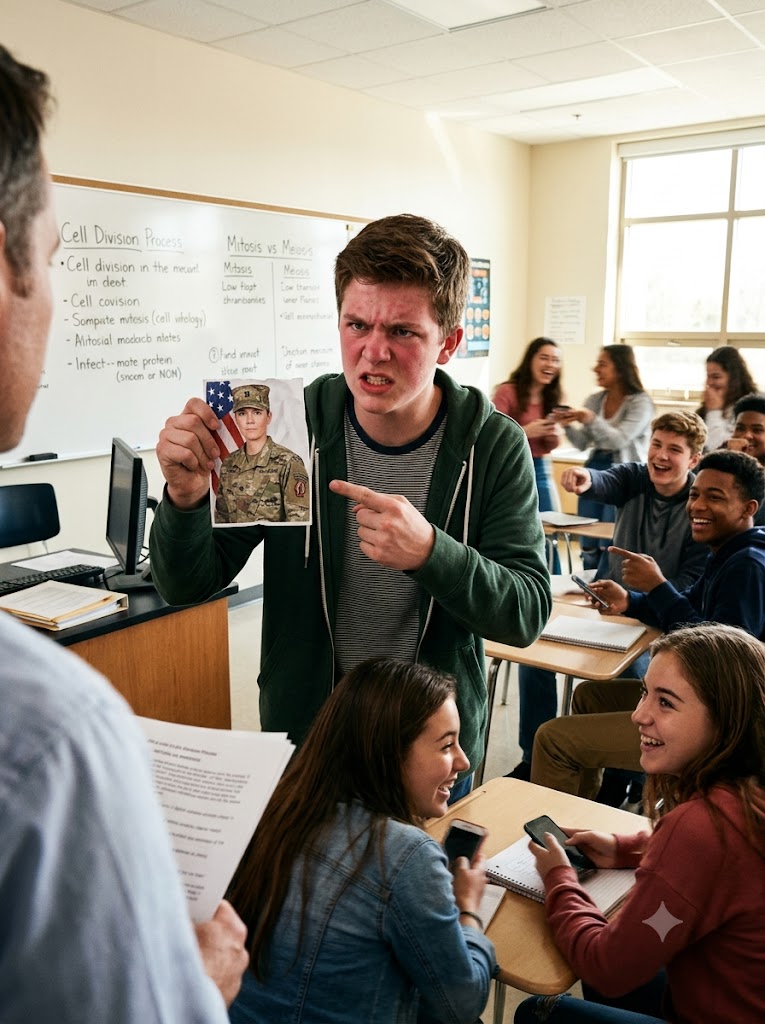
“Your mother commanded Special Forces soldiers? Nolan, do you seriously expect us to believe that?” Mr. Harlan asked, loud enough for the entire classroom to hear. I stood beside the whiteboard with an old photograph trembling between my fingers, while thirty teenagers stared at me like I had just claimed my mother was the president. When someone in the back whispered, “Maybe she commands the grocery store,” laughter erupted across the room. Mr. Harlan smiled instead of stopping it, and that was the moment I realized telling the truth wasn’t going to protect me.
My name is Nolan Pierce, and until that Wednesday morning, I had never particularly cared whether anyone knew what my mother did for a living. At home, she was Evelyn Pierce, a forty-five-year-old woman who burned toast, complained about our unreliable dishwasher, and fell asleep watching crime shows with the television remote balanced on her stomach. She also happened to be a colonel in the United States Army, with more than twenty years of service and leadership assignments involving Special Forces personnel. But she had always insisted that her career wasn’t something I should use to impress people, and I had respected that rule without questioning it.
Our school, Westbridge High, had organized something called American Heroes Week, and every student in my history class had to give a presentation about someone they admired. Most kids chose firefighters, grandparents, professional athletes, or historical figures, but I chose Mom because I knew how much she had sacrificed without ever asking for recognition. I brought a photograph from a dusty military installation, showing her in uniform beside several soldiers and a row of sun-faded vehicles. I hadn’t brought medals, official documents, or newspaper articles because I thought the assignment was about why someone mattered to us, not about proving their professional credentials.
Mr. Harlan apparently disagreed, especially when I explained that my mother had held command responsibilities involving elite military personnel. He leaned against his desk, folded his arms, and asked, “Do you understand how demanding those positions are, Nolan?” I answered that I did, although I couldn’t discuss everything she had done, and his eyebrows rose as though I had delivered the punch line to a joke. “Convenient,” he said, turning toward the class, “because whenever somebody invents an extraordinary story, the details are always classified.”
Blake Turner, who sat near the windows, laughed so hard he knocked his water bottle off his desk. I tried explaining that my mother had served overseas and worked with senior military leaders, but Mr. Harlan interrupted before I could finish. “Your mother might be a wonderful person, Nolan, but there’s no shame in having an ordinary job,” he said, tapping my photograph with one finger. “There is, however, something wrong with exaggerating someone’s accomplishments to make yourself look important.”
His words hit harder than the laughter because they sounded disturbingly similar to my mother’s own warning about never using her career for attention. I looked at the photograph again, noticing the faded American flag on a building behind her and the exhausted faces of the soldiers standing beside her. There were things about that picture Mom had never explained, including why one soldier had his hand resting on her shoulder and why she always became quiet whenever I asked about him. I wanted to call her right there, but I couldn’t stand the thought of making her leave an important meeting just to rescue me from an argument.
When I returned to my desk, Mr. Harlan gave me a temporary failing grade for what he called “unsupported claims,” and Blake whispered, “Better luck next time, Commander Junior.” A girl named Leah Morgan glanced at me sympathetically but said nothing, and somehow her silence hurt almost as much as everyone else’s laughter. During lunch, screenshots of my presentation photograph appeared in our class group chat beside jokes about imaginary military missions. I deleted the notifications without answering, although every time my phone vibrated, my stomach tightened.
That afternoon, the entire school assembled in the auditorium for the main Heroes Week ceremony, which featured veterans, local officials, and several senior military guests. Mr. Harlan stood near the stage looking extraordinarily pleased with himself because he had helped coordinate the event, and he kept reminding students that Admiral Thomas Mercer was among the honored visitors. I sat near the middle, wishing I could disappear into the faded blue upholstery. When the admiral stepped to the microphone and opened the printed program, I noticed him pause at something on the page.
He leaned toward the principal, Dr. Vivian Cole, and quietly asked a question I couldn’t hear. She consulted her notes, nodded, and looked toward the side entrance with an expression that suddenly seemed nervous. The admiral straightened, scanned the audience, and said, “Before we begin, is there a student here named Nolan Pierce?” I raised my hand slowly, and his face changed the instant he saw me.
Then the auditorium doors opened, and a woman in Army dress uniform stepped inside, accompanied by two senior officers. I recognized her immediately, but the decorated uniform, silver eagles, and unexpected arrival made my breath catch. My mother had never told me she was coming, and as Admiral Mercer rose from his chair, Mr. Harlan’s confident smile began to disappear.
Part 2: The Admiral Who Knew My Mother
My mother walked down the center aisle with the same calm expression she wore whenever something serious demanded her attention. The overhead lights caught the ribbons on her jacket, and I heard chairs scrape as the visiting military officers stood. Admiral Mercer descended the steps and greeted her like an old colleague, shaking her hand before briefly placing his other hand on her shoulder. Mr. Harlan gripped the edge of the podium in disbelief, and I noticed that several parents were already reaching for their phones.
“Colonel Pierce,” the admiral said, “we’re glad you could make it.” Mom thanked him, then glanced toward me and gave a tiny, almost apologetic smile. Dr. Cole announced that Mom had been invited as an honored guest several weeks earlier, after arranging leave to attend the ceremony. She hadn’t come to rescue me, because she didn’t yet know anything was wrong, and suddenly I wondered how she would react when she discovered what had happened.
Before the program continued, Admiral Mercer asked why several students had mentioned an argument about Colonel Pierce. Mr. Harlan stepped forward quickly and called it “a classroom misunderstanding,” questioning my terminology about special operations. “I was simply asking for accuracy,” he insisted, adding, “Surely that isn’t unreasonable.” The admiral’s expression sharpened as he asked, “Did you investigate before publicly calling the boy dishonest?” Mr. Harlan lowered his eyes and admitted that he hadn’t.
Mom could have let the admiral keep questioning him, but she raised a hand. “This day is supposed to honor service, not turn my son’s embarrassment into entertainment,” she said, and the audience fell still. Mr. Harlan mistook her restraint for support and tried explaining that command positions like hers were extremely unusual. She looked him straight in the eye and replied, “Then you ask, because being unfamiliar with someone’s history doesn’t give you permission to rewrite it.” I had heard that calm, controlled tone before, and I knew she was deeply upset.
The admiral returned to the microphone and offered only facts that could be discussed publicly. He described Mom’s rank, her years of Army service, and leadership assignments coordinating Special Forces personnel during joint operations. He also recalled her challenging one of his planning decisions when she believed an important risk had been overlooked. A few veterans chuckled when Mom muttered, “You made it very easy, Thomas,” and he replied, “That’s why I listened.” Watching them, I realized there was an entire part of my mother’s life that existed beyond the stories she told at our kitchen table.
Then he looked across the auditorium and said, “Nolan Pierce was truthful this morning, before anybody wearing a uniform came through that door.” Nobody laughed, and the silence felt heavier than the noise that had filled my classroom. Mr. Harlan approached the microphone after a long pause and admitted he’d called me a liar without evidence and permitted the class to laugh. I didn’t clap when he apologized, and Mom didn’t ask me to, because an apology couldn’t erase what had happened. I kept watching his face, wondering whether he regretted hurting me or simply regretted being exposed.
When the assembly ended, Mom found me between the seats, opened her arms, and held me while the room emptied around us. “I thought you’d be mad I talked about your work,” I confessed, pressing my forehead against her uniform. She pulled back and said, “I never meant for my rule to stop you from telling the truth or asking for help, sweetheart.” Her expression changed when I explained how long the laughter had continued, and she quietly promised that we would address it properly.
Dr. Cole asked us into a small conference room, where I described the presentation while she took notes. She promised a formal review and pointed out that the assignment had never required professional documentation for family members. Mom wanted the same protection for every student, including a custodian’s child, and said my teacher’s behavior would have been equally unacceptable regardless of her military rank. Dr. Cole agreed, then paused over her laptop while examining an earlier email.
“What is it?” Mom asked, and the principal rotated the screen toward us, her mouth pulled tight. An email sent to Mr. Harlan three days earlier contained the confirmed guest list, including the unmistakable name Colonel Evelyn Pierce; beneath it was his brief response, “Received, thank you.” I stared at those words as the embarrassment I’d felt all morning hardened into anger. My teacher hadn’t simply failed to believe me—he’d been told my mother’s name before I ever stood in front of his class.
Part 3: The Email That Changed Everything
Mom read the email twice, then asked Dr. Cole to invite Mr. Harlan into the room. He arrived ten minutes later carrying a paper cup of coffee, but he stopped when he saw the screen. “You received this guest list Monday,” the principal said, pointing to my mother’s name, and he nodded while explaining that he’d been coordinating dozens of visitors. I watched him closely, remembering how confidently he’d told my classmates that I was inventing everything.
“Did you know she was my mother?” I asked, and everyone turned toward me. Mr. Harlan looked at the table rather than answer, so I repeated the question, feeling my voice grow stronger. Finally he said, “I recognized the surname, but I assumed you’d misunderstood what her assignment involved.” He’d decided I was wrong without asking anyone, even though the information had been sitting in his inbox. When he called it “poor judgment,” I wondered whether those words were supposed to make me feel better.
Dr. Cole placed her notebook between us and explained that the school would document the incident and review my grade. Mr. Harlan started talking about his fourteen years of teaching, but she interrupted him. “Experience should have made you more careful, not less,” she said, and he pressed his lips together. Mom didn’t ask for his dismissal or use her rank to threaten him; she simply demanded meaningful action after the ceremony’s attention disappeared. The principal promised to follow the school’s disciplinary process and ensure that my complaint received proper consideration.
Then Dr. Cole asked whether I wanted to change classes, and the question caught me off guard. I imagined never walking through Mr. Harlan’s doorway again, never hearing Blake’s laugh or watching my teacher raise an eyebrow when I answered a question. But I loved history, and I didn’t want the day to end with me losing a class where I belonged. I said I’d think about it, and Mom supported that decision without trying to choose for me.
In the parking lot, sunlight flashed against our windshield while students hurried toward buses. I asked Mom why she’d spent years telling me not to talk about her military career if she didn’t want me to remain quiet. She set her uniform cap on the roof of the car and explained that she had meant never to borrow another person’s achievements to make myself feel superior. “But defending yourself isn’t showing off,” she said, “and telling an adult you’ve been hurt isn’t disloyalty to me.” My eyes filled because I had spent the entire morning believing that asking her for help would somehow disappoint her.
The next morning, a yellow note waited beside my cereal bowl because Mom had left early for a meeting. She’d written, “Tell the truth. Ask for help when you need it. You don’t have to earn respect through somebody else’s title,” and drawn our dog, Pickles, wearing a general’s hat. I laughed, folded the note into my backpack, and headed for school. On the bus, though, I discovered someone had posted a video of the admiral correcting Mr. Harlan, and the comments were already spreading through our student group chats.
Blake caught me by the vending machines and said, “So your mom really is famous,” as though this were exciting news we’d discovered together. I looked at him and answered, “I told you yesterday.” His friends stopped smiling, and he shifted his backpack awkwardly from one shoulder to the other. “Look, I was joking,” he offered, but I told him jokes were supposed to be funny to somebody besides the person telling them. He muttered an apology, and I walked away before he could turn it into another performance.
Mr. Harlan stood beside the whiteboard when our history class began, his usual confident expression replaced by something tired and uncertain. He told the class he had accused a student without checking the facts and encouraged disrespect by laughing along, then acknowledged that the school was formally reviewing his conduct. He didn’t ask me to stand, speak, or accept his apology, which was the first considerate decision I’d seen him make. After class, he returned my presentation with an A and a handwritten acknowledgment that he had failed to evaluate it fairly, but I slid the paper into my folder without thanking him.
That night, Mom was in sweatpants making spaghetti when she noticed the original photograph lying beside my homework. She asked if I wanted to talk about the ceremony, and I said I was more interested in the soldier standing beside her, the one whose hand rested on her shoulder. The wooden spoon stopped moving, and she turned off the burner before sitting down across from me. “His name was Captain Andrew Vale,” she said softly, “and there’s a reason I never told you the full story of that picture.”
Part 4: The Man in the Photograph
Mom carried the photograph to the kitchen table and sat with it between her hands while the stove cooled behind her. She told me Captain Andrew Vale had been one of the first officers to take her ideas seriously when she was still establishing herself as a leader. In the picture, they were standing outside a temporary operations center after a demanding assignment that involved coordinating transportation, supplies, and communications. “There was nothing glamorous about it,” she said, running her thumb along the faded edge. “The important part was making sure people had what they needed and could return home safely.”
During one difficult operation, Mom had noticed that a transportation plan would leave an entire team waiting without reliable communications. She challenged the schedule, even though several senior officers had already approved it and wanted the meeting to end. Andrew supported her concerns and helped develop a safer alternative; afterward, when the team returned, someone snapped the photograph. I asked why he looked so proud with his hand on her shoulder, and she answered, “Because we spoke up when staying silent would have been easier.” Suddenly, the picture I had carried into school meant something far greater than proof of my mother’s rank.
“Where is he now?” I asked, although the sadness in her expression made me fear the answer. Mom told me Andrew had died during a later deployment, leaving behind a wife and a young daughter. She still sent his family cards, and sometimes his daughter, now grown, visited us when she traveled through our state. I studied his face again, seeing not an impressive military figure but someone who had laughed with my mother, trusted her judgment, and never returned to his own family. For the first time, I understood why she rarely displayed her decorations or talked about the people she’d served beside.
Mom explained that strangers often wanted to hear the exciting parts of military life, not exhausting planning meetings, worried families, or the responsibility of admitting mistakes. “I worried that if I told you only the impressive things, you’d miss what actually mattered,” she said, reaching across the table. Then she added, “But hiding every difficult story was a mistake too, because you started believing that honesty meant silence.” I told her that Mr. Harlan had made me feel ashamed of being proud of her, and she answered that nobody had the right to make me ashamed of telling the truth.
By Friday, Dr. Cole informed us that Mr. Harlan had received a formal written reprimand and would undergo additional classroom observations. She offered again to move me, but I chose to stay because I liked the subject, not because I’d forgiven him. His apologies sounded sincere, yet I still watched him carefully whenever he corrected another student. I wanted him to become a better teacher, but I didn’t feel responsible for restoring his confidence or making him comfortable around me.
Leah approached me after school and admitted she’d laughed during my presentation because she was afraid the class would turn against her too. “I knew it was wrong,” she said, picking nervously at a loose thread on her backpack. I thanked her for apologizing but explained that watching someone be humiliated wasn’t the same as standing beside them. She accepted that without arguing, and the following week she began joining me at lunch. We didn’t become close friends overnight, but I appreciated that she was trying to change her behavior instead of demanding that I forget what happened.
On Monday, I was carrying my lunch tray across the cafeteria when I heard someone say, “Give it back.” A new student named Owen Brooks stood beside a table, reaching for a photograph Blake Turner was holding above his shoulder. Owen’s face was bright red, and the photograph showed an older man beside a military truck, his sleeves rolled up and his hands stained with grease. “What’s this guy supposed to be?” Blake asked, grinning at his friends. “Another secret commando?”
For one moment, I considered walking past because I had only just escaped being the center of everyone’s attention. Instead, I set down my tray, stepped toward the table, and said, “Put the photograph down.” Blake smirked and asked whether I planned to summon another admiral, but I pointed toward the lunch supervisor near the cafeteria doors. “No,” I answered, “I’m going to ask for help, and you’re going to explain why you’re taking somebody else’s property.” He handed the photograph back while muttering something about a harmless joke, and I reported what had happened before returning to my lunch.
Owen examined the photograph carefully before slipping it inside his notebook. “That’s my grandfather,” he told me, “and he was only an Army mechanic.” I remembered Mom’s stories about transportation plans and how much depended on vehicles that actually worked. “Only?” I repeated, pulling out the chair across from him. “Sounds to me like he kept a lot of people moving.” Owen smiled for the first time, then hesitantly asked whether I thought his grandfather’s story belonged at Heroes Week.
Part 5: The Hero I Finally Understood
“Of course it belongs,” I told Owen, although he still looked uncertain because classmates at his previous school had mocked his grandfather’s work. I asked him to show me the photograph again, noticing the grease on the older man’s hands and the proud smile beneath his cap. Something about it reminded me of Captain Vale standing beside Mom, both of them ordinary people whose work had mattered to others. I realized I had spent so much time trying to prove my mother was extraordinary that I’d almost forgotten what she wanted me to understand: service wasn’t a competition.
I told Mom what happened that evening while she was preparing dinner, and she listened without interrupting. When I finished, she asked whether Owen had his photograph back and whether the lunch supervisor knew what happened. I answered yes to both, and she smiled before saying, “You handled that like yourself.” I joked that maybe I was becoming a Special Forces commander, but she shook her head and explained that helping someone didn’t require a military title. For some reason, that felt better than being compared with an important officer.
Two weeks later, Westbridge announced a small community evening honoring local veterans and military families, and Dr. Cole asked whether I wanted to participate. My first reaction was to refuse because I could still hear my classmates laughing whenever I imagined standing in front of an audience. But Owen had been hoping to bring his grandfather, and Leah offered to help organize the photographs, so I eventually agreed. We decided to give short presentations without rankings or competitions, simply telling stories about people whose work had mattered to their families and communities.
The cafeteria smelled of coffee and warm chocolate-chip cookies when the evening arrived. Folding chairs lined the floor, veterans gathered around tables covered in photographs, and an American flag stood beside the little stage. Mom came straight from work wearing jeans and a plain navy sweater, looking more like the woman who reminded me to finish my homework than the decorated colonel who’d silenced an auditorium. Owen introduced her to his grandfather, and they spent several minutes discussing equipment repairs and supply vehicles. I watched Owen stand a little taller each time Mom asked another question about his grandfather’s experience.
Leah introduced her aunt, who worked as an emergency-room nurse, while Owen described how his grandfather had repaired trucks carrying supplies between military bases. When it was my turn, I held up a different photograph from Heroes Week, showing Mom standing beside Captain Andrew Vale and their friends outside the dusty operations center. My hands shook, but I didn’t lower the picture or look away. “This is my mother,” I began, “and for a long time, I thought the most important thing about her was that she was a colonel.”
I told them about Mom’s long absences, her birthday calls from unfamiliar time zones, and the little notes she left beside my cereal bowl. I explained that one of the soldiers in the photograph had died years later, and that Mom had taught me to understand the people behind military uniforms. “Being brave doesn’t mean you’re always right,” I said, feeling my voice grow steadier. “Sometimes it means listening, questioning a decision, standing beside somebody who’s alone, or admitting you’ve made a mistake.” When I looked toward Mom, she was wiping a tear from beneath one eye, and I knew my words had reached her.
Mr. Harlan stood near Dr. Cole at the back of the cafeteria, listening quietly. Afterward, he approached me, thanked me for speaking, and explained that he was changing the way he handled students’ personal stories. I told him I hoped he would, but I didn’t offer forgiveness or pretend we had become close. Dr. Cole later explained that the school had revised its presentation guidelines, encouraging teachers to raise factual concerns privately instead of embarrassing students before an audience. Knowing another student might be spared my experience meant more than seeing my teacher publicly corrected.
On the drive home, Mom asked whether I’d been nervous, and I admitted I’d nearly dropped the photograph twice. She laughed, then reached over at a red light and squeezed my hand. “I’m proud of you,” she said, “not because you proved anything about me, but because you made room for other people to tell their stories.” I watched the quiet neighborhoods pass outside the window and realized I no longer cared whether everyone at school understood how accomplished my mother was. I knew what mattered, and for once, that knowledge felt like enough.
A few days later, I hung Andrew’s photograph above my desk beside my original assignment, still marked with Mr. Harlan’s red A. Beneath the grade, I wrote a sentence of my own: “The truth doesn’t become true when somebody important confirms it.” Mom was still the colonel whose arrival had silenced an auditorium, but at home she was the woman who checked my homework, laughed at terrible jokes, and occasionally needed help opening stubborn jars. I hadn’t forgiven everyone who had humiliated me, and I didn’t need to, because moving forward didn’t require pretending the hurt had never happened. The greatest thing my mother had given me wasn’t her rank or reputation, but the confidence to believe in myself, tell the truth, and stand beside someone else when it mattered.
Legal Notice: This story is a work of fiction. Names, characters, businesses, events, and incidents are the product of the author’s imagination or are used fictitiously. Any resemblance to actual persons—living or dead—or to actual events is purely coincidental. Thank you! 💓