
My Son Tried to Steal Everything I Owned by Calling Me Mentally Unstable. Then the Judge Recognized My Name.
My son and daughter-in-law laughed when I entered the courtroom alone, carrying a cane and wearing a coat that had seen better days. They had photographs of my injuries, a doctor’s letter, and a lawyer ready to declare me incapable of managing my own life. They expected to leave with my house, my savings, and complete control over my future. What they didn’t know was that I had spent twenty-six years teaching people how to recognize a financial crime. And I’d been watching them.
Part 1
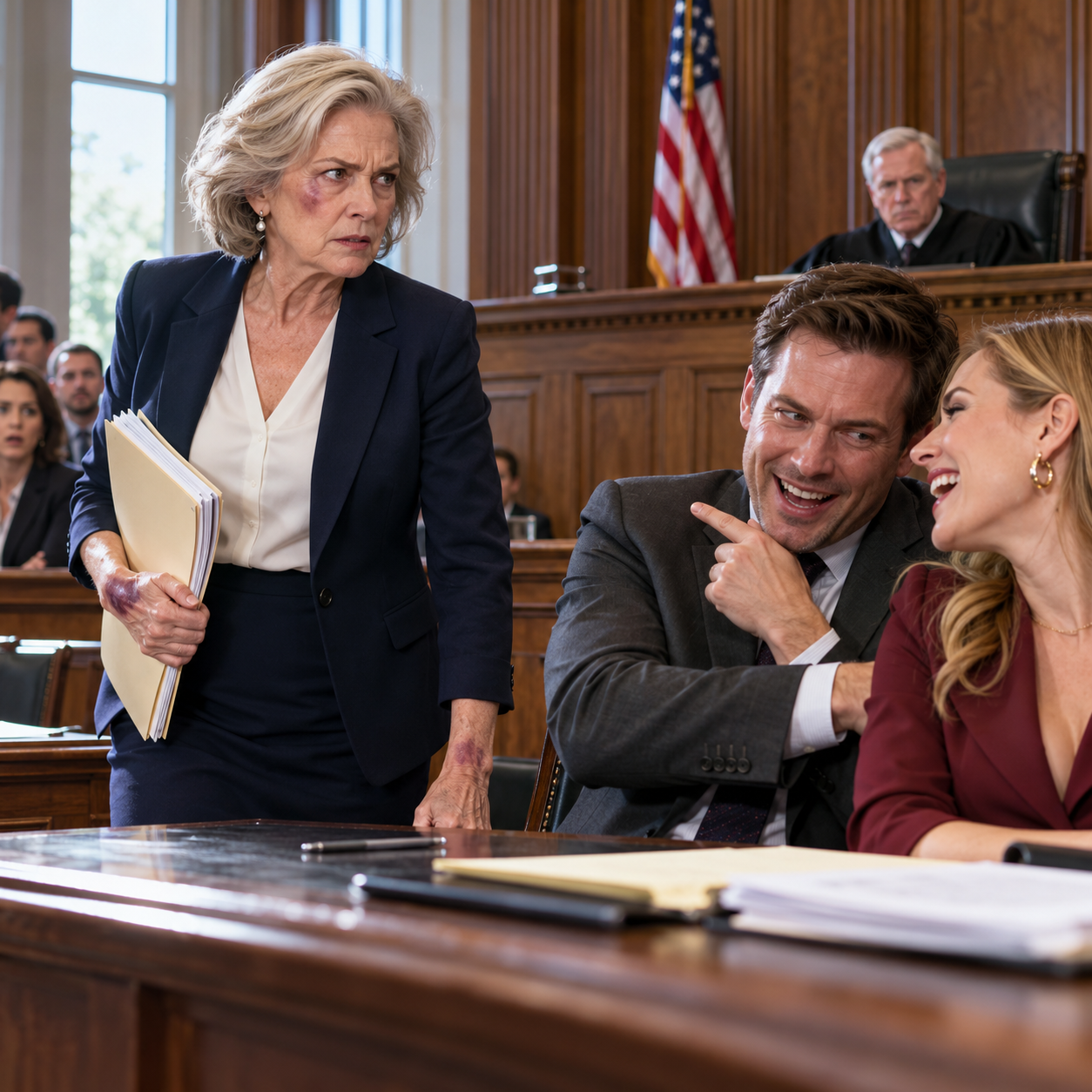
The first thing I heard when I entered Courtroom Four was my son’s laughter. Grant Calder leaned toward his wife, Paige, and whispered something that made her cover her mouth with a perfectly manicured hand. I couldn’t hear every word, but I caught enough: “By tonight, everything will be ours.” My walking cane clicked against the polished floor as I passed their table, and neither of them bothered to hide their smiles.
I was seventy-one years old, wearing a navy wool coat and comfortable black shoes, with a strip of medical tape still visible above my left eyebrow. To anyone watching, I probably looked like a frightened widow who had wandered into the wrong building. I had no attorney beside me, no expensive briefcase, and no family member holding my arm. That was precisely the picture Grant and Paige wanted the judge to see.
Their lawyer, Roland Price, was already arranging photographs across his table when I took my seat. He glanced at me with the practiced sympathy people reserve for someone they consider helpless, then leaned over to whisper to Grant. My son nodded, straightened his tie, and folded his hands like a concerned family man preparing for a difficult responsibility. I recognized the performance because I had watched him rehearse it in my own living room.
Six months earlier, my husband, Thomas, had died after forty-three years of marriage. He had been a quiet man who restored antique radios, made terrible pancakes every Sunday, and insisted that our house needed another coat of paint even when the walls looked perfectly fine. We had built that house outside Columbus, Ohio, when Grant was five years old. Every cabinet, garden bed, and crooked porch step held a memory I wasn’t ready to surrender.
Grant was our only child, and Thomas had spent years making excuses for him. When Grant abandoned a business venture, Thomas helped pay the debts; when he lost another job, Thomas called it bad luck. I loved my son, but I had stopped confusing love with blindness a long time ago. Unfortunately, after Thomas’s funeral, Grant began treating my grief as permission to make decisions for me.
At first, his visits seemed thoughtful. He brought groceries, replaced a kitchen faucet, and offered to organize the financial documents Thomas had left behind. Paige appeared with homemade casseroles and kept saying that families needed to “pull together” during difficult times. I appreciated the meals, although I found it curious that she seemed more interested in the filing cabinet in Thomas’s study than in whether I was sleeping.
The first serious argument happened when Grant asked to become an authorized signer on my retirement accounts. We were sitting at the kitchen table, with rain tapping against the window and Thomas’s old coffee mug between us. I told him I had managed our finances for decades and didn’t need another person’s signature on my money. Grant stared at me for several seconds before saying, “Dad always handled the important things, Mom. Maybe you don’t remember that.”
I looked at him carefully, wondering whether he genuinely believed what he’d just said. Thomas had handled the garden, the cars, and most conversations with neighbors, but I had managed our investments, taxes, and business accounts. Grant knew very little about my professional life because he’d never shown much interest in it. I decided not to correct him, and that small decision would later prove more important than I could have imagined.
Two weeks afterward, Paige began photographing ordinary moments around the house. She took pictures when I misplaced my reading glasses, when I forgot a grocery item, and when I stumbled over a loose rug near the hallway. Whenever I questioned her, she said the photographs were for my protection. Then she started carrying a little notebook in which she recorded dates, observations, and what she called my “confused episodes.”
One evening, I found the notebook open beside my kitchen sink, its pages filled with descriptions of incidents that had never occurred. According to Paige, I had forgotten where I lived, tried to leave the house in the middle of the night, and accused family members of stealing. Beneath those entries was a handwritten sentence that made my stomach tighten: “Need stronger documentation before the hearing.” I photographed the page, closed the notebook, and realized my son wasn’t preparing to care for me; he was preparing to take control of me.
Part 2
The following morning, I asked Grant to come over without Paige. I made coffee, set out two cups, and placed his wife’s notebook on the table between us. His expression changed before he even sat down, and I knew immediately that the entries weren’t some innocent misunderstanding. He flipped through the pages, shrugged, and said, “Paige is just worried about you, Mom. We all are.”
I pointed to the entry claiming I had wandered outside at two in the morning. “I was attending my book club’s anniversary dinner that evening, Grant, and I have six people who can confirm it.” He rubbed his forehead and suggested that perhaps I had confused the dates. When I told him to leave the notebook behind, he snatched it from the table and walked out without finishing his coffee.
After that conversation, their behavior changed from watchful to controlling. Grant began opening my mail, Paige insisted on accompanying me to appointments, and both of them questioned every purchase I made. When I changed the passwords to my accounts, Grant called me selfish and accused me of keeping family money from the people who would eventually inherit it. I reminded him that an inheritance belonged to the living person who owned it until that person died.
The first injury occurred in October, when Paige discovered that I had refused to authorize access to my savings. She confronted me near the hallway cabinet, grabbed my wrist when I tried to walk away, and held it tightly enough to leave a dark bruise. Grant arrived ten minutes later and listened while she claimed I’d become upset and stumbled. Instead of asking whether I was hurt, he asked why I kept making things difficult.
I visited an urgent care clinic the next afternoon and told the nurse exactly what had happened. I also asked for copies of the medical record, something Paige would have found very strange if she’d known about it. For thirty years, I’d kept records of other people’s financial misconduct, and I knew that memories could be challenged more easily than documentation. Still, I wasn’t prepared for how quickly Grant would turn our house into a place where I no longer felt welcome.
In early November, he came to discuss selling the property. He claimed the stairs were dangerous, the maintenance was overwhelming, and a senior living community would offer everything I needed. I told him I intended to stay in the house where Thomas and I had spent our happiest years. Grant stepped toward me so abruptly that I backed into the hallway wall, striking my shoulder against the wooden trim.
For one terrible moment, I saw a stranger where my little boy had once stood. He stared at me, then at the wall, before telling me I’d lost my balance because I refused to use my cane properly. Paige appeared with an ice pack and a look of carefully arranged concern. By dinner, she had already written another entry about my deteriorating condition, while Grant assured her that I wouldn’t remember the incident accurately.
I knew I needed help, but I also understood that accusing my only son without independent evidence could become complicated. I contacted my longtime friend, retired attorney Margaret Ellis, and asked whether she could recommend someone familiar with guardianship disputes. Margaret listened without interrupting, then said, “Miriam, whatever they’re planning, you need to document every step.” I told her I had already begun, although I didn’t explain exactly how.
There was another reason I hesitated to confront them publicly. Two months before Thomas died, he had confessed that Grant had borrowed money from several people and concealed the extent of his debts. Thomas had discovered an unfamiliar agreement bearing his signature and feared someone was using his name without permission. He’d promised to investigate after his next medical appointment, but he never had the opportunity.
I remembered that conversation when I returned to his study and found the bottom drawer of his desk slightly open. Several folders had been moved, and a manila envelope containing older property records was missing. On the blotter lay an unfamiliar business card for a company called Stonebridge Asset Recovery. I turned it over and found a telephone number written in Grant’s handwriting, followed by two words that chilled me: “After guardianship.”
Part 3
I called the number on the business card from a prepaid phone the following morning. A receptionist answered with a cheerful greeting, but her tone became guarded when I asked whether Stonebridge handled residential property transfers. She said the company specialized in acquiring distressed assets and couldn’t discuss individual clients. Before ending the call, she asked whether I was calling about the Calder property, even though I’d never given her my name.
That afternoon, I drove to the county recorder’s office and searched the public property records. Our house was still in my name, with no recorded mortgage or pending transfer, but someone had recently requested a copy of the deed and tax history. The request was connected to a business entity I didn’t recognize, Calder Residential Holdings. I copied the information and returned home with the unpleasant feeling that Grant had begun treating my house as something he already owned.
When I confronted him about the company, he acted surprised. He claimed Stonebridge was helping him refinance a struggling business and that the similar name was a coincidence. Paige stood behind him, arms crossed, and asked why I was wasting time digging through paperwork instead of looking after my health. I noticed that she glanced at Grant before answering every question, as though waiting for permission to continue their carefully coordinated story.
On November twentieth, I returned from grocery shopping and heard drawers opening inside Thomas’s study. Grant was standing beside the desk with several folders tucked under his arm, including the blue file Thomas had always used for our estate planning documents. I demanded that he put everything back, but he insisted he was protecting important records from being lost. When I reached for the blue folder, the struggle ended with me striking the edge of the doorframe.
I stood gripping the desk, stunned by how casually he began rearranging the scattered papers. Grant told me I had stumbled while trying to snatch something from him, then called Paige to describe another accident. She arrived carrying her notebook and photographed the mark above my eyebrow before asking whether I remembered what had happened. I said nothing, because I had just realized they were no longer afraid of being caught.
What Grant didn’t know was that I had installed motion-activated cameras in the hallway, living room, and study entrance several weeks earlier. The system had been recommended by a security specialist Margaret knew, and it stored encrypted footage outside the house. I had originally wanted to monitor the property and document unauthorized access, not capture my own son behaving this way. Watching those recordings later was among the hardest things I’ve ever done.
The footage showed more than the confrontations. On several evenings, Grant and Paige searched through Thomas’s papers, photographed bank statements, and discussed which accounts they could reach if I were declared incapable. One recording captured Paige saying, “Once the judge signs it, she won’t get to argue anymore.” Grant replied that Stonebridge was expecting an answer before Christmas, and the desperation in his voice suggested a deadline neither of them had told me about.
Three weeks before the guardianship hearing, I returned from a routine dental appointment and discovered that my house key no longer worked. Grant answered the door through the narrow opening permitted by the security chain and announced that he’d changed the locks for my own protection. He offered to let me inside if I agreed to meet with his chosen care coordinator. When I refused, he closed the door, leaving me standing on the porch with my overnight bag.
I spent that night at a roadside motel overlooking a gas station, with the heating unit rattling beneath the window and Thomas’s photograph on the nightstand. At midnight, Grant sent a message saying, “Stop making this difficult. We’re trying to help you.” I read it twice, then opened my laptop and began reviewing the account alerts I’d been receiving. Three transfer requests had been rejected by my financial institution, each accompanied by documents claiming Grant possessed financial authority I had never granted.
I called the bank’s fraud department, secured my accounts, and requested preservation of the original submissions and access records. The documents contained a copy of my signature that looked convincing until I examined the spacing, alignment, and repeated imperfections. The same signature image had been reused on separate forms, and its source appeared to be an older family document. That was when I understood why Grant had been so desperate to retrieve Thomas’s blue folder: my son wasn’t merely trying to gain control of my future; he had already tried to take my money.
Part 4
For the next eighteen days, my motel room became the smallest investigation office I’d ever occupied. I spread bank correspondence across the narrow desk, indexed security recordings, and compared digital documents against originals I’d preserved years earlier. Margaret helped me obtain preliminary advice about the guardianship process, while I personally prepared my response and supporting exhibits. I also reported the lockout and my concerns about unauthorized financial activity, making sure each report received a reference number.
The fraud investigation at the bank revealed an even more troubling detail. Grant had submitted documents showing himself as my financial agent, but the supposed authorization contained a witness signature belonging to a person who had died three years earlier. A separate transaction request identified Calder Residential Holdings as the intended recipient of a substantial transfer. Grant had apparently expected the bank to accept the paperwork before anyone asked difficult questions.
Meanwhile, Roland Price filed photographs of my injuries and a written statement from Paige describing my supposed cognitive decline. He also submitted a brief letter from a physician who had evaluated me during a routine appointment, although the letter made no diagnosis of dementia or incapacity. In his petition, Price argued that the family needed immediate authority to prevent further harm. I wondered whether he’d read the evidence critically or simply believed everything his clients had told him.
I responded with medical records, dated photographs, banking correspondence, and a request that the court consider the security footage. My documents were delivered according to the court’s instructions, but I kept the original recordings and verified copies organized separately. I didn’t want a dramatic ambush that could be dismissed on procedural grounds. I wanted the truth presented in a form that could withstand every question the opposing attorney might ask.
On the morning of the hearing, Margaret offered to accompany me, but I asked her to remain available by telephone. I wasn’t trying to prove that I could defeat every lawyer in Ohio without assistance; I simply wanted to speak for myself when my son claimed I couldn’t. My hands trembled slightly while I buttoned my navy coat, and I allowed myself a moment of grief. The woman looking back from the motel mirror seemed older than she’d been six months earlier.
Back in Courtroom Four, Roland Price rose when Judge Helen Whitcomb entered and began outlining the family’s concerns. He described repeated falls, increasing confusion, and what he called my dangerous resistance to reasonable supervision. Grant lowered his eyes whenever the judge looked in his direction, while Paige kept a tissue pressed against her cheek. Their performance was convincing enough that I noticed several people in the gallery watching me with unmistakable pity.
Then Judge Whitcomb opened my response and paused at the first page. She adjusted her glasses, studied the name, and looked directly at me. “Mrs. Calder, were you involved in the Bellweather pension fraud investigation some years ago?” I answered that I had served as the lead forensic accountant and testified in the resulting proceedings. Grant turned toward me so quickly that his chair scraped loudly across the floor.
The judge explained that she remembered reading about the case while beginning her legal career. Bellweather had become a landmark example of how concealed transactions could strip ordinary workers of their retirement savings. I had helped trace the missing funds, later founded an investigative accounting firm, and eventually specialized in disputed estates and financial exploitation cases. Grant knew his mother had owned a business, but he’d apparently never bothered to learn what that business actually did.
“Your Honor,” Roland interrupted, “her former occupation doesn’t change the present medical concerns.” Judge Whitcomb agreed that professional accomplishments alone couldn’t determine someone’s current capacity, then asked whether I wished to address the allegations directly. I rose carefully, steadied myself with my cane, and told her that I had brought records explaining the injuries and the financial circumstances surrounding the petition. The courtroom grew quiet as the clerk prepared to receive my exhibits.
I removed a small silver flash drive from its worn leather case and placed it beside my indexed evidence binder. “These injuries were not caused by accidental falls,” I said, meeting the judge’s eyes. “They occurred during confrontations with my son and daughter-in-law, and I have contemporaneous records documenting what happened.” Behind me, Grant muttered that I was making things up, but I didn’t turn around. Instead, I opened my binder to the first numbered exhibit and asked permission to explain why every photograph they’d submitted told a different story from the one they intended.
Part 5
Judge Whitcomb examined my exhibit list and asked me to identify the recording system, explain how the files had been preserved, and confirm that the timestamps matched the dates in the petition. I answered each question and provided the installation records, original file information, and supporting medical documents. After hearing Roland’s objections, she allowed the relevant footage to be reviewed for the limited purpose of deciding the emergency guardianship request. Grant leaned toward his attorney and whispered urgently, but Roland held up one hand without looking at him.
The first recording showed Paige grabbing my wrist during our October argument. The second showed Grant advancing toward me in the hallway before I struck the wall, while the third captured the confrontation over Thomas’s blue folder. Nobody spoke as the judge reviewed the clips and compared them with the photographs Grant had submitted. When the recording ended, Paige covered her face, and my son looked at me with an expression I had never seen before: genuine fear.
Roland stood and argued that family disagreements didn’t necessarily establish incapacity or wrongdoing. Judge Whitcomb acknowledged that the court wasn’t conducting a criminal trial, then questioned why the petition described these incidents as unexplained falls. Grant tried to interrupt, claiming that I had deliberately provoked arguments, but the judge instructed him to speak through his attorney. I opened the next section of my binder and explained that the financial records provided important context for the family’s sudden concern about my independence.
The bank’s preservation records documented rejected transfers, disputed authorization forms, and attempts to move money toward Calder Residential Holdings. I explained the duplicated signature image, the questionable witness information, and the connection between that company and the business card found in Thomas’s study. Roland turned toward Grant and quietly asked him a question I couldn’t hear. Whatever answer he received made him close his folder and request permission to confer privately with his clients.
After a recess, Judge Whitcomb returned and announced that the evidence did not support the requested emergency guardianship. She denied the petition, noting that the medical information was insufficient to establish incapacity and that the circumstances raised serious concerns about the petitioners’ conduct. She also directed that the relevant materials be preserved and referred the financial and physical-mistreatment allegations to the appropriate authorities. Grant stared at the table as though the words had emptied the room of air.
Outside the courtroom, Paige hurried toward me with tears running down her cheeks. “Miriam, please. We never wanted things to go this far,” she said, reaching for my sleeve. I stepped back, and she stopped immediately. Grant appeared behind her, insisting that Stonebridge had threatened to pursue his debts and that he’d only wanted temporary access to my money until he could straighten everything out.
“Then you should have asked for help,” I told him, surprised by how calm my voice sounded. He said he was my son, that families made mistakes, and that Thomas would have wanted us to work things out. Hearing him invoke his father’s name after everything he’d done finally broke the last fragile connection between us. “Your father spent his life protecting this family,” I replied. “You tried to destroy what he left behind, and you used my love for you to do it.”
The investigation continued for several months, revealing that Grant had promised Stonebridge an ownership interest in the house as security for his personal obligations. The company ultimately received nothing, and the disputed account transactions were blocked before my savings could be transferred. Grant and Paige later faced criminal charges relating to the false financial documents and their treatment of me; both entered negotiated pleas that included restitution obligations and court-ordered supervision. I attended the final hearing, not because I wanted revenge, but because I wanted to hear the truth acknowledged without another excuse.
I reclaimed my home through legal proceedings, replaced the locks, and installed a new security system. Margaret helped me arrange updated estate documents that left Grant no authority over my affairs and no expectation of inheriting my property. I gave much of the money I’d once intended to leave him to organizations that assist older adults facing exploitation. When Grant sent a letter asking for forgiveness, I read it once and placed it in a drawer without answering.
One Sunday morning, nearly a year after the guardianship hearing, I sat on my porch with Thomas’s old coffee mug warming my hands. The garden needed trimming, the porch step still creaked, and a cardinal was singing from the maple tree he’d planted when we moved in. I missed my husband every day, and I mourned the son I thought I’d raised, but I no longer mistook grief for an obligation to surrender my peace. At seventy-two, I had my house, my dignity, and my future, and none of them belonged to Grant anymore.
Legal Notice: This story is a work of fiction. Names, characters, businesses, events, and incidents are the product of the author’s imagination or are used fictitiously. Any resemblance to actual persons—living or dead—or to actual events is purely coincidental. Thank you! 💓


