
My Son-in-Law’s Mother Tried to Evict Me From My Late Wife’s Mountain Cabin—28 Minutes Later, the Sheriff Opened My Folder
My son-in-law’s mother arrived at my late wife’s Colorado mountain cabin with three movers, a truckload of furniture, and a key my own daughter had supposedly given her. She laughed in my face and announced that I was too old to fight for the house. I didn’t argue. I made one phone call, and twenty-eight minutes later, the sheriff pulled into my driveway. But when he opened the folder I’d kept locked away for years, he discovered something far worse than an attempted eviction.
Part 1
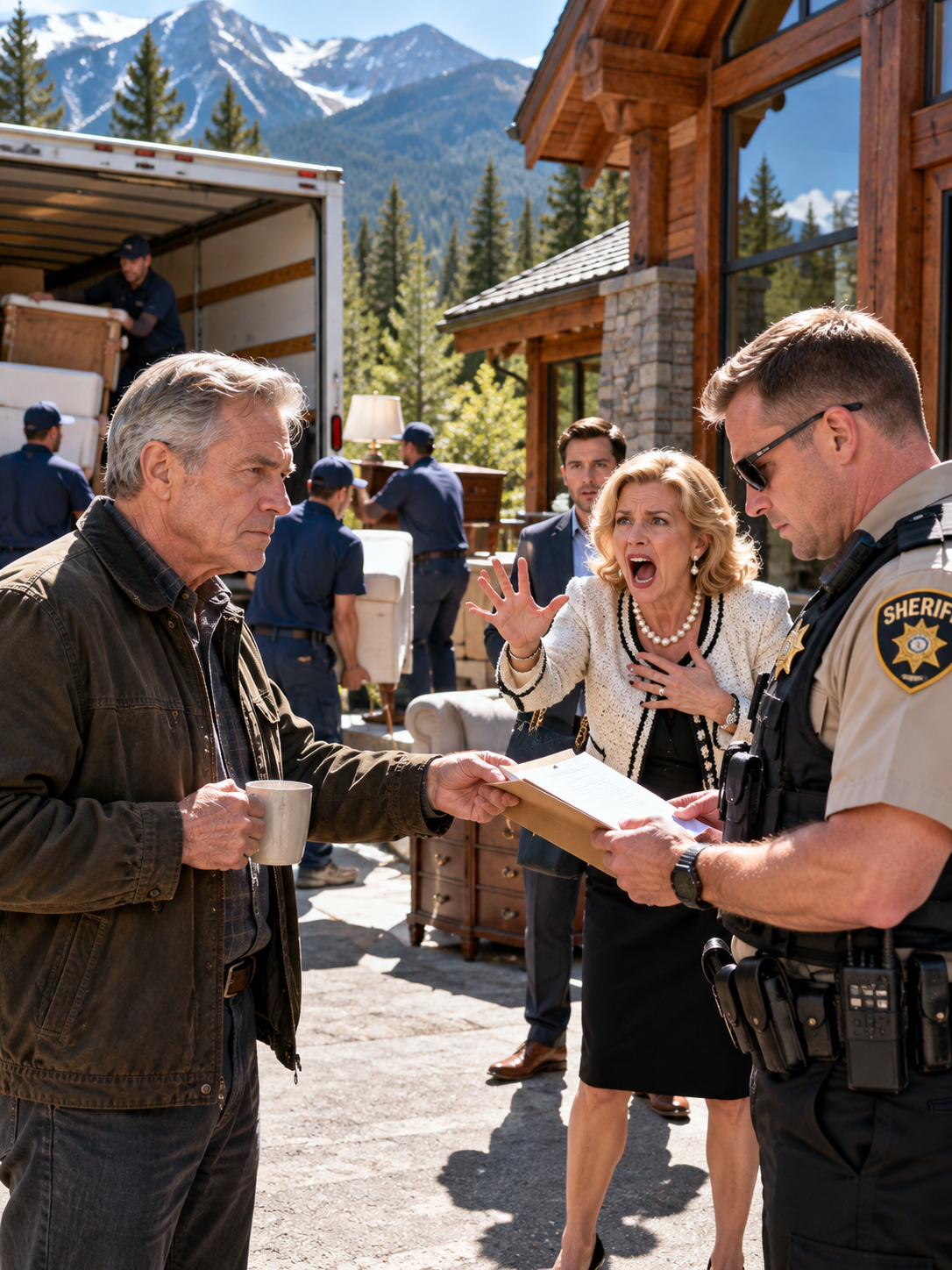
“Your daughter gave me the keys, so you might as well start packing!” The woman shouting from my driveway was Marlene Pritchard, my son-in-law’s mother, and behind her three movers were unloading furniture from a white truck. I stood on the porch holding my morning coffee, watching a leather sofa approach the house my late wife had designed. It was eight seventeen on a Saturday morning, and until that moment, the loudest sound I’d heard was a woodpecker working on a pine tree.
My name is Peter Hayes, and I’ve lived in the mountains outside Evergreen, Colorado, for almost thirty years. My wife, Alice, and I built our cabin while our daughter, Kendra, was still in elementary school, spending weekends hauling lumber and arguing about where the kitchen windows should face. Alice wanted the sunrise over the eastern ridge, so that’s where the windows went. Three years after losing her to cancer, I still watched that sunrise every morning with two coffee cups on the table, although only one ever got used.
Marlene climbed out of a black SUV wearing enormous sunglasses and a cream-colored coat that probably cost more than my chainsaw. She was a wealthy widow who enjoyed reminding everyone that her family had owned property in Aspen, although I’d never heard her mention where the money originally came from. “Good morning, Peter!” she called, jingling a silver key. “Kendra said you’d probably be difficult, but I told Scott we’d manage.”
Scott was my son-in-law, a real estate developer whose smile had always made me check whether my wallet was still in my pocket. He’d married Kendra six years earlier, and lately he’d become unusually interested in my property. At Christmas, he suggested transferring the cabin into Kendra’s name to simplify my estate. When I refused, he started recommending retirement communities.
“What exactly did Kendra tell you?” I asked, stepping down from the porch. Marlene pointed toward the house and explained that she was moving into the upstairs bedroom while I made arrangements for somewhere more suitable. She said Scott had handled the paperwork and Kendra had approved everything. Then she smiled and added, “You’re seventy-one, Peter. Nobody expects you to keep a property like this forever.”
I glanced toward the movers, who were carrying a heavy wooden cabinet past Alice’s flower beds. “Set that down,” I told them, and the youngest man stopped immediately. Marlene clicked her tongue and said I was embarrassing myself. When she ordered them to continue, I asked whether anyone had actually shown them proof that they had permission to enter.
The foreman admitted they’d been hired by Scott and had received a delivery address, not ownership documents. Marlene waved the key in front of my face and announced that possession was all the proof she needed. I looked at the familiar brass head and recognized it as one of the spare keys I’d given Kendra after her mother died. That realization hurt more than Marlene’s insults.
“Has anything gone inside yet?” I asked the foreman, who shook his head. I told him to leave everything where it was while we established who had authority over the property. Then I called Cole Ramirez, the county sheriff, and explained that someone was attempting to occupy my residence without permission. He asked whether anyone was threatening me or forcing entry, and I told him nobody had crossed the threshold yet.
Marlene watched me end the call and laughed. “Calling your mountain buddies won’t change the legal paperwork, sweetheart,” she said, folding her arms. I told her we’d see what the sheriff thought. She leaned closer and whispered that Scott had warned her about my memory problems, and that arguing would only make it easier to prove I shouldn’t live alone.
Exactly twenty-eight minutes after my call, Cole’s patrol SUV rolled up the driveway, throwing pale dust across the stacked furniture. He stepped out, greeted everyone, and asked the movers to stop working while he sorted out the conflicting claims. Marlene immediately informed him that she was the rightful occupant and I was an elderly relative refusing to accept a family decision. Cole turned toward me and asked whether I had documents establishing my right to the property.
I retrieved a thick folder from the fireproof safe beneath my study desk. Inside were certified property records, Alice’s trust documents, and the legal correspondence I’d received after Scott began pressuring me. The cabin belonged to the Hayes Family Preservation Trust, and I was its current trustee with exclusive authority over occupancy decisions. Kendra was named as a possible successor, but she had no present right to transfer ownership or authorize another person to move in.
Cole examined the records and made a call to verify the recorded property information. He explained that he couldn’t resolve every potential civil dispute on the driveway, but the documents gave him no basis to recognize Marlene’s claim over my objection. He instructed the movers not to enter and warned Marlene that forcing her way inside could lead to legal consequences. The foreman immediately began loading the furniture back into his truck.
Marlene’s smile disappeared, replaced by furious disbelief. “Scott has signed documents!” she shouted, digging through her handbag and producing several folded pages. Cole examined them, then asked me to look at the final sheet. Beneath a declaration supposedly authorizing a transfer of control was my full name and what appeared to be my signature, dated the previous Tuesday.
I had been fishing with my neighbor that Tuesday and hadn’t signed anything for Scott in months. I stared at the signature while Marlene insisted it proved she was entitled to the cabin. Then Cole noticed an attached statement declaring that I was mentally incapable of managing my own affairs. At the bottom was another signature, written in my daughter’s unmistakable handwriting.
Part 2
The driveway became painfully quiet after Cole asked everyone to stop arguing. Marlene snatched at the papers, but he handed them back only after photographing the relevant pages for his report. “These documents need to be examined properly,” he said. “Until then, nobody is moving into this house against the current occupant’s wishes.” The moving crew packed everything, and Marlene threatened lawsuits before disappearing into her SUV.
I remained on the porch long after the vehicles left. The coffee in my cup had gone cold, and tire tracks cut across the patch of wildflowers Alice had planted near the driveway. Cole recommended contacting my attorney immediately and preserving every message from Scott and Kendra. Before leaving, he added, “Peter, that statement about your mental condition didn’t come from a doctor.”
I already suspected as much, but hearing it aloud made my stomach tighten. Three months earlier, Scott had begun asking strange questions about whether I forgot appointments or misplaced my keys. Once, when I couldn’t remember the name of a restaurant we’d visited, he exchanged a meaningful glance with Kendra. I’d dismissed it as the kind of teasing people direct at older relatives.
My attorney, Evelyn Price, answered on the fourth ring despite it being Saturday. She’d helped Alice establish the trust fifteen years earlier and knew every clause better than I did. When I described the document, she asked me to photograph its signatures and send them securely. Then she said something that changed my understanding of the morning: “They aren’t just trying to move Marlene into your cabin, Peter. They’re trying to establish that someone else controls it.”
Kendra called twenty minutes later. I answered because I wanted to hear her explanation before deciding what to believe. “Dad, please don’t make this a police matter,” she said. “Marlene needs somewhere to stay temporarily, and Scott thought it would be easier if she settled in before you started worrying.” I asked why she’d signed a statement suggesting I couldn’t manage my own affairs, and she went silent.
Finally, she said Scott had prepared the paperwork and she’d trusted him. She insisted nobody intended to take my house permanently, although she couldn’t explain why Marlene had brought an entire truckload of furniture. When I mentioned the document bearing my signature, Kendra said, “That’s between you and Scott.” I recognized that answer from her teenage years: it meant she knew more than she wanted to admit.
Monday morning, I drove to the county clerk’s office and requested copies of every recent filing connected to my property. The clerk found a rejected ownership-change submission and an application involving access across the northern portion of the trust’s land. I knew the northern boundary well because Alice and I had spent years maintaining the trail that climbed toward a neighboring ridge. I couldn’t imagine why anyone would want to widen it into a road.
Evelyn met me afterward at her office, where the smell of printer toner mixed with coffee from a machine that had never worked properly. She explained that a developer had recently purchased approximately two hundred acres beyond the ridge. Without access through my property, construction equipment would face a difficult and expensive route around the mountain. Someone had apparently promised the developer a permanent roadway easement.
We examined aerial photographs showing a proposed access road running directly through Alice’s wildflower meadow. The route continued past the small clearing where we’d scattered her ashes, then crossed the creek she’d spent years protecting from erosion. I felt something inside me harden. Whoever had drawn that line knew the property as land to be acquired, not as a place people had loved.
Scott’s development company appeared in the application’s supporting documents. More troubling was a letter promising that the required property authorization would be delivered within thirty days. Evelyn instructed me not to contact the developer while she requested additional records and prepared formal objections. I went home wondering how much money Scott expected to receive for a road he couldn’t legally grant.
That evening, an unfamiliar number appeared on my phone. The caller introduced himself as an attorney representing Alpine Crest Development and asked whether I intended to honor my family’s agreement. When I explained that no authorized agreement existed, he paused before saying his client had already advanced a substantial amount of money. Then he asked whether I understood that Scott had personally guaranteed repayment of the entire advance.
I asked the amount. “Two hundred eighty thousand dollars,” he replied. The figure explained the moving truck, the false statement about my memory, and Marlene’s desperation to establish possession. What I couldn’t understand was why my own daughter had allowed them to gamble so much money on property she knew I had never agreed to surrender.
Part 3
The next morning, I walked the northern trail carrying Alice’s old walking stick. Fresh orange surveying ribbons hung from three trees beside the creek, and wooden stakes marked a line through the meadow. Nobody had asked permission to place them. I photographed everything, gathered the ribbons without disturbing the stakes, and sent the pictures to Evelyn.
I had spent forty years repairing mountain homes and knew what a construction road would do to that hillside. Removing trees would expose the soil, and spring runoff could turn the meadow into a muddy channel. Alice had designed stone terraces to protect the creek after a flood nearly washed away our original garden. Seeing survey stakes among those stones felt like watching someone measure her memory for demolition.
Kendra finally agreed to meet me at a diner in Evergreen. She arrived wearing the green sweater I’d given her last Christmas and looked exhausted. I asked whether Scott had told her about the developer’s advance, and she admitted he had. “His business was in trouble,” she said. “He said one completed deal would get us out of debt, and your property was the only practical access.”
I asked why she hadn’t come to me. Kendra stirred her coffee until it turned pale and admitted she’d known I would refuse. Scott had promised that the road could be hidden behind trees, that Marlene would maintain the cabin, and that I’d eventually enjoy living somewhere smaller. She spoke as though those promises justified making decisions about a house that wasn’t hers.
“What about the statement saying I’m incompetent?” I asked. Kendra’s eyes filled with tears, but she didn’t deny signing it. She said Scott had convinced her that grieving people sometimes lost the ability to recognize what was good for them. I reminded her that I’d managed the property, paid my bills, and lived independently since her mother’s death. “You weren’t worried about me,” I said. “You were worried I’d say no.”
She reached across the table, but I moved my hand away. “I thought we’d have time to explain after everything settled,” she whispered. I asked whether she understood that I might have awakened one morning to find strangers building a road through her mother’s meadow. Her silence answered more clearly than any apology.
Evelyn discovered another complication that afternoon. Scott had submitted an application asserting that Kendra was acting as successor trustee because I was supposedly unable to fulfill my responsibilities. The filing referenced the same false declaration Marlene had shown Cole. Although the clerk had rejected the proposed transfer, a preliminary development agreement still named our trust as the party granting access.
Evelyn immediately notified the title company, developer, and county planning department that the supposed authorization was disputed. She also prepared a petition asking the court to confirm my authority and prevent anyone from acting on the forged documents. “The trust protects the land,” she explained, “but we have to protect the record, too.” I signed the paperwork with a hand that shook from anger rather than age.
That evening, my neighbor Hank brought over a security photograph from the camera above his driveway. It showed Scott’s pickup approaching the property the previous Thursday with a surveyor’s vehicle following behind. More troubling was the passenger seated beside Scott. Kendra had been there, watching while strangers entered the land her mother had wanted preserved.
I called her and asked one question: “Were you with them when they marked the road?” She admitted she had accompanied Scott and opened the gate for the surveyors. Then she said, “Dad, they were only taking measurements.” I told her measurements were the first step toward something I had explicitly forbidden, and that she was no longer welcome on the property without my permission.
Before bed, Evelyn sent me copies of the development agreement Scott had attempted to deliver. I examined the final page and recognized a familiar slant in the signature supposedly belonging to me. Kendra had learned to imitate my handwriting when she was young, signing birthday cards from both parents whenever Alice was busy. Looking at the crooked final letter, I realized Scott might not have forged my signature at all.
Part 4
I didn’t confront Kendra about the signature immediately. Instead, I brought the documents to Evelyn and asked her to have an independent examiner compare them with verified samples of my handwriting. I also gave her several birthday cards Kendra had signed on my behalf years earlier. Evelyn studied the pages and said, “Peter, whatever we find, you need to be prepared for the possibility that your daughter participated knowingly.”
Scott called that afternoon, demanding that I stop interfering with his business. He claimed the development project would create jobs and increase local property values, and accused me of destroying opportunities because I couldn’t accept change. When I mentioned the disputed signature, he grew quiet. Then he offered me eighty thousand dollars if I would sign a legitimate easement agreement before the developer withdrew.
I almost laughed. He’d promised someone else access worth considerably more than eighty thousand dollars, then offered me a fraction of the proceeds after his scheme began collapsing. “Alice and I protected that land for a reason,” I told him. Scott replied that my late wife wasn’t around to make decisions anymore. I ended the call before anger tempted me to say something I’d regret.
At the courthouse two weeks later, Evelyn presented the trust documents, my sworn statement, and preliminary findings concerning the disputed authorization. The judge issued temporary orders preventing any purported trustee transfer or roadway construction while the ownership issues were examined. Alpine Crest suspended its development agreement and notified Scott that it reserved the right to pursue repayment. I walked out with legal protection for the cabin, but the damage to my family was becoming permanent.
Marlene appeared outside the courthouse wearing dark glasses and an expression of injured dignity. She accused me of humiliating her in front of the movers and insisted she’d genuinely believed Kendra had authority to invite her into the cabin. Evelyn asked why Marlene had signed an investor agreement with Scott’s company if she was merely an innocent relative needing somewhere to live. Marlene stopped speaking, and I saw genuine panic replace the familiar arrogance.
The agreement revealed that Marlene had contributed money toward Scott’s project in exchange for a percentage of his expected profit. Her proposed occupancy at the cabin was intended to establish a family presence while the transfer dispute was resolved, making it harder for me to keep Scott’s representatives off the property. She’d told me I was too old to fight because she expected intimidation to succeed. Now she faced the possibility of losing both her investment and the money the developer wanted returned.
Kendra arrived before Marlene could leave. I asked her directly whether she had copied my signature onto the property authorization, and she looked toward Scott instead of answering. He urged her to say nothing without their lawyer present. Finally, she whispered, “I signed the page because he said you would agree eventually.” The admission felt like the final piece of something I’d been trying desperately not to understand.
I told her that she’d crossed a line no apology could erase. Kendra began crying and said she was afraid of losing her home, her marriage, and everything she’d built. I reminded her that Alice and I had struggled for years to build our cabin without taking anything that belonged to someone else. “You could have asked for help,” I said. “Instead, you decided my home was yours to sacrifice.”
The following month brought depositions, financial records, and investigators examining the disputed filings. The handwriting report supported my claim that I hadn’t signed the authorization, while Kendra’s statements contradicted Scott’s original account. Alpine Crest withdrew from the arrangement and pursued its contractual remedies against Scott’s company. Marlene began blaming everyone except herself, but the documents recorded exactly what she’d agreed to finance.
Evelyn also discovered a payment schedule attached to Scott’s agreement. It listed a seventy-five-thousand-dollar fee payable to Kendra after the easement closed, separate from the money intended to rescue his business. My daughter hadn’t merely feared disappointing her husband. She’d expected to personally benefit from selling access through her mother’s land.
That night, I sat at Alice’s kitchen table beneath the yellow light she’d chosen when we built the place. Kendra sent a message asking me to withdraw my complaints so the family could start over. I looked at the payment schedule beside my coffee and understood that she still wanted me to absorb the consequences of decisions she’d made for herself. For the first time in my life, I didn’t answer my daughter’s call.
Part 5
By the time the first snow reached the upper ridge, Scott’s development company was facing lawsuits, his relationship with Kendra had collapsed, and Marlene had stopped pretending she was entitled to my cabin. None of those consequences happened as quickly as she’d driven away from my driveway that Saturday. There were months of legal expenses, statements, court appearances, and mornings when I woke before dawn wondering whether I should have sold the property years earlier.
Then I’d look through the kitchen windows at the meadow Alice had planted. The wildflowers were gone for the season, but their dried stems still stood above the frost. I remembered her kneeling beside the creek with dirt on her jeans, telling me she wanted Kendra’s children to experience a place that hadn’t been paved over. We never had grandchildren, but the promise still mattered.
In December, the court confirmed my authority as trustee and rejected the disputed documents that Scott’s company had attempted to use. The title records were cleared, and the temporary restrictions were replaced with orders resolving the fraudulent ownership claims. Evelyn also petitioned to remove Kendra from consideration as successor trustee because of her involvement in the attempted unauthorized transaction. Under the trust’s existing provisions, an independent fiduciary could eventually take over instead.
The financial investigation continued separately. Scott ultimately reached a settlement with Alpine Crest involving repayment, and his company was forced to liquidate assets. The questionable signatures and statements were referred to the appropriate authorities, while Kendra cooperated with investigators through her attorney. I didn’t demand to know every development because I’d learned that waiting for their lives to fall apart would only keep mine tied to theirs.
Marlene sent one final letter, claiming she’d been deceived by her son and that the confrontation with the sheriff had damaged her reputation. She suggested that I could repair the situation by publicly announcing she’d acted in good faith. I remembered her laughing about my age and ordering strangers to carry furniture into Alice’s home. Evelyn responded that any future communication should concern only legitimate legal matters.
Kendra came to see me in January. I met her at a coffee shop rather than allowing her into the cabin, and she sat across from me twisting a paper napkin until it tore. She said she was separating from Scott and had started working again to rebuild her finances. Then she asked whether we could return to how things had been before that Saturday.
I looked at the daughter who used to fall asleep in the passenger seat while Alice and I drove up the mountain. I remembered teaching her to fish, helping her with college applications, and walking her down the aisle when she married Scott. I loved those memories, but they couldn’t excuse what she’d done. “You didn’t make one mistake, Kendra,” I said. “You made a series of choices, and every one depended on me being too trusting to stop you.”
She cried and told me she was sorry. I believed she regretted what had happened, especially now that the financial rewards she’d expected were gone. But regret wasn’t enough to rebuild trust, and I told her I wouldn’t pretend otherwise. When she asked whether I still loved her, I answered, “I do, but loving you doesn’t mean giving you another opportunity to take from me.”
That spring, I worked with Evelyn and a local conservation organization to establish additional protections for the meadow and creek while preserving my right to live in the cabin. We reviewed the existing trust carefully and arranged restrictions against commercial road construction through the most vulnerable parts of the property. I also updated my estate instructions so future decisions wouldn’t depend on anyone who saw Alice’s home as a convenient source of money. For the first time in months, the paperwork made me feel relieved rather than frightened.
Cole stopped by one afternoon while I was repairing the porch railing. He brought coffee from the little gas station at the bottom of the mountain and asked whether I’d had any more unexpected moving trucks. I laughed and told him the only recent delivery had been lumber for the steps. He looked toward the meadow and said Alice would have been pleased that I’d kept my promise.
After he left, I found the old wooden chair Alice used to sit in and carried it onto the porch beside mine. The paint had faded, and one armrest was loose, but I decided to repair it instead of replacing it. I made coffee, sat down, and watched the late sunlight turn the mountains a pale shade of gold. Somewhere beyond the trees, a hawk circled over the creek, and the cabin settled quietly around me.
Marlene had arrived believing age made me powerless, and my own daughter had believed affection would make me surrender what mattered most. Both were wrong. I hadn’t needed to shout, threaten, or take revenge; I’d needed to protect the truth and refuse to let people who betrayed me write the ending of my life. Looking toward Alice’s empty chair, I whispered, “I kept our home, sweetheart. And this time, nobody gets to take it away.”
Legal Notice: This story is a work of fiction. Names, characters, businesses, events, and incidents are the product of the author’s imagination or are used fictitiously. Any resemblance to actual persons—living or dead—or to actual events is purely coincidental. Thank you! 💓

