
My Son-in-Law Called Security to Throw Me Out of His Luxury Dealership—Then His Boss Came Downstairs
“Get security! That man can’t afford anything in here!” my son-in-law shouted across the luxury showroom, pointing at my faded work shirt while customers stared. My daughter had spent years believing I was a failed businessman who barely scraped by on retirement. I didn’t defend myself when her husband mocked my old Honda or ordered me outside. I simply waited beside a silver Bentley, because the dealership owner was coming downstairs—and the appointment he’d scheduled with me would expose far more than my bank balance.
Part 1
The first time I suspected my daughter was struggling, I noticed duct tape on my grandson’s sneakers. It was Thanksgiving, and nine-year-old Owen had been telling me about a science project while the toe of his right shoe separated every time he swung his foot. His younger sister, Sadie, wore a sweater with sleeves too short for her wrists. Their father proudly uncorked a four-hundred-dollar wine.
My son-in-law, Preston Vale, discussed expensive things without asking how anyone else was doing. He was the senior sales manager at Crestline Luxury Motors outside Nashville, and he dressed as though every family dinner were an opportunity to impress a customer. When Owen said he wanted a telescope, Preston told him to concentrate on practical subjects instead. Then he glanced at me and said, “Your grandpa has plenty of time for hobbies, now that his little business is gone.”
I was sixty-four, retired, and drove a thirteen-year-old Honda Accord with a dent above the rear wheel. I still wore the boots I’d bought when I operated a plumbing supply warehouse, because good leather didn’t stop being useful when a person acquired money. Eighteen months earlier, I’d sold the eight-location company I built across Tennessee and Kentucky for seventeen million dollars. My daughter, Allison, knew I’d sold it, but she had never asked about the price, and Preston had convinced her the deal barely covered my debts.
Allison had once been the girl who sat on overturned buckets in my warehouse, drawing imaginary houses on packing slips while I counted pipe fittings. She loved that a business could begin with one rented room and become something useful to hundreds of people. After she married Preston, our conversations narrowed to birthday arrangements and questions about whether I needed help paying bills. Whenever I offered to take the children shopping, Preston would smile and explain that his family didn’t accept handouts.
At Easter, he arrived in a leased Range Rover and spent half an hour describing its sound system. Later, Allison told me Sadie had missed a school field trip because the cost had caught them at a bad time. I offered to pay for the next one, and she hesitated before repeating Preston’s favorite phrase: “We’re managing, Dad.” She looked down as she said it, and I finally understood that something more serious than family pride might be happening.
I didn’t have access to their accounts, and I wasn’t going to pretend I did. I hired an investigator, Miles Donnelly, to check public records and observe Preston only in public places, because I needed to know whether there were facts Allison should consider. His first report identified business liens, a recently changed vehicle registration, and repeated meetings with a woman named Celeste Rowe. The photographs, taken outside restaurants and a hotel, suggested a relationship Preston had never mentioned to our family, but photographs alone couldn’t explain their finances.
Crestline had advertised a silver Bentley Continental GT for almost eight months. I’d considered buying a comfortable touring car after retirement, and this one had a maintenance history worth investigating. I contacted the dealership owner, Everett Shaw, under my legal initials, W. H. Keene, and discussed the vehicle directly with his office. We agreed on a Thursday viewing, with the purchase contingent on a final inspection; he promised discretion because I’d said I disliked sales theatrics.
I knew Preston would be working that day. I didn’t warn him or mention our relationship to Everett; I wanted to see how he treated someone he believed had nothing to offer. That decision wasn’t entirely generous, and I won’t pretend otherwise. On Thursday morning, I put on my old blue flannel, parked the dented Accord in Crestline’s visitor lot, and stepped into the white, gleaming showroom.
A young salesperson started toward me with a welcoming smile, but Preston spotted me first. He abandoned a couple near the Mercedes display, strode across the floor, and stopped between me and the Bentley. “What are you doing here, Walt?” he demanded, loud enough that the couple turned around. I told him I had come to see a car, and watched his expression change from embarrassment to something much uglier.
Part 2
“That car costs nearly two hundred thousand dollars,” Preston said, drawing out each word as if speaking to a child. I glanced at the silver paint beneath the ceiling lights and asked whether I might see the interior. The driver’s door was unlocked for display, so I opened it and looked at the stitched leather seat. Behind me, Preston inhaled sharply, the sound of a man preparing to make a spectacle of himself.
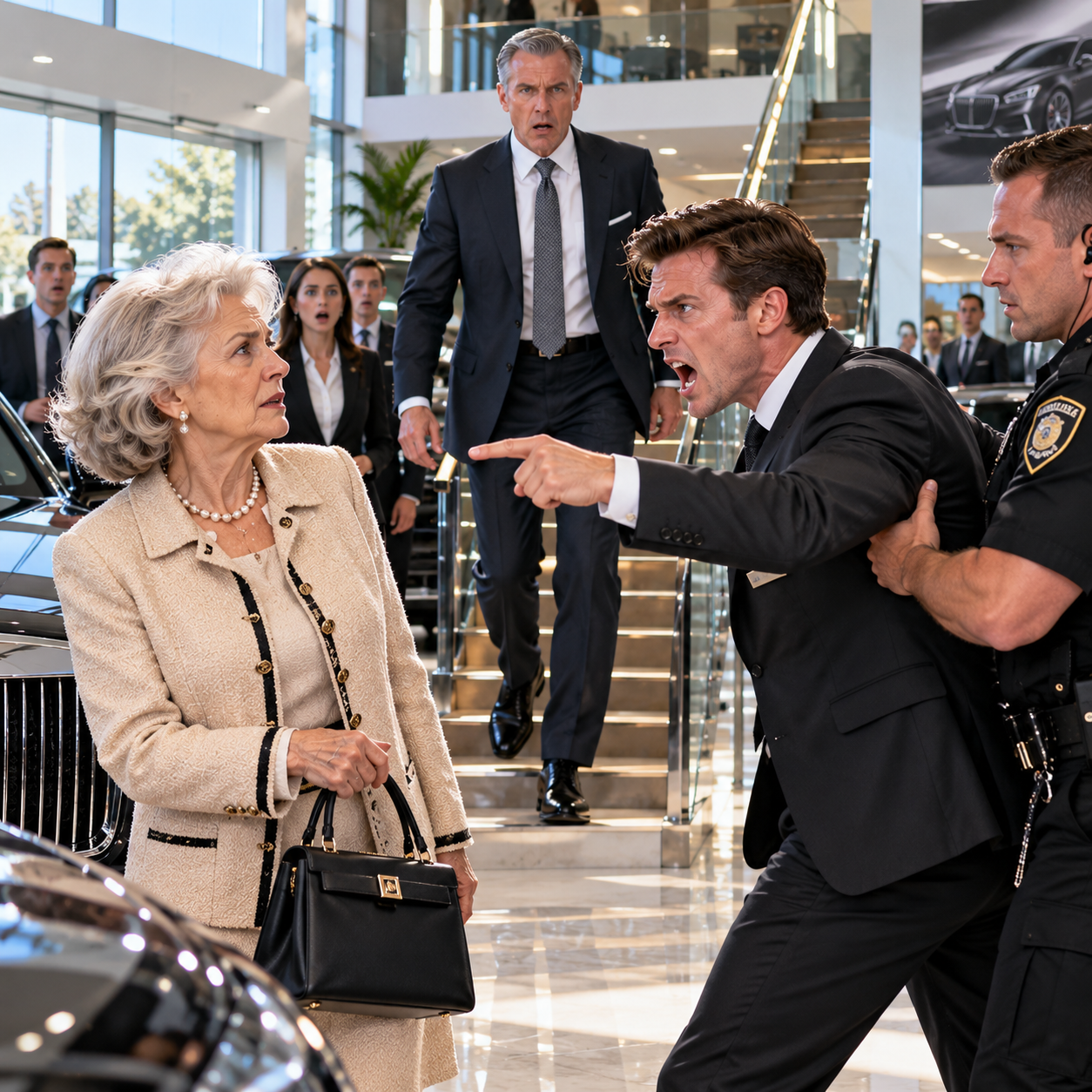
“Close that door,” he ordered, grabbing the edge without touching me. “You drive a beat-up Honda and walk around in those filthy boots. You can’t afford the floor mats, let alone this car.” The young salesperson approached, but Preston waved him away and pointed toward the entrance. “Security! This gentleman needs to leave before he damages something.”
A guard approached as the showroom became quiet. I could hear the ventilation system and a key ring jingling in the guard’s hand. “I’m here for an appointment,” I said, keeping my voice level, but Preston laughed in front of the customers he’d abandoned. “An appointment with who, the janitor? Walt, stop embarrassing yourself and get outside.”
Footsteps sounded on the staircase from the executive offices. Everett Shaw descended with his assistant, frowning at the guard beside me. “Mr. Keene,” he said, extending his hand. “Welcome. I’m sorry I wasn’t downstairs when you arrived. We’ve prepared the Bentley’s service documents, as requested.”
Preston’s face changed so abruptly that I almost looked away. “Mr. Shaw,” he began, “this gentleman is my father-in-law. I was just trying to avoid a misunderstanding.” Everett looked at the customers, then at the open Bentley, and asked why a scheduled buyer had been threatened with removal. Preston tried explaining that I wasn’t a serious customer, apparently forgetting the appointment Everett had just confirmed.
“That isn’t your decision to make based on his clothes,” Everett said. “And you left an active customer conversation to embarrass him in front of the entire floor.” He asked the guard to return to his post and instructed the assistant to escort Preston to a private office. “You’re off the showroom effective now. Human resources will review this incident and the previous customer complaints we’ve discussed.”
Preston turned toward me, his mouth tight with resentment. “You set me up,” he whispered, but Everett answered before I could. “Nobody instructed you to insult a visitor. You chose that yourself.” The couple near the Mercedes had been watching silently, and the woman shook her head when Preston passed. For the first time in years, I saw my son-in-law walk away without having the last word.
Upstairs, Everett apologized and offered to postpone the sale if the experience had soured my interest. He showed me the inspection reports, warranty information, and service history, explaining a minor repair I hadn’t known about. We negotiated a final price of $194,500, and I arranged a bank transfer through the dealership’s normal verification process. I wasn’t buying the car to punish Preston, although I couldn’t deny that I had chosen the timing of my visit.
HR terminated Preston the next afternoon. The Bentley was delivered to a storage garage. I drove home in my Accord and ate chicken soup alone. At 8:47, Allison called, her voice tight and unfamiliar. “Preston came home with a box from his office,” she said. “He says you went there using a fake identity and deliberately got him fired.”
“I used my legal initials,” I said. “He didn’t ask who I was before calling security.” She fell quiet, then asked the question I knew was coming. “Dad, how could you afford a Bentley? Preston says you’ve been hiding money from me.” I told her we needed a private conversation, without Preston deciding which parts she was allowed to hear.
“Come over tomorrow after you take the kids to school,” I said. “I’ll show you the sale documents, and then you can tell me what you think.” She agreed, but before hanging up, she whispered, “There’s something else, Dad. Preston says if you give me money, it could cost us the house.” I stared at the dark phone, wondering what kind of problem my son-in-law was so desperate to keep hidden.
Part 3
Allison arrived at 8:15 with a travel mug and the same tired expression her mother used to wear after an overnight shift. She sat at my kitchen table but kept her coat on, as if she expected our conversation to turn into a fight. I placed the sale agreement and tax summary between us, leaving the other folder closed. “Read these first,” I said, pushing a pair of my spare glasses across the table when she realized she’d forgotten hers.
Her eyes moved down the page, stopped, and returned to the number. “Seventeen million?” she whispered. I explained that it was the gross sale price, not my checking account balance, and that taxes, fees, and carefully planned investments changed what was available. She looked up, hurt mixed with astonishment. “Preston told me your company collapsed and somebody bought the leftovers to settle your loans.”
“That wasn’t true,” I said. “But I should have told you myself instead of assuming we’d eventually talk.” Allison rubbed her forehead and asked why I’d continued driving the Honda if I was wealthy. I told her it started every morning, was paid for, and reminded me of the warehouse where her mother used to bring us sandwiches. She laughed once, then looked ashamed that she’d ever considered the car proof of failure.
I didn’t begin with the photographs. First I told her what I’d noticed: Owen’s taped shoe, Sadie’s missed trip, and the strange contrast between those sacrifices and Preston’s expensive purchases. Allison folded her hands around the travel mug and admitted that Preston handled the bills while she cared for the children. He’d recently suggested they refinance their house, claiming a promotion would make everything easier. After losing his job, he’d insisted she sign paperwork quickly before lenders learned his employment status had changed.
“Don’t sign anything until you’ve had an independent professional review it,” I said, remembering how fiercely she disliked being told what to do. She surprised me by nodding. Then she admitted that a collection notice had arrived in her name for a card she rarely used, and Preston had claimed it was a bank error. The envelope was still in her purse, unopened since he’d snatched it from the mail and told her not to worry.
We called the card issuer together, with Allison answering the identification questions and asking for copies of statements. She learned that she was a joint account holder on a balance much larger than she’d believed, and the agent explained how to obtain a complete accounting. Allison also requested her credit reports and scheduled an appointment with a financial counselor. Each step put real information in her hands, where Preston had insisted she didn’t need it.
Only after that did I open Miles’s folder. I told her the photographs showed Preston and a woman at restaurants and outside a hotel, but that I couldn’t prove the nature of their relationship. Allison studied the images in silence, turning one around when she recognized a jacket she’d bought him for their anniversary. “He told me he was at a dealer conference that weekend,” she murmured. I offered to close the folder, and she shook her head.
“Her name is Celeste Rowe,” I said, “and she’s in commercial real estate.” Allison asked whether I had been watching her marriage for months, and I admitted I had hired the investigator without speaking to her first. She was angry, and I let her be; caring about my daughter didn’t mean I was entitled to manage her private life. “I wish you’d trusted me enough to tell me you were worried,” she said, and I answered that she was right.
I gave her attorney Marissa Ortega’s number before she left. Two hours later, she texted me from home. Preston had moved several financial folders out of their usual drawer, and an online account they’d opened for the children’s education showed a withdrawal neither child could have authorized. “Dad,” she wrote, “it says nine thousand dollars was transferred out last month. He told me the account was untouched.” I called her immediately, wondering whether this was a desperate mistake or evidence of something much worse.
Part 4
Allison met Marissa Ortega the next afternoon and brought the documents she’d gathered, including the education-account statement. Marissa explained that the first priority was establishing which accounts were joint, which were individual, and what records could lawfully be obtained through the divorce process if Allison chose to file. She advised her to preserve existing statements, protect her credit, and avoid moving shared money without legal advice. Allison came home looking tired, but she finally had a plan she understood.
Preston responded badly when she asked about the nine thousand dollars. He said he’d borrowed it temporarily to cover a business opportunity, then accused her of letting me turn her against him. When she requested receipts and a repayment date, he told her that she had no idea how difficult it was to provide for a family. The irony was not lost on her: the children’s accounts had been used while their ordinary needs went unmet.
She requested detailed credit information and found three cards she hadn’t known Preston held, with balances totaling approximately forty-one thousand dollars. A personal loan for thirty-five thousand dollars appeared in his name, and the Range Rover’s monthly lease was far higher than he’d admitted. Including the mortgage, vehicles, and unsecured borrowing, household liabilities approached three hundred thousand dollars. Some debt was manageable on paper; the real problem was the secrecy and the loss of reliable income.
Allison accepted my offer to buy school shoes and groceries but warned me not to pay Preston’s debts without legal advice. We went shopping together, and Owen chose sneakers without needing to check the price. Sadie picked a new sweater in a deep green that matched her eyes. For a few minutes, all we had to discuss was whether they’d grow out of them before winter.
The next week, Allison confronted Preston about Celeste with Marissa’s guidance and a plan for where she and the children could stay if the discussion became difficult. He first denied knowing her, then claimed the meetings were work-related, and finally admitted they’d been involved for months. He insisted the marriage had been troubled and complained that Allison spent too much time with the children. She told him the children weren’t the reason he’d made those choices, packed their overnight bags, and came to my apartment.
That evening, she sat on my couch with a blanket around her shoulders while Owen and Sadie watched a nature program in the next room. “I kept defending him because I thought it was my job to keep us together,” she said. I told her a marriage couldn’t be carried by one person’s excuses, though I knew she had to arrive at that understanding herself. She decided to pursue separation, and Marissa prepared the necessary filings.
Preston alternated accusations with requests for loans. I saved the messages and let Marissa handle anything relevant to the case. Through his attorney, he later claimed I’d pressured Allison to leave and that my wealth had created expectations she couldn’t meet. Those arguments did little to explain missing education funds or the financial disclosures requested by the court, but they prolonged the process.
During preliminary proceedings, records established that Preston had spent from accounts Allison believed were reserved for their family needs. Marissa pursued appropriate credits and repayment provisions, and the parents negotiated a temporary parenting schedule based on the children’s routines and circumstances. I never asked Allison to cut Preston off from the children; that wasn’t my decision, and they deserved not to become weapons in their parents’ dispute. My role was to provide a stable place and avoid poisoning their view of either parent.
A month after the filing, the court-ordered financial disclosures brought another surprise. Preston had pledged a share of a jointly owned investment account as collateral for a business obligation without explaining the arrangement to Allison, and the documents raised questions about whether she had approved it. Marissa arranged further review instead of making an accusation she couldn’t yet prove. Allison called me from the attorney’s parking lot and said, “Dad, I thought the affair was the worst thing he hid, but I don’t even know what our signatures mean anymore.”
Part 5
The divorce was finalized the following spring, after months of negotiations, financial review, and difficult conversations about the children. Allison kept the family home under a settlement that accounted for the mortgage, and Preston assumed specified personal debts as part of the property division. The agreement required him to replenish the nine thousand dollars removed from the education account on a defined schedule, with enforcement provisions if he failed. Child support and parenting time were established based on the required financial information and the children’s interests.
Preston didn’t disappear, and I didn’t expect him to. He remained Owen and Sadie’s father, which meant Allison had to manage a practical co-parenting relationship even after her feelings toward him had ended. He found another sales position, smaller and less prestigious, and occasionally sent me messages about how I’d ruined his career. I didn’t answer; his conduct at the dealership and decisions at home belonged to him, and I had nothing left to argue about.
Allison returned to paid work as an office coordinator at a medical practice. Her first paycheck mattered more than its amount. She called me from the parking lot after her first shift, laughing because she’d already learned the names of everyone on her team. “I forgot I could be good at something outside this house,” she said, and I could hear the old confidence coming back.
On Tuesdays and Thursdays, I picked up Owen and Sadie after school while Allison finished work. Owen and I built a simple model bridge using wooden sticks, and he insisted on testing it with a stack of paperback books. Sadie filled an entire sketchbook with birds copied from a field guide. Sometimes they asked why their dad lived somewhere else, and I answered without turning their questions into a verdict on him.
With an estate attorney, I funded education trusts for both children. I’d intended to help my grandchildren long before their parents separated. I made sure Allison understood the arrangements and could ask independent questions, because she’d already lived too many years being told not to bother with numbers. She sat at the table afterward and cried quietly, then asked if we could go over the statements together next month.
We also had to talk about the years we’d spent apart. Allison admitted she had allowed Preston to mock my car, my clothes, and the business I built, and I told her how much her silence had hurt. I apologized for assuming she’d discover the truth about my finances without an honest conversation. Neither apology erased the past, but we began rebuilding trust through ordinary habits: phone calls answered, plans kept, and questions asked directly instead of through someone else.
That Thanksgiving, I drove the Bentley to Allison’s house for the first time. Owen came onto the porch with his mouth open, while Sadie asked if the silver paint would look different in the rain. Allison watched them circle the car and shook her head. “He called security because of your old boots,” she said, then smiled when I replied, “I’m wearing the same boots today.”
Inside, turkey roasted in the oven, crayons covered the children’s end of the table, and nobody was performing wealth for an audience. Allison asked me to carve the turkey, then joined me in the kitchen and admitted she’d been nervous about inviting me, afraid the holiday would remind us of everything we’d lost. I told her it reminded me of what we were rebuilding. She handed me the carving knife, and for once there was no one waiting to correct us.
I never forgave Preston for humiliating me or for the decisions that hurt my daughter and grandchildren. He wasn’t welcome in my home, and I didn’t need to witness his misfortunes to feel at peace. What mattered was that Allison could pay her bills, question a statement, and put her children to bed without asking permission to be heard. I thought I had gone into that showroom to prove a man wrong about my money, but I walked away knowing his opinion had never been worth the price he put on it.
Legal Notice: This story is a work of fiction. Names, characters, businesses, events, and incidents are the product of the author’s imagination or are used fictitiously. Any resemblance to actual persons—living or dead—or to actual events is purely coincidental. Thank you! 💓


