
My Sister Left Her Two Kids in My $2,100 Mountain Cabin After I Refused to Babysit — So I Left Her a Surprise She Never Expected
My sister asked me to watch her children during the one vacation I had saved for in fourteen years, and I told her no. When I unlocked my mountain cabin, I found two backpacks, a cartoon playing, and a note telling me to enjoy my holiday while raising her kids. She’d told their father I had volunteered. I thought the worst betrayal was the lie, until I discovered where my sister had gone—and why she chose my cabin.
Part 1
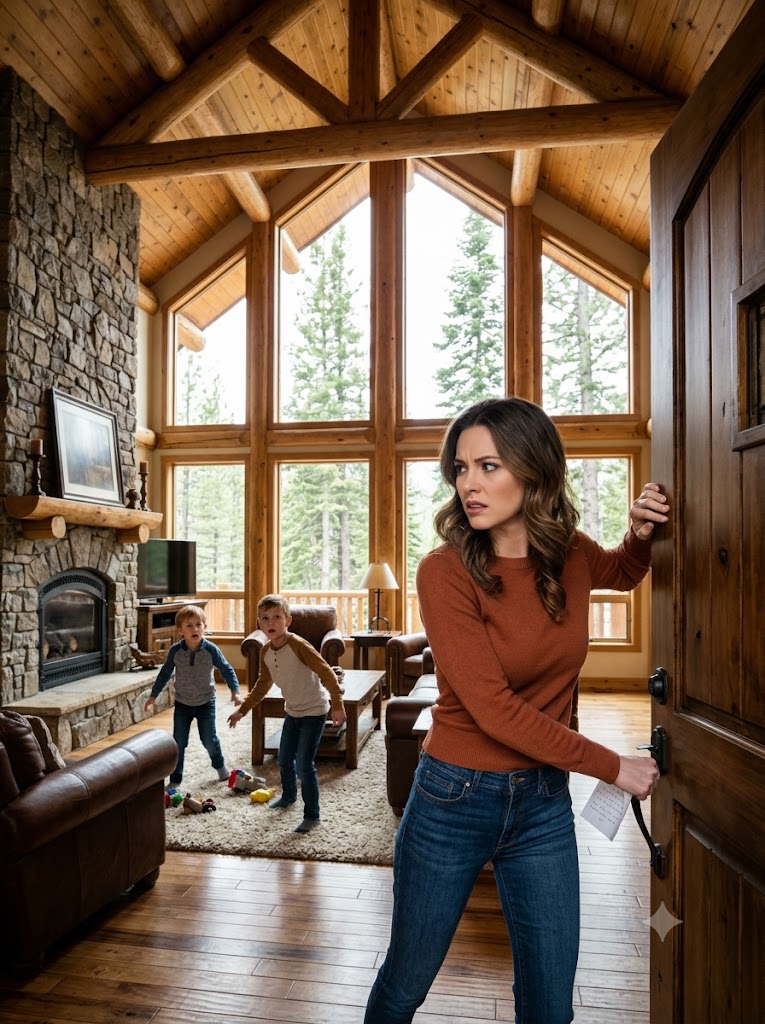
The first thing I noticed was the blinking green light inside a little boy’s sneaker. It was lying on the welcome mat of my rented mountain cabin, beside a pink pair with scuffed toes, and neither pair belonged to me. I had two grocery bags digging into my wrists, a duffel on my shoulder, and fourteen months of anticipation behind me. Then my six-year-old nephew appeared from the living room and said, “Aunt Viv, Mom said you’d be here before dinner.”
Behind him stood his sister, Lily, clutching a spiral notebook like a flight attendant holding emergency instructions. She was nine, painfully observant, and wearing the expression children get when adults have told them two different stories. “Mom said you wanted us to come,” she said. “She said it was your surprise.”
My sister, Tessa, knew exactly what this trip meant to me. I drove a county bookmobile through rural Idaho, where my days were spent delivering books to schools, retirement homes, and towns too small to have a library. My vacation fund had grown through skipped restaurant meals and extra Saturday shifts, until I could rent a cedar cabin above Payette Lake for seven glorious days. I’d planned coffee on the deck, long walks, and the luxury of not being needed.
Six weeks earlier, Tessa had asked me to take Lily and Max during those dates. “Just while I handle something,” she’d said, refusing to explain what that something was. I’d told her I loved the children but wasn’t giving up my first real break in years, and she’d said, “Of course. Forget I asked.” Her voice had been sweet enough to make me suspicious, but she hadn’t mentioned it again.
On the kitchen counter, beneath a jar of peanut butter I hadn’t purchased, was a note in Tessa’s handwriting. “Enjoy your vacation—back Saturday! Bedtime: Lily 8:30, Max 8; their bags are packed. Daniel thinks they’re with you, so don’t confuse him. Love, T.” She’d added a smiley face beside the word vacation.
I read it twice while the refrigerator hummed behind me. Daniel was Tessa’s husband, a decent, overworked man who maintained irrigation systems and frequently came home wearing muddy boots. He thought the children were with me because Tessa had told him they would be, not because he had ever asked me. The realization made my face hot.
My phone showed no missed calls from her. I dialed immediately, then again after her voicemail picked up, and sent, “The kids are here; call now—I never agreed.” While I waited, I checked the locks and the children, made sure Max had his belongings, and asked Lily when their mother had left. “Just before your car came up the road,” she said, watching me carefully. “She said she’d text when she got where she was going.”
Tessa could open the keypad because I had stupidly reused the same code as my apartment’s emergency lock. I’d shared that number when she was locked out of her house last winter, and she’d seen the rental address when I proudly showed her the booking. I changed the keypad code through the host’s approved guest portal, then asked the children if they’d eaten. They hadn’t, so I made grilled cheese from my groceries and gave them apple slices.
Max wanted to know whether bears could turn doorknobs, and Lily wanted to know whether she’d done something wrong. “Neither of you is in trouble,” I said, squeezing mustard onto my sandwich. “The grown-ups have a scheduling problem, and that’s for us to solve.” Lily nodded without looking convinced.
By eight, Tessa still hadn’t responded, and I was done protecting her fiction. I called Daniel, whose first words were, “Hey, Viv, thanks again for offering to take them. Can I say goodnight?” I glanced at Tessa’s note on the counter, then told him exactly how I’d found his children. There was a silence long enough for me to hear Max laughing at the television.
Daniel finally asked, “Where is my wife?” I looked at the unanswered messages on my phone and realized I had no idea.
Part 2
Daniel didn’t raise his voice. He asked whether Lily and Max were safe, whether Max’s overnight bag contained his inhaler, and whether I wanted him to drive up immediately. “They’re safe with me,” I said. “The mountain road is dark and wet now, so I’ll bring them to you first thing tomorrow.”
He thanked me once, without asking me to keep Tessa’s secret. When I handed the phone to the children, Max launched into a report about possible bears, while Lily read from her notebook: “We’re having the best time with Aunt Viv.” She sounded rehearsed. Daniel told her she didn’t need to say anything except goodnight.
After they fell asleep, I finally opened Lily’s notebook. The pages held a neatly written schedule, emergency numbers, favorite snacks, and instructions that said, “Tell Dad Aunt Viv invited us. Do not bother Mom unless it’s serious.” The last instruction had been underlined twice. Lily had been made responsible for a lie.
At 9:17, Tessa texted, “Everything’s fine. I’ll explain later. My battery is low.” I replied, “Daniel knows. I’m taking the kids home in the morning.” The message showed as delivered, but she never answered. Outside, the lake reflected moonlight, and I kept checking the hallway.
Lily appeared around ten, wrapped in the cabin’s spare blanket. “Are you angry with Mom?” she asked, settling at the end of the couch. I told her I was upset about an adult decision, not about her or Max. She picked at a loose thread and whispered, “Mom said you might say no when you saw us, but then you’d feel bad.”
I didn’t know what to say to that. Lily continued, “I told her you said no already, and she said, ‘Your aunt never stays mad when she sees you two.’” For the first time all evening, I felt less angry than cold. Tessa hadn’t misunderstood my answer; she’d made a plan around overriding it.
Morning smelled of pine sap and pancake mix. Max pronounced my lopsided pancakes excellent, then counted twenty-three cows on the drive toward Boise before falling asleep with his head tipped against the window. Lily kept her notebook zipped in her backpack, and I didn’t ask her to explain anything else. They deserved a normal car ride.
Daniel was waiting outside their house in the work jacket he wore to the irrigation district. Max ran to him, and Lily walked more slowly, holding her backpack straps until Daniel crouched down and hugged her. He told them he had taken time off and would be home all week. They immediately began arguing about whether they could build a blanket fort.
Inside, the kitchen smelled of coffee and toast. Daniel said he’d found a charge on their joint credit card from a lakeside inn in northern Idaho, for one adult and seven nights. “I thought she was attending a professional workshop,” he said, staring at the receipt on his phone. “She told me you wanted the children because you barely see them.”
“That’s two lies,” I said. Daniel nodded, then admitted Tessa had spoken last winter about feeling exhausted and invisible. He’d told her to take a nap while the children were at school, believing he was being practical. “I wasn’t listening,” he said, “but I would have taken leave if she’d asked me directly.”
I left Tessa’s original note on the kitchen counter and wrote “Enjoy your holiday” on the back of a grocery receipt beneath her green travel mug. I wasn’t trying to punish the children or trap Daniel; I wanted Tessa to walk into a house where her husband knew the truth. When I stepped onto the porch, Daniel thanked me again and said, “You don’t owe us another minute of your vacation.”
I reached my cabin that afternoon, turned off the abandoned cartoon on the television, and ran a bath. As the water filled, my phone lit up with Tessa’s name. The first message read, “Why does Daniel have the kids?” The second arrived thirty seconds later: “What exactly did you tell him?”
Part 3
I set my phone facedown beside the soaking tub and watched the lake through the glass. I’d imagined that returning the children would end the problem, but Tessa had apparently expected me to maintain her arrangement even after it collapsed. By dinner, she had sent eleven messages, every one about what I’d done to her. Not one asked whether Lily or Max had been frightened or confused.
On Tuesday morning, I took my coffee outside under the dripping fir branches. Tessa’s latest message said, “You know I needed this week. You don’t have kids, so you can’t understand.” A minute later came, “That was unfair. I’m sorry.” I could almost hear her deleting and rewriting her version of the story, trying to find one where I was the unreasonable person.
I didn’t respond. I walked the shoreline trail, stopped at a small bakery for a cinnamon roll, and spent three hours reading a mystery novel in a chair facing the water. It felt rebellious to do ordinary things slowly. For years I’d arranged my life around Tessa’s last-minute childcare requests, because she was the mother and I was supposedly the one with spare time.
Our mother, Carol, had encouraged that division. “You have freedom, Vivian,” she’d say whenever Tessa needed help. “Your sister has responsibilities.” The sentence was usually delivered while I was stacking returned library books after a ten-hour shift or canceling plans to pick up somebody else’s child. Apparently, responsibilities counted only if they came with children.
At lunchtime, Mom called. “Tessa says you made a terrible scene and abandoned the children with Daniel,” she announced without greeting me. I looked down at the empty trail winding through the trees. “Their father,” I said. “I brought them to their father after Tessa left them in a cabin without my consent.”
Mom sighed as if I were deliberately missing the point. “She was overwhelmed, and you could have handled one week.” I reminded her that she had declined Tessa’s request, too, because she had a quilting trip planned. Silence followed, then she said, “That’s different. I already committed to something.” I told her, “So had I,” and ended the call.
That afternoon, Daniel sent me a photograph of Lily and Max building a blanket fort in the living room. Lily had made a paper sign reading “Bear Headquarters,” and Max was asleep inside under three pillows. Daniel wrote, “They are doing fine. You should stay at the lake. I have everything covered.” It was the first message about the situation that didn’t ask anything from me.
I asked whether he’d reached Tessa. He said he’d texted only once: “Kids are safe with me. I’m off work this week. You can finish your time away, but we need to talk when you’re back.” He didn’t want me involved in their marriage, and I appreciated that. He said the charge was confirmed.
By Wednesday, I’d begun wondering whether Tessa was meeting someone, especially after I saw the words “romantic lake package” on the inn’s website. I hated the thought, partly for Daniel and partly because it gave her deception yet another layer. Then Daniel sent a brief update: “I heard from her. She says she’s alone. She says she needed silence.” I wasn’t sure whether to believe her.
That evening, Tessa arrived home early. I knew because the motion light on Daniel’s front porch, which I’d helped install the previous Christmas, sent an alert to an old shared household group that I hadn’t left. I saw no video, only the timestamp; Daniel later told me she’d spent nearly an hour sitting in her car.
At 7:40, my phone showed another message: “I found the note under my mug.” This time there were no angry questions. Then she wrote, “Lily told me she was scared you wouldn’t want her anymore.” I stared at those words, furious that my niece had been left carrying the fear created by her mother’s decision.
Part 4
I called Daniel rather than answer Tessa. He picked up from his backyard, where I could hear a sprinkler ticking against the fence, and assured me he’d already spoken with Lily. “I told her you love her and that adults sometimes need to make different plans,” he said. “She knows she didn’t do anything wrong, but I think she’ll need to hear it from you, too.”
I asked him to put Lily on the phone. She sounded hesitant until I mentioned that I’d found a book about mountain wildlife at a shop near the lake. “I’m saving it for our next regular library day,” I said. “You and Max can come visit me when we all agree on a date.” She asked whether I was still her aunt, and I said, “Always. None of this changes that.”
Daniel then explained what Tessa had told him after finally coming inside. She’d spent three days sleeping late in a modest lakefront room, eating sandwiches on a dock, and reading paperback novels borrowed from the lobby. There had been no secret lover or mysterious meeting. “She wanted to be somewhere no one called her name,” he said, “but she decided everyone else would pay for that quiet.”
I understood the desire better than Tessa would ever believe. Some days my bookmobile carried noisy third graders for six hours, and I reached home craving a room without another human voice. But Tessa had left two children with an adult who’d specifically declined to care for them, then instructed her daughter to lie. Wanting rest could explain her choice; it couldn’t erase it.
On Friday, Tessa called for the first time. I answered on the deck with a blanket over my knees, and she opened with, “Did you really have to tell Daniel everything?” I asked whether she’d prefer that I lie about finding her children alone in a locked cabin. She said she’d been on the property until I arrived, as though timing her departure made the arrangement acceptable.
“I watched you pull up,” she admitted. “I knew once you saw them, you wouldn’t turn them away.” She sounded tired and defensive, and suddenly I realized this wasn’t an impulsive mistake. She’d coordinated the bags, the code, the schedule, and the timing, all while counting on my love for Lily and Max to protect her plan.
“You counted on me being responsible so you could be irresponsible,” I said. Tessa began crying and told me she hadn’t slept properly in months, that she felt like a walking checklist, that Daniel never noticed how many small tasks kept the house running. I let her finish, then asked, “Why didn’t you tell him you needed the week?” She whispered, “Because he would’ve said no.”
Daniel, I knew, had already said he would have worked something out. I didn’t argue about what their marriage was like behind closed doors, because that wasn’t mine to repair. Instead, I told her my apartment and rental codes had changed, that I would no longer accept surprise childcare, and that future visits with the children required advance agreement with both parents. “I love them,” I said. “I won’t be used as the reason they don’t get honesty from you.”
Tessa asked whether we could forget the whole thing if she apologized. “No,” I said. “You can apologize, and I can still remember it.” She cried harder, then said I was punishing her for being exhausted. I ended the call before I said something I couldn’t take back.
On my final morning at the cabin, the lake was silver beneath the clouds. I packed slowly, checking drawers for socks and books, and noticed how quiet I’d become inside my own thoughts. Then I received an email from the rental host about a security report filed on the day I’d arrived. Tessa had told them I approved the children’s early check-in—and had signed my name to the request.
Part 5
The email included a copy of the early-access request, submitted through the host’s guest form an hour before I arrived. Tessa had used my name and booking number, entered my familiar keypad code, and assured the host that I was arriving shortly to supervise the children. The host had accepted it without verifying who submitted it.
I replied with a factual account, attached Tessa’s note, and asked the host to flag the unauthorized request so my account wouldn’t be used that way again. The manager confirmed that my reservation was secure and that the incident would be documented. It made her claim of spontaneity impossible to believe.
Back in Boise, I saved the messages and changed the remaining access codes Tessa knew. I also removed her from the list of people authorized to collect my spare apartment key. I was tired of having my generosity treated like an unattended door.
Daniel began taking the children every other Saturday without asking Tessa to leave their lunches packed. He also took responsibility for school forms, dentist appointments, and the endless search for missing shoes. Tessa started spending Thursday evenings at a pottery studio, and a relative told me her first three bowls looked like crushed flowerpots. That was progress, not restored trust.
In September, the children’s school sent out new emergency contact forms. Daniel told me they’d put his mother as the first backup instead of me. “We should have asked before putting you down all those years,” he said, and I thanked him. Someone had finally understood consent.
Lily and Max still visited the bookmobile once a month with their father. Max gravitated toward dinosaur books, while Lily insisted on stories with clever girls who solved mysteries without grown-ups. We had hot chocolate afterward at the cafe across from the park, and I always made sure Daniel knew when we’d finish. I showed up when I said yes.
Tessa sent me an apology in October. She admitted she’d frightened Lily by making her a messenger. She wrote, “I knew you had said no. I chose to make that no impossible. I’m sorry.” I believed she regretted it, but I wasn’t ready to give her the old access to my life.
At Thanksgiving, Mom invited me to their house and added that everyone was expected to move forward. “Family shouldn’t keep score,” she said on the phone. I reminded her she’d refused Tessa’s childcare request to protect her own quilting trip, and she changed the subject. I spent Thanksgiving with friends, eating pie at a crowded kitchen table where nobody presumed to know my availability better than I did.
In December, Tessa asked whether we could meet for coffee. I agreed to half an hour at a cafe near my bookmobile route, not as a step toward the closeness we’d once had but because I wanted to speak without an audience. She told me she and Daniel were talking more honestly about parenting, and I said I was glad for the children. When she reached across the table for my hand, I gently moved mine to my coffee cup.
“I hope things get better for you,” I told her. “But I don’t want our relationship to go back to what it was.” She nodded, swallowing hard, and for once didn’t argue with my answer. We parted without a hug.
The next summer, I booked another week at the same lake, with a new password and a new booking code. This time I told Tessa only after I came home. On my last morning there, I sat on the deck with a book open in my lap while the water turned gold in the sunlight, and nobody asked me to justify being alone. I had finally learned that a vacation wasn’t selfish, that loving children didn’t make me their automatic caretaker, and that the word “no” was a complete answer—even to family.
Legal Notice: This story is a work of fiction. Names, characters, businesses, events, and incidents are the product of the author’s imagination or are used fictitiously. Any resemblance to actual persons—living or dead—or to actual events is purely coincidental. Thank you! 💓
WordsCharactersReading time


