
My Parents Spent Our Entire College Fund on My Twin Sister—Four Years Later, the Graduation Announcement Made Them Go Silent
At eighteen, I watched my parents put our entire college fund behind my twin sister because they said she had more potential. I worked nights, borrowed money, and made my own way through the same university they paid for her to attend. Four years later, they arrived at graduation with flowers, cameras, and a celebration planned around her. Then the university president announced the valedictorian. My father lowered his camera, my mother began crying, and my sister revealed something neither of them expected me to know.
Part 1: The Daughter They Didn’t Invest In
The first time Dad called one of his daughters an investment, we were eighteen and sitting on our living room carpet. Two college acceptance letters lay beside a bowl of stale pretzels, and April rain tapped against the windows. My twin sister, Laurel, twisted her bracelet while Dad opened a spreadsheet. I thought we were discussing a family budget, not deciding which daughter deserved a future.
We had both been admitted to Westbridge University outside Philadelphia, where tuition cost forty-eight thousand dollars a year. Laurel had a nine-thousand-dollar leadership award; my academic scholarship was thirty-two thousand, renewable if I kept my grades up. Our parents had saved approximately a hundred and fifty-six thousand dollars for college. I suggested splitting it and making up the differences with loans and jobs.
Dad shook his head. “Then neither of you gets a proper start,” he said, tapping Laurel’s figures. “Marketing depends on relationships, and Westbridge’s network could launch her career.” Mom studied her tea while he pushed my scholarship letter aside.
“Cassidy already has a huge award,” Dad continued. “She’s practical; she’ll figure out the rest.” I waited for Mom to point out that practical people still owed sixteen thousand dollars annually. Instead, she murmured, “This doesn’t mean we love you less.”
“So Laurel gets everything?” I asked. Dad said the account belonged to our parents, not us, and called his decision financially responsible. “Your sister has exceptional potential,” he explained. “Supporting her education is the smarter investment.” The word smarter seemed to hang between my sister and me.
Laurel looked stricken. “We could each take some,” she offered, but Dad said the decision was final. When I asked for help with books, he suggested seeing how I managed the first semester. Upstairs, I passed framed pictures of our identical seventh-grade haircuts and matching graduation dresses. We had shared almost everything until sharing cost real money.
That summer I worked mornings at a grocery store and evenings sorting invoices for a plumbing contractor. My savings covered fees and books; a federal loan helped with tuition, and commuting from home spared me dorm costs. Each morning I packed lunch at six and drove forty minutes to campus. Laurel moved into residence housing paid for by our parents.
Our freshman experiences barely resembled each other. Laurel sent pictures from networking dinners while I memorized which parking lots stayed open late. One Thursday, I missed a dinner celebrating her election to a student marketing committee because I had a campus employment interview. Dad said I needed to organize my priorities, even after I explained the job would cover textbooks.
I got twelve hours a week entering purchasing records in the university’s facilities office. Fluorescent lights buzzed above dented filing cabinets, and my supervisor taught me how to catch duplicate invoices. I liked making messy numbers usable, though my hands smelled of toner when I drove home. Every paycheck disappeared almost as soon as it arrived.
In December, I made the dean’s list and carried the announcement home in my coat pocket. Dad said, “That’s what we expected from you,” before asking about Laurel’s student ambassador interview. Mom smiled but didn’t ask to see my grades. I pinned the letter above my own desk instead of putting it on the refrigerator.
Two days before Christmas, I learned I’d advanced to interviews for a resident assistant position. Campus housing and meals would remove my largest expense, though the job required late-night shifts and emergency calls. Dad glanced at the letter and smiled. “See? That’s exactly why we didn’t need to spend money on you.”
I watched him leave, the letter shaking slightly in my hand. He hadn’t asked whether I was exhausted, or whether I was frightened of losing my scholarship. Every problem I solved became proof that I’d never needed anything in the first place. And I was only one semester into four years of proving it.
Part 2: What Independence Actually Cost
I got the resident assistant position in March, after an interview about handling feuding roommates. Instead of choosing a side, I asked what both students needed to feel safe sharing a room. The interviewer smiled and offered me the job a week later. When I called Mom, she said, “Wonderful, that’s housing taken care of.”
The job began that August in a brick residence hall with unreliable elevators and a rattling ice machine. I handled lost keys, bathroom floods, and disputes over overnight guests. Once I spent three hours helping a frightened freshman contact her family after an upsetting call. The next morning, exhausted, I went straight to class.
Living on campus meant I could attend office hours and stop losing eighty minutes daily to the highway. My scholarship still left a tuition gap, so I kept my purchasing job and accepted another modest loan. I checked my bank balance before ordering coffee. Laurel, meanwhile, rarely had to think about those numbers.
My major was operations analytics, which sounded dull until Professor Nadia Serrano assigned a warehouse routing problem. Most students chose the solution with the lowest transportation cost. I noticed it sent refrigerated food on longer trips, increasing spoilage. “Are we measuring the right kind of efficiency?” I asked, and she stopped writing.
Dr. Serrano invited me to office hours, where she covered a whiteboard with delivery windows and inventory losses. “You questioned the objective instead of blindly optimizing it,” she told me. Nobody had praised how my mind worked without suggesting that meant I needed less help. By winter, I was assisting her on a paid grocery-distribution research project.
Laurel was doing well in marketing, too. She became vice president of a student organization, completed an advertising internship, and seemed to know everyone on campus. I admired her, though her successes arrived at home wrapped in Dad’s commentary about what his money was accomplishing. At Thanksgiving he introduced her to our cousins as “the one we’re putting through Westbridge.”
He introduced me afterward as “our independent girl.” I escaped to the kitchen and found Laurel stacking plates beside the sink. “He shouldn’t talk about you that way,” she said, reaching for a towel. I reminded her that he’d been doing it for two years.
She offered to speak to him, but I refused to let her become my interpreter. “If he wants to know what I do, he can ask,” I said. Laurel leaned against the refrigerator and admitted that every accomplishment made Dad ask what it would lead to financially. “Sometimes I feel like I’m being graded in dollars,” she whispered.
That surprised me. Laurel had received the opportunities, but she’d also inherited our father’s expectations. I told her I didn’t need her to fail so my life would count, and she said she knew. We hugged awkwardly, like people rediscovering a language they once shared.
Junior year brought a paid internship at a distribution company, where I traced late deliveries through endless spreadsheets. I identified a recurring scheduling error that the operations manager corrected after reviewing my analysis. A supervisor wrote a recommendation describing my work as unusually careful. I kept it in my drawer, where it couldn’t become another family comparison.
That winter, Laurel secured a second marketing internship, and I took her for cheap tacos near campus. She asked how much I owed in student loans and looked troubled when I answered. Then she admitted she’d asked Dad during freshman year to redirect some college money toward me. “You should’ve had something,” she said.
“What did he say?” I asked, setting down my fork. Laurel studied the chipped tabletop before answering. “He said you needed to learn to stand alone because my career would depend on connections. He told me never to bring it up again.” I had thought Dad made one unfair decision at eighteen; now I knew he had refused a chance to change it.
Part 3: A Name They Never Expected to Hear
By senior year, I could identify troublesome residence-hall rooms by the music coming through their doors. I supervised newer assistants, reviewed incident reports, and carried the same cracked lunch container from freshman year. Money remained tight, but my cumulative GPA had reached 3.96. For the first time, graduation felt like a beginning rather than merely an escape.
Dr. Serrano invited me to lead a project with a regional food bank network. Rural sites ran short of staples while others received more than they could store. We compared delivery schedules, inventory reports, and volunteer availability, then proposed new allocations. Our pilot wasn’t glamorous, but three sites reported more reliable deliveries during winter storms.
At our presentation, the food bank director thanked me for asking drivers about their routes before redesigning them. Dr. Serrano stood at the back, looking pleased. Afterward, she asked whether I’d considered graduate research, and I laughed because I was applying for jobs. I wanted a paycheck that covered rent without elaborate calculations.
I interviewed with a healthcare logistics firm near Pittsburgh. Asked how I’d improve hospital deliveries, I described our project, including mistakes we corrected after listening to volunteers. Two weeks later, the company offered me an operations analyst position contingent on graduation. I sat on my dorm-room floor reading the email until my roommate asked if I was crying.
Laurel had good news too: a marketing job at a respected Philadelphia consumer brand. She’d earned it through internships, endless applications, and interviews she rehearsed until midnight. When she called, I shouted with excitement. We celebrated each other without discussing whose achievement mattered more.
Dad couldn’t seem to do that. At Sunday dinner, he announced Laurel’s salary before she’d finished chewing and described how Westbridge justified their investment. When I mentioned my own offer, he said, “We knew you’d land somewhere,” and resumed asking about her benefits. Mom passed me another dinner roll as though nothing had happened.
A week later, Dr. Serrano summoned me to her office. A yellow folder waited beside two untouched cups of tea, and I wondered whether our research contained an error. Instead, she explained that faculty had nominated me for Westbridge’s highest graduating student honor. I stared at her, convinced she’d confused me with another Cassidy.
The valedictorian was chosen through academic records, faculty recommendations, campus contributions, and a proposed speech. Several finalists were being considered, and nothing was guaranteed. “Your work made lives easier for people who will never appear on our website,” Dr. Serrano said. “Don’t leave that out when you write.”
Walking back to my residence hall, I wanted desperately to call Mom. I imagined telling her a professor believed I might speak before thousands of people. Then I remembered four years of hearing congratulations immediately followed by questions about Laurel. I put my phone away and opened a blank document.
I wrote about the difference between recognizing potential and providing opportunities for it to grow. I kept my parents out of the speech, because everyone graduating had a different story about support. Dr. Serrano helped remove sentences that sounded impressive but said nothing. In April, I was invited to the final selection interview.
The decision arrived while I helped a freshman move out after a difficult semester. I waited until her father carried away the final box before reading the message. It began, “Congratulations, Cassidy Fletcher,” and I sank onto an empty stairwell. The university had selected me as class valedictorian.
The university asked me to keep the news confidential until commencement materials were released. I told my professor and closest friends but not my parents; they’d had four years to ask about my work. A few days later, Mom called to confirm graduation dinner at Laurel’s favorite restaurant. She never asked whether I had plans of my own.
At rehearsal, Laurel found me beside the auditorium holding a printed program. Her eyes widened when she noticed the honors page, then she threw her arms around me. “You’re giving the speech?” she whispered, and I nodded. When she asked whether Mom and Dad knew, I said, “They’ll hear it when everyone else does.”
Part 4: The Name at the Microphone
Graduation morning smelled of cut flowers, damp pavement, and takeout coffee. Mom arrived with two bouquets, while Dad checked the camera battery around his neck. He talked about Laurel’s new employer throughout breakfast and reminded us of dinner at her favorite restaurant. I smiled for a picture with my sister, then slipped backstage.
Behind the curtain, speakers adjusted their robes and compared notes. Through a gap, I spotted Dad searching for Laurel’s cap among hundreds of graduates. Mom sat beside him, holding both bouquets across her lap. I unfolded my speech, then reminded myself to speak to classmates rather than impress administrators.
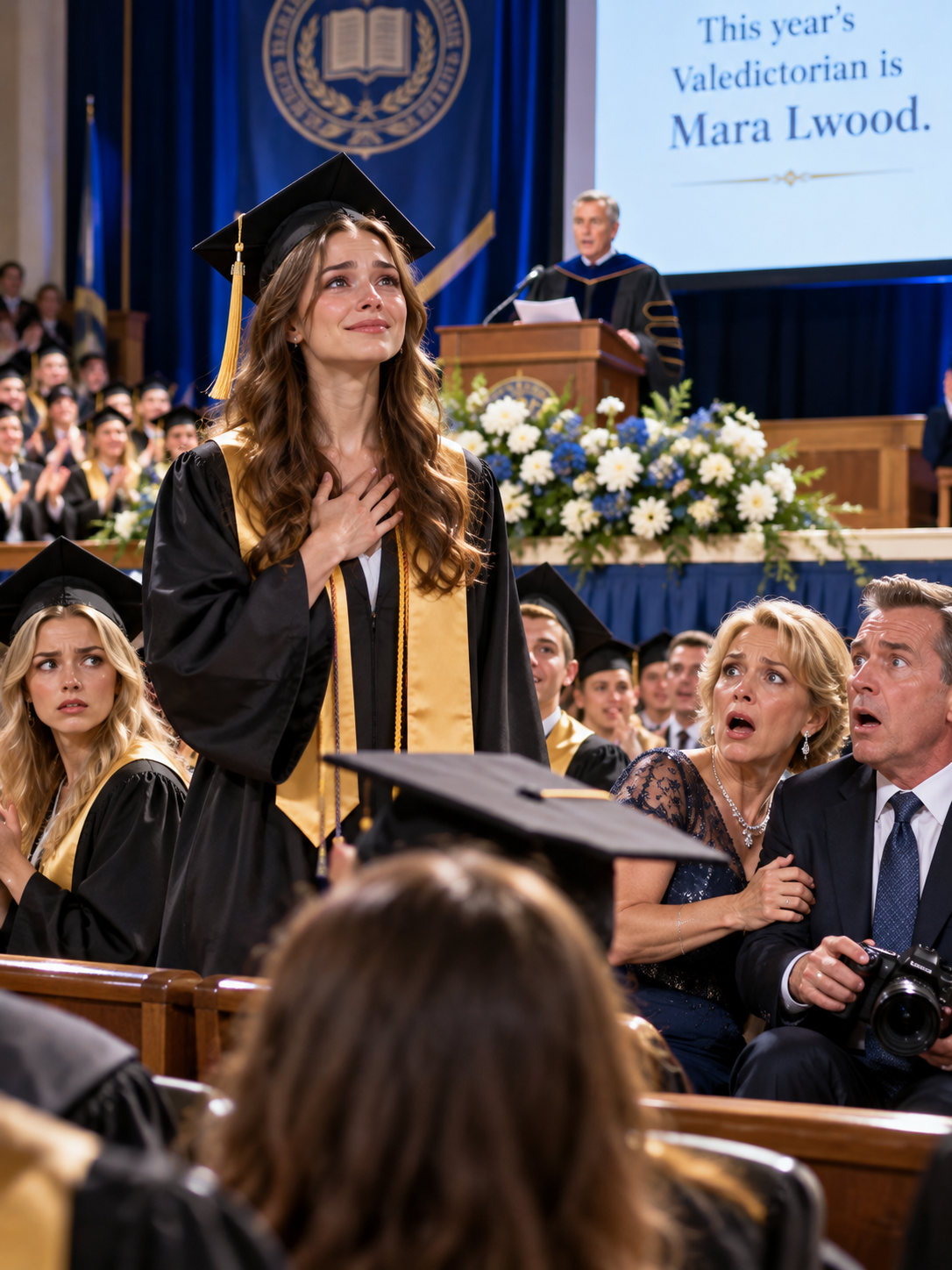
The president introduced the faculty and announced academic awards while applause rolled through the hall. My hands were cold, and someone backstage offered me water. Then he returned to the podium and introduced the valedictorian: a student with a 3.96 GPA, campus leadership, research in distribution systems, and a project supporting regional food banks.
Mom straightened at the mention of food banks. Dad’s camera remained pointed toward the students. “Please welcome Cassidy Fletcher,” the president announced, and I stepped into the light. Dad lowered his camera so suddenly it struck his knee, while Mom grabbed his sleeve.
Laurel was already standing and applauding, her face bright with uncomplicated pride. I couldn’t hear what Mom said to Dad, though I saw her lips move. Strangely, I didn’t feel triumphant as I approached the microphone. I was simply nervous about delivering the speech I’d practiced.
I talked about how potential isn’t always loud, effortless, or immediately visible. I described the food bank driver who showed us why an efficient route on paper could fail during school traffic. “Before we measure another person’s possibilities, we should ask whether we’ve given them room to grow,” I told the crowd. The applause felt warm, not like a verdict against anyone.
After the ceremony, families crowded the courtyard beneath flowering trees. Dr. Serrano hugged me and introduced me to someone interested in our project. Laurel nearly knocked my cap loose with her embrace. “You were incredible,” she whispered, and I knew she meant it.
Dad approached with his camera hanging unused. “Why didn’t you tell us?” he asked, sounding hurt. I reminded him that I’d spent four years studying the subject the president had just described. “We knew you were doing fine,” Mom said, her eyes red, “but not anything like this.”
“You knew my classes and where I worked,” I answered. “You never asked what the projects were or what I hoped to do afterward.” Dad protested that they’d always expected me to succeed. I suddenly understood how comfortably expectation could replace attention.
He insisted the college fund had been limited and they’d been forced to choose. “Laurel’s career depends on connections,” he said. “We made the best decision with what we knew.” I looked at my sister and shook my head. “You weren’t wrong to believe in her. You were wrong to decide believing in her required giving up on me.”
Laurel twisted the bracelet she’d worn four years earlier. “I offered to split it,” she reminded him. Dad said he’d wanted to spare her financial stress so she could focus on networking. “Then why was Cassidy’s financial stress acceptable?” she asked, and he had no answer.
Mom began crying, while Dad rubbed his forehead. “Maybe handling college alone made you stronger,” he suggested. I resisted the familiar urge to make his words easier for him. “I became stronger while dealing with your decision,” I said. “That doesn’t mean the decision was good.”
Dad offered to pay my remaining loans, right there among the balloons and cameras. Four years earlier, that offer would have changed my daily life, but now it felt like a shortcut around responsibility. I said we could discuss money after we discussed what they’d actually done. Mom whispered, “Richard, I told you we should have helped both girls,” and I stopped because she’d never admitted that before.
Part 5: The Cost of Being the Reliable Daughter
I turned toward Mom, gripping the bouquets until their paper tore. “You knew it was unfair?” I asked. She admitted she’d argued with Dad after the scholarship letters arrived, but stopped to avoid a fight. “So you let me carry it instead,” I said, and she lowered her eyes.
Mom began apologizing, but I couldn’t bear another reassurance. I declined the graduation dinner. I’d promised friends we’d celebrate together, and I refused to rearrange my day again. Laurel took my arm and said she’d join us for dessert.
“We’re trying to make this right,” Dad said, reaching for his wallet as if the problem could be settled immediately. I told him repayment couldn’t restore nights I’d worried about tuition or years of being overlooked. He started to object, then saw my expression and stopped. For once, I left before he decided the conversation was finished.
That evening, Laurel and I shared fries at a noisy diner full of graduates. She admitted she’d feared disappointing Dad if her career didn’t justify his spending. Even with a good job, she’d felt like a prediction that had to come true. I told her neither of us had ever been an investment, and she quietly agreed.
Three weeks later, we met at a coffee shop. Dad brought my loan estimates, and Mom brought the spreadsheet from the afternoon they’d divided our futures. My name still sat beside a column of zeros. I wondered whether they saw what those zeros meant.
Dad admitted he’d mistaken confidence for not needing support. “Laurel reminded me of myself at eighteen,” he explained. “I understood what she wanted, and I assumed you would manage.” Mom acknowledged that his certainty had provided an excuse for her silence, which mattered more than the tears she’d cried at graduation.
I told them I wasn’t interested in becoming their favorite child now that I’d won an award. Laurel’s degree and job were achievements she’d earned, not mistakes requiring correction. “You didn’t back the wrong daughter,” I said. “You decided one daughter’s needs counted more, when both of us deserved your faith.”
Dad asked again about my remaining loans, just over twenty-four thousand dollars. I agreed to direct repayment through my loan servicer as a contribution they’d refused to make earlier. “But this won’t buy holidays, visits, or forgiveness,” I told him. He nodded without asking me to soften the condition.
That summer, I moved to Pittsburgh for my new job. My apartment was tiny, with a kitchen table that doubled as a desk and a radiator that clicked through the night. I loved unlocking the door after work and knowing I didn’t owe anyone an explanation. Laurel visited with a houseplant and helped assemble my crooked bookshelf.
Our parents made the promised payments, but I kept my distance. I answered occasional calls, declined family dinners, and stopped sending accomplishments home for approval. Dad began asking about my actual projects, and Mom learned not to turn every exchange into an apology. I appreciated the effort without pretending the relationship had been repaired.
Laurel called after a mistake in a client meeting. She said she’d heard Dad’s old speeches about investments in her head all afternoon. I reminded her that one mistake couldn’t erase her value any more than my grades had created mine. She laughed and promised to write that down.
Six months after graduation, I presented a scheduling improvement to my hospital logistics team. We’d reduced delivery delays, and my manager thanked me for including drivers and nurses in the planning. I returned to my desk pleased with the work itself. I didn’t feel the need to photograph the presentation or send proof to Dad.
That night, I looked at my commencement photograph and noticed Laurel cheering behind me and Dr. Serrano smiling near the stage. My parents were somewhere in the crowd, finally surprised into seeing what they’d overlooked for four years. I didn’t hate them, but I wasn’t ready to forgive a decision that had shaped so much of my life. Their regret belonged to them; everything I’d built belonged to me.
Legal Notice: This story is a work of fiction. Names, characters, businesses, events, and incidents are the product of the author’s imagination or are used fictitiously. Any resemblance to actual persons—living or dead—or to actual events is purely coincidental. Thank you! 💓

