
My Parents Sold Our Home and Left My Daughter in the Snow—Then Their Closing Papers Exposed the Lie
My seven-year-old daughter stood outside a locked gate while snow gathered on her backpack, and my mother watched from a warm house with a coffee mug in her hand. “Grandma said I’m homeless,” Molly whispered when I reached her. I thought my parents had sold their house without giving us notice, which was terrible enough. Then an attorney sent me a document bearing my father’s signature and a claim about Molly and me that was impossible. Their closing was scheduled for the next morning.
Part 1
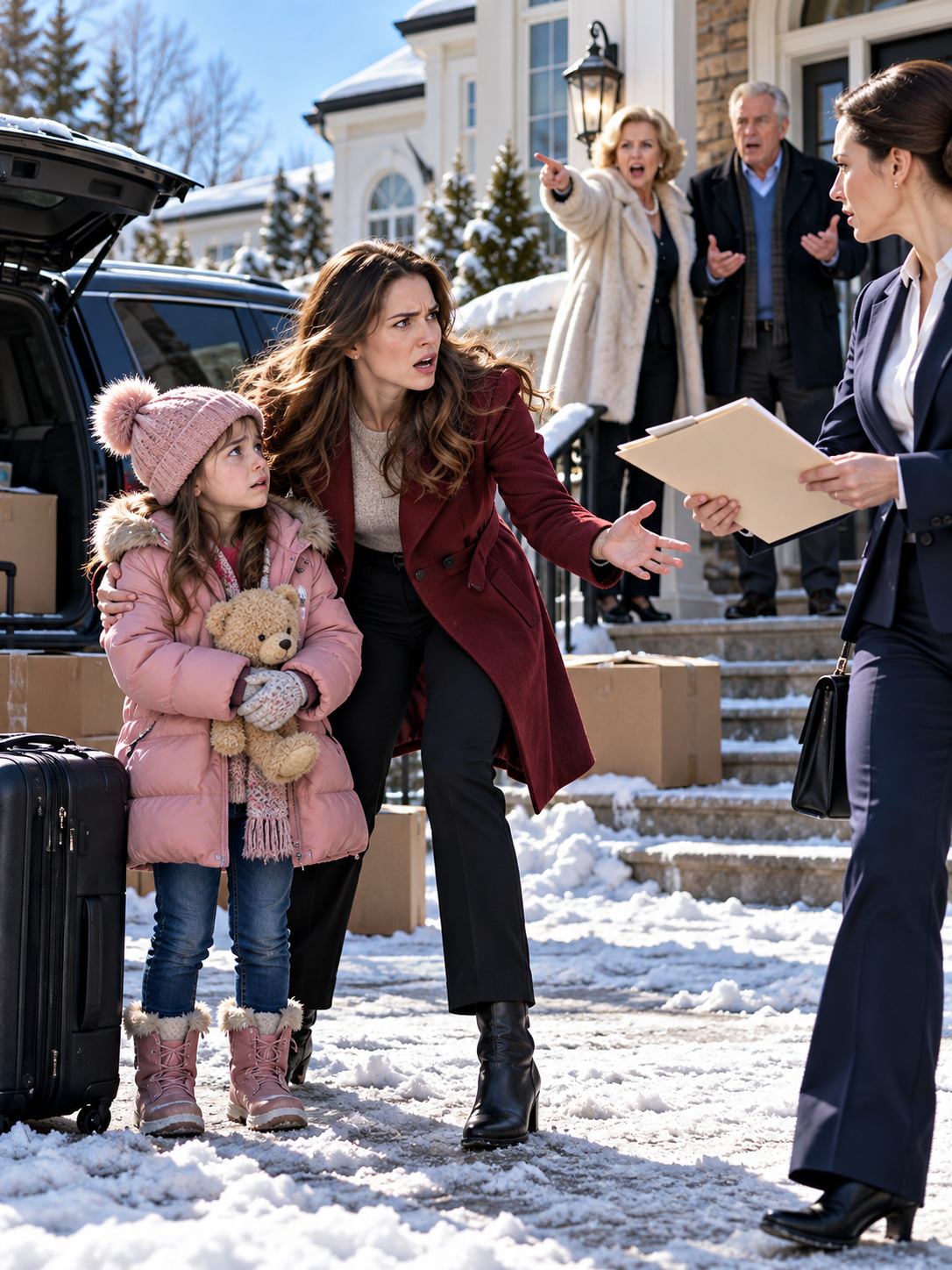
The first thing I saw was Molly’s pink backpack against the black iron gate. It was four fifteen on a February afternoon outside Harrisburg, Pennsylvania, and snow was sticking to the curb. My seven-year-old stood beneath our maple tree in the thin jacket she wore for the thirty-second walk from the bus to the house. When she saw my car, she tried to call out, but I barely heard her.
I hurried across the driveway, nearly slipping, and wrapped my coat around her. “Mom,” she whispered, her chin trembling against my shoulder. Her gloves were damp, and snow crusted her backpack zipper. Behind the gate, a red SOLD sign leaned against my mother’s dormant flower bed.
“Why are you out here?” I asked, dialing 911. Molly looked at the glowing kitchen windows. “Grandma said we don’t live here anymore,” she told me. Then, so quietly I almost missed it, “She said I’m homeless.”
I gave the dispatcher our address and explained how long Molly might have been outside. My mother had promised to collect her from the school bus at two thirty because I was covering another nursing shift at the hospital. Molly’s emergency phone had run out of power inside her backpack. I had trusted my mother to open a door, not to tell a second grader she had nowhere to live.
The gate clicked open while I was speaking. My mother, Elaine, came down the path carrying a steaming blue mug. “For heaven’s sake, Claire,” she said. “She could have waited beneath the porch roof.”
“The gate was locked,” I replied, tightening my hold on Molly. Mom examined the padlock as if someone else were responsible. “We have people coming through,” she said. “Things are changing, and you haven’t bothered to make arrangements.”
My father, Richard, appeared behind her. “Don’t create a spectacle,” he called, eyeing the neighbors’ windows. “The sale is practically done.” His voice had the same sharp edge it carried when I was sixteen and embarrassed him at dinner.
Fourteen months earlier, after my divorce, Molly and I had rented the downstairs apartment of their house. It had a separate entrance, a little kitchen, and two bedrooms; I transferred fourteen hundred dollars in rent every month. We’d signed a fixed-term lease with three months remaining. Dad had insisted on doing everything “properly,” a word I suddenly hated.
My parents had discussed retiring somewhere warmer, but never mentioned accepting an offer or setting a closing date. I’d asked about the SOLD sign the previous weekend, and Mom claimed their agent needed it for photographs. Now I could see how many explanations I’d accepted simply because they came from my parents. An ambulance turned onto our street before I could confront them.
A paramedic named Dana guided Molly into the heated vehicle and checked her while I answered questions. Another asked if she’d been permitted inside at any point. “No,” Molly replied, staring at her wet shoes. Mom started forward, then retreated when Dana shut the doors.
At the emergency department, Molly received dry clothes, blankets, and an examination. The doctor said she was stable but wanted to observe her, and I finally loosened my grip on the chair. “Can homeless kids still go to school?” Molly asked, leaving her hot chocolate untouched. I moved closer so she could see my face.
“You’re not homeless,” I promised. “You have a home with me, always.” After she fell asleep, I gathered our lease, fourteen rent receipts, and Mom’s messages promising school pickup. I forwarded them to Tessa Ward, an attorney who’d helped during my divorce.
Tessa called as I watched Molly sleep. “Don’t sign anything or agree to move,” she said. “Claire, have you ever given your parents written notice that you’re terminating the lease?” When I said no, she asked me to open the attachment she’d just emailed.
The document came from the buyer’s closing packet, obtained after Tessa contacted the listing agent. On the first page, my father declared that the property would be delivered vacant, with no tenants or outstanding rental rights. The second page was a letter supposedly surrendering our apartment early. Beneath it sat a signature that looked disturbingly like mine.
Part 2
I enlarged the signature until the letters dissolved into pixels. It had my looping C and familiar final hook. Above it, a typed sentence said I had voluntarily surrendered possession of the downstairs apartment effective February first. Molly’s purple boots were still beside our door.
“Did you sign any paperwork when your parents first discussed selling?” Tessa asked. I remembered initialing a repair estimate last fall, but nothing about moving. The letter was dated January twenty-fourth, during my hospital shift. “I never saw this,” I said, and Tessa’s tone changed from concerned to brisk.
She asked me to send the original lease, not just screenshots, and to save every message without deleting anything. My banking app showed Dad accepting February rent after the supposed surrender. Tessa said a home could be sold with tenants in place, but a sale didn’t automatically erase a fixed-term lease. More importantly, someone had represented to the buyers that we were already gone.
Molly shifted beneath her blanket and asked for her stuffed fox, which we’d left on her bed. I promised we’d collect it together when she felt better. She watched me slide the phone facedown. “Is Grandma mad because I told you?” she asked, and I had to choose my next words carefully.
“Adults are responsible for what they do,” I told her. “You didn’t cause any of this.” She smoothed a sticker on her wristband. Then she asked if we could find a house with a yellow front door, because yellow looked friendly.
At six the following morning, Tessa sent formal notices to the listing agent, the buyers’ attorney, and the title company. She attached our lease, payment records, and a statement disputing the surrender letter, and requested that the closing be paused until the occupancy issue was resolved. She also began preparing an emergency court application to prevent anyone from excluding us from the apartment. I read from a plastic chair as breakfast carts rattled past.
At eight twenty, my father’s name flashed across my phone. “What did you do?” he demanded, so loudly that I moved into the hallway. “Our agent says the buyers won’t close until their lawyer investigates your claims.” He still thought he could talk past the papers.
“I’m not disputing that you own the house,” I said. “I’m disputing that you can pretend Molly and I don’t live there.” He exhaled hard, then accused me of sabotaging their retirement. When I reminded him that Molly had been locked outside in the snow, he answered, “Your mother made a judgment call.”
I hung up. A social worker helped arrange a safe place for us that night, and my friend Jenna offered her guest room without asking me to explain everything twice. I gathered Molly’s discharge papers and imagined stepping through that gate again. For the first time in my life, I wasn’t certain they would let me.
Before leaving the hospital, I received a message from the real-estate agent. She said the buyers, newly married and planning to use the downstairs apartment for a relative, had specifically required vacant possession. She also forwarded an email my father had written to the closing team: “My daughter vacated on February first. No keys or belongings remain.” Molly slept beside me in socks from that apartment.
I called Tessa and asked how someone could have missed our clothes, schoolbooks, and furniture during an inspection. “The buyers never went into your unit,” she said. “Your parents told the agent it was locked for repairs.” Then she sent a photograph of our original lease beside the surrender letter, both signatures magnified.
A tiny blue dot hung beneath the last stroke in each image, in exactly the same place. It wasn’t a flourish; it was the mark left when my pen had leaked fourteen months earlier. Someone hadn’t merely imitated my handwriting. Someone had copied my signature from the lease and pasted it onto a document designed to erase that very lease.
Part 3
Jenna’s guest room smelled of lavender detergent and popcorn. Molly curled up beside me with a borrowed teddy bear, but woke whenever a car door slammed. At midnight she asked whether Grandma could sell Jenna’s house too. I said no, then lay awake thinking about what my parents had taught her.
In the morning, I drove to the apartment while Molly stayed with Jenna. I wanted her fox, schoolbooks, and our favorite beach photograph. I used my key but asked Jenna’s husband to witness the visit. He waited on the sidewalk while I entered through the separate basement door.
Nothing was packed, despite Dad’s claims. Molly’s spelling test, marked with a gold star, sat beneath a cereal box on the counter. Boots lined the radiator; drawings covered the refrigerator. I photographed everything, then heard my mother moving above me, her footsteps stopping directly over my head.
She met me on the stairs carrying a folder. “You could have avoided all this if you’d cooperated,” she said, glancing at the duffel bag in my hand. “We’re not getting younger, Claire.” I asked why she’d left Molly outside. “The agent had a walkthrough,” she said. “I couldn’t have her running around.”
“You could have called me,” I said. “Or let her into the kitchen.” Mom pressed the folder against her chest. “And then you’d have said we tricked you,” she replied, revealing more than she meant to. For a moment we stared at one another, and I understood that her priority had never been keeping Molly warm.
As I left, our neighbor Mrs. Calder waved me over from her porch. She had seen the ambulance and wanted to know whether Molly was all right. Her doorbell camera faced the gate, and she offered its recording. I thought it would show only how long Molly waited.
The video showed Molly stepping off the bus and walking toward the gate at two thirty-six. My mother came out, spoke to her for less than a minute, then stepped back inside the fence and secured the padlock. Molly stood still at first, as though waiting for a joke to end. After several minutes, she sat on her backpack in the snow.
Tessa watched the clip in silence when I sent it. “Keep the original file,” she said. “This supports your account, but the court will also need your lease, the communications, and Molly’s medical records.” She had already requested the electronic records behind the disputed surrender letter and contacted the appropriate authorities about the apparent signature misuse. Nothing had been decided legally yet, but the buyers’ attorney had confirmed that the closing was suspended.
By late afternoon, the buyers exercised their contractual right to terminate after my parents failed to resolve the vacant-possession problem. Their lawyer demanded the deposit back and reserved further claims. My father called eleven times, then sent an email with the subject line WHAT YOU HAVE COST US. Attached was a lender’s demand concerning a North Carolina retirement townhouse.
They had bought before they’d sold. Without the sale, a payment was looming and their deposit was at risk. I finally understood the rush, the lies, and the insistence that our apartment had somehow become empty. They needed us gone on paper because they couldn’t afford to wait for us to leave in reality.
That evening, Dad left a voicemail saying he would find another buyer and that “uncooperative occupants” wouldn’t stop him twice. Tessa was preparing court protection and a claim over the false document. I drove back to Jenna’s, where Molly was building a yellow house from plastic bricks. I thought the worst part of the fight was over.
Six days later, Mrs. Calder sent me a photograph from my parents’ driveway. Two movers were carrying our couch through the open downstairs door, and Molly’s boxes stood beside the snowbank. My mother stood behind them with a clipboard, supervising what she had no right to take. One box had a paper sun Molly had drawn on its side; its yellow rays were smearing in the melting snow.
Part 4
I left Jenna’s driveway after Mrs. Calder’s message. Tessa answered on the second ring and told me to pull over before doing anything else. “Don’t get into a confrontation,” she said. “Photograph everything. I’m calling the moving company and court.” She’d already sought emergency protection; now we had evidence of an attempted removal.
By the time I reached the house, the couch was on the lawn beneath a moving blanket. One mover carried Molly’s little desk. I showed them the lease and explained that neither I nor my attorney had authorized the move. Their supervisor called, and they stopped work.
My mother marched out with the clipboard, cheeks bright red. “You’ve been gone almost a week,” she said. “That means you’ve abandoned the apartment.” I pointed at our books, dishes, and coats inside. “Staying with a friend because you frightened my child isn’t surrendering my home,” I answered.
Dad came around the driveway holding his phone. “We can’t sell this place with you blocking everything,” he snapped, as Mrs. Calder watched. I told him that if he wanted a different moving date, he could discuss it with Tessa. He cited thirty years of mortgage payments; I cited my rent.
Tessa asked me to document the scene and leave with the items Molly urgently needed. Her colleague met me there while the movers stopped. That afternoon she submitted the new photographs and witness information to the court. A hearing was set for morning; I rehearsed facts instead of angry speeches.
At the hearing, my father’s lawyer argued that I had voluntarily moved out and that the disputed surrender letter proved it. Tessa produced February’s rent receipt, photographs of our furnished apartment, the hospital record, and my written denial of the signature. She also presented Mrs. Calder’s video showing Mom locking the gate while Molly stood outside. The judge didn’t decide every allegation that morning, but ordered my parents not to change locks, interfere with our access, or remove our possessions while the dispute was pending. For once, my parents could not call me dramatic; someone outside the family was reading the evidence and demanding answers.
In the hallway, my mother reached for my sleeve. “Claire, please,” she whispered. “If you just withdraw everything, we can still fix this as a family.” I looked at her hand, then at the same woman who’d watched her granddaughter waiting in the snow. “Family was what you had before you made her stand outside,” I said, and stepped away.
The collapse of the sale carried consequences I hadn’t needed to invent. The buyers demanded their deposit and compensation; the attorneys negotiated a confidential settlement. Closing costs, legal bills, and lost money connected to the North Carolina purchase ate into what Dad had expected to take away from the house. The disputed signature was still under examination.
I could have insisted on occupying the apartment until the final day of our lease. Instead, I told Tessa that Molly deserved to live somewhere she didn’t have to listen for footsteps above her ceiling. She negotiated a written agreement protecting our tenancy until an agreed departure, plus moving costs and relocation money. I would return my keys only after securing another home and the payment.
Their lawyer persuaded them to sign, although Dad sent one last message accusing me of taking advantage of them. I deleted nothing and replied only through Tessa. Then Molly and I toured an apartment near her school, where the landlord welcomed children.
Molly liked the place until she saw the empty bedrooms. She took my hand and asked whether we would have to leave this apartment suddenly too. I told her we would have a real lease and that no one could simply decide our home didn’t count. She nodded, but in the car she asked the question I’d been dreading: “Mom, what if Grandma finds us and says we’re homeless again?”
Part 5
I parked outside a grocery store, where carts rattled across wet pavement, before answering Molly. “Grandma can’t decide where we belong,” I told her. “If we ever move, I’ll explain why, make a plan, and stay beside you.” She asked whether we could get a yellow welcome mat, the way a child might ask permission to hope again; I said yes before she could change her mind.
We signed the new lease two weeks later. Above a bakery near her school, it had sunny windows, a fireplace, and a secure entrance. Mrs. Vega, our landlord, showed Molly the gate and emergency exit. She let us hang a paper sun on the door. On our second visit, Molly checked the window latches while I asked whether a new owner could suddenly cancel our lease, and Mrs. Vega explained our rights without treating either question as foolish.
Moving wasn’t effortless. My savings covered our deposit; Tessa’s settlement covered movers, missed work, and relocation costs. I changed hospital shifts to meet Molly’s bus, with Jenna as backup. This time, everyone kept their promises. I scanned our signed lease, kept a printed copy with our emergency contacts, and placed another in Jenna’s care; I wanted a home whose security was more than a reassuring voice.
My parents’ attorney eventually confirmed that their deal with the buyers was fully resolved. They returned the deposit, paid agreed costs, and abandoned the North Carolina townhouse purchase when their financing could not be completed on schedule. Tessa secured a retraction of the false surrender claim and preserved the signature evidence for authorities. Our civil claims ended in a settlement, not a reconciliation.
Mom called twice after the agreements were signed. First, she claimed she hadn’t realized Molly was frightened. When I asked why she hadn’t opened the gate, she said the buyers’ agent might have noticed Molly’s things inside, as if that explained the choice instead of condemning it. Then she cried about the lost townhouse and Dad’s suffering. I listened until she said, “We gave you a place to stay when nobody else would.”
“I paid you rent,” I said. “And you left my child outside to make a sale easier.” Mom went quiet, then asked when she could see Molly. I said there would be no visits or calls; she could contact Tessa. Molly’s safety mattered more than Mom’s feelings.
At school, Molly’s counselor helped her find words for what had happened. Sometimes she asked about SOLD signs, and we talked about what made a home safe. Other days she cared about spelling tests and goldfish. Ordinary worries returned, a victory no court could give us.
On moving day, I went back to the downstairs apartment with Jenna to collect our last boxes. It smelled of cardboard and lemon cleaner. Dad stayed in the garage; Mom watched from upstairs. I wondered whether either of them remembered teaching me to return borrowed things in better condition than I found them; they had given my daughter a fear that would take time to heal. I left our keys for their attorney.
Molly waited at Jenna’s until the furniture was in place, then came up the new stairs carrying her stuffed fox. She inspected her bedroom and the paper sun on its door. “Did we bring everything?” she asked. “Everything important,” I said. She opened a box, found her gold-star spelling test, and taped it above the desk.
That evening, we ate pizza on the living-room floor while the fireplace made a soft ticking sound. Our yellow mat lay outside; fresh bread scented the hallway. Molly leaned against me and asked, “Is this our permanent home?” I knew promises couldn’t stop the world changing, but they could be kept.
“This is our home,” I told her. “And wherever we live, you’ll never have to face a locked gate alone again.” She wrapped her arms around me, then went to fetch her fox for bedtime. Hallway light caught our paper sun; I hadn’t looked over my shoulder once. My parents had sold the idea that a home was something they could take away; Molly and I had built one they no longer had the power to define.
Legal Notice: This story is a work of fiction. Names, characters, businesses, events, and incidents are the product of the author’s imagination or are used fictitiously. Any resemblance to actual persons—living or dead—or to actual events is purely coincidental. Thank you! 💓

