
My Parents Had Me Arrested for My Grandfather’s $5 Million—Then the Police Chief Opened My File
At 1:46 a.m., two officers arrived with a warrant while my parents stood behind them, smiling. My sister livestreamed my arrest for allegedly stealing my grandfather’s $5 million inheritance. I didn’t resist. At the police station, a desk officer opened my file and fell silent. Fifteen minutes later, the chief walked in and said something that turned my family’s celebration into their nightmare.
Part 1
The first officer knocked hard enough to rattle the picture above my entryway. When I opened the door in mismatched socks, he read my name, Penelope Ward, from a warrant and arrested me for suspected estate fraud. Behind him, my mother, Denise, held my father’s arm as though they’d come to a graduation. My younger sister, Brielle, aimed her phone at my face and whispered to her livestream, “Here comes the criminal.”
I asked to read the warrant, and the officer showed me the judge’s signature. My father, Russell, stepped forward with an expression I’d known since childhood: disappointment carefully arranged to look respectable. “You could have shared,” he said. I glanced at the viewers’ comments flying up Brielle’s screen and realized they weren’t here to protect my grandfather’s estate; they were here to enjoy watching me lose it.
Three months earlier, I drove to the Kansas City office of Adrian Bell, Grandpa’s longtime lawyer. It was raining hard, and the lobby smelled of wet wool and polished stone. Grandpa Henry had died at eighty-seven, leaving baseball cards, a farmhouse near Independence, and a trust built through years of owning commercial properties. I expected paperwork, not the end of my family.
Adrian sat at a mahogany conference table with a thick folder placed exactly between my parents and me. Brielle wore sunglasses indoors and tapped her nails against a coffee cup. When Adrian announced that Grandpa had left me sole beneficial ownership of a five-million-dollar trust, my mother actually laughed. “You must have skipped a page,” she said, while my father demanded that he read the document again.
I didn’t feel triumphant. Grandpa had raised me while my parents prioritized Brielle’s dance competitions. He’d taught me to calculate sales tax and driven me to my first internship. The last time I saw him, he squeezed my hand and said, “Promise me you won’t let anyone turn your life into a family debt.” I thought he meant the usual arguments about money.
Adrian then read a provision about an independent successor trustee taking over administration if I became legally incapacitated. That wasn’t unusual, but he lingered over the paragraph about documentation and court review. Brielle exchanged a look with my father, and my mother asked whether relatives could request an assessment of my competence. Adrian answered too quickly: “There are procedures.”
Afterward I tried to speak to him alone, but he said he had another appointment. My family left without mentioning Grandpa, the funeral, or any of the years we’d spent caring for him. At the elevator, Brielle leaned close and said, “You always get everything because you know how to look innocent.” I watched my reflection in the closing doors and wondered what, exactly, they’d just decided.
Four weeks later, a bank fraud analyst called about repeated attempts to access the trust’s online records from an unfamiliar device. I worked as a forensic financial analyst for a federal inspector general’s office, so I knew enough to recognize that unusual activity wasn’t proof of who’d done it. I asked the bank to protect the account, preserve its logs, and contact the trustee through verified channels. That afternoon, I found the spare house key missing from my bag.
I installed cameras covering my own front door and home office and told my friend and attorney, Nora Patel, what had happened. Two days later, while I ate tomato soup at a diner, an alert showed Brielle unlocking my front door. She went straight to my desk, photographed trust papers, and searched a drawer containing my work identification. I watched the footage twice before calling Nora, my hands shaking so badly I spilled soup onto my sleeve.
Nora told me to change the locks and let the proper investigators handle the evidence. She also asked me a question that made my stomach tighten: “Why was Brielle looking for your identification instead of the money?” Before I could answer, an email arrived from an address I’d never seen, containing a photograph of my grandfather’s signature on a document he had supposedly signed six days after he died.
Part 2
The attachment was titled “Emergency Trustee Petition,” with a poor imitation of Grandpa’s handwriting. He used to cross his sevens and underline his name; this version did neither. Someone described me as unable to manage finances, though I’d handled my mortgage and career for years. The sender wrote only, “Ask Bell what he plans to file on Monday.”
I wanted to drive straight to Adrian’s office, but Nora asked me to come to hers instead. She spread the papers under a desk lamp and warned me not to treat an anonymous email as proven fact. The independent trustee confirmed that no change of beneficiary or trustee had been approved. “They can’t simply declare you incapable,” she explained, “but they can create a very expensive mess if they submit false evidence.”
The next surprise came from a woman named Talia Brooks, a junior bookkeeper at Adrian’s firm. She met us at a courthouse coffee shop, keeping her coat on. She’d copied a bill labeled “family reassignment,” charged to my father, and overheard Adrian discussing medical documentation he didn’t have. “I don’t know what they’re going to do,” she whispered, “but he told me to erase an appointment from the calendar.”
I needed evidence, not an argument they could twist into proof I was unstable. Nora contacted investigators and advised me to keep my federal employer informed because of the potential misuse of my work credentials. I recused myself from every official matter connected to my relatives and handed over the camera originals through counsel. My job gave me no authority to investigate my family.
Brielle returned three days before my arrest with a copied key, but I’d changed the locks. She rang the bell and claimed Mom was worried about me. The next day, a courier brought trust transactions marked in red as “suspicious transfers.” I could recognize Grandpa’s accounting codes in the margin, but the totals made no sense. Someone had copied his precision without understanding the system; the clumsy mistake frightened me because it meant they were getting impatient.
Nora inspected the pages and noticed that the dates had been rearranged. My father had made harmless transfers into the trust look like withdrawals I’d authorized. One foreign account number had two transposed digits, a telltale copying error. We kept the originals, photographed the packaging, and notified investigators rather than trying to lure my family into another crime.
I spent the next forty-eight hours sleeping badly and checking the porch camera. Mom left a voicemail saying the money belonged to “all of us,” offering forgiveness if I signed over management. Brielle posted about a “greedy relative,” using a photo of our childhood house. By dinnertime, strangers were arguing about me in the comments.
The night the officers came, I noticed that the warrant described transactions using exactly the altered dates Nora had flagged. I said nothing about the case in front of Brielle’s camera and asked the officers for my lawyer. They were professional, though clearly uncomfortable with my family’s applause. As I stepped into the cruiser, I heard my mother tell Brielle, “Make sure everyone sees her face.”
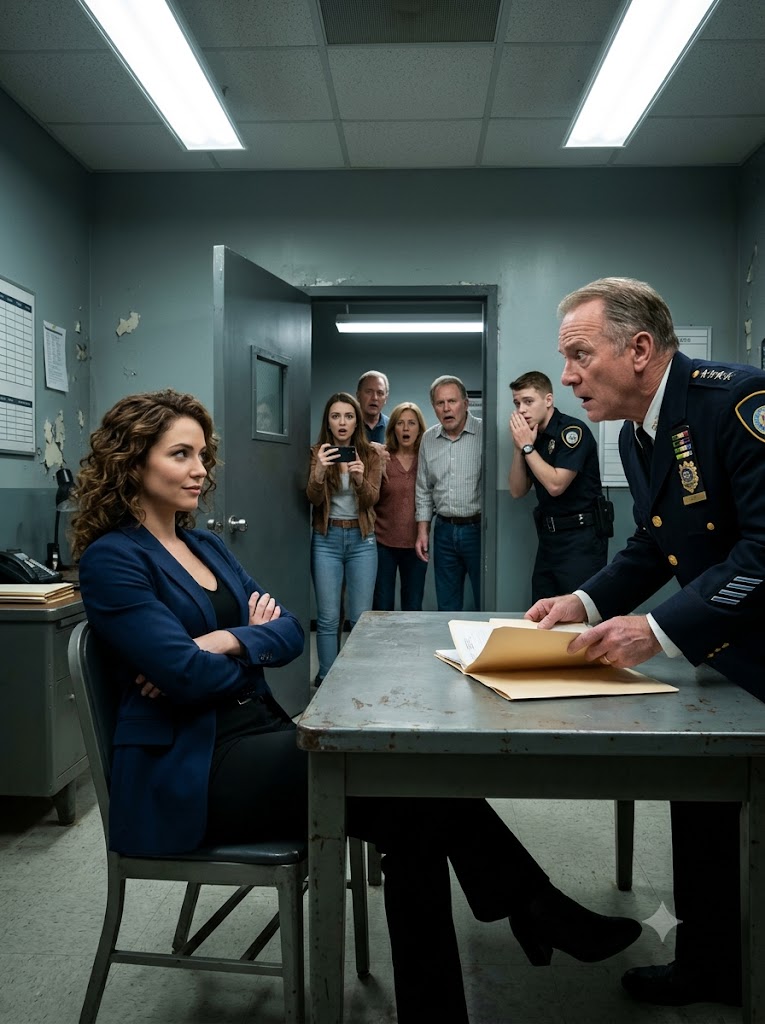
At the station, a desk officer named Morales typed my information, read the report, and frowned. He compared the arrest paperwork with an alert in a separate case file, then called his supervisor without explaining why. My stomach twisted; I’d been calm at home because I trusted the evidence, but sitting beneath fluorescent lights with my wrists aching felt different. Morales came back and said, “We need to verify something before processing this any further.”
Fifteen minutes later, Chief Daniel Mercer entered the interview room carrying the arrest packet. He looked at my name, then at a photograph clipped to the inside of the folder. “Ma’am,” he said, his voice unsteady, “you’re the cooperating witness in the Bell investigation, aren’t you?” I realized someone had finally connected my family’s allegations to the case they’d been trying to bury.
Part 3
I nodded, but the chief didn’t apologize or promise to erase my arrest. He said the department had received a confidential notice from investigators reviewing Adrian’s law firm, although the information hadn’t reached the officers serving the warrant. He had called the prosecutor who signed off on the application, and they were arranging an immediate review with the court. “Your job doesn’t put you above the law,” he told me, “but a warrant based on altered records is a serious problem for everyone.”
That was the first honest thing I’d heard from someone in uniform all night, and it forced me to admit how scared I’d been. I had spent months collecting evidence, but I could not control what strangers believed when they saw me in handcuffs. I told him where Nora had preserved the original documents and asked him to contact her directly. When she arrived, her hair was still flattened from sleep, but she carried a neat binder and a paper bag holding a blueberry muffin. “You can cry later,” she murmured as she set it down, “but you do have to eat something.”
The prosecutor compared the dates in my family’s complaint with certified records from the bank. The supposedly missing money had never left the trust; it had moved between authorized accounts under the independent trustee’s signature. The false allegation didn’t evaporate instantly, but the prosecutor sought to withdraw it, and a judge approved my release that morning. I stepped outside at dawn exhausted, furious, and determined not to let my family call it a misunderstanding.
By then Brielle’s livestream clip had spread everywhere. She had more than a million followers, and the recording of my arrest had accumulated over a million views by lunchtime. Her caption called me “the woman who stole our inheritance,” while my mother’s smiling face appeared behind the officers like a victory photograph. Nora told me not to read the comments, but I saw one asking why my parents looked happy to see their daughter handcuffed.
Investigators served preservation requests on Adrian’s firm, seeking emails, invoices, and the drafts Talia had described. A warrant authorized the seizure of specific digital records, and Talia cooperated through her own lawyer. I learned that my father had paid Adrian consulting fees from a company he owned, then described them as ordinary estate expenses. That pattern had been flagged before my arrest, which explained why my name triggered such urgent concern at the station.
I wanted to believe the worst was over, until Nora called me to her office with another surprise. A bank examiner had traced several attempted transfers to an account controlled by a business partner of my father’s. The transactions had failed, but someone had tested the account’s security using information taken from my desk. What had looked like a family fight over a will now resembled an organized attempt to move money that never belonged to them.
That afternoon my father left a voicemail. “We all got carried away,” he said, his voice smooth and almost affectionate. “Just tell them it was a paperwork mix-up, and we can start fresh.” I replayed it once for Nora, then deleted it from my phone after she’d safely preserved a copy. The thing that hurt wasn’t the request; it was how easily he assumed I would protect him again.
Brielle went live once more from my parents’ living room, wearing the same pink sweater she’d worn outside my house. She waved a champagne glass and called the arrest proof that “truth always wins,” even though I’d already been released. In the background my mother laughed, and my father appeared to be reading something on his tablet. Then the doorbell rang, and Brielle turned her camera toward the entryway.
The video cut off within seconds. Nora’s phone rang almost immediately, and I watched her expression change as she listened. “Investigators have just served warrants at both properties,” she told me. Then she added, “And they found a recording in Adrian’s files that changes what we thought your grandfather knew.”
Part 4
The recording began with rustling paper and Grandpa asking Adrian whether an amendment would protect his money from creditors. Adrian agreed, then suggested naming my father as alternate trustee with broad access. Grandpa paused long enough for a clock to tick four times. “Russell has already taken from me once,” he said. “I will not give him permission to do it again.”
I sat in Nora’s office with the transcript spread across my knees, remembering Grandpa’s habit of saving grocery receipts in labeled envelopes. He’d been private about his finances, but he’d never sounded frightened of my father in front of me. The recording continued, revealing that a nonprofit housing project Grandpa supported had lost a substantial donation years earlier. My father had controlled the vendor account, and Grandpa suspected the money had gone somewhere it shouldn’t.
That was why the inheritance was mine alone. Grandpa hadn’t made the decision to punish my sister for being favored or to reward me for being useful; he had spent years trying to keep family money away from people who treated it as theirs by birthright. He’d also arranged independent oversight of the trust, precisely because he feared someone would pressure me. His letter to the trustee read, “If Penelope asks for help, believe her the first time.” I had to put the page down before my tears blurred the ink.
Investigators found the forged competency petition on Adrian’s office server, along with several drafts revised after Grandpa’s death. Emails suggested Adrian intended to use the false financial complaint as support for an emergency request to restrict my control of the trust. My mother had submitted a statement describing me as unpredictable, and Brielle had supplied screenshots stripped of context. Their plan required making me look dangerous before asking a court to put my future in their hands.
The warrants also reached my parents’ house. Brielle’s second livestream had cut off when federal agents arrived, identified themselves, and secured the scene while documents and devices were collected. No one needed to smash furniture or shout for the cameras; the simple sight of investigators at the door was enough to silence her. Later, her followers replayed the moment her smile vanished as she realized the officers weren’t there for me.
I didn’t watch it more than once. I remembered walking barefoot across my porch for the first video while neighbors watched, and hating everyone who might have replayed it. I knew too well what it felt like to have your worst moment passed around by strangers, and I didn’t want another person’s humiliation to become my whole life. What mattered was that the recordings, banking logs, and signed affidavits were now in the hands of people who could evaluate them. Nora reminded me that charges and convictions weren’t the same thing, however satisfying the headlines sounded.
A week later, prosecutors filed charges against Adrian and my father involving attempted financial fraud and related false statements. My mother and Brielle faced their own allegations for their roles in the false complaint and the attempted trust takeover. Each had an attorney, and each denied different pieces of the evidence. It was messier than the neat downfall I’d imagined while sitting in the police station.
At work, my supervisor reassigned me to unrelated cases until conflict-of-interest questions were settled. I understood the decision, but losing my ordinary routine stung; my family had managed to reach even the part of my life they’d always mocked. I spent mornings walking along the river and afternoons helping Nora organize records. Sometimes I woke at 1:46 without knowing why.
Near Christmas, the trustee sent an envelope. It contained a final handwritten note Grandpa had instructed them to deliver only if a dispute threatened my inheritance. “The money is not the thing I most wanted you to have,” he wrote. Underneath was an address in Independence and a key taped to an index card. I stared at the familiar handwriting, wondering what he had left there that none of us had seen.
Part 5
The key opened a narrow drawer in Grandpa’s old workshop, beneath the workbench where he’d taught me to sand wooden picture frames. Inside lay a tin of family photographs and a ledger wrapped in a faded dish towel. The pages recorded loans he had made to my father, repayments that never arrived, and donations he’d quietly restored after money disappeared. On the final page, he wrote, “I couldn’t make Russell honest. His choices were never Penelope’s burden.”
I brought the ledger to Nora, who sent copies to investigators and the trustee. It supported the financial trail without pretending Grandpa had been able to predict every later scheme. More importantly, his note released something I’d carried since childhood: the idea that keeping the peace was my responsibility. I’d spent years accepting smaller hurts because I thought that was what families did.
Fourteen months after the arrest, I sat in federal court as the case reached sentencing after guilty pleas and a trial on the remaining charges. Adrian had been convicted on financial fraud and evidence-related counts and faced disbarment proceedings. My father was convicted in connection with the attempted transfers and the fraudulent filings; my mother and Brielle pleaded guilty to narrower offenses for their documented roles. The judge considered each person’s conduct and imposed different terms, including prison for Adrian and my father, supervised sentences for my mother and sister, and restitution orders.
It didn’t feel like a movie ending. There was no applause or courtroom speech that erased what had happened. Brielle kept staring at the table, her hands empty without a phone. My father avoided my eyes, while my mother cried into a tissue, as though the only tragedy in the room was what had happened to her.
When the hearing finished, my mother stepped toward me before her attorney guided her back. “Penelope, please,” she said. “I know we made mistakes. You’re still our daughter.” I looked at the woman who had smiled while police led me from my home and wondered whether she understood the difference between mistakes and choices made again and again.
“You knew the papers were false,” I told her, keeping my voice low. “You watched Brielle broadcast my arrest. You never asked whether I was safe.” Her mouth trembled, but I didn’t wait for another explanation. I walked away without offering forgiveness because I didn’t have any to give.
Months later, the trust was intact under independent administration, and I made decisions about its charitable giving with advisers who answered questions instead of demanding loyalty. I funded a small program that offered free financial and legal guidance to older homeowners, the kind of people Grandpa used to help without leaving his name. I kept the farmhouse and restored its porch, but I didn’t buy a bigger house or a flashier car. The freedom to make ordinary choices mattered more than proving I’d won.
The arrest record was corrected through the proper legal process, and I returned to my profession without pretending it hadn’t changed me. My sister’s original video still surfaced occasionally, stripped of context, so I stopped searching my name. Nora remained my friend as well as my lawyer, although she finally insisted I learn to handle my own paperwork again. On Fridays, we ate diner pie and complained about ordinary things, a luxury I hadn’t appreciated before.
One afternoon I found an old photograph of Grandpa standing beside me at a little-league field, holding a crooked paper trophy I’d made him. On its back he’d written, “To Penny, who asks the right questions.” I placed it beside my desk, where sunlight warmed the frame, and let myself miss him without thinking about the trust. He had given me far more than money.
At 1:46 one spring morning, I happened to wake when rain tapped against the farmhouse windows. For the first time, I didn’t picture handcuffs or my sister’s phone; I heard Grandpa’s old clock ticking downstairs. I made coffee, unlocked the back door, and stepped into the clean morning air. My family had tried to take my name, my freedom, and my future, but none of those things belonged to them anymore.
Legal Notice: This story is a work of fiction. Names, characters, businesses, events, and incidents are the product of the author’s imagination or are used fictitiously. Any resemblance to actual persons—living or dead—or to actual events is purely coincidental. Thank you! 💓


