
My Mother Tried to Dump Three Kids at My Apartment for Christmas—But Her Spare Key No Longer Worked, and I Was Already in Mexico
My mother arrived at my Denver apartment on December 23 with three children, a portable crib, and a key she believed would force me to babysit through Christmas. I’d refused twice, but she’d promised my brother a romantic mountain getaway anyway. She knew I would never abandon my nieces and nephew in the cold. What she didn’t know was that I’d already changed the lock and left the country. When my doorbell camera rang, her expression changed—but that wasn’t the worst betrayal.
Part 1
“You already agreed, sweetheart, so please don’t embarrass me in front of everyone.” My mother said it with a smile so tight I could see the muscles jumping beside her mouth. We were sitting around my parents’ dining table in suburban Denver, with twelve relatives finishing dessert and my brother looking delighted about his upcoming Christmas vacation. The trouble was that I had never agreed to babysit his three children, and Mom knew it.
“I said no, Mom,” I answered, putting down my fork. “Twice, actually.” My brother, Derek, stopped cutting his cheesecake, while his wife, Vanessa, looked from me to our mother with a confused expression. Mom’s smile disappeared, and the familiar silence settled over the table, the kind that usually ended with me apologizing for making everyone uncomfortable.
My name is Hannah Brooks, and at thirty-one, I had spent most of my adult life being the convenient daughter. I owned a small content strategy business that I’d built from my one-bedroom apartment after leaving a marketing agency four years earlier. I worked with medical practices, independent retailers, and software companies, often spending ten-hour days managing projects that paid my rent. Unfortunately, my family considered anything done on a laptop less important than work performed inside an office building.
My mother, Elaine, had a favorite sentence: “Hannah works from home, so she can handle it.” That sentence had turned me into an unpaid delivery service, emergency babysitter, grocery shopper, and appointment coordinator. When I complained, she reminded me that Derek had three children and a demanding career, while I was single and supposedly free of real responsibilities. My father usually stared at his television and let her finish the argument.
Derek was thirty-six and worked as an orthodontist, while Vanessa managed the chaos of raising Sophie, six, Carter, four, and baby Lily, who was nine months old. I loved those children, particularly the way Carter called my laptop my “important homework machine” and Sophie insisted I attend every school performance. I didn’t mind babysitting when someone asked respectfully and gave me time to plan. What exhausted me was discovering that my family believed affection came with unlimited access to my calendar.
At Thanksgiving, I’d spent nearly six hours preparing food, supervising the children, and washing dishes while everyone else relaxed. When Mom wanted a family photograph, she handed me her phone and told me to make sure nobody was blinking. The next morning, she posted that picture with a caption celebrating her wonderful family. I was missing because I’d been standing behind the camera, and nobody seemed to notice.
Two weeks before Christmas, Mom called while I was reviewing a website proposal for an important client. She explained that Derek and Vanessa had booked a four-night cabin vacation in the Rocky Mountains because they desperately needed time alone. I said that sounded wonderful, until she casually announced that the children would stay with me from December 23 through December 26. She even suggested bringing a portable crib and letting the older children sleep on my couch.
I reminded her that my apartment had one bedroom and that I had a major project deadline immediately after Christmas. Mom said I could work while the children played, as if a crawling baby and two energetic children required no attention. When I refused, she accused me of being selfish and said Derek deserved a break. Eventually, she sighed, said, “Fine, do whatever you want,” and hung up.
For nine days, nobody mentioned childcare again. I assumed Derek and Vanessa had found another arrangement, although part of me remained suspicious because Mom had never accepted disappointment gracefully. Then came the family dinner, where she publicly thanked me for volunteering to keep the children over Christmas. She’d waited until relatives were listening because she believed an audience would make refusing impossible.
“Derek already paid for the cabin,” Mom announced when I contradicted her. “You can’t back out now.” Vanessa immediately looked alarmed and explained that the reservation was nonrefundable, while Derek demanded to know why I was changing my mind. I repeated that I had never offered to babysit and that their booking was not an obligation I’d accepted.
Mom leaned across the table and whispered that I was making her look like a liar. “Then stop lying about what I agreed to,” I replied, loudly enough for everyone to hear. My aunt Patricia suddenly became very interested in her coffee, while Dad cleared his throat and suggested we discuss this privately. Derek looked at Mom and asked whether she’d actually spoken to me about the arrangement.
“Of course I did,” she snapped. “Hannah just likes making everything difficult.” I stood, collected my coat, and told Derek directly that I would not be available during those four days. Vanessa stared down at her plate, but Derek shook his head and muttered that family should be able to count on one another.
On the drive home, snow began tapping against my windshield, and I kept replaying the conversation. I knew exactly how my mother operated: she created a crisis, waited until refusing would hurt somebody else, and then made me responsible for solving it. By the time I parked outside my apartment, my stomach had tightened with a realization I couldn’t ignore. Two years earlier, I’d given Mom an emergency key, and she still carried it on her keychain.
That night, a message appeared in the family group chat containing a detailed Christmas schedule. My name was listed beside every meal, bedtime, and childcare responsibility, with a drop-off time of nine on December 23. Underneath, Mom had written, “Everything is settled, so nobody needs to change their plans.” I stared at the screen, suddenly certain that saying no again wouldn’t be enough.
Part 2
I barely slept that night, imagining Mom standing in my hallway while the children cried and she demanded that I open the door. By morning, I understood that she wasn’t bluffing, because she’d done similar things before on a smaller scale. Once, she’d left Sophie with my building’s concierge after I told her I had a meeting, assuming I’d come downstairs rather than inconvenience the staff. I needed a boundary she couldn’t simply step around.
I called my property manager, explained that an old emergency key was no longer secure, and requested permission to rekey the apartment. She approved the change and allowed me to install a compatible video doorbell without damaging the building. Two days later, the locksmith replaced the cylinder while I watched from the hallway. When he handed me the new keys, I felt an absurd rush of relief.
That evening, I sent Derek and Vanessa another direct message confirming that I wouldn’t be providing childcare during Christmas. Derek didn’t respond, while Vanessa wrote that she hoped we could work something out. Mom replied, “You’ll be sitting home alone anyway, so stop being dramatic.” Reading that sentence made my next decision surprisingly easy.
I had nearly eighty thousand airline miles saved for a vacation I’d postponed repeatedly because of family obligations. Within an hour, I’d booked a flight to Oaxaca, Mexico, and reserved a small guesthouse with reliable internet and a shaded courtyard. My client had already approved remote work, so traveling wouldn’t affect my deadline. I gave the property manager my travel dates and arranged for my friend Brooke to serve as my local emergency contact.
On December 22, I boarded my flight with a carry-on suitcase, laptop, and a paperback I’d been meaning to finish. Denver was preparing for bitter winter weather, and I watched the airport’s snow-covered runways disappear beneath the clouds. My stomach fluttered with guilt every time my phone vibrated, but I reminded myself that the children had two capable parents and a grandmother who had made promises on their behalf. I wasn’t leaving anyone I’d agreed to care for.
The following morning, warm sunlight spilled across the terracotta tiles of my guesthouse. I made coffee, opened my laptop, and reviewed a client’s website draft while birds chattered outside the courtyard window. At 9:12 Denver time, my doorbell camera sent an alert. I clicked the notification, and the peaceful morning abruptly collided with a scene I’d spent two weeks anticipating.
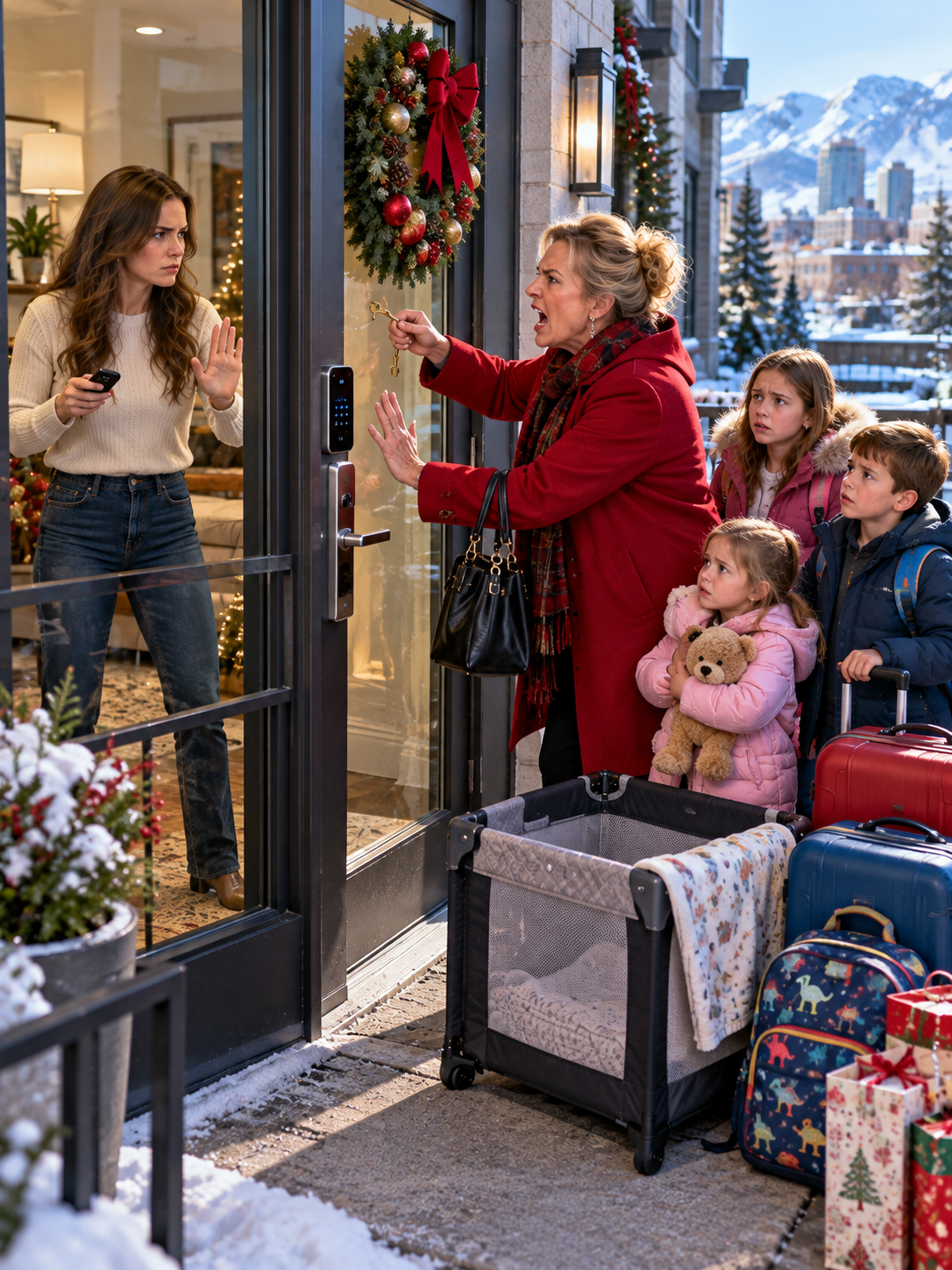
Mom stood outside my apartment wearing a thick burgundy coat, holding Lily in one arm and a silver key in the other. Sophie and Carter were bundled in winter jackets beside two suitcases, a diaper bag, and a folded portable crib. All three children appeared safe and warmly dressed, but the hallway was no place to leave them. Mom pushed her key into the lock, twisted it, and froze when the door refused to open.
She tried again, then rattled the handle with enough force to make the camera shake. “Hannah!” she shouted, banging on the door. “Open up! We’ve got the children!” I activated the speaker and told her calmly that I’d refused the arrangement and wasn’t available.
“Stop playing games and unlock this door,” she demanded. I explained that the lock had been changed and that I wasn’t in the apartment. Mom laughed bitterly, insisting I must be hiding inside to punish her. When I told her I was in Mexico, her expression shifted from annoyance to disbelief.
“You left the country?” she shrieked. “What am I supposed to do with three children?” I told her to take them somewhere warm immediately and call Derek, since their parents were responsible for arranging care. She accused me of abandoning the children, but I reminded her that she had brought them to an apartment without confirming anyone would be there. I ended the connection when she began shouting insults.
Four minutes later, Derek called from his car. He said Mom had told him I’d apologized and confirmed the arrangement after the dinner, although he admitted he’d never heard that from me personally. I reminded him that I’d refused in front of him and again by text. After a long silence, he said he was turning around and would collect the children.
I watched through the camera as Mom brought the children back to her heated SUV to wait for Derek. My hands shook once the immediate concern for their safety had passed, but I didn’t regret protecting my apartment. Then Vanessa sent me a private message containing a screenshot from a conversation she said she’d just discovered on Derek’s tablet. The date was two days before our family dinner, and the first line was from my mother: “She’ll refuse in front of everyone, but don’t worry. I know exactly how to make her take the kids.”
Part 3
I enlarged Vanessa’s screenshot until I could read every line. Beneath Mom’s message, Derek had replied, “I heard her say she couldn’t do it, but she’ll calm down once the kids are there.” Mom responded with a laughing emoji and promised to handle the delivery herself. The conversation was dated before our family dinner, proving my brother had known I hadn’t agreed long before he booked his vacation.
I called Vanessa immediately, my anger cutting through the fragile calm I’d found that morning. She explained that she’d seen the messages on Derek’s tablet after opening it to check their cabin reservation. She sounded embarrassed and admitted she’d suspected Mom was pressuring me, but had convinced herself the adults would work everything out. “I didn’t want to lose the trip,” she whispered.
I asked why she’d kept packing after hearing me refuse at dinner. Vanessa went quiet, then admitted she’d assumed I’d eventually surrender because I always had before. That confession hurt more than her excuses because it exposed the truth beneath the entire arrangement. Nobody had genuinely believed I’d volunteered; they simply believed they could outlast my refusal.
When Derek called again, I confronted him with the messages. He claimed Mom had written them while angry and insisted he’d expected us to reach an agreement before Christmas. I asked whether he’d ever received a yes from me. He couldn’t answer, so I told him I’d already known the answer before asking.
“You’ve watched Mom do this to me for years,” I said. “You knew exactly what would happen if she arrived with the children.” Derek muttered that he hadn’t wanted to upset anyone and that canceling the cabin would cost eighteen hundred dollars. I told him that losing a deposit was an expensive lesson, but it wasn’t a reason to force someone into childcare.
He said the children were back home, warm and safe, and Vanessa was preparing lunch. I was relieved, especially after seeing Sophie standing in that hallway looking confused. Then Derek added, “Mom says you’re not welcome at Christmas dinner anymore.” I almost laughed because I hadn’t been planning to attend.
The family group chat became unbearable that afternoon. Mom posted a photograph of the luggage outside my door and claimed I’d abandoned three children during freezing weather. Several relatives immediately demanded an explanation, while others sent private messages accusing me of being heartless. I could feel the old panic rising, the desperate urge to explain myself until everybody approved of my decision.
Instead, I wrote one message stating that I’d declined childcare repeatedly, wasn’t home, and that the children’s parents had collected them safely. I attached screenshots showing my refusal and Mom’s acknowledgment of it, while leaving the children out of the argument. Then I muted the conversation. I wasn’t going to spend Christmas conducting a public trial of my own boundaries.
The next morning, I woke to a missed call from my property manager. Mom had contacted the building, claiming I was having an emotional crisis and that she needed emergency access to check on me. Fortunately, the manager had followed building policy, declined to provide access, and called me directly. I confirmed that I was safe, traveling voluntarily, and didn’t want anyone admitted to my apartment on my behalf.
I sat in the courtyard afterward, staring at a flowering vine climbing the whitewashed wall. Mom wasn’t trying to ensure I was safe; she was trying to regain access to a space where she believed she still had authority. I suddenly remembered all the times she’d entered my apartment with her emergency key to leave groceries, collect packages, or “tidy up” without asking. I’d mistaken those intrusions for affection because acknowledging them as control would have required an uncomfortable confrontation.
My friend Brooke called while I was trying to return to work. She’d seen Mom’s accusations and wanted to know whether I was okay. When I explained everything, she reminded me that being available from home didn’t mean my business was imaginary or my personal time belonged to others. “Your mother doesn’t need to agree with your decision,” she said. “She needs to accept that she can’t reverse it.”
That evening, an email arrived from my biggest client, confirming that the website launch was still scheduled for the following week. I reviewed the remaining tasks, realized I could complete them on time, and felt the first genuine excitement of my vacation. Then Mom sent one final voicemail: “I spent thirty-one years raising you, Hannah. You don’t get to tell me what I can and cannot do.” I deleted nothing, but I finally understood what our relationship had become.
Part 4
Christmas Eve in Oaxaca began with church bells and the smell of bread baking somewhere beyond my guesthouse courtyard. I spent the morning finishing the final pages of my client’s website, then walked through a market crowded with flowers, woven baskets, and families shopping for holiday meals. Nobody there knew about my mother’s accusations or my brother’s ruined vacation. For a few precious hours, I was simply a woman enjoying a place she’d always wanted to visit.
At lunch, I sat beneath a striped awning eating chicken with mole sauce while musicians played across the square. My phone remained in my bag, and I realized how unusual it felt not to check whether someone needed me. I wasn’t used to deciding what to do based entirely on what I wanted. That freedom was wonderful, but also surprisingly difficult to accept.
Derek called that evening, and I answered because I wanted to confirm that the children were doing well. He said they’d decorated cookies, watched Christmas movies, and opened a few presents early because everyone needed cheering up. Then he admitted Mom had spent most of the day complaining that I’d ruined the holiday. I told him the children deserved a Christmas that wasn’t dominated by arguments about me.
“She keeps saying you could’ve just helped us out,” he said. I asked whether he understood why I was angry with him, not just Mom. After a pause, he admitted he’d been counting on me giving in and that he knew it wasn’t fair. His apology was awkward, but at least it contained no demand that I make him feel better.
When he asked whether we could put everything behind us after Christmas, I said no. I needed time to decide what kind of relationship we could have when he no longer expected free labor or automatic obedience. He sounded disappointed, but I wasn’t interested in rushing toward forgiveness so he could feel comfortable again. I ended the call and returned to the music drifting across the courtyard.
On Christmas morning, I woke to sunlight moving across the bedroom wall and a message from Sophie. She had borrowed Vanessa’s phone to send me a photograph of a paper snowflake she’d made. Underneath, Vanessa had written that Sophie wanted to know whether I was angry with her. My throat tightened as I imagined the little girl wondering why the adults were fighting.
I recorded a cheerful message telling Sophie that I loved her, wasn’t upset with any of the children, and couldn’t wait to see her artwork in person. I didn’t explain the argument or suggest that anyone had done something wrong by wanting a vacation. Children shouldn’t become messengers in disputes they didn’t create. Sophie replied with a voice note asking whether Mexico had butterflies, and I laughed for the first time that morning.
I spent the rest of Christmas wandering through the old streets, buying small handmade ornaments for the children and a blue ceramic mug for myself. That evening, I watched the sunset from the guesthouse roof while neighbors exchanged greetings below. I thought about how many holidays I’d spent exhausted in somebody else’s kitchen, hoping my family would notice how much I contributed. This one felt quieter, but it finally belonged to me.
When I returned to Denver on December 28, the apartment was exactly as I’d left it. My plants were healthy, the new lock worked, and no extra suitcases occupied my hallway. Brooke met me for dinner, and we talked about Oaxaca, business plans, and everything except the family argument until I brought it up myself. It felt wonderful to have a conversation in which my problems weren’t the only reason I mattered.
Two days later, Mom appeared at the building carrying a gift bag and asked the front desk to call me. I agreed to speak with her in the lobby, where the smell of pine decorations still hung in the air. She began by saying Christmas had been miserable and that she hoped I was satisfied. I told her I hadn’t traveled to punish anyone, but I would no longer accept decisions made without my consent.
She offered what sounded like an apology until she reached the words, “I’m sorry you were so determined to misunderstand me.” Then she asked for a new emergency key, claiming it would prove I trusted her again. I told her she wouldn’t receive one and that future visits required an invitation. She left the gift bag on the desk and walked away without saying goodbye.
Inside was a scarf, a box of chocolates, and an envelope containing the cabin cancellation receipt. Someone had written, “Your share: $1,800,” across the top. I stared at it, astonished that my mother still believed I owed money for a vacation I hadn’t booked. I photographed the note, put the envelope away, and sent Derek one message refusing reimbursement.
His answer arrived almost immediately: “I told her not to do that. Dad says she’s just upset because you didn’t follow the plan.” I looked at those words for a long moment. Even after everything, my parents weren’t describing the arrangement as a request I’d refused; they were describing it as a plan I had failed to obey.
Part 5
I asked Derek what Dad meant by “the plan,” but he didn’t answer until the following morning. He admitted that both our parents had expected me to surrender once the children arrived, and Dad had actually suggested waiting until the last possible minute so I wouldn’t have time to arrange another solution. Hearing that hurt differently from Mom’s manipulation. I’d always excused Dad as someone who disliked confrontation, but remaining silent while another person was mistreated was still a choice.
When Dad called later that week, I told him I’d seen Derek’s message. He tried to explain that he’d only wanted everyone to enjoy Christmas and hadn’t expected matters to get so unpleasant. I asked why my enjoyment had never figured into his plans. He was silent, then admitted he’d relied on me to keep the peace because I was the child who usually did.
That admission didn’t repair anything, but it ended my habit of making excuses for him. I told Dad I needed distance from both my parents and wouldn’t attend family gatherings until I felt ready. He said he understood, although I could hear the disappointment in his voice. For once, I let someone else’s disappointment remain theirs to manage.
January brought a welcome return to work. The website project launched successfully, and my client extended our contract for another year, praising the careful planning that had kept everything on schedule. I sat at my desk with a fresh cup of coffee, remembering Mom’s insistence that I could supervise three children while completing the project. My business wasn’t a hobby that happened to make money; it was the career I’d built through years of effort.
Derek contacted me in February about Sophie’s birthday. Instead of announcing what I would do, he asked whether I’d like to join them at the children’s museum for two hours on Saturday. I appreciated the difference, but I also made it clear that I wasn’t volunteering to supervise the party or handle its preparation. He agreed, and for the first time in years, I attended a family event without being assigned a job.
Sophie ran toward me when I arrived, waving a drawing of a butterfly she’d made after seeing my photographs from Mexico. Carter showed me an elaborate structure he’d built from magnetic tiles, while Lily grinned from Vanessa’s arms. I spent the afternoon enjoying their company, taking pictures, and eating birthday cake. When the party ended, I kissed them goodbye and went home without anybody asking me to clean up.
Vanessa walked me to the parking lot and apologized again for assuming I’d give in. She admitted that becoming a parent had made her forget people without children still had responsibilities, ambitions, and lives of their own. I thanked her for acknowledging that, but told her trust would take time to rebuild. She didn’t argue or ask me to reassure her, which was the most useful response she could have offered.
Over the following months, Derek occasionally asked whether I wanted to visit the children, and I sometimes said yes. Other times I declined because I had deadlines, plans, or simply wanted a quiet weekend. He gradually stopped demanding explanations, although our relationship remained more distant than before. I didn’t mistake his improved manners for the return of trust.
Mom continued sending messages about how families should forgive one another, especially around birthdays and holidays. None acknowledged that she’d repeatedly ignored my refusal or tried to enter my apartment without permission. Eventually, I stopped reading them and told Dad that future communication needed to respect my decision to maintain distance. I didn’t owe anyone another opportunity to control my life simply because we shared a family name.
That summer, I took another vacation, this time with Brooke. We rented a cabin beside a lake in northern Colorado, spent mornings hiking, and cooked dinner together without anybody assigning responsibilities. One evening, she took a photograph of me standing beside the water, laughing because the wind had blown my hair across my face. When I looked at it later, I noticed something that made me unexpectedly emotional: I was finally in the picture.
The following December, Derek asked about Christmas plans nearly a month in advance. I told him I’d visit the children for an afternoon before the holiday, but Christmas Day itself would be mine. He accepted without bargaining, and we arranged a short visit with a specific beginning and end. My parents weren’t invited, and I made no apology for that decision.
On Christmas morning, I woke in my apartment to fresh snow covering the sidewalks. I made cinnamon pancakes, opened a novel, and called Brooke to confirm our dinner plans. My phone showed a photograph from Sophie of the butterfly ornament I’d brought her from Mexico the previous year, hanging proudly on the family’s Christmas tree. I smiled, sent her a heart, and returned to my breakfast.
I thought about the morning Mom had arrived at my locked door with three children and the certainty that I would surrender. She’d believed my love for those children could be used to make my decisions for me, just as she’d used guilt and obligation for years. Changing the lock hadn’t solved every problem, but it had forced me to understand that protecting my time and independence wasn’t a betrayal. The real betrayal had been expecting me to give them up without a choice.
Later, I stood by the window watching snowflakes drift past the glass. My apartment was peaceful, my business was thriving, and the people who remained close to me respected my right to say no. I still loved my nieces and nephew, but I no longer confused loving them with taking responsibility for every problem their parents faced. I was their aunt, not a backup parent waiting beside an unlocked door.
My mother had spent years telling me that family came first, but she’d never considered that I was part of that family too. I didn’t need her permission to build a life I enjoyed, and I didn’t need her forgiveness for refusing a responsibility I’d never accepted. That Christmas, as I picked up my coat and headed out to spend the evening with friends, I finally understood something simple.
A spare key could open my apartment, but it had never given anyone ownership of my life. And this time, I was keeping both for myself.
Legal Notice: This story is a work of fiction. Names, characters, businesses, events, and incidents are the product of the author’s imagination or are used fictitiously. Any resemblance to actual persons—living or dead—or to actual events is purely coincidental. Thank you! 💓


