
My Mother Offered Me Money While I Was Working as a Waiter—She Had No Idea My Father Had Been Dead for Three Years
Three years after my mother abandoned us, she found me waiting tables and offered to send me money like I was a stranger she pitied. She was dining with the little girl she’d raised while my father and I struggled to survive. She even told me Dad could have his old life back if he apologized. I almost laughed. Dad had been buried for three years, and she didn’t know. But when she learned the truth, the lies protecting her perfect marriage began unraveling.
Part 1: A Table for Three
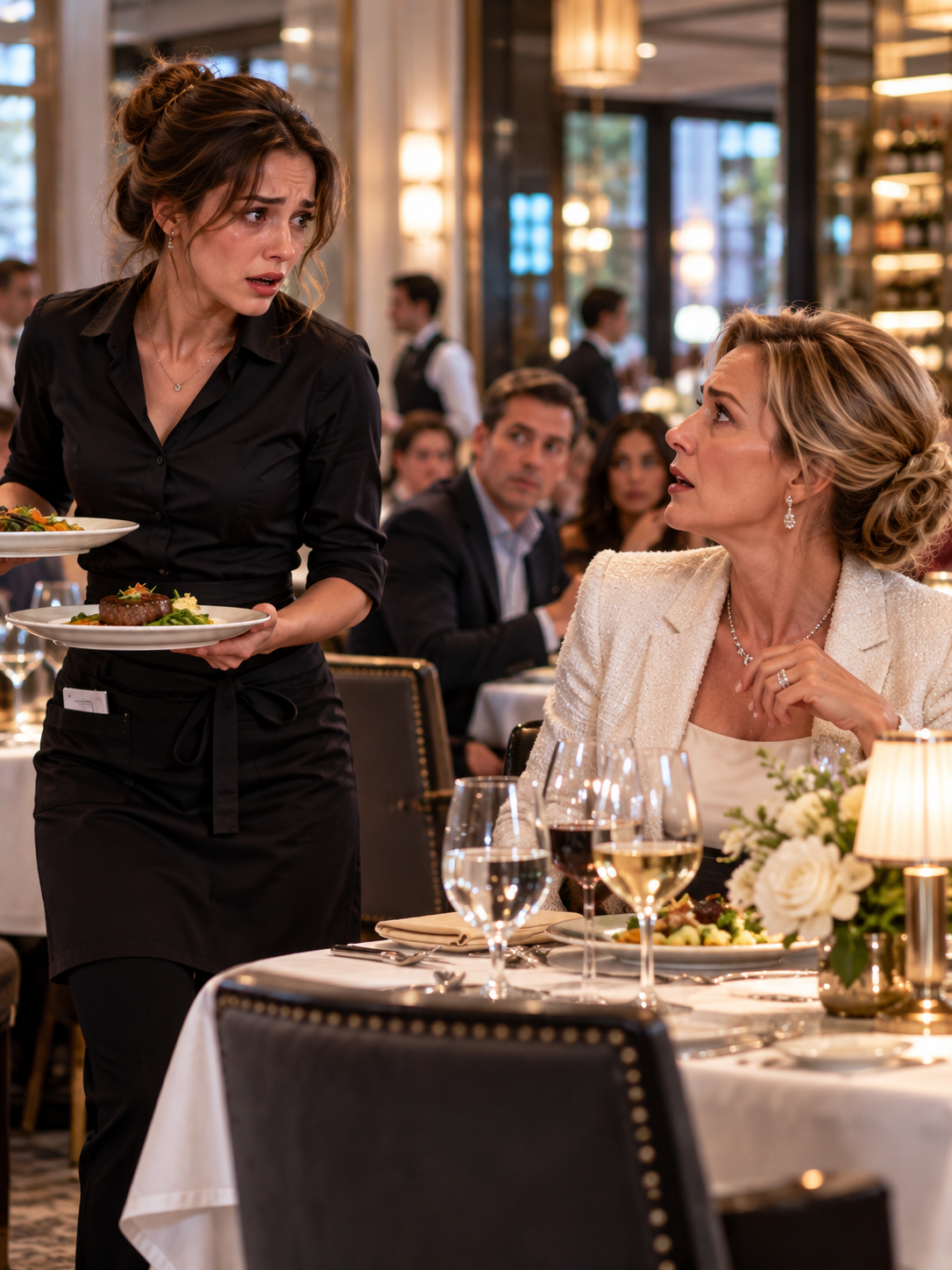
The woman at table twelve ordered salmon, sparkling water, and a side of steamed vegetables without looking up from her menu. I recognized her voice before I recognized the diamond ring on her finger. My mother, Celeste Marlowe, was sitting beneath the brass pendant lights of a Cleveland restaurant with a little girl in a red sweater who couldn’t have been older than seven. I had rehearsed meeting her a hundred times, but never while wearing a black apron with a streak of tomato sauce across the pocket.
“Noah?” she said when I reached for the menus. Her eyes traveled from my face to my worn sneakers, then settled on the small hearing aid behind my right ear. “Goodness. Is this really where you’re working?” The girl looked between us, curious, while I adjusted the tray against my hip and asked whether they wanted bread.
Celeste ignored the question. She introduced the child as Ruby, her daughter, although she made no effort to explain who I was. After the meal, she opened a payment app and held her phone toward me. “Give me your number,” she said. “You and your father should at least buy yourselves something decent to eat.”
The smell of grilled fish suddenly made me nauseated. “Keep your money, Celeste,” I answered, careful to stay polite enough that my manager wouldn’t intervene. “We haven’t asked you for anything.” Her expression tightened, and she accused my father of filling my head with bitterness.
“He was always too proud to accept help,” she said. “If he’d admitted he was wrong, things might have turned out differently.” Ruby was drawing stars on a paper placemat, and for a moment I envied how little she understood. Celeste leaned closer and added, “Tell him I might reconsider everything if he apologizes properly.”
I set their receipt on the table. “I’m not delivering messages for you.” She sighed, as if my refusal confirmed some unfortunate lesson about my upbringing, then gathered Ruby’s coat and left without touching her change. Only after the door closed did I realize my hands were shaking.
My coworker Tessa hurried over with a fresh stack of napkins. “Was that Celeste Marlowe? The woman who runs Marlowe Holdings?” When I nodded, she said she’d seen Celeste interviewed about supporting struggling families. Another server mentioned a music wing she’d financed at a community center, supposedly named for the son she rarely saw.
“She said in that interview that losing her first family was her greatest regret,” Tessa told me. I looked at the spot where Celeste had been sitting and remembered Dad repairing the same pair of winter boots with duct tape. A generous philanthropist could make wonderful headlines while remaining absent from one very specific child’s life. I remembered seeing strangers applaud her speeches about family values while Dad and I counted quarters at a laundromat. Hearing Tessa call her generous felt like listening to someone describe a woman I had never met.
I hadn’t always been a waiter. At sixteen, I practiced piano four hours a day and planned to audition for conservatories, while Dad repaired commercial elevators and accompanied me to every recital. He called my left hand the thunder and my right hand the rain. After Celeste left, those were the first things we lost: lessons, then our apartment, then the piano.
She’d announced her business was ruined and begged Dad to sign papers protecting her from creditors. He trusted her, signed, and later found obligations attached to his name that he couldn’t pay. Celeste vanished into the mansion of an investor named Grant Voss while Dad took every extra shift offered, even though he was recovering from complications after donating part of his liver to a relative.
Tessa touched my elbow. “Are you okay?” I told her I was fine because it was easier than explaining how much of the story she’d heard was false. After closing, I bought white chrysanthemums and a single cupcake from the all-night grocery store. Tomorrow was Dad’s birthday, and I had a long drive to make before I could talk to him.
Part 2: The Birthday Nobody Remembered
The cemetery was nearly empty when I arrived, and the gravel crackled beneath my shoes. I brushed wet leaves from Dad’s headstone, set down the chrysanthemums, and lit a tiny candle sheltered by my coat. “Happy birthday, Dad,” I whispered, then told him about Celeste and the little girl who’d called her Mom. I wondered how he would feel hearing her speak as though he still waited for her.
Dad’s name was Daniel Hayes. His stone recorded an October date three years earlier, but it couldn’t record the nights he’d worked despite a fever or the ridiculous jokes he’d made when I was scared. It couldn’t explain why, at nineteen, I had signed hospital forms with trembling hands and become the only person available to arrange his funeral.
The next afternoon, Celeste returned to the restaurant with a complaint. She stood beside our manager, claiming Ruby had felt ill after dinner, although the little girl had seemed perfectly healthy when she left. “I expect an apology,” Celeste said when I approached. “From you, and eventually from your father.”
I asked whether Ruby needed medical attention, and Celeste admitted she was fine now. Then she lowered her voice and told me to stop embarrassing her family. A few customers turned in their seats as I replied, “You mean the family you chose after throwing us out?”
Three years earlier, Celeste had convinced Dad that her investment company was collapsing. She presented alarming letters about debts, then said divorce would keep creditors from taking our home. Dad signed because he believed she was sacrificing her marriage to protect us. Two weeks later, her wedding photographs appeared online: Celeste in silk, Grant Voss at her side, both smiling beneath chandeliers.
We went to the hotel because Dad couldn’t believe the photographs. I remember the scent of lilies in the lobby and the way he smoothed the sleeves of the only jacket he owned. He asked Celeste why she’d married Grant when she’d said she couldn’t afford groceries for us. Instead of answering, she called security and told the guests Dad was harassing her.
Later she claimed the bankruptcy had been a test of his loyalty, and Grant needed her because of a serious illness. She said Dad should wait quietly until things settled. When he refused, she accused him of trying to sabotage her happiness, while I stood there watching him realize that every sacrifice he’d made had been taken for granted.
I still had the injury from our last visit. Grant had taunted me outside a hospital room when I was trying to arrange Dad’s specialist care; I stepped toward him, furious, and he stumbled backward as Celeste rounded the corner. Believing I’d attacked him, she shoved me against a metal railing, and the resulting damage left me with lasting hearing loss. I lost the ability to hear pitch reliably, and my conservatory plans disappeared with the rest of our savings.
“He was a difficult man,” Celeste said now, as though she could read the memories passing across my face. “Grant offered you both a clean start, and you rejected it.” I asked her where she’d been when Dad needed surgery for a severe infection, and she repeated the same story: he’d refused help because he was stubborn.
“We tried to use the assistance card you gave me,” I said. “It was blocked before we could pay the specialist’s deposit. The hospital treated him, but he couldn’t be transferred to the team his doctors recommended.” Celeste’s forehead creased, and she said Grant had told her we’d used the money to move away.
“Move where?” I asked. “Arizona,” she answered. “Grant said Daniel started a new business there and wanted nothing to do with me.” I felt the room tilt slightly, because that invented future was more generous than the real one Dad had been denied.
“Dad died three years ago,” I said. Celeste stared at me, then shook her head with an almost irritated smile. “Don’t be ridiculous, Noah. Grant showed me a letter from him last Christmas.” My anger turned cold: someone had been writing letters in my dead father’s name.
Part 3: The Photograph on the Shelf
My manager sent me home after Celeste left, and I didn’t argue. At my apartment, the radiator knocked behind the couch while I opened a shoebox of Dad’s things: recital programs, repair-shop receipts, and the birthday card he’d written when I turned eighteen. I hadn’t kept these objects to punish anyone. I kept them because they were proof that someone had loved me when every other part of our life was falling apart.
A knock sounded at seven. Celeste stood in the hallway without her usual driver, wearing a wool coat that probably cost more than my monthly rent. “I need to see him,” she said. I told her she could go to the cemetery, but she looked past my shoulder and saw Dad’s photograph beside the white flowers.
She stepped inside only after I moved away from the doorway. On the shelf stood a modest framed portrait bearing his name and dates. Celeste reached for it, then stopped when I said, “Please don’t touch that.” Her gaze dropped to the date, and her confidence seemed to disappear all at once.
“Grant said Daniel sent a letter in December,” she whispered. “He said your father wanted nothing to do with us.” I opened the shoebox and showed her Dad’s final hospital discharge summary, marked deceased, and the funeral-home receipt. She read them without speaking, as if paperwork might somehow become less real if she waited long enough.
She asked why nobody had told her. I showed her my old phone, where I’d saved unanswered messages from the hospital and a final voicemail begging her to call. Her number had stopped accepting calls, and when I contacted her office, an assistant told me not to disturb the family. “I thought you knew,” I said. “I thought you simply didn’t care.”
Celeste started crying, but I couldn’t comfort her. She offered to pay my overdue rent, replace my hearing aid, and arrange an appointment with any specialist I wanted. “Those might have mattered when Dad was alive,” I said. “Right now I want you to leave.” She obeyed, slowly, without asking for a hug.
Two days later, a woman named Miriam Cross phoned me. She introduced herself as an attorney conducting an internal investigation for Marlowe Holdings, authorized by Celeste after learning about Dad’s death. Miriam said she wanted permission to review copies of the records I’d kept and made clear I wasn’t obliged to cooperate. I agreed to one meeting with an independent lawyer present because I’d spent three years wondering who had invented the debts that destroyed us. When I asked to see the source records instead of a summary, Miriam spread the exhibits across the table. It was the first time someone with real authority had invited me to ask questions rather than telling me to be quiet.
Miriam showed us business records I’d never seen. The worst obligations Dad had been pressured to accept weren’t ordinary business losses; they were personal guarantees connected to shell companies Grant controlled. Some signatures and notices appeared altered, and the firm had referred the evidence to outside investigators rather than announce conclusions it couldn’t yet prove.
My lawyer asked whether Celeste had known. Miriam couldn’t answer that, but she confirmed Celeste had approved the original separation arrangement and continued using the public story of her financial collapse even after her company recovered. Whatever Grant had forged, her abandonment wasn’t an accident or a misunderstanding.
Then Miriam showed me something I didn’t expect: a still image from hospital security footage, recovered from an archived incident report. In it, Grant stood near a stairwell, watching Celeste approach from the far corridor while I faced him. The next sequence contradicted his account that I’d knocked him down.
“The hospital preserved a copy when your injury was reported,” Miriam explained. I remembered the impact against the railing and the strange pressure in my ears, but I’d spent years believing there was no evidence beyond my word. Now a small grainy image showed how carefully Grant had arranged the scene, and how quickly Celeste had chosen to believe him.
Part 4: What Her Money Could Never Repair
Celeste called the following evening, asking whether we could meet somewhere quiet. I refused until she said she had information about the blocked assistance card. We met in the public courtyard outside my lawyer’s office, where traffic splashed through puddles and the wind carried the smell of roasted coffee from a nearby cart. I wanted facts, not another speech about regret.
She said the card had contained the promised funds when she’d handed it to me. Grant had persuaded her to let him manage its account, then restricted access after the hospital confrontation and presented her with fabricated messages claiming I’d withdrawn the money. “I believed him because believing him meant I didn’t have to face what I’d done,” she admitted. I asked whether she had ever checked the account history herself. She said Grant handled the details and repeatedly reminded her that I had supposedly threatened him at the hospital. Hearing her repeat his words, I realized how conveniently she had surrendered her own judgment.
She also confirmed that Grant had created letters supposedly written by Dad after his death. He’d sent them through an intermediary, keeping alive the story that Daniel had moved away and rebuilt his life. Celeste had never called him directly, although she could have tried. That omission mattered more to me than any clever forgery.
“I want to pay for your care,” she said, pushing a folder across the bench. Inside were proposals for hearing specialists, tuition funding, and a transfer of company shares. I closed it without looking at the amounts. “You can give me all your assets,” I told her, “but you can’t give Dad one more birthday.”
She asked if I would consider letting her back into my life someday. I explained that she hadn’t merely followed Grant’s lies; she’d humiliated Dad publicly, ignored my calls, and hurt me when I needed protection. “You don’t become my mother again because you’re finally sorry,” I said. Her tears were real, but so were the years they’d arrived too late to change.
The investigation continued without me at its center. Grant denied wrongdoing, hired a publicist, and described Celeste as unstable to anyone who would listen. His lawyers challenged the documents, but auditors found financial transfers inconsistent with the companies’ stated purpose, and a forensic review flagged the disputed signatures. Authorities eventually opened a case involving falsified documents and financial fraud.
When Celeste filed for divorce, Grant threatened a public custody fight over Ruby. I heard about it from Miriam, who assured me that the little girl wasn’t responsible for anything her parents had done. I agreed, but said I wanted Ruby protected from news stories identifying me as her half brother. The child shouldn’t inherit another adult’s shame.
For several weeks Celeste sent no messages. Then she came to Dad’s grave on a damp Saturday morning while I was replacing the flowers. She stood several feet away, carrying white chrysanthemums tied with twine, and asked whether she could place them beside mine. I said she could leave them at the gate; I wouldn’t pretend Dad had invited her. I told her about the afternoon Dad had repaired a broken piano pedal using parts from his toolbox. He’d said an instrument wasn’t ruined just because something inside it stopped working. Celeste listened with folded hands, learning about the days she had missed from someone who still wished Dad could tell those stories himself.
“I know you won’t forgive me,” she said. “I don’t expect you to.” I replied that I hoped she’d tell the truth about what happened, not because it could restore our family but because Dad deserved something more honest than the public story she’d sold for years. She nodded and left without trying to touch me.
The next morning, Tessa called before my alarm went off. “Noah, turn on the news,” she said, her voice tight. Celeste was standing at a microphone beneath the Marlowe Holdings logo, and the first sentence out of her mouth made my stomach drop: “For three years, I’ve allowed the world to believe my first husband abandoned me. That story is false.”
Part 5: The Music That Was Still Mine
I watched Celeste’s statement on my phone from the edge of my kitchen table. She acknowledged the staged bankruptcy story, the financial support she’d withheld, and the injury I’d suffered when she chose Grant’s account over mine. She didn’t reveal my address or ask viewers to pressure me into reconciliation. Then she announced that she was stepping down from the company while independent investigators reviewed its records.
Reporters asked whether Grant had manipulated her. “He lied to me,” she answered, “but I made choices that harmed my husband and son long before I knew how many lies he’d told.” For once, she didn’t call Dad stubborn or suggest he’d made her life difficult. I switched off the stream before the questions ended because her confession belonged to her, not to me.
The fallout unfolded over months, not in one satisfying afternoon. Auditors uncovered false invoices and misdirected payments linked to Grant’s companies, and prosecutors eventually filed fraud-related charges. Grant fought the allegations, then entered a plea agreement covering the offenses the evidence could establish; the court ordered restitution and imposed a custodial sentence.
Celeste’s divorce also took months. Ruby stayed with a trusted relative during the worst publicity. Celeste set aside money for her care and created an independently administered fund supporting patients facing serious medical costs. She named it for Dad. I declined a board position.
A letter arrived from Celeste after the foundation opened. I read it once, standing beside my apartment window while sleet scratched the glass. She apologized and promised not to contact me again unless I asked. I placed the letter in a drawer and never replied.
The hardest part of those months wasn’t rejecting her money. It was accepting that even if she’d made every apology correctly, I would still have to build a life without Dad. Every piano I passed reminded me of the last song Dad had asked me to play.
Tessa noticed I lingered near the restaurant’s old upright piano after closing. One night she introduced me to her uncle, Martin, who directed an after-school arts program. He knew my hearing was unreliable and asked whether I’d consider teaching beginners to read music and feel rhythm through the keys. I hesitated, still comparing myself with the pianist I used to be.
Martin invited me to try one class. Seven children arrived with mismatched notebooks and more questions than I could answer, and a little girl named Hazel asked why I touched the piano’s wooden frame when a note sounded. I showed her how the vibration traveled through the instrument. When she pressed middle C and felt the faint tremor beneath her fingertips, her entire face brightened.
I began teaching two evenings a week, then increased my hours as more families enrolled. With savings from my restaurant shifts and a small community arts grant, I helped the program purchase a refurbished upright piano. I kept waiting tables until teaching covered rent and groceries. Dad would have approved of the spreadsheet I kept beside the sheet music.
On what would have been his next birthday, I carried yellow daisies to the cemetery instead of white chrysanthemums. “I’m teaching again,” I told his headstone. “Not the way we planned, but I’m learning, too.” I stayed until the cold stiffened my fingers.
That afternoon Hazel returned for a lesson and played a simple melody almost perfectly. I sat beside her, listening with what hearing I had and feeling the lower notes through the bench. She grinned when she finished, and I imagined Dad beside us, delighted by her determination. My mother had lost her place in my life, but she hadn’t taken away everything he gave me.
After Hazel left, I played Dad’s favorite lullaby slowly, letting the imperfect notes ring into the quiet room. I didn’t need Celeste’s forgiveness, her fortune, or even her remorse to make that moment mine. “Happy birthday, Dad,” I whispered when the final vibration faded. “I found my way home.”
Legal Notice: This story is a work of fiction. Names, characters, businesses, events, and incidents are the product of the author’s imagination or are used fictitiously. Any resemblance to actual persons—living or dead—or to actual events is purely coincidental. Thank you! 💓


