
My Mother-in-Law Demanded My Newborn Son—Then Security Asked, “Judge Reyes?”
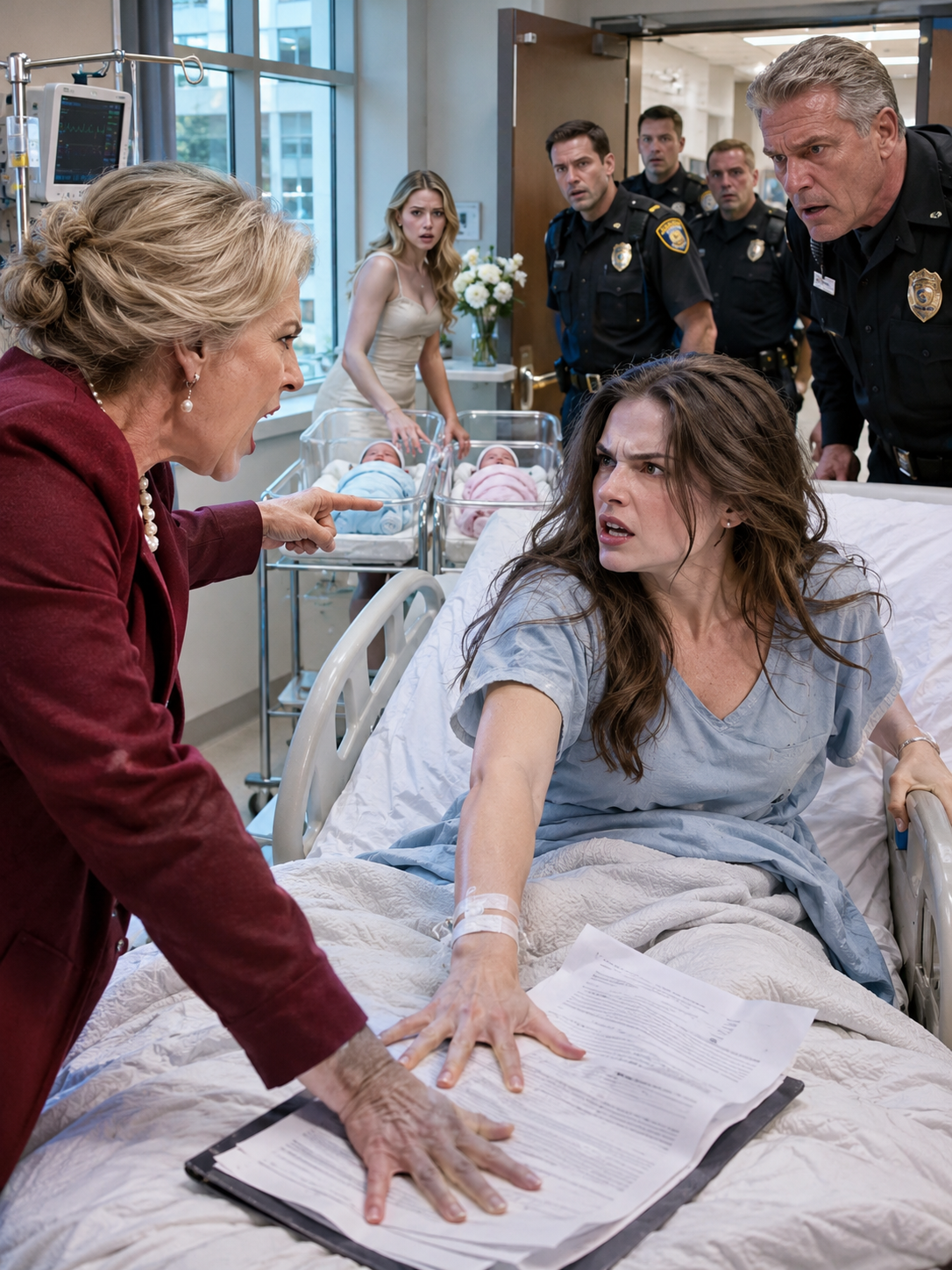
Twelve hours after an emergency C-section, I was holding on to the simple hope of taking my newborn twins home together when my mother-in-law walked into my hospital room with adoption papers, announced that my son belonged with her daughter, and accused me of being too unstable to raise him; I thought the worst moment came when she lifted him from his bassinet without permission, but the real shock began when the security chief recognized me—and my husband’s carefully hidden reason for wanting our babies separated finally started to surface.
Part 1
Rain ticked against the sixth-floor window, and my son squeaked in his sleep. Twelve hours earlier, an emergency C-section had brought Benjamin and Ruby into the world, and I was still learning how to sit up without wincing. Their bassinets stood beside my bed, close enough that I could count every breath.
My husband, Miles, had gone home for a change of clothes and promised to return before lunch. I wanted sleep and five quiet minutes with the babies. Instead, at 2:14, the door swung open hard enough to rattle the metal coat hook. My mother-in-law, Celeste Voss, entered in a cream wool coat, followed by her daughter, Andrea, whose hands were buried in her cardigan pockets.
“Why are you in this expensive room?” Celeste asked before saying hello. Her perfume reached me before she reached the bed. “Miles works himself sick, and you spend money as if it falls from the ceiling.” I told her my insurance covered the accommodation, but she had already opened a leather folder.
Celeste laid a document across my lunch tray, knocking my untouched applesauce sideways. Across the top I read, “Consent to Adoption,” and beneath it, Benjamin’s full name. “Andrea and Paul have waited years for a child,” she said. “You have two, Naomi, so you can spare one.”
I looked at Andrea, expecting her to interrupt. She kept her eyes on the wet street below, pressing a thumbnail into the edge of her cardigan. “You cannot be serious,” I said, lifting the paper with fingertips that still trembled from exhaustion. Celeste pointed to the signature line and told me that I could keep Ruby.
“Andrea deserves a family,” Celeste said, as though we were dividing serving dishes after Thanksgiving. I had heard Andrea cry about infertility. But Benjamin was not an answer to someone else’s grief. “My children are staying together,” I said, and pushed the folder away.
Celeste’s mouth tightened. “Miles agreed this would be best,” she replied. That stopped me longer than the paperwork had, because I remembered him kissing Benjamin’s forehead that morning. I asked what exactly he had agreed to, but she turned toward the bassinets instead of answering.
She lifted Benjamin before I could reach the call button. His face crumpled, and he began crying with the fierce little voice I’d waited months to hear. “Put him down,” I said, trying to rise, but the movement pulled painfully at my healing abdomen. Celeste stepped closer, told me to stop being dramatic, and struck my cheek when I reached for his blanket.
For a second, all I could hear was the monitor beeping beside me. Andrea said, “Mom, that’s enough,” yet made no move to take Benjamin back. I pressed the red assistance button and asked the nurse through the intercom to send security. Celeste straightened her coat, my crying son still in her arms, and smiled like she’d been waiting for an audience.
The nurse arrived first, followed by four hospital security officers. “She’s confused,” Celeste said immediately, turning her back toward me. “She tried to grab the baby from me and nearly dropped him.” The nurse glanced at my reddening cheek and the adoption forms scattered across my tray, then moved toward Benjamin with both hands ready.
“Please give the baby to the nurse,” one officer said. Celeste demanded that they remove me from the room instead, insisting I was unfit and needed to be evaluated. A tall, gray-haired man entered behind the officers and studied my face before checking the infant in Celeste’s arms. His name badge read Chief Thomas Mercer.
I recognized him from a courthouse safety briefing two winters earlier, though I had no idea whether he would remember me. He stepped beside the bed, looked at my wristband, and drew a sharp breath. “Judge Naomi Reyes?” he asked, his voice suddenly quiet. Celeste’s grip on Benjamin’s blanket tightened, and I understood that my husband’s story about who I was had just collided with the truth.
Part 2
“Yes,” I told Chief Mercer. “But right now I’m a patient, and I want my son back.” His expression steadied, and he asked the nurse to take the baby while an officer kept the doorway clear. Celeste resisted for one awful heartbeat, then handed Benjamin over when the nurse explained that his mother had not authorized the visit. He settled against the nurse’s shoulder, still hiccuping from crying.
Mercer asked everyone to remain while he established what had happened. The nurse checked my cheek and called my doctor, while a second nurse took both babies for a quick assessment just outside the room. The empty bassinets terrified me. Then the nurse returned and said, “They’re fine, Naomi,” and I finally breathed.
Celeste stared at Mercer. “Why did you call her a judge?” she demanded. “My son said she handled office paperwork and quit her job.” I watched her expression move from disbelief to anger when Mercer explained that I served on the state appellate bench. The information had always been public; Miles simply preferred his family to think he was the important one.
I’d kept my professional surname, Reyes, after our wedding, but I’d let Miles introduce me as his wife and change the subject whenever my work came up. Celeste praised his software company and asked when I would find a useful job. I stayed quiet to avoid arguments. Lying there with a sore cheek and two newborns, I saw how much that silence had cost.
“What I do for work doesn’t change what happened here,” I told Mercer. He nodded and had the staff preserve the visitor log, hallway video, and papers Celeste had brought. I gave a statement about the slap and the attempt to remove Benjamin, and Andrea quietly confirmed that her mother had picked him up against my wishes. Celeste glared at her daughter.
The hospital restricted their visits while the incident was investigated, and local police came to interview us. I requested my medical notes. The nurse photographed the mark on my cheek with my permission, and the attending physician checked my recovery. For the first time that afternoon, the room felt like somewhere I could heal.
Miles arrived just after four, carrying a duffel bag and the smell of wet asphalt on his jacket. He saw the officer outside my door, then the bruise on my face, but neither question he asked was about me. “Why is my mother talking to the police?” he said, setting the bag down so hard it tipped over. “Do you know what kind of trouble this could cause?”
“She hit me and tried to take Benjamin,” I replied. Miles rubbed his forehead and said Celeste had gotten carried away. When I told him about the adoption papers, he closed his eyes instead of looking surprised. The realization settled over me slowly: he had known they were coming.
“We discussed possibilities,” he said, lowering his voice when the nurse passed the door. “Andrea has had a terrible year, and you know how much this would mean to her.” I told him that loving his sister didn’t give him the right to offer her our child. He said I was making everything sound uglier than it was.
I asked him to explain why the document named Benjamin rather than Ruby. Miles said the distinction didn’t matter, though his hand kept drifting to his phone. I remembered a call he’d taken last week behind our closed study door, where I’d heard him say, “Paul needs certainty before he signs.” At the time I assumed it concerned his company.
“Did you promise your sister our son?” I asked. Miles refused to meet my eyes and suggested we talk after I was discharged. Then his screen lit up on the windowsill with a message from Andrea’s husband: “No signed consent, no bridge funding.” He snatched the phone away, but I had already read it.
My husband didn’t look frightened about losing his son. He looked frightened about losing a deal, and I couldn’t stop wondering what Benjamin had been promised in exchange for.
Part 3
That evening, I called my attorney, Dana Moreno, from the hospital bed while the twins slept beside me. I told her every detail, including the message I’d seen, and asked how to keep them safe without turning my courtroom position into a weapon. Dana told me to save what I had, stop negotiating privately with Miles, and let an independent judge handle any family-court orders. By midnight, she’d helped me prepare a request for emergency protection and temporary custody.
Miles returned the next morning holding coffee I hadn’t asked for. He sat near the window and talked about how much pressure he was under, avoiding the bassinets as if they might interrupt him. “Crestline Systems needs a little breathing room,” he said. “Paul has investors who believe in us, but they want the family settled first.”
“Settled how?” I asked, while I adjusted Ruby’s knitted cap. Miles hesitated, then said Andrea would give Benjamin a beautiful home and we’d still see him at holidays. He described it as a generous arrangement, but his eyes stayed on the untouched coffee. I asked whether Paul’s investment depended on my signature, and Miles said nothing.
An hour later, Andrea called. She sounded exhausted and told me she hadn’t slept since the hospital. “Mom said you were considering the adoption,” she whispered, “and Miles said the lawyers had everything ready.” I told her no one had ever asked me, and she began crying so hard I had to wait for her to speak again.
Then she forwarded a chain of messages she’d received from Miles and Paul, saying she could no longer pretend not to understand. One attachment was a financing proposal for Crestline Systems: nearly two million dollars in conditional backing, with a separate family-placement plan referenced in the emails. The papers couldn’t transfer a child without my consent and court approval, but exposed their bargain. I forwarded the messages to Dana rather than confronting Paul myself.
When Dana called back, her tone was clipped. “We’ll preserve these and ask the court to require the original records,” she said. “The police should receive them as well, because an adoption cannot be traded for a business investment.” I stared at Benjamin’s tiny hand curled around the edge of his blanket. The thought that someone had calculated a price while I was choosing nursery curtains made me feel suddenly cold.
I had helped Miles launch his business, though not in the way his family imagined. I paid most of our household expenses so he could keep reinvesting his earnings, and I’d covered one early payroll shortage from my savings. He’d called it an investment in our future and kissed me over the kitchen sink. Now I understood which future he’d been trying to protect.
I told Miles through the open hospital door that he needed to leave and communicate through our lawyers. He stared at me, then said, “You’d throw away our marriage over an offer nobody signed?” I looked down at the twins and answered, “You made the offer without asking their mother.” The nurse stood nearby until he finally walked away.
By the following afternoon, Dana had arranged a hearing before a judge who had no professional connection to me. Police were reviewing the hospital evidence. I still had to recover from surgery, feed two babies, and figure out how to return to a home where Miles had a key. My fear felt ordinary and physical, not something a title could erase.
Then Dana called with one more development. Miles had filed his own emergency petition, claiming I’d become unstable after childbirth and was refusing him access to the children. He was asking the court to place both twins with him until I could be evaluated, using the same accusation Celeste had shouted while holding Benjamin.
I had spent my career listening to people argue about what was true. Now my husband was asking a stranger in a black robe to believe his version of the worst day of my life, and I knew the next hearing could change everything.
Part 4
The family courtroom smelled of floor polish and wet wool when Dana wheeled my chair through the doorway. My doctor had cleared me to attend briefly but warned against overdoing it, and I’d left the twins with a nurse I trusted. Across the aisle, Miles sat beside his lawyer in the suit I’d bought him for our anniversary. Celeste and Andrea waited outside under an order separating witnesses.
Judge Miriam Cole had never worked with me, and treated us equally. Miles’s lawyer argued that a tired new mother had misread a family’s clumsy adoption discussion, then presented the postpartum evaluation request. I waited for Dana’s turn.
She began with the hospital records, the photographed mark on my cheek, and the security team’s documented response. Then she submitted Celeste’s unsigned adoption papers and the messages Andrea had voluntarily provided, including the financing proposal tied to Benjamin’s proposed placement. Dana read Miles’s words: “Paul wants the boy’s placement confirmed before he releases the funds.” I didn’t look at him until the judge asked whether he disputed sending the message.
His lawyer called the correspondence incomplete; the judge said safety couldn’t wait for every disputed fact. She granted me temporary primary custody and ordered that Miles’s contact occur only under professionally supervised conditions pending further review. She also issued protective restrictions against Celeste’s approaching me or the children while the separate proceedings continued.
Outside, Miles caught my attention from across the corridor. “Naomi, I never meant for it to go this far,” he said, with his lawyer tugging lightly at his sleeve. I wondered which part he considered acceptable. Instead, I told him to speak to Dana.
The criminal investigation and divorce took months, not minutes. Investigators reviewed the messages and interviewed everyone involved; Celeste eventually accepted responsibility in court for assaulting me, and prosecutors pursued the separate allegations connected to the attempted placement. Miles’s company lost its proposed financing and soon closed. None of those consequences made the sound of Benjamin crying in her arms disappear from my memory.
The final family-court orders gave me sole legal custody and primary physical custody, with any change to Miles’s restricted contact requiring further review. I changed the locks and moved the bassinets beside a sunny window. I returned to the bench only after my maternity leave, careful to stay away from any case connected to the investigation. I no longer let anyone call my silence a virtue.
A year later, a letter from Miles arrived in a thin white envelope. It apologized for his fear of failure, his mother’s interference, and the choices he’d made “under pressure.” I read it once at the kitchen counter while Ruby banged a wooden spoon against her high-chair tray. Then I put it in a folder for Dana and went back to making lunch.
I didn’t reply. Forgiving him would not make him safer, and giving him another chance would not return the hours I had spent afraid someone would take my children. If he ever became capable of showing up responsibly, that was his work to do within the boundaries the court had set. I had finished doing the emotional work for him.
On the twins’ second birthday, friends gathered beneath paper lanterns. Benjamin smeared blue frosting onto Ruby’s sleeve, and she laughed so hard she nearly dropped her cupcake. Andrea had sent a card, which I set aside without opening; Celeste was no longer part of our lives. Nobody asked me to become smaller.
When the guests left, I carried the twins onto the porch and watched the last light fade over the neighborhood rooftops. Benjamin rested his head on one shoulder, Ruby on the other, both sticky with birthday cake and warm from their baths. I’d once believed keeping a family together meant giving everyone whatever they demanded. Now I knew it meant protecting the people who depended on me, even if that meant closing the door on those who shared our name.
Legal Notice: This story is a work of fiction. Names, characters, businesses, events, and incidents are the product of the author’s imagination or are used fictitiously. Any resemblance to actual persons—living or dead—or to actual events is purely coincidental. Thank you! 💓


